
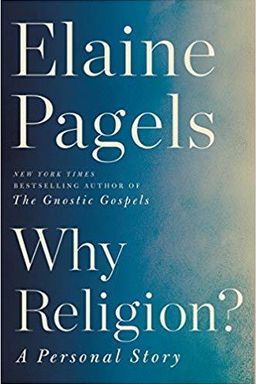
Why Religion cover

Why Religion

by Elaine Pagels

Why Religion? by Elaine Pagels is a poignant memoir that explores how religious study provided her with emotional resilience through profound personal tragedies. This narrative weaves together personal loss and academic discovery, offering readers a unique perspective on faith as a tool for healing.

Why Religion Endures — Searching for Meaning in an Unimaginable World

Why do we turn to religion—especially in times of crisis—when we know more today than any century before? Why do rituals, myths, and stories continue to captivate our hearts even as science explains the cosmos? In Why Religion?, Elaine Pagels, one of the most influential historians of religion, poses this question not merely as a scholar but as a human being touched by staggering loss. Through the deaths of her young son and husband, and the collapse of the secure world she had built, she discovers that religion is not simply belief—it is the way human beings wrestle with chaos, love, and mortality.

Religion as Personal and Cultural Mirror

Pagels invites you to see religion as a mirror of the human condition rather than a system of beliefs to accept or reject. Instead of asking, “Do you believe?”, she wonders, “What do you need?” Here, religion becomes a collective way of giving form to experiences beyond words—love, grief, awe, and terror. From this stance, Pagels explores how myth and ritual help us endure suffering not by explaining it away but by giving us stories and symbols to inhabit it. This insight grew from her encounter with tragedy—the death of her child and husband—and what followed was a life-long meditation on why humans invent religions and how those inventions shape the way we survive loss.

Scholar and Witness: The Dual Lens

As both historian and mourner, Pagels connects her personal story with her academic pursuit. Famous for The Gnostic Gospels, she continues to explore ‘secret’ texts from early Christianity found at Nag Hammadi in Egypt and reveals a diversity of voices long suppressed by orthodox tradition. For her, these texts speak not of dogma but of transformation—‘bringing forth what is within you,’ a saying from the Gospel of Thomas that becomes both research and revelation. This intersection between scholarship and suffering grounds the entire book: religion is not about certitude but about imagination, an attempt to articulate the ineffable.

Why We Still Need Religion

Pagels confronts the modern assumption that religion is obsolete. Drawing on anthropology, psychology, and history, she finds that even those who define themselves as ‘spiritual but not religious’ still draw upon its stories and symbols. For instance, people quote Genesis to condemn or defend sexuality without realizing how deeply those ancient myths continue to shape us. In one striking example, she rereads the story of Adam and Eve not as primitive science but as code for cultural values—it created a world in which human desire and female autonomy were myths of sin and shame. The book asks you to reconsider how myths built your inner architecture, perhaps unconsciously guiding how you love, grieve, and make moral sense of chaos.

From Loss to Connection

Religion, Pagels insists, can function as connective tissue in a fragmented world. Through rituals, art, and poetry, it binds us to what she calls “the imagination’s work of healing.” When she describes her vision after her son’s death—a cosmic net woven of knots binding people together—she gives form to religion’s deepest function: to remind us that we are woven into interconnection across life and death. (Similar insights appear in Viktor Frankl’s Man’s Search for Meaning and Karen Armstrong’s A History of God—each seeing religion as an act of meaning-making rather than dogma.)

Why It Matters for You

By the time you finish the book, Pagels’s question—“Why religion?”—becomes “How else can we understand being alive?” In her hands, religion is not a set of beliefs but an evolving human art form that helps us imagine, endure, and love in the face of the unimaginable. Religion persists not because it tells us what to believe, but because it helps us turn suffering into story, isolation into connection, and loss into meaning. The journey she unfolds invites you to see religion not as relic but as resource—for navigating love, work, death, and the thunderous mystery of existence itself.


The Birth of Belief — Childhood, Society, and Imagination

Pagels begins by looking inward—at the making of her own faith and doubt. Growing up in postwar Palo Alto, she lived between a father who worshiped Darwin and a mother who feared emotion. Her first encounter with religion was not prayer but performance: hearing Billy Graham preach to tens of thousands in San Francisco. His fervent voice condemning America’s sins and promising divine love sent young Elaine, fifteen years old, walking down to be “born again.” Yet, she soon found how belief could break and reshape identity. This moment—her conversion and eventual rebellion—illustrates how religion captures the imagination before it constrains it.

Family as the First Theology

Her home served as a microcosm of the cultural battle between science and spirit. Her father’s hatred of religion sprang from Presbyterian dogma and his embrace of evolution as salvation from superstition. Her mother’s anxiety and distance taught silence rather than faith. Yet, her grandparents’ warmth became her first experience of grace—they taught her how love itself could become ritual. This domestic theology shapes the book’s philosophical pivot: our first conceptions of the divine are emotional before intellectual. (Pagels’s view resembles James Fowler’s stages of faith, emphasizing early relational models.)

Imagination Before Dogma

For teenage Pagels, religion initially opened new imaginative worlds. Through the music, poetry, and drama of evangelical Christians, she encountered a vast symbolic universe—one that broke the beige comfort of Palo Alto’s rationality. But this new universe also became claustrophobic when her Jewish boyfriend died and church friends insisted he was damned for not being ‘born again.’ The night she left the church, she realized how religion can swing from liberation to judgment. This formative rupture seeded her lifelong question: why do some religious traditions open the heart while others close it?

From Individual Awakening to Historical Inquiry

Her disillusionment propelled her to Harvard, where she sought the origins of belief itself. There she turned from “play Bible land” to rigorous research, discovering secret gospels—the Gospel of Thomas, Philip, and Mary Magdalene—that revealed radically different understandings of divine presence. Their sayings challenged institutional religion: salvation comes not through belief alone but through inner discovery. This challenge mirrored Pagels’s own life path—from following external authority to finding inner meaning. It’s religion stripped of hierarchy and full of imagination, where “bringing forth what is within you” becomes a call to authenticity and creativity.

These early experiences illuminate one of the book’s major through-lines: religion emerges first from experience before it becomes doctrine. Whether it’s a child confronting wonder or an adult confronting death, imagination precedes theology. And because imagination cannot be legislated, religion always exceeds control—a theme Pagels develops in every chapter ahead.


Love and Work — Healing, Creation, and Partnership

In her second major thread, Pagels blends intellectual partnership and intimacy. Meeting Heinz Pagels, a physicist exploring the mysteries of cosmic motion, she found someone who mirrored her fascination for unseen realities. Their marriage joined science and spirituality, reason and emotion—‘the cosmic code’ and ‘the gnostic gospel.’ Together they built a life defined by inquiry and love. Yet, the chapter reminds you that love rarely exists apart from work; their partnership reflected the same disciplines of curiosity that define both research and relationship.

Interweaving Faith and Physics

Heinz questioned reality through equations; Elaine explored meaning through ancient texts. They debated endlessly—he asked why religion matters if it doesn’t affect the real world, and she countered by showing how myths shape politics, gender, and sexuality. In Egypt, Israel, and the Sinai, they traced how stories of Adam and Eve became cultural blueprints. Through this exploration, Pagels turned scholarship into confrontation: she faced the realization that Genesis is not primitive science but moral engineering—teaching fertility as duty, sexuality as guilt, and hierarchy as divine law. (Her discoveries echoed anthropologists such as Clifford Geertz, who saw religion as ‘a system of symbols acting to make suffering sufferable.’)

Rediscovering the Divine Feminine

Pagels’s work on the ‘Secret Book of John’ and other hidden gospels revealed suppressed images of God as both Father and Mother. Her conference at Barnard became a turning point: thousands of women laughed aloud hearing ancient texts proclaim “I am the Father and I am the Mother.” In reclaiming the divine feminine, Pagels reframed religion not as dogma but as dialogue—a millennia-long conversation about power and gender. You begin to see that religious imagination mirrors social imagination: the way we picture God affects how we treat each other.

By coupling love and intellectual pursuit, Pagels suggests that work itself can be sacred. Scholarship becomes a form of devotion, partnership an act of creation. Her life with Heinz shows how discovering meaning is not limited to scripture or science—it happens whenever two minds, or two hearts, wrestle with mystery together.


A Lifetime of Grief — The Unbearable and the Unimaginable

When tragedy strikes—when the ordinary structure of life collapses—the question “Why religion?” changes from curiosity to necessity. Pagels’s account of her son’s illness and death, followed by her husband’s accidental death, forms the emotional center of the book. Her story does not search for comfort; it searches for survival. In describing heart surgery, hospital rooms, and funerals, she lays bare how grief erases identity, memory, and meaning. The reason to study religion becomes clear: it is language for the unimaginable.

When Faith Fails

Pagels admits that theological platitudes—“God never gives you more than you can handle”—feel like cruelty. No creed could make sense of the death of a child. What sustained her instead were fragments of ritual: music, communal silence, and ancient words that gave shape to suffering. Hearing Bach’s “A Mighty Fortress Is Our God” invoked imagery of Satan, struggle, and the single word that “shall fell him.” In her darkest night, when she dreamed of battling a menacing being and cried the name “Jesus Christ,” she recognized how ancient words could retain power beyond belief. Religion’s vocabulary—its metaphors—outlast belief itself.

Dreams, Death, and Meaning

Her intimate experiences—visions of presence, sensations of her child and husband nearby—challenge reductionist assumptions about consciousness. Whether psychological or spiritual, they demonstrate religion’s role as narration for experiences reason cannot contain. Like Freud’s “Future of an Illusion” reinterpreted through compassion, Pagels discovers that faith is not medicine for ignorance but an art for grief. The night she envisioned a circle of women surrounding her during her son’s surgery, she understood the communal dimensions of prayer, even among skeptics; it was not belief but shared imagination that gave strength.

Loss as Revelation

In enduring loss, Pagels sees why religion persists: because it gives us rituals for chaos. Her MacArthur Fellowship, arriving days after her son’s surgery, felt less like reward than miracle—a reminder of timing beyond explanation. Her insights echo Viktor Frankl’s idea that meaning cannot be found but must be created. In tragedy, religion functions as language for defiance—a refusal to let suffering remain mute. Through love, ritual, and imagination, we ‘create meaning’ rather than uncover it. It’s the only theology that works when the unimaginable happens.


Going On — Grief, Guilt, and the Practice of Meaning

After loss, life demands reconstruction. Pagels’s next phase explores how culture teaches us to interpret suffering. The anthropologist Clifford Geertz told her that “the work of culture is to make suffering sufferable.” She learns that guilt and grief are not only emotional but also cultural reflexes—ancient scripts telling us how to respond when something breaks. Drawing on the Book of Genesis, Epicurus, and Lucretius, she reveals how Western religion transformed natural tragedy into moral judgment.

Unlearning Cultural Guilt

Pagels dissects the biblical premise that death and suffering came from sin. Because “humans disobeyed,” the world became painful—a theology that makes guilt inherent. Freud called such myths “projections of fear,” yet they endure because they preserve a sense of control. Pagels recognizes in herself that same illusion: guilt feels better than chaos. If pain is punishment, it means someone keeps score. Religion, she argues, transforms randomness into order—even false order. Still, she insists we can reinterpret that pattern into compassion rather than blame.

From Punishment to Insight

Pagels contrasts Job’s angry poetry with traditional piety. Where the Book of Job demands justice from God, orthodox readers inserted a happy ending—a restoration that defuses protest. She prefers the earlier Job who curses the day of his birth yet confronts God as whirlwind, Behemoth, and Leviathan. In these mythic encounters, Job discovers nature as chaotic but not malicious. Religion’s maturity, she suggests, lies in accepting that the universe is not moral but magnificent. The divine whirlwind contains both terror and beauty—what theologian Rudolf Otto called numinous awe.

Learning to “go on” for Pagels means transforming guilt into gratitude: seeing death not as debt but as condition of life. This marks her shift from seeking explanation to practicing acceptance, from asking why to asking how. Religion becomes a tool not to understand suffering but to bear it gracefully—to make suffering sufferable while keeping heart and imagination alive.


Life After Death — Chaos, Satan, and Human Imagination

In the aftermath of her husband’s death, Pagels confronts the concept of chaos—scientifically and spiritually. Working through Heinz’s exploration of chaos theory, she learns that randomness defines the universe and that religion serves as humanity’s creative attempt to find coherence within it. Her vision shifts from a moral world to a natural one: volcanoes erupt because that’s what volcanoes do; not because someone sinned. Out of this confrontation arises her inquiry into the origins of evil—the figure of Satan.

The Devil We Needed

Satan, Pagels discovers, evolved from metaphor into person. Early Jewish sects, protesting Roman rule, needed an enemy to embody suffering and injustice. In the Dead Sea Scrolls, “the sons of light” battle “the sons of darkness.” In the Gospels, this vision intensifies: instead of blaming Rome for crucifying Jesus, writers blame “the Jews” and Satan’s influence. Over centuries, this imagination hardened into anti-Semitism. Pagels exposes how religious storytelling can sanctify hatred—how imagination can tragically translate anger into ideology. (She explores this deeply in The Origin of Satan.)

Imagination as Weapon and Cure

Pagels contrasts anthropologist Renato Rosaldo’s account of “grief and a headhunter’s rage,” showing how imagination becomes both outlet and danger. Whether we invent demons or scapegoats, we transform inner rage into outer violence. The headhunter’s ritual and the Christian Crusades share the same psychological root—imagination unrestrained by empathy. Yet, imagination also heals: it allows stories like the Gospel of Truth and Thunder to reweave connection instead of division. The same faculty that breeds war can birth poetry, sympathy, or art. Religion, then, is moral imagination.

In revisiting the Satan myth, Pagels restores its psychological meaning: the devil is not supernatural but human projection—the shadow cast by unacknowledged rage. When we see that, religion ceases to demonize and begins to humanize. Evil becomes not cosmic opposition but the capacity for cruelty and compassion within each of us. Her meditation on Satan becomes a mirror, asking: how do you wrestle with your own darkness?


Wrestling with the Devil — Faith Beyond Faith

In her next exploration, Pagels dives deeper into the theology of loss, retelling biblical stories as psychological maps. She contrasts Job’s cosmic argument with the Gospel of Mark’s tragic realism. Mark’s Jesus dies abandoned, without promise of restoration—a narrative that resonates with anyone who has faced grief without miracle. For Pagels, this version of gospel feels truer to life: hope amidst failure, peace within uncertainty.

The Power of Story

Revising early texts helped communities reinterpret trauma. Mark’s abrupt ending—women fleeing in fear—is later softened by Matthew and Luke with resurrection scenes. Yet, Pagels prefers the hard truth where terror and hope coexist. The gospel, she writes, is not about victory but about endurance; its “good news” lies not in proof of heaven but in the courage to live without certainty. It echoes her own story—finding meaning after death not through explanations but through continued love and work.

Discovering Mystical Christianity

Turning back to the Gospel of Thomas, Pagels finds a spirituality that unites rather than divides. Jesus’s sayings invite seekers to recognize divine life “within you and outside you.” This introspective mysticism reframes religion as discovery, not belief. It culminates in her reading of Thunder, Complete Mind, a poetic revelation of divine paradox—“I am the whore and the holy one.” This vision restores wholeness to fragmentation; it reveals that opposites coexist and that divinity speaks through contradictions. Religion at its best, she contends, helps us see completeness.

Through these texts, Pagels reimagines Christianity as invitation to awareness. The secret gospels become tools for liberation rather than orthodoxy. Their language aims not to preach but to awaken—to help us see that light is within. Like the net she envisioned at her son’s funeral, this mystical lens binds humanity together, suggesting that the sacred is not above life but woven through it.


Listening to Thunder — Imagination, Revelation, and Healing

The book’s final movement expands from private grief to global reflection. Writing after the events of 9/11, Pagels watches religion turned into weapon once more—politicians invoking ‘crusade,’ invoking Revelation’s apocalyptic imagery to justify war. She recognizes the same mythic machinery she studied in antiquity now animating modern politics. Her scholarly eye and human heart converge: religion can heal or destroy, depending on how we listen to its thunder.

Revelation and Righteous Rage

Pagels traces how John’s Book of Revelation arose from wartime trauma—its monsters symbolizing Rome’s oppression—and how that imagery repeatedly fuels generations of crusades. Visionary language, she notes, magnifies both awe and paranoia: every epoch finds new enemies to label as Babylon, from the pope in Luther’s era to Iraq in America’s. The revelation texts she studied at Nag Hammadi, however, tell another truth: revelation as inner awakening. In these alternate voices, thunder speaks not destruction but recognition—“I am the one who is loved and the one who is hated.”

Healing Myths, Healing Minds

Pagels interprets metaphors of healing drawn from these texts: Jesus as ‘physician of souls,’ offering medicines for body and heart. She compares this to William James’s Varieties of Religious Experience—each tradition a different prescription for meaning. The secret gospels become early philosophical therapies for despair. They teach discernment of spirits—how to tell delusion from insight, fear from faith. Religion here becomes psychological evolution, a way to cultivate awareness and compassion rather than conformity.

Religion as Imaginative Medicine

In connecting Gnostic mythology with modern experience, Pagels concludes that religion is the imagination’s medicine chest, stocked with stories that heal different wounds. Some offer structure; others offer release. What matters is discernment—discovering which myths help the heart recover rather than harden. Her own healing culminates in reunion: at Harvard’s honorary ceremony decades later, surrounded by her grown children, she feels grace as reconnection, echoing the ancient Jewish blessing—“You have brought us alive to see this day.”

In the end, Pagels teaches that listening to thunder means hearing both revelation and reason. The divine voice is not external command but inner resonance—the power that allows suffering to become insight. Religion endures because, in a world filled with chaos and beauty, we still need its music to heal the soul.

Dig Deeper

Get personalized prompts to apply these lessons to your life and deepen your understanding.

Go Deeper

Get the Full Experience

Download Insight Books for AI-powered reflections, quizzes, and more.