
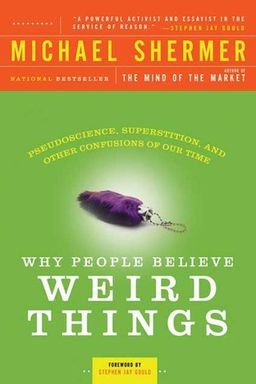
Why People Believe Weird Things cover

Why People Believe Weird Things

by Michael Shermer

Why People Believe Weird Things delves into the perplexing world of pseudoscience and superstition. Michael Shermer provides rational arguments against common misconceptions, revealing how scientific inquiry can debunk myths and false beliefs. This engaging book offers critical tools to differentiate fact from fiction in a world rife with misinformation.

Why People Believe Weird Things

Why do intelligent people believe in pseudoscience, conspiracy theories, or supernatural claims? Michael Shermer’s Why People Believe Weird Things answers that question by combining psychology, science, history, and moral concern. Shermer argues that belief itself is a natural process—an evolved habit of pattern-seeking and cause-finding—but that without critical methods, it easily misfires into superstition or ideological certainty.

At its core, the book teaches you that skepticism is not cynicism. It’s a practical method you can apply to your own life: withholding judgment until evidence is sufficient, asking how you might be wrong, and balancing openness with doubt. From early Greek skeptics to modern scientists (Carl Sagan, Richard Feynman, Stephen Jay Gould), Shermer frames skepticism as a civic virtue and a personal discipline.

The Belief Engine: How your mind generates convictions

Shermer introduces the concept of the evolutionary Belief Engine—your brain’s pattern detector, honed for survival. This engine evolved in an environment where false positives (mistaking wind for predator) were better than false negatives (ignoring danger). That tendency still operates today: you see meaningful intention in coincidences, hear a voice in random noise, or infer divine design from natural complexity. Magical thinking became an adaptive spandrel—a psychological by-product that also served emotional and social needs.

When that same Belief Engine confronts modern information overload, it is prone to systematic error. You misjudge probabilities, confuse anecdotes for data, and reward comforting narratives. Shermer’s challenge is not to eradicate belief but to calibrate it—to recognize evolved biases and supplement them with scientific reasoning, statistics, and skepticism.

Science as your toolkit

Science, for Shermer, is the skeptic’s most powerful tool because it institutionalizes doubt. Through the hypothetico-deductive cycle—formulate hypotheses, deduce predictions, test them—you replace authority and intuition with empirical verification. David Hume’s maxim becomes your filter for extraordinary claims: no testimony is enough to prove a miracle unless the falsehood of that testimony would be a greater miracle. Whenever you hear a story that defies physics or biology, you weigh alternatives and choose the less miraculous explanation.

This scientific stance is provisional: every conclusion remains open to revision. Shermer reminds you of the “essential tension” in science (Thomas Kuhn’s phrase): the balance between openness to revolutionary ideas and skepticism toward poorly supported ones. Darwin exemplified this spirit by gathering massive data, listening to critics, and refining theory rather than clinging to dogma.

Skepticism’s moral purpose

The book is also a moral argument. Skepticism protects society from harm—whether from fraud, pseudoscientific medicine, or ideological witch hunts. Shermer uses examples ranging from facilitated communication scams to creationist courtroom battles to show how critical inquiry can prevent false accusations, wasted resources, and moral panic. Reason is not just intellectually elegant; it’s ethically necessary.

Psychology, persuasion, and the emotional roots of belief

Shermer explains that belief often arises from emotion first, then seeks rational justification later. Intelligence can reinforce bias rather than eliminate it—smart people craft better defenses for ideas they accept for non-rational reasons. Comfort, certainty, and belonging often motivate convictions more than evidence. His Donahue TV example on Holocaust denial shows how emotion and identity overpower rational debate in public discourse.

The book’s repeated message is humility. You are not immune to bias; your very reasoning tools evolved to comfort as well as to analyze. Understanding that helps you correct yourself. Teaching critical thinking doesn’t insult human nature—it works with it. Once you see your belief engine’s quirks, you can consciously rewire it toward evidence and away from credulity.

A narrative that connects history, psychology, and civic life

Across its chapters, Shermer moves from personal experience (his own journey from pyramid power and megavitamins to science) through evolutionary psychology, fallacies of reasoning, psychic investigations, moral panics, creationist trials, Holocaust denial, race science, and even cosmological speculation. The common thread is human error amplified by emotional desire. Each case study—whether of James Van Praagh’s psychic readings, recovered-memory scandals, or Frank Tipler’s immortality physics—demonstrates the same cognitive vulnerability dressed in different intellectual clothes.

Central lesson

Use skepticism as empathy armed with evidence. Doubt claims respectfully, not contemptuously. Ask for convergent proof, recognize psychological needs, and practice provisional belief. This, Shermer argues, is how science and civility co-evolve.

By the end, you realize the book is less a demolition of irrationality and more a blueprint for intellectual virtue. You can admire human creativity and meaning-making while still guarding against deception. Skepticism, practiced correctly, becomes not a negation of belief but its refinement—a disciplined hope that truth will survive testing.


The Belief Engine Within

Shermer’s concept of the Belief Engine explains the evolutionary and cognitive psychology behind why your mind leaps to conclusions and clings to them. You developed this system across millennia to make rapid cause-and-effect judgments. In the ancestral environment, the cost of false belief was low compared to the cost of missing a true threat.

How it evolved

In the environment of evolutionary adaptation, quick pattern recognition meant survival. Your brain inferred agency and intention—so rustling grass was a predator rather than wind. These tendencies persist: you detect patterns in randomness, assign meaning to coincidences, and derive cosmic purpose from chaos. Leda Cosmides, John Tooby, and Steven Pinker’s evolutionary psychology framework helps contextualize this: cognition evolved for adaptive efficiency, not truth-tracking perfection.

Why it misfires today

Modern society replaces ancestral threats with abstract ones—stock markets, disease, or existential uncertainty—yet your Belief Engine operates with the same rules. It produces Type 1 errors (believing falsehoods) because those were once safer than Type 2 errors (rejecting truths). Without corrective education, these mechanisms encourage pseudoscience, superstition, and mass delusion.

Shermer applies this to illustrate phenomena like the “Hundredth Monkey” myth and ESP experiments at Edgar Cayce’s Association for Research and Enlightenment. In a large sample, you expect statistical outliers—yet people interpret them as paranormal proof. Your evolved bias for agency and significance shapes interpretation far more than data literacy.

Reprogramming the engine

You can correct the engine through deliberate skepticism. Learn statistical reasoning: understand base rates, normal distributions, and probability. Ask how likely a claim is given random variation. Treat emotional anecdotes with caution and verify through controlled tests. Shermer frames these habits as moral practices—because they protect society from fraud and error. Once you realize your beliefs arise from evolved heuristics, you can apply science not as ideology but as self-defense against cognitive bias.

A practical maxim

Ask whether believing a claim requires more miracles than disbelieving it. Favor explanations that match statistical expectation over ones that defy it.

The Belief Engine metaphor transforms skepticism from a dry intellectual exercise into a cognitive self-awareness practice. You stop asking whether only gullible people err, and start asking how normal brains produce error predictably—and how yours can be trained to think better.


How Thinking Fails

Shermer catalogues twenty-five fallacies of reasoning to help you spot where thinking goes wrong. These errors appear across science, pseudoscience, logic, and psychology. The taxonomy arms you with pattern recognition for intellectual self-defense.

Scientific and pseudo‑scientific mistakes

Shermer distinguishes respectable uncertainty from flawed method. In science, observation is influenced by theory—the frame shapes what you see. Equipment constructs results (Eddington’s net analogy: you catch only fish your net can hold). In pseudoscience, anecdotes replace data, jargon replaces rigor. Psychics dressing emotional storytelling in scientific vocabulary (“energy frequencies”) exemplify this confusion.

Logical traps

Fallacies like ad hominem, appeal to ignorance, false dichotomy, and circular reasoning underlie daily argument. When creationists say, “If evolution is wrong, creation must be right,” they commit a false dilemma. Shermer teaches you to separate the falsification of one idea from the validation of another. Hume’s Maxim reappears as your rational boundary; Spinoza’s dictum—don’t ridicule, understand—guards against dogmatic dismissal.

Psychological biases

You also face lazy cognition: craving certainty, control, and simple answers. Shermer warns of “ideological immunity”—the capacity of educated people to resist disconfirming evidence because they can rationalize better. High IQ isn’t protection; it’s ammunition for defending prior beliefs.

Corrective strategy

Ask four questions about any claim: Who benefits? What alternatives exist? What would falsify it? How reproducible is the evidence?

Learning these fallacies transforms your thinking from passive reception into active analysis. You gain habits of disconfirmation—a willingness to test your own beliefs as rigorously as you test others’ claims.


Seeing and Believing: Psychics and Perception

One of Shermer’s most vivid chapters investigates psychics, mediums, and the alluring illusion of mind reading. Using his experiences on Oprah and Unsolved Mysteries, he exposes how ordinary cognitive biases make extraordinary performances seem supernatural.

Cold and hot reading tricks

Cold reading depends on general statements, rapid feedback, and selective phrasing to produce apparent accuracy. Hot reading adds prior information—notes taken from conversations or producers. Rosemary Altea naming a guest she met earlier demonstrates this method. What convinces viewers is empathy and memory bias, not evidence.

The bell curve and chance

Shermer’s ESP experiments at the A.R.E. revealed that in any large group, a few people naturally outperform chance. Without statistical context, those outliers look paranormal. He uses Zener card data to show how normal distribution explains seeming miracles.

Selective memory

Humans remember emotionally charged hits and forget misses. Applause and reinforcement create mutual belief between psychic and audience. Media magnifies this dynamic by editing only successful readings.

How to evaluate claims

Demand double-blind testing, quantitative analysis, and reproducibility. Extraordinary claims require controlled evidence, not emotional conviction.

Shermer’s encounter with psychics teaches practical skepticism: magic and psychology overlap, and only awareness of probability and performance can disentangle them. Once you know the tricks and the stats, mystery loses its false power.


Moral Panics and Witch Hunts

Shermer connects medieval witch crazes to modern moral panics like the 1980s Satanic ritual hysteria and recovered-memory epidemics. In every case, belief spreads through a social feedback loop fueled by authority, anxiety, and media reinforcement.

How the loop works

A triggering accusation, amplified by credible institutions—priests, therapists, journalists—creates legitimacy. Each validation invites more claims until feedback reaches critical mass. The process ends only when skepticism or legal standards intervene.

Examples across history

Manningtree (1645) shows how witch accusations escalated through villages. The East Wenatchee case in 1980s Washington demonstrates similar dynamics with sexual-abuse charges. One detective’s coercive interviews built false evidence until collapse. Shermer cites sociologists Richard Bromley and Jeffrey Victor to reveal how primed cultural anxieties—fear of evil, family breakdown—build contagions of belief.

Counter-loop actions

Demand independent corroboration, record interviews, verify claims empirically, and question authority incentives. These steps interrupt runaway feedback.

By mapping the feedback loop, Shermer transforms moral panic from mystery into psychology. Recognizing structure helps you spot hysteria before it metastasizes into harm.


Science, Religion, and the Courts

The book’s legal chapters document how creationist movements challenged science education in U.S. courts, culminating in Edwards v. Aguillard (1987). Shermer uses this narrative to define the boundary between scientific inquiry and religious belief in civic life.

Three creationist phases

First came bans on teaching evolution (Scopes trial, 1925). Then came calls for equal time (“Genesis vs. Darwin”). Finally, creationists rebranded faith as “creation-science.” Courts had to decide what counts as science.

Defining science legally

Judge Overton’s McLean ruling and the Supreme Court’s Edwards decision relied on expert briefs from seventy-two Nobel laureates, including Murray Gell-Mann and Stephen Jay Gould. They defined science by five criteria: guided by natural law, explained by natural mechanisms, testable, provisional, and falsifiable. Creationism failed these tests because it presupposed supernatural causation and scriptural inerrancy.

Why the rulings matter

The Supreme Court ruled 7–2 against the Louisiana act, affirming that state education must remain secular. The decision preserved scientific literacy and civic neutrality. Shermer highlights how scientists collectively defended their method while respecting religious freedom—a model of competent public engagement.

Core principle

Science asks how nature works; religion asks why meaning exists. Confusing the two impoverishes both.

The creationism debate becomes an allegory: skepticism defends not just facts but democratic process. You learn how institutions codify the scientific ethos—open testing, humility, and evidence before ideology.


Denial, Race, and the Politics of Pseudoscience

Shermer’s closing chapters confront pseudoscience that serves ideology—Holocaust denial, race science, and cosmic immortality claims. All distort evidence to satisfy emotional or political needs.

Holocaust denial

Denial replaces history with conspiracy. Figures like David Irving, Robert Faurisson, Mark Weber, and Ernst Zündel run networks that masquerade as scholarly yet systematically cherry-pick facts. Shermer contrasts denial tactics with historian methods: the convergence of evidence. Documents, testimony, photos, and demographics independently align to confirm genocide. The absence of a single "smoking gun" does not outweigh a mountain of corroboration.

Race science networks

He then traces funding links between the Pioneer Fund, Noontide Press, and eugenic publications like Mankind Quarterly. Race science cloaks prejudice in data tables. Modern genetics, from Cavalli-Sforza’s population studies, demolishes the simplistic concept of pure races—showing greater diversity within groups than between them.

Tipler’s cosmic resurrection

Finally, Shermer engages theological cosmology: physicist Frank Tipler’s Omega Point theory claiming universal resurrection via computational physics. It represents wishful metaphysics disguised as physics—an elegant version of magical thinking. Shermer lists empirical and philosophical problems: contingency chains, identity continuity, and speculative leaps.

Shared structure of error

Across denial, racism, and pseudo‑cosmology, the pattern repeats: emotional needs outweigh evidential standards. These are moral and methodological failures, not just factual ones.

Shermer’s synthesis ends where it began—with the psychology of belief. Whether yearning for immortality or national myth, humans risk seducing reason with desire. Skepticism becomes political and moral responsibility: defending truth through disciplined compassion.

Dig Deeper

Get personalized prompts to apply these lessons to your life and deepen your understanding.

Go Deeper

Get the Full Experience

Download Insight Books for AI-powered reflections, quizzes, and more.