
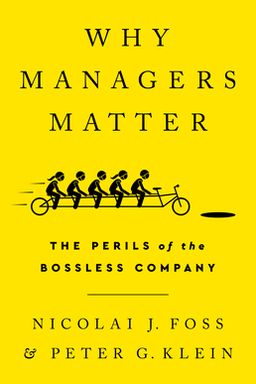
Why Managers Matter cover

Why Managers Matter

by Nicolai J Foss & Peter G Klein

Why Managers Matter delves into the dynamics of company structures, challenging the allure of bossless organizations. Authors Nicolai J. Foss and Peter G. Klein reveal how a strategic blend of hierarchy and autonomy can drive organizational success, offering valuable insights for leaders and employees navigating today''s complex business landscape.

The Illusion and Reality of Bosslessness

The Illusion and Reality of Bosslessness

You live in an age fascinated by the idea of the bossless company. Books, TED talks, and startup mythologies all sell a seductive claim: hierarchy is dying, and people can organize themselves through trust, technology, and purpose. Think of Spotify’s squads, Valve’s Flatland handbook, or Frederic Laloux’s Reinventing Organizations—each promises a managerial revolution. But when you look closely, the landscape is more nuanced than the hype.

The Cultural Origin of the Ideal

The longing for autonomy and anti‑bureaucracy has deep roots. It stretches from 19th-century cooperatives to the 1960s counterculture and Maslow’s human potential movement. Managers and entrepreneurs reimagined those ideals through Silicon Valley rhetoric—open offices, purpose over control, self‑managed tribes. Semler’s Semco, Gore’s lattice, and Mondragón illustrate recurring attempts to flatten organizational life in pursuit of freedom and engagement.

Why the Promise Persists

Flatness sells hope. It resonates with a generation weary of hierarchy and drawn to meaning and creativity. The narrative also leverages technology: digital platforms make coordination seem automatic, and tools like Slack or GitLab’s merge processes feel like substitutes for bosses. But every case that works—Wikipedia, Valve, Morning Star—does so under very specific conditions. Each hides governance scaffolding behind the rhetoric.

The Hard Evidence

Examine the famous examples and you uncover paradoxes. Valve’s egalitarian facade conceals informal cliques and formidable founder power. Wikipedia’s openness depends on early norm-setting and dispute rules created by Jimmy Wales. Even Morning Star’s peer contracts (CLOUs) still require a mediation hierarchy that ends with its founder. The pattern is consistent—bosslessness functions only where strong frameworks or governing norms exist.

The True Lesson

The real takeaway isn’t that hierarchy is obsolete, but that leadership and management have evolved. The traditional image of bosses commanding through orders has given way to architects designing context, systems, and rules that let others act. Autonomy thrives when you have clear boundaries, accountability, and trust structures to catch ambiguity before it spreads. Without them, freedom is noise—not productive independence.

Central Claim

“The death of hierarchy has been greatly exaggerated.” You should treat bosslessness as an experiment, not a doctrine. The best organizations combine autonomy with managerial design, not the absence of management.

So when you feel drawn to abolish titles, remember what history and evidence show: hierarchy persists because it solves coordination and cooperation problems that pure freedom does not. Your challenge isn’t to destroy it, but to reinvent it intelligently.


Why Firms Still Need Hierarchy

Why Firms Still Need Hierarchy

You might assume hierarchy exists because of tradition or ego. In reality, it’s an economic design. Ronald Coase explained that firms exist to reduce transaction costs—the time, effort, and risk of negotiating every small exchange through market prices. You build hierarchies because it's cheaper to direct employees than to write thousands of micro-contracts. Oliver Williamson refined this logic by showing how internal governance substitutes for courts and external law, providing trust and flexibility inside the firm.

Coordination and Cooperation

Managers solve two hard problems. Coordination: who does what, when, and how. Cooperation: ensuring people actually follow through without opportunism. Hierarchy creates channels for both. In Walmart’s logistics and Apple’s product ecosystems, the visible hand of management aligns complex interdependencies better than free-market negotiation ever could.

Design for Complexity

As firms grow and diversify, hierarchy becomes structure for managing complexity. Alfred Chandler’s dictum—structure follows strategy—explains the move toward multidivisional designs (the M-form). These allow top management to focus on strategy while decentralizing operations into accountable units. Hierarchy is not ideology; it’s architecture for coherence.

Boundaries of the Firm

The question “where the firm ends” reflects Coase’s insight. Uber’s use of contractors versus employees shows how technology shifts those boundaries: apps cut negotiation costs but don't abolish legal and enforcement challenges. Firms persist when internal governance remains cheaper or safer than external contracting.

Practical Implication

Hierarchy is an enduring coordination technology. Its shape evolves, but its purpose—reducing uncertainty, aligning actions, and protecting cooperation—remains vital even in digital economies.

You should think of hierarchy as a design tool. The right question isn’t whether to flatten, but how to structure responsibility for complexity, uncertainty, and shared purpose.


When Flatness Works

When Flatness Works

Flattening can succeed—but only when conditions align. Flat teams outperform hierarchy under modular, independent, well-measured tasks and strong cultural complements. That’s why Gore, Morning Star, and Valve thrive in niche conditions yet struggle at larger scale.

Modularity and Independence

Modularity means the system’s parts connect through clear, stable interfaces. In software development, modular code lets squads work autonomously, as at Valve or GitLab. A tomato processor like Morning Star can separate activities into repeatable units, enabling autonomous peer governance through lateral contracts. When tasks are entangled—like in healthcare or aerospace—flatness collapses under coordination load.

Group Size and Informal Cohesion

Small groups sustain flatness better. Gore’s 150-person rule reflects cognitive limits and relational intimacy. Within that size, people can manage accountability informally. Once scale exceeds that threshold, hierarchy reappears because coordination costs skyrocket.

Complementarities

Milgrom and Roberts’ concept of complementarities explains why autonomy needs matching systems. Lincoln Electric’s success with high discretion works because of stable employment, internal promotion, and performance measurement. Remove those and autonomy turns into chaos.

  • Favor decentralization when tasks are modular and locally understood.
  • Avoid full bosslessness when coordination and safety risks are high.
  • Pair autonomy with measurement, training, and cultural norms.

Key Lesson

Flat structures succeed when they rest on design discipline—modular architecture, small scale, and complementary systems. Freedom without structure is fragility.

Your job isn’t to choose hierarchy or freedom as absolute ideals, but to match structure to task interdependence, trust, and scale.


The Hidden Power Structures

The Hidden Power Structures

Even in bossless experiments, power resurfaces. Robert Michels’ Iron Law of Oligarchy predicts that in any organization—even one dedicated to equality—informal elites emerge. Valve’s social hierarchy of 'barons' and Wikipedia’s persistent founder influence prove that removing titles doesn’t remove power.

From Equality to Informal Authority

At Valve, employees describe a popularity dynamic determining project access. At Wikipedia, a small core of early editors set enduring norms. Both examples show structural vacuum invites invisible hierarchies. Without formal roles, influence shifts to control over information, resources, or social trust.

Design for Accountability

Ricardo Semler and Lars Kolind learned that radical decentralization needs guardrails—clear dispute processes, transparent decision rules, and periodic audits. Otherwise, covert elites undermine fairness. Even Semco, the poster child of democracy at work, diminished after Semler’s exit, showing how informal dependency on charismatic founders weakens sustainability.

Rule of Thumb

Removing bosses doesn’t remove authority—it only changes how it manifests. Plan for human nature by designing transparent systems that prevent informal oligarchy.

If you want lasting decentralization, focus on governance rather than titles. No organization operates without power; successful ones decide consciously how it’s distributed.


Management Reimagined

Management Reimagined

Modern management isn’t dying—it’s changing form. In knowledge economies, the manager becomes designer and steward rather than supervisor. Jimmy Wales exemplifies the designer model: he didn’t write Wikipedia’s content; he wrote its code and rules for dispute resolution. Managers today must set architectures, incentives, and boundaries that let expertise flourish without micromanagement.

Designing Systems, Not Commands

The shift is from telling people how to work to designing how work fits together. Netflix’s “freedom and responsibility” thrives because freedom comes with demanding metrics—the Keeper Test ensures accountability. Managers increasingly handle design of culture, measurement, and interfaces instead of day-to-day supervision.

Delegation and Crisis Leadership

During crises (like the pandemic), authority rebounds as firms need quick, integrative decisions. Studies show top teams have grown larger but more operationally involved. Leaders oscillate between delegation and central intervention depending on uncertainty and coordination needs—a pattern that redefines hierarchy as adaptive, not static.

The Middle Manager’s Redemption

Middle managers translate strategy into reality. They coordinate, bridge silos, and maintain coherence. Removing them often breaks communication chains. At Intel, midlevel managers drove strategic shifts toward microprocessors long before top management endorsed them—proof of managerial depth as innovation engine.

Key Insight

Managers aren’t obsolete—they’re architects of rules and connectors among experts. Their artistry lies in creating conditions where autonomy and alignment coexist.

You should see management as dynamic scaffolding: adapt coordination without stifling independence, design fairness without centralizing control.


The Risks and Resets of Bosslessness

The Risks and Resets of Bosslessness

Bosslessness brings not just freedom but fragility. Without clear alignment, informal bureaucracy grows, cultural mismatches surface, and coordination slows. Zappos, Oticon, and Blinkist show how radical decentralization often reverts to hierarchy once unpredictability and decision overload appear.

Coordination Breakdown

Oticon’s spaghetti organization collapsed under excessive initiatives and decision unpredictability. More projects didn’t equal more creativity—just confusion. Zappos’ Holacracy overloaded teams with meetings, draining attention. Freedom without boundaries turns into a self-management bureaucracy.

Cultural and Skill Limits

Not everyone thrives in bossless settings. Autonomy demands self-discipline and cross-functional skill. Firms like Semco or Valve rely heavily on recruiting “T-shaped” individuals—breadth and depth combined. Without those personal capacities, open systems disorient and demotivate workers.

Design Before Dismantling

Before you remove managers, ask whether your work is modular, whether norms support peer accountability, and whether leaders are ready to design instead of direct. If not, bosslessness becomes costly. Most successful experiments eventually stabilize as hybrids—flat where local insight rules, hierarchical where integration matters.

Warning

Delayering without design creates bureaucracy in disguise. Freedom needs architecture to prevent collapse under coordination costs.

Use flatness selectively—as experiment, not ideology. Sustainable autonomy arises from engineered culture, not abandonment of structure.


Hierarchy as Innovation Engine

Hierarchy as Innovation Engine

Contrary to popular belief, hierarchy doesn’t suffocate innovation—it often organizes it. Studies of Bell Labs, Intel, and W. L. Gore show that creative breakthroughs come from combining autonomy with sponsorship and coordination. Charles O’Reilly and Michael Tushman call this ambidexterity: the ability to explore while exploiting existing competencies.

Dual Structures for Exploration and Exploitation

Innovative firms often split their operations. One arm focuses on efficiency and reliability; another experiments without fear of failure. Managers become bridge architects, aligning incentives, allocating funds, and deciding which experiments get scaled.

Middle-Up Change Dynamics

Intel’s strategic shift—driven by midlevel managers observing market signals—illustrates innovation through internal adaptation. Hierarchical firms succeed when midlevels translate local insight upward and top leadership recognizes and sponsors change. That interplay is missing in ideology-driven flat cultures where consensus replaces judgment.

Balancing Freedom and Focus

Hierarchy creates the focus necessary to avoid idea overload. Oticon’s flood of initiatives proves that without selective central sponsorship, creativity can derail execution. Innovation depends not just on freedom to invent, but on authority to choose.

Lesson

The best innovators aren’t anarchists—they’re organized explorers. Hierarchy provides guardrails and resources that let creativity scale into lasting impact.

If you want innovation, protect autonomy within disciplined structure. It’s ambidexterity, not bosslessness, that wins over time.

Dig Deeper

Get personalized prompts to apply these lessons to your life and deepen your understanding.

Go Deeper

Get the Full Experience

Download Insight Books for AI-powered reflections, quizzes, and more.