
Idea 1
The Growth of Information: From Atoms to Economies
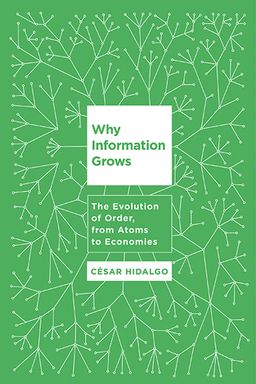
Have you ever wondered why our world seems to get more complex, not less, even as time constantly pushes things toward decay? In Why Information Grows, César Hidalgo explores this paradox by asking a deceptively simple question: how does order—what he calls information—emerge and expand in a universe ruled by the second law of thermodynamics, where disorder and entropy are always increasing?
Hidalgo argues that the key to understanding the rise of complexity—from swirling galaxies to DNA molecules to human societies and modern economies—is rooted in the same fundamental physics. He claims that information is not abstract but physical. It is the arrangement of matter, the order that transforms a pile of atoms into a car, a skyscraper, or a smartphone. This embodiment of information explains why objects, organisms, and economies require energy, solid structures, and the ability to compute to keep information alive and growing. Humanity’s unique capacity to create and manipulate information—to imaginatively embed order in matter—is what makes us extraordinary.
From Boltzmann to the Modern Economy
The book opens by revisiting the nineteenth-century physicist Ludwig Boltzmann, who first connected the physical order of systems to probability and entropy. Boltzmann knew that the universe tends toward disorder, yet he saw paradoxical growth of complexity all around—life, society, technology. His failed attempt to reconcile this contradiction marks the start of Hidalgo’s story. By blending physics and economics, Hidalgo picks up Boltzmann’s quest and expands it: what Boltzmann explored in atoms and gases, Hidalgo explores across human networks and economies.
Information as Physical Order
Information, Hidalgo reminds us, isn’t merely data or meaning—it’s physical order itself. The world’s richness is the result of how atoms arrange themselves into intricate configurations, defying the general drift toward randomness. A crashed Bugatti and a functioning one share the same atoms, but vastly different levels of organization. The loss of order is the loss of information. What makes Earth special in the cosmos isn’t its abundance of matter or energy, but its extraordinary concentration of organized structures—information stored in biology, technology, and thought.
Energy, Solids, and Computation: The Trinity of Growth
For information to grow, Hidalgo says it must overcome entropy through three mechanisms. First, flows of energy—like sunlight or geothermal heat—keep systems out of equilibrium, allowing order to manifest. Second, solids preserve information by freezing dynamic patterns into lasting structures, as DNA stores biological order and technology stores human knowhow. Third, computation—the ability of matter to process information—turns atoms, cells, and societies into engines of creativity. Together, these principles explain how complexity arises and accumulates: matter learns, processes, and replicates patterns.
Human Networks as Information Processors
Hidalgo extends this logic to the social and economic realm. Human societies grow by accumulating knowledge and knowhow—the computational engines inside networks of people. Unlike DNA or proteins, human knowledge must be embodied in brains and relationships. This reliance on humans introduces limits: we can’t store infinite knowhow individually, so we rely on networks (firms, cities, institutions) to collectively hold and process it. These social computers are the true creators of physical order, or what Hidalgo calls crystals of imagination—products that materialize human creativity in tangible form.
The Evolutionary Arc: From Atoms to Economies
By reframing economies as systems of information growth, Hidalgo connects physics, biology, and sociology into one elegant continuum. Life and economies alike depend on energy, solid structures, and computation to resist entropy and generate complexity. Our products—the cars, chips, and cities we build—are frozen packets of imagination that amplify our capacity to make further information. Prosperity, then, is not about wealth accumulation but about increasing a society’s ability to make information grow. It’s why some nations advance faster than others: they harness larger social networks that can compute collectively and sustain complexity.
Why This Matters
Hidalgo’s core proposition reshapes how you can see progress, technology, and even everyday life. Every act of creation—writing a book, coding software, planting trees—is a small defense against entropy. Each embodies imagination turned solid. By interpreting economies as systems of information growth, Hidalgo reveals that inequality emerges not from capital or resources but from uneven access to computational capacity—our networks of knowledge. Understanding this makes you see the world differently: not as competing markets, but as evolving pockets of organized complexity, each an echo of the universe’s deepest drive—to make information grow.