
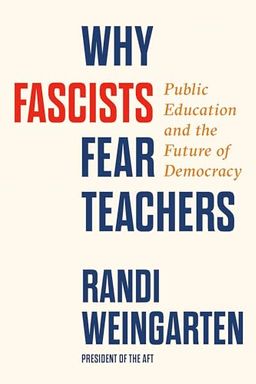
Why Fascists Fear Teachers cover

Why Fascists Fear Teachers

by Randi Weingarten

The president of the American Federation of Teachers explains why fascist regimes clamp down on educators and reinforces the importance of teaching critical thinking skills.

Public Schools as Democratic Defense

How can you keep democracy resilient when demagogues flood the public square with fear and disinformation? In this book, Randi Weingarten argues that strong public schools and strong unions are the backbone of democratic life. She contends that teaching critical thinking, building community schools, and defending collective bargaining are not just education policies—they are civic safeguards against authoritarianism.

Weingarten ties classroom practice to constitutional health. When teachers cultivate independent judgment, you inoculate communities against propaganda. When unions raise standards and mobilize civic participation, you rebuild the middle class. And when schools act as hubs for health, safety, and opportunity, you stitch the social fabric that extremists try to tear apart. This framework helps you see culture-war attacks, voucher pushes, and union busting as a single political project with the same end: to weaken the public’s capacity to govern itself.

What’s at stake

The book opens with a simple claim: critical thinking is a civic muscle, not an elective. Drawing on founders like Madison and Jefferson, Weingarten shows why universal education was designed to prevent tyranny. She brings that principle to life with Janusz Korczak’s democratic orphanage in Warsaw—children practiced self-governance and moral reasoning under the shadow of fascism. His refusal to abandon his students as they were marched to the camps underlines the book’s thesis: teaching truth and judgment is resistance.

Key Idea

"Critical thinking is the antidote" to indoctrination—teachers help students weigh evidence so they can’t be easily manipulated.

The two-front assault

You see a coordinated playbook to undermine that antidote. On one front, culture-war entrepreneurs (Christopher Rufo, Moms for Liberty) manufacture moral panics—book bans, "CRT," "grooming"—to discredit schools and intimidate educators. On the other, policy operatives push privatization and anti-union laws (Wisconsin’s Act 10, voucher expansions, and transition plans like Project 2025) that drain resources and dismantle public oversight.

The pattern is consistent: sow distrust in public schools, impose vague "divisive concepts" bans that chill inquiry, then redirect funds to private providers. The book traces this from local school boards (Central Bucks, Pennsylvania) to federal blueprints (agency downsizing, Title I reductions) and influential actors (Betsy DeVos–aligned networks, Heritage’s Project 2025, and, as the book reports, high-profile advisors like Elon Musk shaping agency cuts). (Note: the book situates these moves within a longer history of anti-union and privatization efforts, from Taft-Hartley to modern voucher expansions.)

How the defense works

The counterstrategy centers on people and place. Teachers bring current events into class and teach evidence, as Ryan Richman does in New Hampshire and Raphael Bonhomme does in Washington, D.C. Community schools remove barriers to learning by delivering dental care, mental-health supports, food access, and career pathways (Reconnecting McDowell’s teacher housing, mobile clinics, and after-school STEM are the model). Unions bargain beyond wages for nurses, counselors, librarians, and class-size limits (the Chicago Teachers Union under Karen Lewis and Stacy Davis Gates reframed bargaining "for the common good").

The book also tackles two non-academic threats: guns and screens. Teachers who survived or responded to tragedies, like Abbey Clements at Sandy Hook, push for background checks and assault-weapon bans. On the digital front, Weingarten backs Kids Online Safety Act updates and school-day phone limits to address anxiety, addiction, and distraction linked to social media’s design (the surgeon general’s warnings and Meta’s internal research add urgency).

Evidence and outcomes

You get data with the narratives. After Act 10, Wisconsin’s union membership and educator capacity cratered; experienced teachers left and student outcomes fell. In McDowell County, integrated services reduced dropouts and boosted graduation. Nationally, union approval climbed to about seven in ten Americans by 2024, and organizing petitions surged 53 percent year-over-year—a reminder that solidarity is making a comeback.

A civic throughline

"Unions practice democracy internally and expand civic agency externally—this is why authoritarians fear them."

What you can do

The book reads as a practical manual. You defend democracy by defending the conditions for learning and civic formation. That means supporting teachers’ ability to teach history and debate, backing community schools, voting in school-board races, resisting voucher schemes that drain funds, advocating for gun-safety and youth online-safety laws, and strengthening unions that bargain for public goods.

If you connect these pieces, the thesis is clear: schools are where you learn to be a citizen, and unions are where you practice solidarity. Authoritarians target both. Your response—grounded in critical thinking, shared services, and collective power—keeps the promise of American democracy alive. (Think John Dewey’s Democracy and Education meets a twenty-first-century organizing playbook.)


Critical Thinking as Civic Muscle

Weingarten treats critical thinking as a public-safety system for the mind. In her telling, teachers don’t just deliver facts; they train you to weigh evidence, interrogate claims, and form judgments that resist manipulation. That is why authoritarian movements—from fascists in Europe to modern-day propagandists—so often target educators: independent minds are harder to control.

The civic purpose of schooling

The founders saw schooling as civic preparation. Madison, Adams, and Jefferson believed an informed citizenry would check demagogues before they seized power. Weingarten modernizes that idea: when you can scrutinize an inflation claim or crime statistic instead of swallowing a partisan headline, you’re less vulnerable to panic and scapegoating (a central mechanism of the culture wars).

Key Idea

Korczak’s democratic orphanage shows how classrooms can be micro-democracies where students practice judgment, rights, and responsibility—even under threat.

How teachers build the muscle

You see practical, replicable routines. In New Hampshire, Ryan Richman links current events to historical injustices—the Rohingya and Uyghurs with civil-rights history; in D.C., Raphael Bonhomme has third graders study Advisory Neighborhood Commissions and propose policy, turning civics from rote knowledge into lived experience. These methods scaffold evidence evaluation and civic participation at age-appropriate levels.

The book argues that classroom freedom matters as much as curriculum. Inquiry-based discussion lets students explore hard topics—race, gender, religion—without fear. When states pass “divisive concepts” laws with vague language, they create a chilling effect; teachers self-censor, and students lose chances to practice democratic deliberation. The New Hampshire federal ruling striking down its law shows how legal pushback can restore space for learning.

Research and real-world stakes

Education correlates with support for democratic norms and lower tolerance for authoritarian leaders. The book cites modern scholarship (e.g., Glaeser, Ponzetto, Shleifer; Carnevale et al.) to show how schooling builds the cognitive and social skills you need to weigh evidence, consider competing perspectives, and navigate pluralistic societies. This is not just about elections; it’s about daily resilience to conspiracy theories and scapegoating narratives.

Weingarten frames critical thinking as the antidote to indoctrination from any direction. Instead of telling students what to think, teachers show them how to think: fact-check sources, compare claims, and test arguments. In practice, that looks like data analysis in economics class, structured debates in social studies, and evidence-based writing in English—little habits that, cumulatively, immunize you against demagoguery.

Why the attacks focus here

Propagandists try to shrink the Overton window of acceptable discussion. Label a topic “woke” or “indoctrination,” and suddenly it’s risky for teachers to explore the very issues where students most need guidance. The book shows how groups like Moms for Liberty and operatives like Chris Rufo reframe academic terms (CRT) into cudgels to generate outrage, pass bans, and intimidate educators. The goal is less debate, not more.

Yet pushback works. Courts can restore guardrails; communities can elect school boards that value inquiry; unions can defend academic freedom in bargaining and public messaging. The lesson for you: defend teachers’ space to teach how to think, not what to think. That’s how you keep classrooms democratic and minds resilient. (Note: this echoes John Dewey’s view that democracy must be “born anew” in each generation through education.)


The Culture-War Privatization Playbook

Weingarten maps a strategy that turns schools into political battlegrounds to justify defunding and privatization. The steps are simple and repeatable: manufacture a moral panic, stoke distrust, pass punitive laws, then redirect public dollars to private providers. You see this playbook in local school boards, state legislatures, and federal blueprints.

Manufacture outrage, chill classrooms

Christopher Rufo’s rebranding of “critical race theory” into a toxic catch-all made it easy to whip up hearings, press cycles, and bills. Moms for Liberty leveraged COVID frustrations and culture-war frames to win some school-board races and push book bans and speech restrictions. In districts like Central Bucks (PA), boards spent public money on legal battles over LGBTQ inclusion while letting basic infrastructure languish—misplaced priorities by design.

Quote from the text

Chris Rufo: "to get universal school choice you really need to operate from a premise of universal public school distrust."

Legislate, defund, privatize

The panic primes policy. States pass “divisive concepts” and “don’t say gay” laws to intimidate teachers and make complaints easy. Voucher and charter expansions then siphon funds from public systems; resources shrink, performance suffers, and the bad-faith narrative (“public schools fail”) gains new ammunition. This recursive loop is the point, not a side effect.

At the federal level, the book spotlights Project 2025 (Heritage-backed) as a ready-made transition plan to downsize agencies, curtail workers’ rights, and redirect funds from Title I and special education toward private and religious models. It further reports early executive actions in a second Trump term—Executive Orders 14242 and 14251—and names high-profile advisors like Elon Musk whose “DOGE” team, according to the text, cut agency budgets, paused student-loan application portals, and oversaw mass layoffs. (Note: the book presents these as examples of how personnel and blueprints convert ideology into rapid administrative change.)

Local and national consequences

The effects cascade. The ACLU and OCR documented hostile environments for LGBTQ students in places like Central Bucks, while districts burned funds on censorship efforts. Florida rejected and rewrote AP African American Studies, and state-level bans produced hundreds of pulled titles. Nationally, threats to close or hollow the Department of Education risk services to tens of millions of low-income students and those with disabilities; the book cites a $400 million grant threat to Columbia as an early example of funding as leverage over institutions.

Yet the strategy has limits. Where communities organize—Central Bucks voters ousted several Moms for Liberty–aligned members—extremist slates can be defeated. Courts have struck down vague teaching bans. And public resistance to universal vouchers is real; ballot measures and polling repeatedly show skepticism once voters see the budgetary and equity tradeoffs.

How you counter it

Weingarten argues for a three-part response. First, inoculate against misinformation—teach media literacy, show the data trails behind claims, and keep public communication transparent. Second, organize where the decisions are made—school boards, statehouses, and appropriations committees. Third, tie your defense to tangible wins: librarians, nurses, safe buildings, relevant career pathways. When families feel the benefits, culture-war noise loses steam.

The big idea: the culture war is a means to an end—concentrating power and privatizing public goods. If you keep the focus on student well-being and shared prosperity, you can reframe the entire debate around what schools are for and whom they serve.


Community Schools and Student Safety

If you want learning to stick, you must remove the barriers that keep kids from showing up ready to learn. The book’s community schools chapter shows how educators, unions, and local partners turn schools into hubs for health, nutrition, mental health, and career training. It pairs that with a blunt assessment of two threats schools can’t ignore: guns and social media.

McDowell County as a model

In West Virginia’s McDowell County—hit by coal’s collapse and the opioid crisis—AFT and community partners built a holistic response: teacher housing to attract talent, mobile dental clinics, clothing closets, after-school STEM, and even a juvenile drug court. These are not extras; they’re prerequisites for learning when poverty and trauma are pervasive. The payoff was measurable: dropouts fell, graduation rates rose, and academic performance moved closer to national averages.

Guiding Principle

"Freedom is not enough"—Lyndon Johnson’s insight: removing practical barriers is what makes equal opportunity real.

Schools as one-stop hubs

You’re invited to see schools as social infrastructure. On a single campus, families can access vision screenings, counseling, dental care, food pantries, and adult education. Teachers in Los Angeles and Houston used strikes and grants to expand this model, proving that bargaining and community organizing can deliver services as part of the education mission (not in competition with it).

Career and technical education fits here, too. Programs like the Brooklyn STEAM Center (across eight high schools), Peoria’s Pathways with Caterpillar, and Micron partnerships give students on-ramps to cybersecurity, engineering, and skilled trades. When you align education to real labor markets, students see school as a bridge to a dignified life—another antidote to cynicism and disinformation.

Guns and the classroom

Gun violence is now the leading cause of death for U.S. children. The book centers human stories like Abbey Clements at Sandy Hook to make the stakes unmistakable. Teachers have formed groups such as Teachers Unify to End Gun Violence and advocate for background checks, safe-storage laws, and banning assault-style weapons. The obstacle is not policy know-how; it’s political will—and industry lobbying that freezes commonsense reforms.

Screens, social media, and mental health

Adolescent anxiety, depression, and self-harm tracked upward with the smartphone era (ownership crossing 50 percent around 2012). The surgeon general calls loneliness an epidemic, and internal research from Meta/Instagram shows harm to teen girls in particular. Teachers report distraction is rampant; many districts now restrict phones during class. The book backs stronger defaults by law: Kids Online Safety Act and COPPA updates (which passed the Senate but stalled in the House), along with state efforts in California and New York.

Weingarten’s point is practical: classrooms can’t counter algorithmic design choices alone. You need guardrails on addictive features, data harvesting, and recommendation systems that prey on adolescent vulnerability. School-day phone limits help, but upstream regulation matters more.

A community-safety blueprint

Put it together and you get a simple formula. Wraparound services remove barriers to learning; CTE builds purpose; gun-safety laws reduce existential risk; online-safety rules protect attention and mental health. Unions and community partners are the engine that turns these from ideas into institutions. When you protect the whole child, you make academics possible—and you make democracy durable.


Unions and the Common Good

Weingarten frames unions as democratic institutions that raise wages, reduce inequality, and mobilize civic participation—all while delivering concrete gains for students. When union density falls, you feel it: wages stagnate, the middle class shrinks, and public services lose their defenders. When unions organize and bargain for the common good, schools and communities both get stronger.

Raising the floor, widening the circle

Historically, unions built the American middle class—wages, pensions, health care—and lifted non-union workers through spillover effects. The book links an 8 percent decline in union membership (1985–2011) with an 8 percent decline in the middle class, underscoring the macro stakes (while noting research debates about causality). Politically, union members vote at higher rates and engage more deeply in civic life; networks built at work translate to campaigns, school-board races, and issue advocacy.

Why it matters

"Unions practice democracy internally and expand civic agency externally—this is why authoritarians fear them."

Bargaining beyond pay

The Chicago Teachers Union under Karen Lewis pioneered “bargaining for the common good”—contracts that included nurses, counselors, librarians, class-size caps, restorative justice, and community schools. Parents joined the fight because they saw their interests on the table. Recent agreements (under Stacy Davis Gates) continue this approach with cost-of-living raises plus commitments to expand libraries and community schools. In healthcare, AFT’s Code Red campaign used nurse locals to expose staffing shortages that harm patients, showing how labor fights can be public-safety fights.

In classrooms, union strength correlates with better retention and more experienced teachers—both linked to student achievement. Unions also marshal resources: book giveaways, innovation funds, apprenticeship partnerships (e.g., Micron), and educator pipelines (Marlena Simmons’s programs) that address shortages and create homegrown talent.

Why unions are targeted

Authoritarians from Mussolini to Hitler crushed unions early because solidarity threatens concentrated power. In the U.S., anti-union laws and campaigns (Taft-Hartley, PATCO firings, Freedom Foundation efforts) impaired labor’s ability to defend public goods. Wisconsin’s Act 10 is the case study: K–12 cuts of roughly $800 million, tenure rolled back, union membership halved, lobby capacity gutted—from 17 to two lobbyists at the Wisconsin Education Association Council. Teacher flight followed, experience fell, achievement declined.

Yet there’s a turn. By 2024, union approval rose to around 70 percent, and NLRB petitions jumped 53 percent from 2021 to 2022 (1,638 to 2,510). AFT organized 185 new units between 2022 and 2024 across education, health, and public service. The takeaway: despite legal headwinds, workers are organizing where they live and learn.

Your role in the common good

Support union efforts that put students and patients first—nurse staffing, school counselors, safe buildings, community schools, and CTE pathways. Vote for school-board and state candidates who back collective bargaining. If you’re an educator, consider organizing around issues families feel daily: school libraries, class size, safety, and mental health. Bargaining that serves the community earns the community’s support—and secures the resources schools actually need.


Privatization’s Costs, Better Paths Forward

The book argues that vouchers and unregulated charter expansion aren’t neutral reforms; they are political strategies that weaken public institutions and concentrate control. When you follow the money and the outcomes, the pattern is clear: funds flow to private providers and wealthier families, accountability drops, segregation often rises, and the students with the greatest needs get left behind.

Historical roots and motives

Milton Friedman’s market-school vision intersected with segregationist resistance after Brown v. Board (Prince Edward County’s school closures and white-only academies loom large). In recent decades, wealthy donors and think tanks (Koch networks, DeVos-backed groups) have sustained voucher advocacy that reroutes public dollars to private and religious providers. The rhetoric is choice; the result is often stratification.

A concealed goal

"Starve public schools so vouchers become the de facto system."

What the data show

Arizona’s universal voucher expansion (ESA) illustrates the fiscal strain: reported shortfalls ballooned (the book cites a $1.4 billion gap), while many voucher beneficiaries were already in private schools and lived in wealthier ZIP codes. Nationally, ballot measures on universal vouchers often fail once voters see the budget math and who benefits. Cyber-charter scandals in states like Pennsylvania and the mixed results from New Orleans’ all-charter experiment point to regulatory gaps and perverse incentives (marketing and real estate over pedagogy).

Meanwhile, attacks on higher ed oversight—like efforts to shutter parts of the Department of Education or threaten grants (e.g., the book’s Columbia example)—signal how privatization logic extends to colleges: weaken public accountability, then leverage funding for ideological ends.

A better growth agenda

The alternative is not status-quo complacency; it’s public investment in what works. Community schools reduce barriers and improve outcomes (McDowell County). CTE turns diplomas into paychecks: Brooklyn’s STEAM Center, Peoria’s Pathways with Caterpillar, Lincoln-West School of Science and Health, and Micron-linked pipelines show how unions and educators can partner with industry without surrendering public purpose. These programs align with polling that shows strong voter support for skills training.

Union-backed contracts can lock in these gains: librarians, nurses, and counselors; class-size caps; dedicated funding for community schools; and pathways that recognize college is valuable but not the only route. If you want sustained improvement, build governance and funding that reward inclusion, transparency, and long-term community value—not short-term enrollment hustle.

Action steps for you

• Track budgets locally: calculate how vouchers or cyber charters drain dollars from your district.
• Vote in school-board and state races where oversight is decided.
• Support community-school grants and CTE partnerships tied to living-wage careers.
• Back union bargaining that sets student-centered standards (libraries, staffing, safety).
• Push for accountability parity: any school taking public funds should follow public transparency and civil-rights rules.

The book’s closing argument ties back to democracy. Public education at its best teaches you to think, convenes you with people unlike yourself, and gives your community practical tools to solve problems. Privatization erodes those shared spaces. If you want a durable democracy, invest in the institutions that teach us how to be citizens together—and protect the people who make those institutions work.

Dig Deeper

Get personalized prompts to apply these lessons to your life and deepen your understanding.

Go Deeper

Get the Full Experience

Download Insight Books for AI-powered reflections, quizzes, and more.