
Idea 1
Why We Never Learn from History
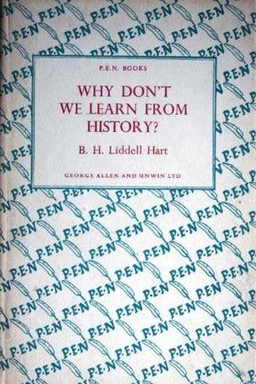
Why do human beings keep repeating the same mistakes? Why do wars, power struggles, and ideological delusions recur in endless cycles? Sir B. H. Liddell Hart’s Why Don’t We Learn from History? asks precisely this question and offers a candid, sometimes unsettling answer: we do not learn because we refuse to face truth. We prefer comforting myths to uncomfortable realities. We repeat our mistakes because we edit our memories, moralize them, or camouflage them in noble language.
Liddell Hart, a pioneering British military historian and strategist, wrote this book not as abstract philosophy but as a culmination of a lifetime observing how self-deception shapes both military history and human behavior. Blending history, psychology, and political theory, he dissects the mechanisms—fear, vanity, blind loyalty, patriotism, and authoritarian ambition—that prevent nations and individuals from learning what history could teach. What emerges is a sweeping vision: history offers truth, and truth can make humanity wiser—but only if we have the humility to face it without distortion.
History as a Mirror, Not a Myth
To Liddell Hart, history’s value lies in its capacity to show both how things usually go wrong and how they might go right. What it cannot give are ready-made recipes for progress. He insists, “History can show us what to avoid, even if it cannot teach us what to do.” The historian’s job, therefore, is not to glorify nations or heroes but to expose patterns of error—especially the patterns that recur in politics and war.
Yet the very societies that need history’s guidance most often censor, manipulate, or ignore it. Governments camouflage failure behind patriotism; institutions prefer flattering legends; citizens shrink from disquieting truths. Liddell Hart’s warning is clear: when history becomes propaganda, people lose their ability to learn. Like a patient who destroys the X-ray, humanity keeps breaking the same bones.
The Fear and Evasion of Truth
Central to the book is Liddell Hart’s argument that most people fear truth because it threatens comfortable illusions. He recounts how armies and governments suppress facts after disastrous campaigns, as with Haig’s Flanders offensive in World War I—a catastrophe prolonged by reports falsely saying it was “most satisfactory.” These distortions are not exceptional; they are systemic. Officials, afraid to admit errors, produce what Hart calls “camouflaged history”: documents crafted “for the record,” not for reality.
For Liddell Hart, this fear of truth is not only moral cowardice but practical suicide. False history breeds false confidence, and false confidence breeds war. Nations intoxicated by their own myths—Napoleon’s France, Hitler’s Germany—march proudly toward destruction. “The dry rot of armies,” Hart writes, “is the false confidence that comes from camouflaged history.” Until the courage to confront unpleasant truth becomes habitual, civilization cannot progress beyond recurring folly.
Freedom, Power, and the Cycle of Dictatorship
In Part II, Hart expands from individuals and armies to whole systems of government. Whether under monarchy, democracy, or despotism, he finds the same pattern: power tends to blind itself. Authority, he observes, confuses obedience with infallibility. Democracies often drown in mediocrity; dictatorships in delusion. Each claims moral superiority, but both are different forms of blindness. A democracy’s vice is complacent conformity; a dictatorship’s vice is moral certainty—and both lead to catastrophe.
Drawing parallels from Napoleon to Hitler, Hart identifies a recurring psychology of dictatorship: leaders rise through exploiting discontent, consolidate by suppressing criticism, and fall through self-deception. Their “pattern” becomes almost scientific: purge rivals, censor dissent, glorify unity, and, finally, start a war to distract from decay. What changes across centuries are not methods but technologies. Human psychology remains constant.
The Path to Wisdom: Scientific Honesty and Moral Courage
For Hart, the antidote lies in cultivating what he calls the “scientific spirit”—an attitude of critical inquiry, proportion, and self-criticism. He defines a truly scientific mind as one that reacts to criticism not with emotion or indignation, but by asking: “Is it true?” This moral courage—to question one’s own assumptions, loyalties, and leaders—forms the foundation of genuine freedom. Without it, truth perishes, and with it, civilization.
He repeatedly returns to the example of soldiers and commanders. The best are not the most rigidly loyal, but those who think clearly, doubt bravely, and act humanely. Moral courage—rare even among those of great physical bravery—is the quality that separates tragic folly from progress. Truth, Hart insists, must take precedence over patriotism, popularity, and power. For “truth matters more than faith, even in times of crisis.”
Why Learning from History Still Matters
Liddell Hart concludes that humanity stands between two fates: to continue the cycle of blind conflict or to ascend toward conscious self-understanding. The advent of atomic war made this challenge existential; “we have come,” he wrote, “either to the last page of war or the last page of history.” His faith, however, is not naïve optimism but pragmatic hope: people can learn, if they are willing to see. For him, the study of history is not the memorization of events but the cultivation of clear sight—learning to anticipate folly before it hardens into tragedy.
Through his book’s three parts—History and Truth, Government and Freedom, and War and Peace—Liddell Hart shows that clear thought and moral independence are not lofty ideals but survival skills. History is not a dead record of the past; it is a continual mirror of the present. And that mirror, uncomfortable though it may be, is the only instrument that can keep humanity from destroying itself.