
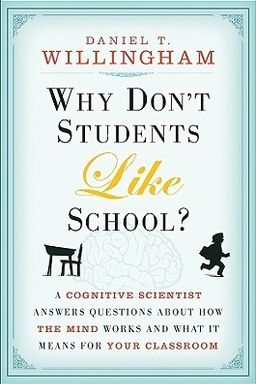
Why Don’t Students Like School cover

Why Don’t Students Like School

by Daniel T Willingham

Why Don’t Students Like School? delves into cognitive science to offer educators insights on improving teaching methods. By understanding memory, learning, and intelligence, teachers can create more engaging and effective educational experiences, fostering better learning environments and enhancing student success.

How the Mind Works—and Why Students Don't Always Like School

Why do so many students dread school, despite being naturally curious? This question sits at the heart of Daniel T. Willingham’s Why Don’t Students Like School?—a book that bridges cognitive science and classroom reality. Willingham, a cognitive psychologist at the University of Virginia, argues that students’ dislike of school isn’t a matter of laziness or disengagement—it’s rooted in how the human mind actually works.

At its core, Willingham contends that the mind is not designed for thinking, but for avoiding thinking. Thinking is slow, effortful, and unreliable compared to other mental processes like seeing or moving. Yet humans are drawn to the pleasure of mental work—when it succeeds. That distinction—when thinking feels fruitful versus frustrating—becomes the foundation for understanding what makes schoolwork enjoyable, memorable, and meaningful.

The Pleasure of Solving Problems

People love solving puzzles, crosswords, or word games because solving them gives a tiny chemical reward in the brain, a hit of dopamine. The same mechanism applies to learning: students enjoy mental effort when they sense progress. But if a problem feels impossible—or conversely, too easy—they disengage. Willingham calls this the “Goldilocks principle” of learning: students remain curious only when the challenge feels just right.

The implication is that teachers must engineer this delicate balance. Classroom tasks should be neither overwhelming nor trivial. For instance, a student who constantly faces problems beyond her grasp will come to associate thinking with failure and frustration. On the other hand, if she’s never challenged, there’s no thrill of accomplishment.

How Thinking Actually Works

To understand why thinking can be so hard, Willingham introduces a simple but powerful model of the mind. We have three interacting components:

  • The environment: the sensory input around us—texts, visuals, sounds, situations.
  • Working memory: the limited mental workspace where conscious thought occurs.
  • Long-term memory: the vast storehouse of everything you know, from math facts to movie plots.

Thinking, Willingham argues, happens when you combine information from these sources in working memory. But here’s the catch: working memory is tiny. It can only hold a few items at once. That’s why juggling multiple ideas or steps in a math problem can feel mentally exhausting—our cognitive ‘desk space’ gets cluttered fast.

Long-term memory, on the other hand, has no known limits. The more knowledge stored there, the more efficiently one can think. In fact, background knowledge acts as a cognitive shortcut: it frees up mental bandwidth in working memory. This is why a well-read student can analyze a history document faster than a novice—it’s not raw intelligence but accumulated knowledge that makes the difference.

Curiosity Is Fragile

If curiosity drives learning, what threatens it? According to Willingham, it’s confusion and failure. Once a student senses that satisfying the curiosity gap (solving the mental puzzle) is unlikely, interest fades. In practice, that means the way a teacher frames a question, paces a lesson, or scaffolds difficulty can determine whether students stay engaged or check out mentally.

“People are naturally curious, but we are not naturally good thinkers. Unless the cognitive conditions are right, we will avoid thinking.”

This insight reframes the teacher’s job: not simply to deliver information but to orchestrate mental success. Great teachers, in Willingham’s view, act like skillful puzzle designers—they structure lessons so that mental effort feels productive, not painful.

Why This Matters

The book’s central theme ripples into every other chapter. It’s not enough for teachers to have good intentions or inspiring stories—they must understand how cognition truly works. Later chapters unpack this insight into nine cognitive principles that reshape everything from how students remember lessons to how intelligence can grow with effort.

You’ll explore why factual knowledge is the foundation of critical thinking, how memory functions as “the residue of thought,” why abstract concepts resist transfer, and why true learning depends on extensive, deliberate practice. You’ll also see how many popular myths—like learning styles or innate intelligence—don’t hold up under scientific scrutiny.

Ultimately, Willingham’s message is both sobering and hopeful: teaching should be guided by how students’ minds actually operate, not by trends, intuition, or untested theories. When cognitive science meets classroom craft, school can become not just a place of knowledge—but a place where thinking itself becomes a source of joy.


Facts First: Knowledge Fuels Thinking

Teachers often dream of shaping students into critical thinkers, but Daniel Willingham argues that critical thinking requires knowing facts first. He confronts a long-standing false dichotomy in education: the belief that teaching facts (as on standardized tests) and teaching deeper thinking are at odds. The truth, he insists, is that they are inseparable.

Why Facts Matter So Deeply

Thinking depends on the knowledge stored in our long-term memory. We can’t reason about what we don’t know. For example, a reader who knows little about baseball will struggle to understand a passage describing a double play, even if their general reading skills are strong. Knowledge allows comprehension—it fills in the unstated assumptions and logical links writers leave out.

Moreover, the more knowledge we have, the easier it becomes to learn new information. Students with deep background knowledge in history, for instance, can absorb new historical topics faster because they already have mental scaffolding in place. As Willingham puts it: “When it comes to knowledge, the rich get richer.”

The Myth of “Just Look It Up”

Why not rely on Google rather than memory? Willingham points out that if working memory is the space where thinking happens, interrupting it constantly to look things up stalls thought. A student can’t reason fluidly if they’re perpetually retrieving basic facts from external sources. To think well, knowledge must reside in memory, ready to be accessed instantly.

He likens this to chess masters, who recall tens of thousands of board configurations. Their superiority isn’t due to abstract strategy alone—it’s grounded in massive memory for past games. The same applies to learning history, algebra, or reading comprehension.

Knowledge Accelerates Thinking

Willingham offers elegant demonstrations. In one study, students familiar with baseball recalled more details from a passage about a game than stronger readers who weren’t baseball fans. Why? Their domain knowledge made the passage meaningful and easier to remember. Knowledge enhances working memory through a process called chunking—grouping related information into single mental units. Thus, ABC, CBS, and CNN each take up less mental room than a string of random letters.

In other words, having knowledge doesn’t stifle imagination—it fuels it. Willingham even gently rebuts Einstein’s overused quote that “imagination is more important than knowledge,” pointing out that imagination itself requires something to work with. Knowledge isn’t the enemy of creativity; it’s the substrate that makes creativity possible.

“Skill requires knowledge; knowledge enables skill. They grow together, not in opposition.”

For teachers, the message is clear: before asking students to analyze or critique, give them facts to think about. Factual knowledge makes deeper cognitive processes possible, not redundant.


Memory Is the Residue of Thought

Why do students forget yesterday’s lesson but remember every detail of a TV show? Willingham’s answer is simple but profound: we remember what we think about. Memory isn’t a passive recording device—it’s a selective byproduct of attention and meaning. The mind stores what it processes deeply, not what it merely hears.

Thinking Determines Remembering

In one of his examples, Willingham describes a teacher who has students bake biscuits to experience life on the Underground Railroad. A beautiful idea—but flawed in execution, because the students spent forty seconds thinking about history and forty minutes thinking about mixing flour. The activity was memorable, but not for the intended reason.

In short, you remember what occupied your thoughts. This principle—called “memory as the residue of thought”—has enormous implications for teaching. Lessons must be designed to make students think about the meaning of the material, not the distractions surrounding it.

Stories Trump Facts

Willingham suggests using stories as cognitive vessels for meaning. Stories naturally engage attention and structure memory through causality, conflict, characters, and complications—the “four Cs.” This explains why historical narratives stick better than timelines, and why even adults recall movies and anecdotes effortlessly. If you want students to remember an idea, wrap it in a story.

Design for Meaningful Thinking

Teachers should ask: “What will my lesson actually make students think about?” A PowerPoint project might result in students mastering animation tricks rather than the topic itself. Similarly, an attention-grabbing demonstration might enthrall them with surprise but leave no enduring concept behind.

“Whatever you focus your students on—that’s what they’ll take away.”

The remedy is deliberate lesson design that forces thought about key ideas. Ask comparisons, highlight conflicts, and pose questions that require reasoning. If cognition builds memory, then the teacher’s craft lies in guiding where students’ minds go during class.


From Concrete to Abstract Understanding

Understanding isn’t about memorizing answers—it’s about connecting new ideas to what you already know. Willingham explains that students grasp new concepts only when they can tie them to familiar, concrete experiences. We crave abstraction, but our brains understand in context.

Why Abstraction Is Hard

When a geometry student learns to calculate the area of a tabletop, transferring that knowledge to a soccer field problem seems obvious to an adult—but not to a child. To them, the surface structure (tables versus fields) feels unrelated. That’s because the human mind prefers concrete examples anchored in sensory experience. To teach abstraction, you must multiply examples until patterns emerge naturally.

Making the Abstract Stick

The key is experience. As students encounter a concept across varied contexts—say, calculating area for doors, envelopes, or lawns—they begin to perceive the deep structure behind them. Teachers can accelerate abstraction by guiding students to compare examples and identifying the common principle hidden beneath differences.

Willingham illustrates this using dramatic irony from literature. Comparing multiple plays—like Oedipus Rex, Romeo and Juliet, and Othello—helps students grasp the shared pattern: a character acts on incomplete information while the audience knows the truth. By contrasting examples, students activate deep cognitive processing rather than superficial recall.

“We understand new things in the context of things we already know—and most of what we know is concrete.”

Understanding, then, is “remembering in disguise.” Once abstract knowledge takes root, it becomes a new foundation for future learning—a continuous layering of meanings built from concrete beginnings.


Practice Makes Cognitive Freedom

Learning doesn’t stop at comprehension—it must evolve through practice. Willingham explains that practice frees the mind. When low-level skills become automatic, working memory is liberated for higher thinking. This principle underlies all expertise, from driving to algebra.

The Power of Automatization

Think of the first time you drove a car—you consciously managed mirrors, pedals, and signals. Over time, those processes became automatic, allowing you to focus on traffic strategy instead. For students, memorizing multiplication tables or phonics rules has the same liberating effect. They can reason about complex problems only if the basics no longer demand effort.

Beyond Mastery: Sustained Practice

Practice isn’t just for beginners. Continuing to review mastered material makes memory more durable and more transferable to new contexts. Willingham cites research showing that algebra knowledge fades quickly unless it’s reinforced through later courses. The lesson: use it or lose it—and better yet, space practice out over time.

Distributed practice—revisiting material days or weeks apart—beats cramming. It builds long-term retention and keeps skills sharp. As Willingham puts it, you can study less total time but remember more if you space it wisely.

“It is virtually impossible to become proficient at a mental task without extended practice.”

Teachers sometimes fear “drill and kill,” but Willingham reframes it as “drill and thrill.” Practice, when purposeful and spaced, anchors knowledge so students can think freely, not mechanically.


Experts Think Differently Than Novices

When educators urge students to “think like scientists” or “think like historians,” Willingham issues a caution: experts and novices literally think in different ways. Expertise is not mere knowledge quantity—it’s a qualitative transformation in cognition.

How Experts See

Experts perceive patterns novices can’t. A chess master, for instance, recalls the board not as thirty-two individual pieces but as recognizable clusters of strategic relationships. Similarly, scientists or historians identify deep principles rather than surface details. Students, by contrast, get distracted by context—thinking “this is about soccer fields” instead of “this is about area.”

Experts also talk to themselves differently. Their “self-talk” involves testing hypotheses and anticipating counterexamples, whereas novices merely narrate what they’re doing. Over years of deliberate practice, experts automate low-level tasks, freeing mental bandwidth for deep connections.

Creating vs. Comprehending Knowledge

Students, Willingham argues, are not ready to create knowledge like experts; their cognitive load is too high. Instead, schooling should focus on helping them comprehend knowledge deeply—understanding how scientists or historians construct ideas, not replicating that process from scratch. Assigning “experiments” or “original historical interpretations” can motivate but rarely produces genuine expertise-level cognition.

Students are ready to comprehend knowledge, not to create it. Expert thinking grows from thousands of hours of structured practice, not shortcuts.

The implication is empowering rather than limiting: rather than demanding impossible “expert thinking” from students, teachers can cultivate deep understanding step by step, building the patterns and habits that one day make expertise possible.


The Myth of Learning Styles and Multiple Intelligences

One of Willingham’s most controversial chapters dismantles the beloved idea that students learn best through specific “styles”—visual, auditory, or kinesthetic—or through distinct “multiple intelligences.” Despite decades of enthusiasm in education, he shows there’s no scientific basis for matching instruction to such styles.

Children Learn More Alike Than Different

True, people differ in memory capacity and personality, but cognitive psychologists have found no consistent evidence that teaching to a preferred “modality” (say, showing pictures to visual learners) enhances learning. That’s because most school learning concerns meaning, not appearance or sound. Remembering a concept like photosynthesis relies on understanding its conceptual relationships, not on seeing or hearing it a particular way.

Willingham grants that visual memories may help when memorizing shapes of countries or auditory memory when mastering accents, but those cases are about content, not the learner. It’s more accurate to think in terms of how the material is best represented, not who the student is.

The Appeal—and Danger—of Belief

So why does the myth persist? Confirmation bias. When teachers see a student respond well to a drawing explanation, they assume “Ah, a visual learner!” without realizing the explanation itself may simply have been clearer. These intuitively attractive beliefs comfort us, but they risk misdirecting time and resources.

“Children are more alike than different in how they think and learn.”

Willingham’s alternative? Differentiate instruction based on readiness and prior knowledge—not imaginary learning styles. Cognitive diversity in ability is real; “style” diversity is not.


Intelligence Can Grow Through Hard Work

If you’ve ever had a student claim “I’m just not smart,” Willingham offers deeply encouraging news: intelligence is malleable. While genetics play a role, environment, effort, and belief matter enormously. The key distinction isn’t between smart and dumb, but between those who believe intelligence is fixed and those who see it as improvable.

Nature, Nurture, and the Flynn Effect

Willingham reviews research on identical twins and IQ studies to show that intelligence reflects both genes and environment. He highlights the “Flynn Effect”—the decades-long rise in IQ scores worldwide—as powerful evidence that environment can boost intelligence in entire populations. Nutritional improvements, education access, and more cognitively complex modern life all contribute.

Intelligence, then, is not a fixed inheritance but an interplay between genes steering us toward certain environments and the environments amplifying those tendencies. A genetically curious child, for instance, may seek out books, which further increases intelligence—a self-reinforcing loop.

Mindsets Shape Learning

Borrowing from Carol Dweck, Willingham emphasizes how beliefs about intelligence affect motivation. Students praised for being “smart” avoid hard tasks to protect their label, while those praised for “effort” embrace difficulty as a path to growth. Teachers can change lives simply by praising process over talent: “You worked really hard on that problem,” instead of “You’re brilliant.”

“Children do differ in intelligence, but intelligence can be changed through sustained hard work.”

For teachers, the task is to model confidence in students’ potential, set high expectations, and celebrate persistence. Intelligence grows where effort is believed to matter.


Teaching as a Cognitive Skill—Practice Makes Mastery

In his final chapters, Willingham turns the lens back on teachers. If students’ learning depends on practice, feedback, and reflection, the same applies to teaching. Teaching itself is a complex cognitive skill that must be practiced deliberately to improve.

Reflective Practice and Feedback

Willingham urges educators to videotape their lessons, observe others, and exchange feedback with trusted peers. Watching oneself on video, though uncomfortable, reveals hidden patterns—missed opportunities, tone issues, or classroom dynamics unseen in the moment. This mirrors how athletes and musicians refine performance: through observation and critique.

The process should be structured and supportive—partners focus on concrete behaviors, not personal traits. Over time, reflection creates self-awareness that translates into automatic expertise, just as novices in other domains become experts through repetition and mindful correction.

Start Small, Start Now

Improving teaching need not require dramatic overhauls. Willingham suggests maintaining a brief teaching diary, noting what worked and what didn’t each day. Patterns emerge, revealing which strategies genuinely help students think. Small, consistent self-improvement, he argues, compounds into mastery over time—an echo of the ten-year rule of expertise seen in other fields.

“Teaching, like any complex cognitive skill, must be practiced to be improved.”

Ultimately, Why Don’t Students Like School? ends as it began—with persistence, humility, and optimism. Understanding the mind isn’t a shortcut to easy teaching, but it arms educators with principles that make learning not only possible, but joyful. In knowing how students think, teachers rediscover how to think about teaching itself.

Dig Deeper

Get personalized prompts to apply these lessons to your life and deepen your understanding.

Go Deeper

Get the Full Experience

Download Insight Books for AI-powered reflections, quizzes, and more.