
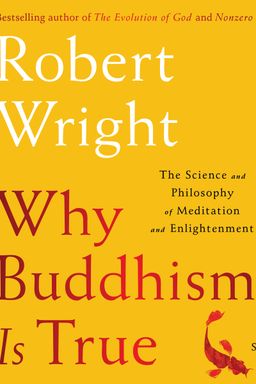
Why Buddhism Is True cover

Why Buddhism Is True

by Robert Wright

Explore the intersection of Buddhism and science in ''Why Buddhism Is True.'' Robert Wright reveals how meditation and Buddhist philosophy, supported by scientific research, can transform your perceptions, control your emotions, and enhance your mental well-being, offering a path to greater peace and self-understanding.

The Evolutionary Illusion of Self and Happiness

Robert Wright argues that your mind wasn’t designed to reveal truth or ensure happiness—it was designed by evolution to spread genes. This deceptively simple claim reshapes everything from cravings to spiritual quests. Whether you reach for a doughnut or recognition, natural selection built those impulses to maximize reproductive success, not well-being. The resulting mismatch—your pursuit of fleeting rewards that rarely satisfy—forms the central problem Wright wants you to confront.

Pleasure and the Hedonic Treadmill

Evolution wired you for pleasure, but under three rules: pleasure drives behavior, it should be transient, and anticipation must be strong. You get excited before a reward more than when you receive it, a pattern confirmed by dopamine studies where monkeys respond to cues more than the juice itself. This anticipatory bias fuels the endless cycle of chasing happiness—a treadmill the Buddha called dukkha, the pervasive dissatisfaction at the heart of human existence.

Why Knowing Doesn’t Free You

You may intellectually grasp this evolutionary trick, yet still eat the doughnut. Understanding doesn’t dissolve craving because the biochemical infrastructure persists. Wright’s own experiences prove cognitive insight is not behavioral liberation; practices are needed to rewire your relationship to desire. Buddhism, particularly through mindfulness and meditation, provides a practical remedy—less as metaphysical belief and more as a technology for seeing through illusions evolution built into you.

Meditation as a Naturalistic Red Pill

Wright borrows from The Matrix to frame meditation as a red pill—a way to see the mind’s machinery firsthand. Natural selection made perception and emotion persuasive but unreliable. Mindfulness lets you perceive that unreliability directly. Concentration practices calm the mind; mindfulness dissects it, exposing the mechanisms behind feelings, perceptions, and identity. This empirical spiritual method reveals your mental constructions—the self, pleasure, meaning—as systems rather than truths.

The Book’s Central Promise

Wright’s thesis bridges Darwin and the Buddha: the illusions that keep you bound—selfhood, essence, craving—arose from adaptive circuitry. Seeing and disidentifying from them is both scientifically intelligible and experientially liberating. Meditation becomes not an escape from biology, but a rebellion against its automatic dominion. Understanding how natural selection makes you suffer and learning how mindfulness interrupts that automatic chain define the moral and practical heart of Wright’s work.


The Modular Mind and Its Hidden Drivers

Your sense of being a unified, rational agent is largely fiction. Neuroscience and cognitive psychology show that your mind is more a coalition of modules than a single CEO. Wright uses studies—from Michael Gazzaniga’s split-brain patients to Nisbett and Wilson’s pantyhose experiment—to demonstrate that consciousness often arrives late to the party. You believe you decided, but the decision emerged from automatic subsystems long before awareness caught up.

Modules and Feelings as Command Systems

Kenrick and Griskevicius describe seven evolutionary "subselves"—status, mating, self-protection, kin care, affiliation, disease avoidance, and mate retention. These are like mini-programs fighting for control. Feelings serve as their fuel. When attraction flares, the mate-acquisition module runs the show; when fear strikes, the self-protection system dominates. Jealousy, analyzed by Cosmides and Tooby, demonstrates this vividly: emotion reorganizes cognition into defense of a bond.

Reason as Servant, Not Master

Echoing David Hume’s insight that “reason is the slave of the passions,” Wright shows that rationality follows affective tracks. fMRI studies on purchasing reveal nucleus accumbens activation predicts desire, not logical reasoning. Evolution tuned thought to emotion’s agenda. This means appeals to logic rarely defeat impulse; only altering affective weight does. Mindfulness, in this light, strengthens self-control by adjusting emotional charge rather than commanding thought directly.

Meditation’s Functional Role

In Wright’s naturalistic Buddhism, mindfulness recalibrates emotional circuits. You learn to notice the feeling that launches a thought—recognizing jealousy or ambition as impulses rather than commands. By watching emotion’s rise, you weaken its authority. That shift corresponds to a change in neural priority—giving another module, perhaps one of compassion or long-term planning, a chance to govern behavior. The ancient doctrine of not-self thus gains scientific footing: the self never really was one ruler; mindfulness teaches you how to work with the parliament.


Seeing Through Feeling and Essence

A key Buddhist claim Wright revives is that what you perceive as the “essence” of things—why something feels precious, disgusting, or sacred—arises from affective and narrative overlays rather than inherent features. You live inside story-shaped feelings, not raw reality. Changing how feeling and story bind together is central to meditation’s power.

Affect Constructs Essence

Paul Bloom’s research on essentialism shows that emotion transforms a tape measure into “JFK’s tape measure” simply by storytelling. Wright cites studies where identical wine tastes “better” at higher price labels—the medial orbitofrontal cortex lights up more, even though taste input is unchanged. This demonstrates how top-down story recruits affective circuits to alter perception itself. Your experience of the world depends on the narratives attached to sensory data.

Emptiness and the Buzz-Saw Insight

On retreat, Wright discovered construction noise could turn from irritation to music when observed nonjudgmentally. The sensory data stayed consistent; only the affective layer shifted. That experiential shift exemplifies emptiness—things lack fixed essences. It’s not nihilism but perception freed from reflexive valuation. Clinical data like the Capgras delusion, where affective linkage to recognition fails, corroborates this: essence arises at the intersection of perception and emotion.

Ethical Expansion Through De-Essentialization

Seeing through essence has moral significance. When you stop treating people as fixed entities—enemy, hero, sinner—the cognitive and emotional machinery of hate weakens. Wright’s weed episode, where a plantain shifted from “weed” to “beautiful life form,” symbolizes how mindfulness can detoxify your moral imagination. Dismantling essences isn’t abstract theory; it’s how you build compassion in a world addicted to tribalism.


Not‑Self and Dissolving Boundaries

One of Buddhism’s most radical insights, the doctrine of not‑self (anatta), gains empirical coherence in Wright’s narrative. The illusion of a stable, sovereign “I” dissolves in two directions: inward, as you see thoughts arise unauthored; and outward, as boundaries between self and world soften. Meditation allows you to watch both dissolutions happen in real time.

Interior Not‑Self

In the Buddha’s analysis of the five aggregates—form, feeling, perception, mental formations, and consciousness—none is fully under your control or permanent. Neuroscience affirms this: the modular mind lacks a central CEO. During meditation, when you see emotions and thoughts appear and disappear without command, you experience non‑ownership. Wright’s episode of noticing resentment toward a snoring neighbor and watching it vanish demonstrates this interior liberation—seeing mental events as transient patterns, not personal traits.

Exterior Not‑Self

A subtler experience can follow: as craving and aversion weaken, the boundary between “you” and the world blurs. Wright describes moments where body sensations and environmental sounds fuse in perception. Philosopher Miri Albahari links this to tanha—the thirst that maintains boundaries. Less craving, less separation. Gary Weber’s reports of “continuous field” consciousness echo this same phenomenon. Whether described as emptiness or oneness, it entails perceiving mutual participation rather than isolation.

Practical and Ethical Payoff

Disowning thoughts brings equanimity; dissolving boundaries expands empathy. You function less as a self-defensive organism and more as part of a shared system. Wright insists this need not be mystical: it’s a natural psychological and moral progression. Seeing the illusory nature of “I” clarifies why compassion towards others feels natural—they are not truly “other.”


Interrupting the Chain: How Liberation Works

The mechanism that makes mindfulness transformative lies in interrupting the habitual chain between feeling and craving. Buddhism calls this causal web paticca‑samuppada, or dependent origination. Wright renders it psychologically precise: liberation happens not through mystical escape but through noticing the exact link where reaction begins.

Conditioned Arising Explained

Sensory contact yields feeling; feeling can prompt craving; craving generates clinging and suffering. Bhikkhu Bodhi’s commentary (used by Wright) places the decisive battle between feeling and craving. When you observe the feeling—anxiety, irritation, desire—without automatically pursuing or rejecting it, the subsequent links falter. This breaking of causation is what Buddhist texts mean by “the unconditioned.”

Mindfulness in Action

Wright’s example of noticing irritation at snoring visualizes the principle. Attention turned to the raw sensation (tightness, heat) instead of the narrative (“he’s ruining my retreat”) dissolves anger’s grip. That pause is not suppression but observation, which deconditions the craving for resistance. Over time, the space between stimulus and reaction widens, granting both psychological freedom and moral clarity.

The Naturalistic Nirvana

Stephen Batchelor’s secular framing—“not being conditioned by something”—captures Wright’s view of nirvana as psychological unhooking rather than metaphysical transcendence. Each moment you perceive feeling without craving, you experience micro‑liberation. Repeat that process, and you cease being a puppet of evolutionary programs. Liberation is cumulative and testable: you suffer less and act more wisely because you’ve interrupted the machinery of automaticity itself.


Meditation, Morality, and the Future of Civilization

Wright closes by expanding the stakes: meditation isn’t just personal therapy—it may be humanity’s best hope for moral evolution. He frames Buddhist practice as cognitive rebellion against natural selection. Evolution prioritizes gene propagation through self-centeredness; mindfulness trains impartial perception, replacing ego-serving algorithms with compassion and clarity.

From Selfish Genes to Selfless Awareness

Natural selection pushes you toward tribalism, status seeking, and short-term gain. Wright proposes adopting the "view from nowhere" (Thomas Nagel) or Sidgwick’s “point of view of the universe.” Seeing reality from beyond your genetic agenda turns impartial ethics into emotional fact—care for others becomes natural when self-boundaries dissolve.

Tribalism and Global Risk

Wright connects the essence-of-person problem to geopolitics. The same mechanisms that demonize out-groups in football games scale into wars when mass media reinforces essences of evil. Meditation’s deflation of essence therefore carries civic import: calmer minds detect situational causes rather than moral essences and are less prone to violent escalation. He recalls his earlier book Nonzero to stress global interdependence: cooperation is now survival, and tribal psychology is the threat.

Practical Optimism

Wright rejects utopian visions. Ethical misuse of mindfulness—teachers abusing authority—proves enlightenment needs scaffolding. Yet he holds pragmatic faith that even small "pockets" of clear-minded individuals can cool societal reactions. A population trained to see mental causes could restrain cycles of vengeance and polarization.

Your Role in the Metacognitive Revolution

Practicing mindfulness thus becomes civic duty. Each moment you perceive clearly rather than reactively contributes to collective sanity. For Wright, enlightenment scales: personal liberation feeds global stability. Meditation, metacognition, and ethical reflection together may amount to an incremental civilization redesign—one grounded in seeing rather than believing.

Dig Deeper

Get personalized prompts to apply these lessons to your life and deepen your understanding.

Go Deeper

Get the Full Experience

Download Insight Books for AI-powered reflections, quizzes, and more.