
Idea 1
Teaching the Language and Logic of Money
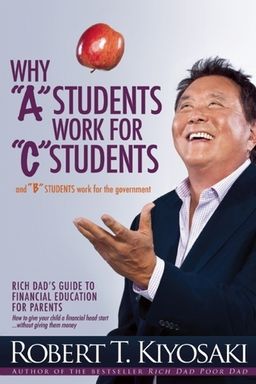
How can you prepare your child for a world where financial ignorance is often punished more harshly than academic failure? In Rich Dad’s Guide to Teaching Your Child About Money, Robert Kiyosaki argues that true education must go beyond math, reading, and test scores—it must include the language, psychology, and mechanics of money. Schools, he contends, have failed to teach financial literacy, leaving families and individuals vulnerable to cycles of debt, dependence, and institutional control. His solution is radical yet practical: parents must become their children’s first and best financial teachers.
Why Schools Miss the Point
Kiyosaki opens with a critique of traditional schooling. Using metaphors like the emperor’s new clothes and Einstein’s fish, he shows how schools produce smart rule-followers rather than financially independent thinkers. Despite billions in education spending, most graduates can’t explain compound interest or distinguish between an asset and a liability. Cultural biases portray money as corrupt, bureaucracies change slowly, and teachers often lack the financial training to teach what they don’t understand.
This ignorance has tangible costs. Mortgage crises, student loan burdens, and the systemic reliance on government entitlements all stem, Kiyosaki argues, from a population that never learned how money actually works. Real-world consequences, from housing crashes to excessive taxation, can be traced back to missed classroom lessons about value creation, leverage, and cash flow.
Money as a Language—and a Life Skill
Kiyosaki insists that money is a language with its own grammar and vocabulary—terms like income, expense, assets, liabilities, and cash flow. Like any language, fluency comes only through conversation and repetition, not memorization. The financial statement replaces the school report card: where teachers mark grades, bankers and investors assess your wealth by your balance sheet. Understanding this document—how money enters and exits your life—is the prerequisite for adulthood in a market economy.
Rich dad’s core mantra anchors this worldview: assets put money in your pocket, liabilities take it out. That simple question—does it put money in or take it out?—becomes the clearest test of wisdom in the real world. Kiyosaki contrasts the poor (few assets, many expenses), the middle class (income offset by liabilities like mortgages and car payments), and the rich (asset-focused, with recurring cash flow from businesses and investments). Teaching this “report card” reframes how children define success.
Learning Windows and the Parent’s Role
The book outlines three developmental “windows” for building financial intelligence. From birth to age 12, children learn best through play and simulation—CASHFLOW® for Kids or Monopoly embed lessons about rent, property, and risk through tactile experience. From 12 to 24, experimentation takes over. Teenagers rebel by nature, and parents should channel that curiosity into ventures or apprenticeships, not suppress it. From 24 to 36, real-world application—sales jobs, mentorship, and entrepreneurial practice—cements habits formed earlier.
The earlier you start, Kiyosaki warns, the stronger the neural and emotional associations with money. Parents must talk openly about bills, budgets, and mistakes, normalizing financial discussion instead of hiding it. Just as children mimic how you drive or speak, they internalize how you save, spend, and invest.
From Employees to Capitalists
Most schools train future employees, not wealth creators. Using his CASHFLOW Quadrant (E–S–B–I), Kiyosaki explains that employees (E) and self-employed professionals (S) exchange time for money and bear the highest tax burden, while business owners (B) and investors (I) build systems that generate tax-favored passive and portfolio income. The world rewards the right side of the quadrant; knowledge, not luck, dictates who crosses over. Parents who urge children to “get a good job” may unknowingly lock them into lifelong tax inefficiency.
This system mirrors the political economy itself: governments incentivize job creation and housing development through tax law. Business owners and investors who align with these aims—providing housing, employment, or commodities—use the same tax code others complain about to reduce taxes legally. Understanding this is not exploitation; it’s literacy.
Life Is Nonlinear: Learning From Failure
Kiyosaki’s own path—from surfboarding teenager to failed wallet manufacturer to real estate investor and bestselling author—illustrates his philosophy. Success, he says, comes in waves, not straight lines. Every downturn provides feedback: when one business collapsed or a public scandal hit, he used the lessons to pivot toward new ventures, culminating in the CASHFLOW games and Rich Dad Company. Teaching your child to anticipate fluctuations, rather than fear them, develops resilience—perhaps the ultimate financial trait.
From Financial Survival to Freedom
The book ultimately argues that financial education is moral education. Without literacy, citizens become dependent on governments and creditors; with it, they can choose generosity, independence, and contribution. Kiyosaki closes with ten “unfair advantages” parents can give their children—skills in transforming income types, using debt wisely, reducing taxes legally, protecting assets, and cultivating emotional intelligence. The goal is not riches for their own sake, but the freedom to live purposefully in an uncertain future. In this framework, every parent becomes a potential rich dad, and every household, a mini-school of financial freedom.