
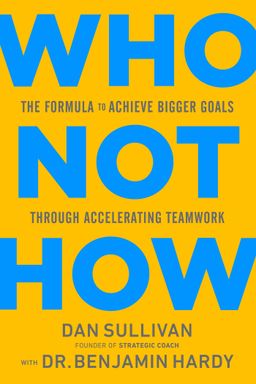
Who Not How cover

Who Not How

by Dan Sullivan with Benjamin Hardy

Discover the power of delegation and teamwork with ''Who Not How.'' Learn how to leverage the strengths of others to achieve your goals faster, free your time, and cultivate meaningful professional relationships. Dan Sullivan and Benjamin Hardy offer a new mindset for entrepreneurs and leaders seeking greater success through effective collaboration.

The Power of "Who Not How"—Why Asking a Better Question Changes Everything

How often do you find yourself stuck on a big goal, wondering, “How on earth am I going to make this happen?” In Who Not How, entrepreneurial coach Dan Sullivan and psychologist Dr. Benjamin Hardy suggest that this is exactly the wrong question to ask. The difference between people who stay overwhelmed and those who soar lies not in working harder or figuring out more sophisticated systems, but in mastering a simple mindset shift: stop asking “How can I do this?” and start asking “Who can help me achieve this?”

Sullivan’s central thesis is straightforward but radical: life’s greatest results come not from personal struggle, but from collaboration. In place of the lone-wolf myth so common in entrepreneurship, the book positions freedom, abundance, and transformation as products of relationships—what Sullivan calls your Whos. By finding the right people, your capacity to create expands exponentially. What’s more, this process frees you to focus on what you do best—your “Unique Ability”—while your Whos handle the rest.

From "How" to "Who": A Paradigm Shift

The book opens with the story of Michael Jordan—a man whose unmatched drive and talent weren’t enough to win him championships until he embraced the power of Whos. When Scottie Pippen joined the Chicago Bulls and Phil Jackson began coaching with a team-based strategy, Jordan’s individual excellence evolved into a dynasty. He didn’t need more “How”; he needed the right “Whos”—the people whose complementary skills and perspectives transformed both his performance and his potential. This example sets the stage for the book’s persona-shifting insight: even the most gifted individuals are amplified by collaboration.

Sullivan argues that the education system wires us backward. From a young age, we’re told that success means doing everything ourselves. Asking for help is considered cheating. As adults, we then internalize a “do-it-yourself” mindset, which slows growth and suffocates innovation. The book reframes “getting help” as an act of leadership: when you identify the right Who and empower them to execute, you simultaneously expand your own freedom, capabilities, and results.

Why "Who" Creates Freedom and Growth

Sullivan’s framework ties this shift to what he calls the four freedoms that every entrepreneur seeks—Freedom of Time, Freedom of Money, Freedom of Relationship, and Freedom of Purpose. Each freedom represents a layer of growth that becomes accessible through Whos, not Hows. When you find Whos:

  • Freedom of Time: You stop being the bottleneck. Delegating tasks lets you focus on activities that truly excite and energize you.
  • Freedom of Money: Your earning potential increases because your time and attention move to higher-value work.
  • Freedom of Relationship: You deliberately design your network, collaborating with people who elevate and inspire you.
  • Freedom of Purpose: You align your work with a deeper mission, uniting multiple Whos around a shared vision that matters.

Each of these freedoms builds on the previous one, producing the ultimate entrepreneurial outcome: a life structured for creativity, flow, and meaning. Instead of managing tasks, you manage vision. Instead of doing everything, you orchestrate collaboration.

How "Who Not How" Works in Practice

The book itself is an example of its message. Sullivan didn’t write a single word—he applied his own philosophy by finding his Who. Dr. Benjamin Hardy, the co-author, became that Who. Sullivan supplied the framework, stories, and insights; Hardy brought his writing skill and psychological knowledge to structure and communicate the message. The result? A stronger book born of collaboration rather than individual effort.

Their collaboration also illustrates Sullivan’s leadership tools, such as the Impact Filter—a one-page document used to clarify vision and expectations. The leader defines what success looks like and why the project matters; then the Who takes ownership of how it gets done. This elegant division of labor allows both sides to work within their strengths, ensuring both efficiency and creativity.

“Results, not effort, are the name of the game,” Sullivan reminds us. We’re rewarded for outcomes, not time spent. By finding Whos who deliver specific results, you can multiply your impact while experiencing less stress and frustration.

Why This Shift Matters Now

In today’s world—where information overload and connectivity both overwhelm and empower us—Who Not How feels timely. The modern challenge isn’t scarcity of resources but scarcity of focus. The people who excel are those who know how to focus their attention where it counts and leverage others for everything else. Sullivan and Hardy argue that this is both a mindset and a life strategy: by asking better questions, you elevate not just your productivity but your psychology.

Ultimately, Who Not How is a book about transformation through relationships. It teaches you to see collaboration not as a compromise, but as an act of creation. The greatest work you’ll ever produce, Sullivan insists, will come from and through other people—and their best work will come through you. When you stop playing checkers and start playing chess, you’re not just working differently; you’re designing a whole new game.


Freedom of Time: Stop Doing It All

If there’s one resource we all have equally—24 hours—it’s time. Yet how we use it determines everything else. In Who Not How, the first step to exponential growth is reclaiming your time by replacing yourself in all the wrong Hows. Dan Sullivan calls this Freedom of Time: the ability to spend your hours on activities that excite you, challenge you, and deliver your biggest results. Every time you add a Who, you buy time—and with it, mental freedom.

From the Watermelon Stand to a Self-Managing Company

Sullivan shares the story of Richie Norton, who at sixteen wanted to make money. His plan was the traditional one—get a minimum-wage job. But his father gave him a new “Who” perspective by suggesting he buy irregular-shaped watermelons cheap from farms and resell them locally. Richie hired his brother, filled a van with discounted produce, and made a summer’s worth of income in hours. That early lesson shaped his philosophy: never trade time for money when you can create smarter systems involving others. Freedom starts with reimagining how your goals get done.

Another example is Sharon Duncan, a successful entrepreneur overwhelmed by her company. Working “a zillion hours,” she felt constantly behind until Sullivan introduced her to the idea of Free Days and a Self-Managing Company. By hiring a Practice Manager—a single Who—she liberated 500 hours a year, enough to spend meaningful time with her elderly mother attending baseball games. What looked like a simple hire became a life-altering reclaiming of time and joy.

“How costs you time. Who creates abundance,” Sullivan explains. Every time you cling to a How, you sacrifice not just hours but opportunity. Every time you find a Who, you expand your capability and potential.

The Psychology of Self-Expansion

Psychologists Arthur and Elaine Aron call this human impulse self-expansion—our innate drive to enhance our competence through relationships. Every new Who you bring into your world adds fresh resources, perspectives, and skills. The reverse is also true: isolation limits growth. In their foster parenting experience, co-author Hardy and his wife saw children flourish not because their talents suddenly changed, but because their environment did. The right relationships, not willpower alone, unlocked transformation.

Why Delegating Isn’t Cheating

The old school taught us that independence is honorable and self-sufficiency is virtue. But Sullivan frames refusal to delegate as arrogance disguised as diligence. When you hire or partner with a Who, it’s not exploitation—it’s expansion for both sides. The Who gains purpose, income, and growth; you gain time and focus. Your responsibility is to lead with clarity and gratitude, not control. The people who achieve Freedom of Time are those who stop asking, “How can I do this?” and start asking, “Who already knows how to do this better than me?”

Ultimately, Freedom of Time is not about doing less; it’s about doing only what only you can do. Every hour reclaimed through Whos becomes creative capital you can reinvest in higher-value work—or meaningful living. Time may be finite, but its value multiplies through collaboration.


Procrastination Is Wisdom: Find Help, Not Willpower

Most of us treat procrastination as a personal failure, but according to Sullivan and Hardy, it’s actually “wisdom in disguise.” When you can’t seem to move on a task, your brain is signaling that the goal is great—but you’re not the right person to execute it alone. The solution isn’t more discipline; it’s a Who.

Why You Procrastinate on Big Goals

Research confirms that procrastination undermines health, happiness, and performance, yet Sullivan reframes it optimistically. Procrastination shows ambition outpacing capacity. You have a dream that inspires you but lack either the time, knowledge, or skill to bring it into motion. High achievers face this paradox most often because they continually stretch beyond their current abilities. The problem is not the dream—it’s the bottleneck of “How.”

From Mental Fatigue to Momentum

The way out begins with clarity. Sullivan’s tool, the Impact Filter, transforms vague desires into defined results by asking six key questions: What is the project? Why is it important? What’s the ideal outcome? What happens if we don’t act? What’s the best result of success? What criteria must be true when finished? When you articulate these answers, you do two powerful things: you sell yourself on the vision and you give others the information needed to execute. Once your “what” and “why” are clear, finding Whos becomes seamless.

Asking the Better Question

When Lars Ulrich placed an ad seeking fellow musicians, he didn’t yet have Metallica—just a clear goal and a willingness to ask “Who?” That openness connected him with James Hetfield, and together they built one of rock’s most successful bands. The same principle applies to your life. Every time you voice your goal publicly, you give potential Whos a chance to find you. As psychologist Joseph Luft’s Johari Window suggests, what’s invisible to you becomes visible when shared. Your Whos are waiting; they can’t join what they don’t know exists.

This subtle shift transforms frustration into flow. Instead of the exhaustion of pushing alone, you experience the momentum of joint progress. The moment you identify a Who capable of moving your goal forward, procrastination evaporates into action and enthusiasm.

“Your future is your property,” Sullivan reminds us. Procrastination is just your future trying to get your attention. Every minute you delay asking ‘Who?’ you delay your future’s arrival.

The magic lies not in exhausting yourself but in courageously inviting others into your vision. Kill procrastination not by doing more, but by asking who can get this done better and faster than me?


Invest in Whos, Not Costs

Many entrepreneurs mistakenly equate spending money with losing it. Who Not How flips that concept: investing in the right people is how you make more money, faster, and with fewer headaches. As Dan Sullivan puts it, “If you have enough money to solve a problem, you don’t have a problem.”

The High Price of Doing It Yourself

The cautionary tale of Wes Sierk illustrates this perfectly. After successfully selling his company, Wes decided to fix his own air conditioner to save a few hundred dollars. He fell off the roof, cracked his skull, and nearly died. Reflecting later, he realized he had risked his future to avoid paying for a $7,900 repair—mere pocket change compared to his resources. For Sullivan, this story dramatizes the mental cost of a scarcity mindset: we spend time and energy on low-value Hows instead of delegating them. In trying to save money, Wes nearly lost everything.

Investment, Not Expense

Contrast Wes with Carl Castledine, CEO of Away Resorts. When building his company, Carl initially tried to do every How himself, even staying up all night learning to code websites. Then he discovered he could have hired a professional for £1,200—a fraction of the opportunity cost. When he finally hired a top sales manager for £120,000, profits jumped £2.5 million in one year. What he once saw as a cost turned out to be the best investment of his career. Each Who multiplied his capacity and returns.

From Cost Mindset to Abundance

The difference lies in perspective. Cost-minded thinking looks at what you lose today; investment-minded thinking looks at what you gain tomorrow. When you view Whos as costs, you limit both them and yourself. When you view Whos as investments, you turn every collaboration into a 10x opportunity. Joe Polish’s Genius Network famously charges $25,000 to join. Members who see that fee as a cost never join; those who regard it as a doorway to transformational people and insights can multiply it into millions. Hardy himself found his co-author, publisher, and business partners through such networks—proof that Whos produce compound returns.

“Transformation doesn’t come from cutting costs—it comes from investing in connections.” Sullivan’s rule: stop counting pennies when you could be creating potential.

By reframing money as fuel for results, you escape the exhausting cycle of frugality. Every dollar spent on the right Who buys you more time, more freedom, and—ultimately—a bigger game to play.


How to Be a Great Who

Building a life of Whos means not only finding the right partners but also becoming one. Joe Polish—the ultra-connector behind Genius Network—provides a masterclass in this. According to Polish, being a great Who starts with the mindset, “What’s in it for them?” not “What’s in it for me?” Transformational relationships begin with generosity.

Give Value Before You Ask for Anything

When Polish met Richard Branson, he didn’t ask for favors—he contributed. Instead of trying to extract value, he donated $15,000 to Branson’s charity Virgin Unite and presented creative ideas for expanding its reach. He followed up by promoting the cause to his network, raising millions. By leading with usefulness, he transformed a one-time dinner invite into a lasting friendship. True Whos don’t chase connections; they create value that magnetizes others.

Keep the Relationship Alive Through Gratitude

Sullivan and Hardy emphasize that relationships are living systems. You can’t plant a seed once and expect it to grow unattended. Expressing consistent gratitude—sincerely and specifically—feeds the connection. Studies confirm what common sense knows: grateful people not only feel happier but attract more opportunities and allies. A handwritten note, a public acknowledgment, or a simple “thank you for making this possible” deepens loyalty and abundance alike.

Be Interested, Not Interesting

Great Whos are curious. They research others’ goals, listen actively, and match help to context. Joe Polish calls this “doing your homework.” It’s emotional intelligence in action: instead of making every meeting about yourself, you become a node connecting others. The paradox of the Who mindset is that by giving more, you gain more—trust, respect, and influence.

“Self-made is an illusion,” Hardy writes. “There are countless divine Whos who made your success possible. Be sure to let them know.”

Becoming a great Who isn’t about self-promotion. It’s about contribution. The more you serve and appreciate others, the richer your collaborations—and your life—will become.


Avoiding the Wrong Whos

Not every Who is a fit—and the price of the wrong one can be freedom itself. Sullivan calls this Freedom of Relationship: deliberately choosing who you spend your energy and time with. As you grow, you must develop the courage to say no to attractive but misaligned opportunities.

Establish Buffers and Boundaries

After nearly working herself to death, consultant Kate Gremillion rebuilt her business around her values and health. She created clear filters—her assistant now screens potential clients, and she engages only with those whose missions align with her own. The result? Fewer calls, but far deeper impact. Like Derek Sivers’ maxim “If it’s not a hell yes, it’s a no,” Sullivan teaches that clarity and restraint are marks of strength, not scarcity.

Leaders Are Defined by What They Decline

Wealth advisor Chad Willardson faced this challenge when a client worth $100 million wanted to hire his firm—on the condition that he dictate how everything would be run. Chad declined. By putting his team’s values over revenue, he gained their trust and enhanced his reputation. For Sullivan, this episode epitomizes Freedom of Relationship: when you’re no longer desperate for connection or money, you can select Whos who elevate rather than drain you.

“Always be the buyer,” Sullivan tells entrepreneurs. When you’re the buyer, you choose who to invest in—clients, partners, employees, or friends. Misaligned Whos waste time and dilute purpose; aligned ones multiply results.

The takeaway: mature success is not measured by how many people want you—but by the select few you choose. When you defend your Freedom of Relationship, you protect every other freedom too.


Freedom of Purpose: Collaboration Over Competition

At its highest level, the Who Not How philosophy becomes spiritual: it’s no longer about time or money, but about purpose. Freedom of Purpose means aligning your gifts and relationships toward something deeply meaningful. And it often begins when you stop competing and start collaborating.

A Tale of Two Biographers

Consider attorney Karen Nance, who spent years trying to write a biography of her trailblazing grandmother. When she learned another writer—academic Dr. Ethelene Whitmire—was working on the same subject, she felt threatened. At first, she prepared to race her rival. But after learning the Who Not How mindset, she reframed competition into collaboration. She reached out and proposed co-authoring the book. Dr. Whitmire eagerly agreed, turning Karen’s overwhelming project into an inevitable success and freeing her to pursue her human rights work. Two Whos transformed anxiety into purpose.

Isolation Shrinks Vision

Sullivan warns that the “lone genius” is a myth that breeds frustration. Working alone narrows vision and magnifies ego. Collaboration expands perspective, confidence, and imaginative scope. (Psychologist David Logan calls competitive workplaces “Stage 3 Cultures” and collaborative ones “Stage 4”—the latter produce the real breakthroughs.) When you shift from protection to co-creation, your mission grows beyond what you could personally accomplish or even imagine.

The Age of Whos

Technology now reinforces Sullivan’s message: truly global cooperation is possible. Whether you’re building a company or writing a book, you can find Whos anywhere—partners, freelancers, mentors, AI tools—who make your purpose scalable. Competing makes you smaller; collaborating makes you infinite.

“Collaboration immediately expands your Freedom of Purpose,” Hardy notes. “Because what you can do with others is exponentially more than what you can do by yourself.”

The hallmark of lasting purpose is that it benefits everyone involved. Your biggest dreams might require not more effort, but more people. When you share them, they cease being your dream alone and become a shared destiny.


Whos Expand Your Vision and Legacy

The ultimate promise of Who Not How is transformation. The right Whos don’t just execute your plans—they enlarge your imagination. They shift what you believe is possible and, in doing so, redefine your purpose.

From Struggle to Miracle

Co-author Ben Hardy experienced this firsthand. When he and his wife fought years of legal battles to adopt their foster children, their turning point came when they hired attorney Dale Dove. Dove not only won their case but went on to change state law, granting new rights to foster parents. Without that Who, their miracle wouldn’t exist. Hardy reflects that our biggest blessings rarely come from effort alone—they arrive through people driven by their own sense of purpose.

Purpose Is Contagious

The legendary friendship between C.S. Lewis and J.R.R. Tolkien shows this beautifully. Lewis’s encouragement pushed Tolkien to finish The Lord of the Rings; Tolkien’s influence led Lewis back to faith, fueling his immortal Chronicles of Narnia. Each man’s purpose ignited the other’s. As Sullivan notes, identity isn’t fixed—it evolves through relationships. Whos don’t just help you achieve goals; they help you become who those goals require you to be.

Be the Hero to Your Whos

Mary and Tony Miller’s janitorial company, JANCOA, applies this at scale. They see themselves as Whos for their 650 employees, helping workers realize dreams far beyond cleaning offices. By supporting education, transportation, and personal goal-setting, JANCOA became the dominant firm in its region—proving that purpose creates profit. Their employees aren’t “just janitors”; they’re contributors to something larger, seeing even ordinary work as sacred.

“The greatest work you’ll ever do,” Sullivan writes, “is with the people you serve and the people you work with.”

When you focus on Whos, your ambitions expand from projects to people. Life becomes less about achieving alone and more about growing together. That’s how vision turns into legacy—when your success multiplies the success of everyone around you.

Dig Deeper

Get personalized prompts to apply these lessons to your life and deepen your understanding.

Go Deeper

Get the Full Experience

Download Insight Books for AI-powered reflections, quizzes, and more.