
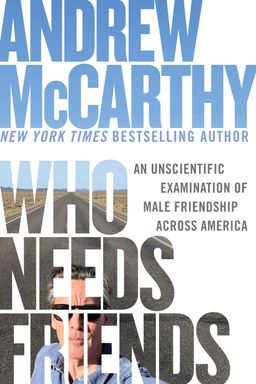
Who Needs Friends cover

Who Needs Friends

by Andrew Mccarthy

The actor and travel writer charts his journey across the country and his conversations with men about their male friendships.

When Friendship Turns Into A Weapon

What happens when the people who once knew you best become the biggest threat to your future? In With Friends Like These, Keri Beevis argues that the most dangerous crucibles aren’t back alleys or battlefields but intimate circles where old loyalties, buried grievances, and split-second decisions combine under pressure. Beevis contends that the line between loyalty and self-preservation is razor-thin—crossed not by monsters but by ordinary people who rationalize one small compromise after another until they’re in freefall.

At a windswept Scottish Airbnb, six former university friends reunite: Griffin (the domineering planner), Amelia (the principled ex-fiancée), Jonah (the loyalist with long-suppressed feelings), Ross (the underestimated outsider), Nancy (the witty hustler in debt), and Billy (the loveable screw-up). When Billy—drunk and exhausted—hits a pedestrian on a dark forest road, the group faces an impossible choice: call the police and ruin a friend’s life or cover it up and try to move on. They choose the latter. The apparent victim, Dougie McCool, carries a rucksack stuffed with cash, a mask, and a menacing knife—hints that he’s “not a good guy.” The decision to hide him in the loch feels, to them, less like a crime and more like tidying away something unlucky and unfair.

What Unravels When You Vote For Compromise

Griffin corrals the group into voting on each big decision, transforming morality into a procedural game: take the phones, hide the body, split the money, keep the story straight. It looks like democracy but functions as domination. The cover-up escalates quickly—moving a body, staging a disposal at dawn, burying a rucksack of cash in the floorboards—because one compromise always needs another to survive. When Dougie’s brother Kenny arrives with two accomplices, the truth isn’t the only thing on trial; so is the group’s cohesion. Kenny dangles threats, counts to ten outside the door, and cracks their loyalty by aiming at their soft spots: their debts, their resentments, their love lives.

Pressure Tests Everyone’s Real Priorities

Amelia wants to call the police but yields to the vote, then watches in horror as democracy curdles into coercion (Griffin even confiscates her phone and calls her by the hated nickname “Mils” to put her back in an old box). Jonah loves her quietly and tries to do the decent thing; he’s the one who later risks everything, armed and handcuffed, to stop the thugs. Ross—long patronized by Griffin—harbors a secret that will change everything: he hired Dougie to stage a fake home invasion to finally scare Griffin, then panicked. Nancy, deep in debt, makes a desperate bid to improve her lot, hiding the cash in a papier-mâché sculpture she made of Griffin’s head. And Billy, out of his depth, keeps acting on instinct: pulling the body into his car, vomiting on the stoop, later bolting for the woods.

Why This Matters To You

You may never face a literal body in the road, but you will face smaller versions: a colleague who fudges numbers, a friend who asks you to keep a confidence that endangers others, a partner who wants you to ignore your conscience “for the team.” Beevis’s thriller doubles as a cautionary lab report on group ethics: how leaders frame choices, how votes bury dissent, how emergencies justify almost anything, and how the cost compound when you select the “least bad” option repeatedly. The book shows how small rationalizations lead to big tragedies—and how the most dangerous person in the room is often the one who truly believes they’re in the right.

What You’ll Take Away From This Summary

You’ll see how incrementalism turns good people into accomplices; how personality fault lines (envy, pride, secrecy, need) become levers in a crisis; and how control masquerading as process (votes, safes, rules) isolates better angels. We’ll follow Griffin’s slow-motion self-destruction; Billy’s survival-at-all-costs spiral; Amelia and Jonah’s quiet courage; Ross’s hunger for dignity; and Nancy’s risky improvisations. Then we’ll examine the invaders—Kenny, Nigel, and Greg—who weaponize fear to fracture trust, only to be undone by their own incompetence and greed. Finally, we’ll weigh the book’s chilling moral: when truth is deferred, fate returns with interest. (Think the claustrophobic ethics of Ruth Ware’s In a Dark, Dark Wood, the group psychology of Liane Moriarty’s Big Little Lies, and the incremental rot of Gillian Flynn’s Gone Girl.)


The Slippery Slope Of Small Compromises

Beevis maps a familiar yet terrifying progression: one tiny moral compromise logically demands another, until you can’t even see the original line you crossed. The friends don’t decide to “commit a crime.” They decide to help Billy “not ruin his life” by driving a dying man to the hospital. Then to avoid police questions, they decide to dump a body in a loch at dawn. Then, with a rucksack of cash winking in the corner, they decide to vote on keeping it “until they figure things out.” Each step sets up the next, because lies have maintenance costs; secrecy is hungry work.

How A Vote Becomes A Weapon

Griffin’s insistence on votes (“We’re all in this together, so we all need a say”) creates the illusion of fairness while isolating dissenters. When Amelia objects to hiding the body, she’s outvoted. When she objects to confiscating everyone’s phones, she’s overruled again—only this time Griffin frames it as “protection” for the group. The safe’s six-digit code, split between Amelia and Nancy, looks like a check-and-balance, but it functions like a trap: their last lifeline (communication) is cut. (Note the echo of Jonestown-style groupthink described in social psychology texts by Irving Janis.)

The Rationalizations You’ll Recognize

You hear the classics: It was an accident; he looked like bad news; we’ll just do this until morning; we can’t ruin Billy’s life; we’ll be suspects if we call now; we need to stick together. Every phrase prioritizes near-term relief over long-term risk, as if the present moment, with its pounding heart and sweaty palms, defines what’s real. The rucksack of money from Dougie—bulging wads of £50 notes, a Halloween mask, a serious knife—makes them feel less like villains and more like cleaners. “He’s a criminal,” they imply. “Maybe we’re helping society.” (Compare the cognitive dissonance in Patricia Highsmith’s Ripley novels.)

Escalation: When A Mess Needs A Manager

Griffin steps into the role. He allocates tasks (ropes, plastic sheeting, boats), times the disposal at first light, and turns the loch’s serenity into an accomplice. When a local PC (Murray) knocks late at night looking for a missing dog, Griffin improvises a sex-in-the-garage cover story. His control calms the group, but it’s counterfeit safety: they’re toddlers placated with a bedtime routine as the house smolders. In fact, every “organized” step increases their dependence on him—and their distance from the truth.

Why You’re Vulnerable To This Too

When a charismatic person reframes decisions as practical logistics, you feel competent while sliding downhill. In your life, this might look like fudging a line item “for now,” running a personal errand on the company card “just this once,” or keeping a client risk “quiet” until quarter-end. The book’s core warning is operational: the first small compromise writes the sequel. To stop the series, you have to interrupt the story earlier than feels fair or necessary.

Key Idea

Compromises don’t add—they cascade. If you can’t explain today’s action out loud to an honest friend, you’re probably setting up tomorrow’s emergency.

By the time the group reaches the loch, their story has rewritten itself: they aren’t morally cornered, they’re committed project managers. You sense how easily anyone could end up in their shoes—not because you’d ever choose evil, but because you’d choose “not yet.”


Griffin: Control, Vanity, And A Long Fall

If this were a Greek tragedy, Griffin King would be the protagonist whose strengths doom him. He’s handsome, organized, decisive, and deadly certain he’s owed a neat life. Those are the very traits that seduce his friends into following him and that later drive him to cruelty. Beevis paints him not as a cartoon villain but as a narcissist in workout gear: a personal trainer who prefers choreography to consequence, votes to values, and performance to intimacy.

The Ex-Fiancé Who Never Let Go

Years before, Amelia broke off their engagement, partially after a single, explosive kiss with Jonah made her see the void in her relationship with Griffin. He never forgave her. He rehearses control through petty humiliations: calling her “Mils,” pocketing her phone “for safety,” flaunting a mix DVD labeled for her (then revealing it’s a sex DVD—recorded without her consent—from their past). He even appears to have stolen a ring she once thought lost. What looks like leadership is revenge theater. (You’ll recognize shades of Tom Ripley’s entitlement or the manipulative charisma in Tana French’s antagonists.)

Inventing A Democracy He Can Win

Griffin turns fear into a process: motions, votes, safes, shifts. He’s “fair” until fairness gets in the way. When Ross loses his fob in the loch, Griffin ridicules him; when Billy whines, Griffin weaponizes shame; when Amelia argues, he invokes the group. His obsession with containment escalates into cruelty, culminating in a sick game staged by Kenny where Griffin is willing to swap Amelia into the torture chair to save himself. You see the rot clearly: it’s not fear speaking; it’s entitlement.

The Vanity That Sinks Him

Out on the loch later—gun leveled by Kenny—Griffin is ordered to swim down to where he and the others weighted Dougie’s body. He can’t. He never learned to swim. The controller who always stayed on deck is now in the water, flailing. He’s shoved overboard and drowns, a perfect, awful image: a man who played at mastery until reality called his bluff. (It’s the thematic inverse of those competent-but-flawed leaders in Harlan Coben’s thrillers who endure by adapting; Griffin can only escalate.)

Why This Archetype Matters To You

You’ve met a Griffin: someone who runs “fair processes” that always end up in their favor, who frames care as control (“Give me your phone for your protection”), who records intimacy as leverage, who confuses humiliation with leadership. Beevis doesn’t just punish Griffin; she shows how his style infects groups. By the end, he’s the only one without even the possibility of redemption—not because he sinned most, but because he could never say “I was wrong.”

Key Idea

Beware the friend who makes “together” a trap. Control dressed as care is still control—and it breeds the very disasters it claims to prevent.


Fault Lines: Secrets Fuel The Fire

The cover-up doesn’t break the group; the group’s preexisting cracks break the cover-up. Beevis layers the ensemble with combustible secrets that feel painfully plausible. Those secrets aren’t evil; they’re human: envy, fear, pride, need. In the closed circle of the Airbnb, they become accelerants.

Ross: Outsider With A Score To Settle

Ross is smart, successful, and perpetually minimized. Years ago, Griffin switched off his phone while Ross was helping him with coursework; Ross missed the final call from his dying brother, Tim. Griffin didn’t apologize—he explained. Ross never healed. So he quietly hires Dougie to stage a fake break-in during the weekend to finally shake Griffin’s power. Then Billy kills Dougie by accident; Ross panics, steals Dougie’s phone, drops it in the loch; later, when Kenny applies pressure, Ross cracks, confesses, and—fatally for Griffin—pins the loch burial on him. Ross isn’t simply “the liar.” He’s the canary who’s been choking for years.

Nancy: Debt, Talent, And A Risky Grab

Nancy’s papier-mâché heads are brilliant; her bank account is not. She sees the rucksack and calculates salvation. She hides most of the cash inside the hollow base of a large caricature sculpture she made of Griffin—plan A: keep it; plan B: blackmail Billy if needed. Her plan implodes when Greg lights the sculpture in the fireplace; the hidden cash burns with it. It’s grimly comic and thematically precise: the “idol” of Griffin quite literally consuming the group’s stolen future. (The image recalls Symbolist motifs in literary noir where objects hold fates—think the Maltese Falcon.)

Billy: The Panicked Survivor

Billy always thinks in the next ten minutes. He drinks too much, hits a man, pukes on the stoop, runs for the window, lies under pressure, and ultimately swims for shore while Griffin drowns. He’s not evil; he’s reactive. His last act is tragic irony: stumbling shoeless onto the country road, waving down help, he’s struck and killed by the very first police car racing to the scene—another “accident” he hoped to outrun.

Amelia & Jonah: A True North Under Siege

Amelia and Jonah aren’t perfect (they stay, they vote, they collude), but they consistently try to de-escalate. Jonah risks his life twice—first to confront the gunmen with a shotgun after freeing himself from handcuffs, later to drag Amelia and Ross from a house fire when Greg’s bonfire gets out of control. Amelia resists Griffin’s mind games, argues for the ambulance, faces down Kenny, and, when forced to “choose” whose life to save, chooses Jonah—then has to live with the cost of that declaration in front of Griffin. Their throughline is simple: when in doubt, help the person in front of you.

Why This Matters To You

Your group’s stress test won’t look like this weekend, but the dynamics will rhyme. Who feels unseen, and where are they already making side plans? Who needs money or recognition so badly they’ll take a reckless bet? Who will bolt when the window opens? Understanding those patterns before the crisis is the only way to avoid the novel’s calculus when it arrives.


Predators, Incompetence, And The Hostage Spiral

Enter Kenny McCool and his two hired thugs, Nigel and Greg: predators who shouldn’t be underestimated—and yet keep proving they’re not criminal masterminds. Their arrival transforms a moral thriller into a siege. Kenny wants two things: his brother and his money. He uses classic coercion: demand, countdown, visible guns, and personal humiliation (he literally shaves Amelia’s power by hacking off her hair; he uses a plastic bag to suffocate her until Ross confesses). He’s part interrogator, part ringmaster.

How They Split The Group

Kenny asks questions he already knows the answer to. He repeats details Ross recognizes (the tracker on Dougie’s phone showed his last signal at the house), which means at least one member of the group has been lying. Then he plays a cruel game: “Mils, choose—save Jonah or Griffin.” It’s not about choice; it’s about exposure. Protecting Jonah brands her a traitor to Griffin. The room fractures along visible lines. (Hostage negotiation manuals warn: divide the hostages from one another; this scene reads like a dramatized case study.)

Incompetence As A Narrative Lever

PC Murray—called to the house the night before on a missing-dog call—returns, stumbles onto spikes the gang laid across the drive, and is later shot in the gut by the jittery Greg. It’s a bleak joke: the officer who should be the cavalry becomes another victim. But ineptitude goes both ways. Greg burns the hidden cash by lighting Nancy’s sculpture in the fireplace. He also trips over Nancy’s body while fleeing the fire, then is knocked out by the wounded Murray with a rock. Nigel and Kenny end up stranded on the loch because neither can swim and they’ve lost an oar. Their menace is real; their competence is not. That gap gives Jonah a thin opening, which he exploits to free Amelia and Ross from the burning house.

Fire As The Great Revealer

The fire scene is the book’s pressure-cooker climax. Greg sets a blaze to mock Griffin’s likeness—then realizes, too late, the base is packed with money. Smoke pours through the room; Ross, nearly blind without glasses, collapses; Amelia is tied to a chair. Jonah works the ropes by feel, snaps the chair, and drags them both into the hall past Nancy’s body and the slumped Murray. Outside, three truths flare at once: cash, like secrets, is combustible; incompetence cascades as fast as compromises; and the person you want next to you is the one who runs into the fire.

What You Learn About Threats

The book recalibrates menace. It’s not the most violent person you have to fear; it’s the person who can make you decide against yourself. Kenny wins not with bullets but with binaries; Greg’s damage comes from stupidity; Nigel’s from obedience. Meanwhile, Jonah, with fewer resources, wins by refusing their frame—finding any third option (a shotgun, a cupboard key, a path through smoke).


Guilt, Blame, And The Price Of Survival

By the end, everyone has blood on their hands—some literal, some moral. The novel rejects clean categories. Who killed Nancy? Technically, her fall down the stairs; effectively, Billy’s shove during a panic after she tried to blackmail him. Who killed Dougie? Billy’s car; the group’s decisions kept him dead. Who killed Griffin? Kenny’s shove; Griffin’s lifelong allergy to accountability. Who killed the truth? All of them, in stages.

The Final Story They Tell

When the authorities finally arrive, Amelia, Jonah, and Ross hew closely to the truth while sliding the hardest edges onto the dead: Billy was driving drunk and hit Dougie; Griffin forced the cover-up and disposal; the rest of them objected but were overruled. It’s not fully fair (they voted too), and it’s not fully false (Griffin did dominate). The moral math is brutal: sometimes the best you can do is draw a line before the next lie. The living choose survival and, in doing so, accept living with a half-clean conscience. (Ruth Ware’s The Lying Game explores a similar dynamic—how a single youthful lie ripples through adult lives.)

Justice, Such As It Is

Kenny, Nigel, and Greg are arrested (the burnt cash and wounded officer make conviction likely). Dougie and Griffin’s bodies are recovered from the loch. Billy, the tragic jester, dies under police wheels while flagging help. Nancy’s death stings the most; she wanted a future more than anyone and picked the most dangerous route toward it. PC Murray, stubborn and kind, lives—just barely—and gets the final brave moment, braining Greg with a rock while bleeding out on the patio.

Your Takeaway About Blame

We prefer neat boxes: heroes, villains, cowards. Beevis denies you that comfort. You’re left with choices you can imagine making: staying quiet for a friend, going along with a vote you hate, pocketing a phone “just in case,” hiding a bag of money where no one will look. The costs are cumulative and, often, paid by the person who least deserves it. The question you leave with isn’t “Who’s worst?” but “Where would I have stopped?”

Key Idea

Survival isn’t the opposite of integrity. But if you choose it at integrity’s expense, be prepared to live with a story that always starts mid-sentence.


Place As Character: The Loch & The House

Beevis uses setting not as wallpaper but as accomplice. The remote loch, the winding forest lanes, the wood-planked garage, the open-plan kitchen—each space is built to do narrative work. You feel how isolation, logistics, and aesthetics become plot engines and moral mirrors.

The Loch: Beauty That Erases

At dawn, the golden-pink sky makes their crime feel small. The oars creak; the water laps; breath fogs. It’s tranquil—“central casting” for a spa ad—until Griffin orders the body and weighted stove pushed overboard in a choreographed drop. The loch becomes a character that eats evidence, a mirror that refuses to reflect. When Kenny later maroons himself there (unable to swim), the loch turns punisher. It’s not mystical; it’s practical. Water keeps secrets until it doesn’t.

The House: Open Plan, Closed Options

Airy rooms—with sightlines that seem liberating—turn out to be hard to defend. The kitchen/living-room flow makes it easy for Kenny to stage-manage everyone: sit on the sofa; watch the chair; look at the screen. The downstairs cloakroom becomes critical space multiple times: hiding Jonah in the cupboard; stashing a wounded PC Murray; dragging a body out of the hallway. The garage is a crime-scene staging bay; the decking is a false promise of relaxed mornings with coffee; the fireplace hostages everyone when it’s set alight.

The Road: Spine Of Fate

Everything bad begins and ends on the one-lane roads. Billy hits Dougie on a blind curve to the Airbnb. Later, Billy’s final bid for rescue ends with him lit by headlights and struck down. Spikes across the drive both trap and injure. The road confers power on whoever controls passage—and whoever doesn’t.

Why This Matters When You Read Thrillers

When a thriller’s place works, you don’t just “see” it; you feel how it dictates choices. (Compare the ski-chalet claustrophobia in Sarah Pearse’s The Sanatorium.) Here, the loch and house co-author the plot. If you want to avoid the group’s fate in your life, notice the “settings” that shape your decisions—boardrooms that pressure silence, messaging platforms that breed secret side channels, workflows that reward “get it done” over “get it right.” The room you’re in writes the options you see.

Dig Deeper

Get personalized prompts to apply these lessons to your life and deepen your understanding.

Go Deeper

Get the Full Experience

Download Insight Books for AI-powered reflections, quizzes, and more.