
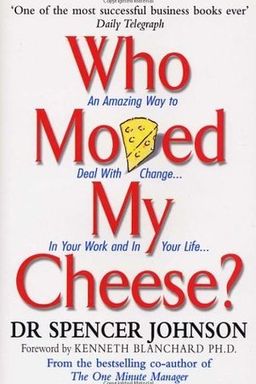
Who Moved My Cheese cover

Who Moved My Cheese

by Dr Spencer Johnson

In ''Who Moved My Cheese,'' Dr. Spencer Johnson uses a modern parable to impart valuable lessons on managing change. Through the journey of two mice and two little people, readers learn to embrace change as a positive force, preparing them to navigate life''s challenges with confidence and adaptability.

Adapting to Change in Life and Work

Have you ever felt lost when something you depended on—your job, your relationship, your comfort zone—suddenly vanished? In Dr. Spencer Johnson’s Who Moved My Cheese?, this exact panic is captured through a simple yet powerful parable about four characters whose beloved “Cheese” disappears. Johnson argues that our success and happiness depend not on our ability to find stability, but on how quickly and willingly we adapt to change. He contends that life’s “Cheese” will always be moved—opportunities shift, careers evolve, relationships end—and that our wellbeing hinges on whether we resist or move with those changes.

At its heart, the book is a guide to navigating life’s inevitable transformations. Through the adventures of Sniff, Scurry, Hem, and Haw—two mice and two “littlepeople”—Johnson reveals how different responses to change lead either to fear and stagnation or growth and fulfillment. The “Maze” represents the environment in which we seek our Cheese, whether that’s work, love, money, or meaning. This metaphor simplifies what many management theorists (like Peter Drucker or Stephen Covey) explored more extensively: that adaptability, not attachment, is the skill of the future.

The Cheese and the Maze: Life’s Ever-Shifting Landscape

Cheese, in Johnson’s story, symbolizes whatever you value most—security, success, or happiness. The Maze represents life’s complex system of challenges and opportunities. Every day, the four characters journey into this Maze in search of Cheese, but when it disappears one day from Cheese Station C, their reactions differ dramatically. The mice, Sniff and Scurry, immediately move on. The littlepeople, Hem and Haw, become paralyzed by denial and fear. This divergence forms the book’s central metaphor for how humans deal with change.

While Sniff and Scurry trust their instincts—they sniff out change and scurry into action—Hem and Haw overthink, complain, and wait for the past to return. Johnson’s point is elegant: intelligence can be both a blessing and a curse. Our ability to reason often traps us in rationalizations (“This shouldn’t have happened” or “It’s unfair”), blinding us to the reality that change is constant. In contrast, those who simplify, observe early signs, and act quickly adapt more effectively.

The Emotional Journey of Change

Johnson structures the story as an emotional evolution: from shock and denial to fear, acceptance, and finally joy. Hem remains stuck in the first stage, refusing to move until conditions revert. Haw, however, undergoes transformation. He laughs at his own stubbornness, confronts his fears, and ventures into the unknown Maze. As he writes lessons (“The handwriting on the wall”), we see his internal shift—each phrase reflecting a mindset change: letting go, anticipating change, and savoring the adventure of adaptation. His graffiti of insights—“Move with the Cheese,” “What would you do if you weren’t afraid?”—functions as both personal mantras and universal lessons.

This emotional journey mirrors real human transitions. As psychologist William Bridges describes in Transitions, change involves three stages: an ending, the neutral zone, and a new beginning. Haw’s story encapsulates this: he mourns the lost Cheese, gets lost in confusion, and finally discovers New Cheese and renewed confidence. Johnson’s narrative resonates because it anthropomorphizes our internal dialogue—our fear of loss and our longing for comfort—even as life demands reinvention.

Why This Story Matters Today

At first glance, Who Moved My Cheese? seems like a fable for corporate training rooms. Yet its simplicity masks a universal truth: change is relentless. In a world of technological disruption, shifting economies, and personal reinvention, Johnson’s metaphor is more relevant than ever. The book’s power lies in its accessibility—you don’t need a business degree to understand that waiting for “Old Cheese” to return is futile. The story pushes readers to ask uncomfortable yet transformative questions: What am I holding on to? What am I afraid of? What new opportunities lie beyond my fears?

Ken Blanchard, Johnson’s collaborator on The One Minute Manager, underscores this in his foreword: individuals and companies succeed only when they embrace flexibility. The book’s simplicity allows it to travel from boardrooms to bedrooms—saving careers, marriages, and self-esteem. When NBC broadcaster Charlie Jones was reassigned to cover new sports, he initially resisted. After reading Johnson’s story, he reframed the change as “moving Cheese,” embraced the challenge, and found renewed purpose. His career flourished because he changed his attitude faster than his circumstances.

The Structure: From Story to Self-Reflection

Johnson’s narrative unfolds in three parts: a group of former classmates discussing how change impacts their lives (“A Gathering”), the parable itself, and a reflective discussion afterward. This framing device transforms the story from a moral lesson into a dialogue. Readers are invited to see themselves in Sniff, Scurry, Hem, or Haw and to discuss how they respond to change. The book’s conversational format encourages ownership—you find your own “Maze,” identify your “Old Cheese,” and decide whether to wait or to move.

Ultimately, Johnson’s message is that life rewards curiosity, courage, and humor. Clinging to old ways ensures decline, but those who watch, anticipate, and adapt will not only survive change—they’ll thrive in it. The biggest shifts begin within: by questioning fears and embracing the movement of the Cheese. As Haw learns, once you move beyond your fear, you feel free.


Meet the Four Cheese Hunters

The heart of Who Moved My Cheese? lies in its four simple characters—Sniff, Scurry, Hem, and Haw. Each represents a different attitude toward change, giving readers an easy way to recognize their own behavioral patterns. While their situation is fictional, the way they respond to loss mirrors very real human reactions.

Sniff and Scurry: Instinct Over Analysis

Sniff and Scurry are the story’s pragmatic heroes. They don’t overthink; they observe, adapt, and act. When the Cheese disappears, they don’t waste a moment complaining. Instead, they put their running shoes back on and plunge into the Maze. Their behavior embodies a philosophy summed up by Johnson: Keep things simple. Notice changes early. Move with the Cheese. This attitude reflects the principle of “fail fast” common in modern innovation circles (a concept popularized by Eric Ries in The Lean Startup).

By trusting their instincts, Sniff and Scurry demonstrate that adaptation doesn’t require intelligence—it requires awareness. They teach us that change is not an enemy, but a signal that it’s time to move forward. Their reward is not just finding new Cheese, but avoiding the emotional paralysis that traps others.

Hem: The Stubborn Resistor

Hem symbolizes the part of us that fears change so deeply that we become immobilized by it. When the Cheese is gone, Hem refuses to believe it. He insists, “Who moved my Cheese?” and demands that things return to normal. His sense of entitlement and denial leads to suffering—he remains hungry, weak, and bitter because he won’t explore other options.

Hem’s mindset reflects a truth about many organizations and individuals: the more invested we are in the past, the harder it is to see the future. Johnson uses Hem to illustrate that comfort and security can become prisons. Like many “Hems” in real life, he confuses stability with safety, failing to realize that refusing to move can be the riskiest move of all.

Haw: The Learner and Adapter

Haw is the character who changes—and through his transformation, readers see the book’s moral unfold. At first, Haw is almost as resistant as Hem. But hunger and curiosity eventually drive him to act. When he laughs at his own stubbornness, fear dissolves, and he begins his journey through the Maze. Along the way, he writes lessons on the wall—“What would you do if you weren’t afraid?”—to remember and share what he’s learning.

Haw’s willingness to reflect, experiment, and move despite uncertainty makes him the story’s role model. He symbolizes resilience—the capacity to bend without breaking. Through him, Johnson shows that courage doesn’t mean having no fear; it means acting despite it.

Which Character Are You?

Johnson closes the book with a discussion among former classmates who relate the story to their own lives. This framing invites readers to ask themselves: Do I act like Sniff, sensing change early? Like Scurry, who reacts quickly? Like Hem, who denies it? Or like Haw, who learns and moves forward?

Most of us are a mix. In one part of life, we may be a Sniff or Scurry—quick to adapt to new technology or trends—but in relationships or habits, we might be Hem, clinging to what’s familiar. The key is not to label ourselves, but to evolve. The more we practice Haw’s approach—observing, laughing, and moving—the easier it becomes to adapt when our own Cheese moves.


The Handwriting on the Wall

One of the book’s most memorable devices is “The Handwriting on the Wall”—a series of simple lessons Haw writes as he journeys through the Maze. These serve as road signs for navigating change. They distill the book’s philosophy into actionable insights that can be applied to work, relationships, or personal growth.

1. Change Happens – They Keep Moving the Cheese

The first truth Johnson sets out is that change is constant. Whether you like it or not, “they” (life, circumstances, markets) keep moving the Cheese. Accepting this prevents you from being blindsided. Many lose their footing when change strikes because they assume stability is permanent. In reality, the only constant is motion.

2. Anticipate Change – Get Ready for the Cheese to Move

Haw learns to “sniff the Cheese often so you know when it’s getting old.” This means staying alert to small shifts before they become crises. Businesses that adapt—like Netflix noticing DVD decline early—embody this principle. Individuals who pay attention to trends in their careers or health can pivot before they hit a wall.

3. Adapt Quickly – The Sooner You Let Go, the Sooner You Move

The longer Haw clings to the hope of recovering his Old Cheese, the more he suffers. Freedom arrives the moment he lets go. This resonates with Stoic philosophy: suffering comes not from events, but from our attachment to them. Once you stop wishing for the past to return, you can step into what’s next.

4. Move with the Cheese – Enjoy the Change!

Eventually, Haw realizes that change isn’t just something to survive—it can be joyful. The act of moving through the unknown becomes invigorating, not paralyzing. This mindset transforms fear into curiosity. When you stop resisting and start exploring, each twist in the Maze feels like discovery rather than loss.

5. Be Ready to Change Quickly and Enjoy It Again

Finally, Johnson reminds us that success doesn’t end the story. Even at Cheese Station N, Haw continues inspecting his Cheese daily, knowing it could move again. Complacency is the silent killer of progress. True adaptability is not a one-time choice—it’s a daily practice of openness.

“The Handwriting on the Wall” functions like a minimalist manifesto, much like Don Miguel Ruiz’s Four Agreements: short, memorable, and universally relevant. It’s not about mastering complexity, but returning to simple truths. When embraced, they make change feel less like chaos and more like rhythm.


Overcoming Fear to Find New Cheese

If there’s one emotion that keeps people stuck when the Cheese moves, it’s fear. Haw’s journey through the Maze is really about conquering the invisible walls built by anxiety, doubt, and regret. Dr. Johnson uses fear not as a villain, but as a mirror—showing how much power we surrender to imagined threats.

The Power of Questioning Fear

At one of his lowest moments, Haw writes the question: “What would you do if you weren’t afraid?” This question alters everything. It shifts him from a victim mindset to a creative one. Instead of focusing on what might go wrong, he begins to envision what could go right. This mirrors cognitive reframing techniques used in modern psychology, where changing the way you interpret fear changes your behavior.

Action Diminishes Anxiety

Once Haw steps into the Maze, he learns that fear shrinks with movement. Each small success—finding crumbs of Cheese, remembering how to navigate—builds confidence. By acting first, he discovers that the imagined dangers of change were far worse than reality. As he writes later, “When you move beyond your fear, you feel free.”

Laughter as Liberation

Johnson emphasizes humor as a stress antidote. Haw laughs at his own stubbornness, realizing how silly it is to expect the world to stay the same. This laughter breaks the emotional ice that kept him frozen. In change management theory (as discussed by authors like John Kotter), humor plays a similar role in easing organizational transitions—it lowers defenses and opens space for imagination.

By facing, questioning, and laughing at his fears, Haw doesn’t just find new Cheese—he finds a freer version of himself. The message is timeless: Your fears are rarely fatal, but staying still often is.


Anticipation and Awareness

Johnson stresses that the smartest response to change is not reaction—it’s anticipation. Sniff and Scurry succeed not because they’re brilliant, but because they stay alert. They notice subtle signs that the Cheese supply is shrinking, while Hem and Haw sleep through the warning signals. Their vigilance shows that adaptation starts long before crisis hits.

Seeing the Signs

In real life, this means observing trends before they become emergencies. Whether it’s the shift in job markets, deterioration in a relationship, or early fatigue in personal health, the key is awareness. The sooner you notice that the Cheese is “getting old,” the more time you have to explore new paths. Ignorance, in contrast, compounds shock and deepens loss.

Why Change Feels Sudden

Haw later realizes that the Cheese hadn’t vanished overnight—it had been depleting slowly. The signs were always there, but he wasn’t paying attention. This is a common human illusion: we mistake gradual change for sudden catastrophe only because we weren’t watching. Johnson’s advice, “Smell the Cheese often,” is a metaphor for staying in tune with reality. Awareness doesn’t stop change; it makes it less painful.

Those who thrive are not those who predict the future perfectly, but those who notice early signals and pivot gracefully. As Haw discovers, anticipation transforms anxiety into advantage.


Moving With the Cheese: Embracing Adventure

By the end of his journey, Haw realizes that change, once feared, can become an adventure. When he discovers New Cheese at Cheese Station N, he is not only nourished but liberated. He no longer craves security because he understands flow—the ability to move effortlessly with life’s shifts.

Savoring the Adventure

Johnson’s most optimistic insight is that joy lies not in finding Cheese but in exploring the Maze. The chase itself—the learning, the adjusting, the curiosity—is what gives life energy. Haw finds happiness even before finding New Cheese because he is finally living with purpose again.

Renewal and Reinvention

When Haw rejoins Sniff and Scurry at the new Cheese Station, he vows to keep his shoes ready and to stay alert. He visits the Maze regularly, not from anxiety but from a sense of exploration. His behavior mirrors the concept of “continuous reinvention” found in modern leadership thinking—never assume success is permanent, and never fear entering uncharted corridors.

By savoring the journey, Haw transforms change from something imposed to something enjoyed. The Maze, once a source of fear, becomes a playground for personal evolution.


Applying the Cheese Story to Real Life

Johnson concludes his book with a realistic discussion—former classmates relate the story to careers, relationships, and family life. This meta-conversation bridges fiction and function. They illustrate how a simple moral fable can catalyze self-awareness and organizational reform.

Workplace Change

In companies, fear of change often drives resistance. As Michael recounts, when his business embraced the Cheese story, it gave employees a shared language for adaptation. Instead of complaining, they began saying, “They moved our Cheese. Let’s find the new one.” This linguistic shift eased transitions and reduced defensiveness—a prime example of culture change through storytelling.

Even layoffs, though painful, became reframed as opportunities. Those who lost jobs used the Cheese metaphor to recast their search as a quest for “New Cheese.” Many eventually found better positions, proving that mindset determines outcome more than circumstance.

Relationships and Personal Growth

For others, the story reveals emotional truths. One classmate admits her relationship is “Old Cheese” that has turned moldy. Another realizes that the problem isn’t the partner but recurring old behaviors. These interpretations show that moving with the Cheese isn’t always about leaving—it can mean growing together differently.

Families also apply the lesson. When a mother shares the story with her children, they discuss who in the family acts like Hem or Haw. It opens conversation about resilience and flexibility—skills children need just as much as adults.

A Framework for the Future

Ultimately, Johnson’s simple fable operates like a mirror. It reflects where you are in your own Maze. Whether you’re confronting job loss, changing industries, or reevaluating personal goals, the Cheese principles remind you that joy lies in readiness, not resistance. In today’s unpredictable world—where “they keep moving the Cheese” faster than ever—the wisdom of Sniff, Scurry, Hem, and Haw remains an enduring compass.

Dig Deeper

Get personalized prompts to apply these lessons to your life and deepen your understanding.

Go Deeper

Get the Full Experience

Download Insight Books for AI-powered reflections, quizzes, and more.