
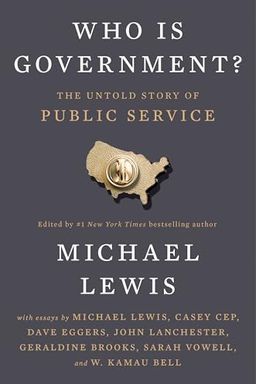
Who Is Government? cover

Who Is Government?

by Michael Lewis

Who Is Government? Real People, Real Stakes

When you picture “the government,” do you see distant buildings, acronyms, and politics—or working people who quietly keep you safe, informed, healthy, and remembered? In Who Is Government?, Michael Lewis (joined by Casey Cep, Dave Eggers, John Lanchester, Geraldine Brooks, Sarah Vowell, and W. Kamau Bell) argues that the real story of American power and purpose lives in its civil servants. The book’s central claim is deceptively simple: you can’t understand the country if you don’t understand the people who run it—those who manage nuclear stockpiles, design safer coal mines, reconcile our accounts with truth and statistics, and even mow the rows of national cemeteries with reverence and precision.

Lewis contends that media and politics have flattened “government” into a faceless villain or backdrop, while the hard, creative, often heroic work happens far from podiums and polls. The book invites you into that work through nine vivid profiles: a mine safety scientist who ends roof-fall deaths, a cemetery administrator who leads the most trusted service organization in America, a NASA cohort on the cusp of finding life on other worlds, a writer who lays bare how a single number (the CPI) shapes policy and perception, an IRS cyber sleuth taking down terrorists and child abusers, a National Archives innovator digitizing democracy, a first-year DOJ paralegal rediscovering antitrust as a civil-rights tool, and an FDA insider building a platform that—mid-crisis—helps save a child from a brain-eating amoeba.

What this book really argues

At bottom, Who Is Government? argues that institutions are only as strong as the people inside them—and that the American civil service, though maligned, still attracts builders, problem-solvers, and caretakers. These are characters who combine technical mastery with moral clarity. They believe in standards and iterating toward excellence (think Atul Gawande’s The Checklist Manifesto), but they also live by stories—case histories, field notes, and human outcomes that never make cable news.

Lewis also pushes a second, urgent claim: if we let political spectacle eclipse the work of bureaucrats, we will drift into a governance vacuum where truth becomes vibe, data becomes “fake,” and the best people go elsewhere. That’s not abstract. It costs lives (as when miners die or rare-disease cures go unknown), dollars (as when inflation myths drive bad choices), and dignity (as when veterans’ families can’t access services that already exist for them).

What you’ll see in these pages

You’ll meet Christopher Mark, a former coal miner turned federal scientist who used data and fieldwork to replace fatalism with engineering. He didn’t just write equations; he changed a culture—showing why technology without regulation doesn’t save lives, and how quiet, iterative work can reach “zero” fatalities in a domain once defined by tragedy.

You’ll spend time with Ron Walters at the National Cemetery Administration, whose team tops all U.S. organizations (public or private) in customer satisfaction. By codifying standards, measuring relentlessly, and training with care, Walters shows how excellence can be designed—and how equity can be lived (every veteran buried the same way, regardless of rank).

You’ll tour NASA’s Jet Propulsion Laboratory with Dave Eggers, where a team preparing the Roman Space Telescope makes starlight vanish to reveal exoplanets. The point isn’t just wonder; it’s that your tax dollars are the only force funding questions that have no billionaire ROI—like “Are we alone?” The book puts you at the table where coronagraphs duel with starshades and where Nancy Grace Roman—the “Mother of Hubble”—still mentors from history.

You’ll learn from John Lanchester that the CPI—the consumer price index—isn’t a conspiracy but a heroic, imperfect attempt to turn 340 million shopping carts into a single guide star. You’ll see how easily vibes devour facts and why abandoning shared data is a fast road out of the Enlightenment (recalling Hans Rosling’s Factfulness and Daniel Kahneman’s work on perception).

You’ll watch IRS special agent Jarod Koopman do jiu-jitsu on global crime—flipping child-exploitation rings, starving terrorist wallets, and forcing the world’s biggest crypto exchange to plead guilty. It’s not the TV story about “the taxman.” It’s about safeguarding children and the financial system when others won’t.

Sarah Vowell follows Pam Wright at the National Archives, where democracy is uploaded, tagged, and made searchable so your grandparents (and Ruth Asawa’s files) live in your phone. And W. Kamau Bell tracks a young DOJ paralegal, Olivia Rynberg-Going, to remind you that antitrust isn’t an abstraction; it’s why your phone calls got cheaper and why Ticketmaster can’t be the only way to hear live music.

Finally, you’ll see Heather Stone at the FDA build CURE ID—a global case-sharing tool for deadly rare diseases—and then, in real time, help a family find a lifesaving off-label drug for a brain-eating amoeba. The win shows the promise of public-interest platforms; the near-miss shows how thin the connective tissue still is.

Why this matters right now

This book arrives at a moment when cynicism about government is fashionable and “Schedule F”–style purges are floated as reforms. Lewis’s answer isn’t starry-eyed. It’s empirical. When you underfund inspections, more miners die. When you mock statistics, markets grow volatile. When you hide behind vibes, pathogens win. And when you invest in people and systems, astonishing, measurable things happen—like zero roof-fall deaths, a cemetery system with 97/100 customer trust, and a child at home who was supposed to die.

Big idea

If you want to know who we are as a nation, don’t start with politicians. Start with the people who turn science into safety, grief into service, data into decisions, and curiosity into discoveries. That’s who government is.

Read this book if you want to restore your sense of how much is still possible when competence meets care—and if you want to see how your life already depends on that marriage, every day.


The Canary in the Mine: Saving Miners

Michael Lewis introduces you to Christopher Mark, a Princeton-born former coal miner who chose a life inside the federal government to solve a lethal riddle: why mine roofs collapse. His career is a rebuke to the cliché that bureaucrats push paper. Mark spent decades in tunnels, instruments in hand, building models and rating systems that changed how engineers and regulators save lives underground.

From Princeton to the pit

Raised by a renowned engineering professor who decoded Gothic cathedrals (Robert Mark), Chris rebelled, skipped the Ivies, and went to work in a West Virginia mine. He loved the place—until he nearly died, twice. He went back to school (Penn State), focused on rock mechanics, and fixated on a problem professors waved away: the contradictory formulas for pillar design in longwall mining. “Which one is right?” he asked. The answer wasn’t in a blackboard proof; it was in the pattern of failures and the geology of each seam.

Turning “anecdotes” into science

Inside the U.S. Bureau of Mines (later MSHA and then Labor), Mark gathered data from hundreds of roof falls. He treated each failure like a baseball stat (think Moneyball meets rock strata), building a “stability factor” that estimated when pillars would hold or crumble. He adapted a simple field test—whacking roofs with ball-peen hammers—to classify rock mass strength, and he mapped dangerous horizontal stresses to plate tectonics: tunnels cut “against the grain” (north–south in West Virginia) failed more often.

Mark then wrote software that any engineer could use. He didn’t mandate a number; he offered a better way to see risk. Companies adopted it because downtime was expensive ($200/minute), and because his science worked in Alabama as well as Pittsburgh—once you adjusted for local geology.

Technology isn’t enough—culture changes safety

Roof bolts—“the most important lifesaving technology in mining”—arrived in the 1940s. Yet fatality rates got worse for two decades. Why? Companies installed the minimum viable bolts to maintain the same risk level and cut costs (classic moral hazard). Only when regulators got enforcement teeth in 1969 did deaths plummet. Mark’s later history, “The Road to Zero,” shows half the safety gains came from technology and knowledge—and half from rule-driven culture change.

The 2007 Crandall Canyon disaster proved the point. The operator ignored Mark’s math and approved dangerously thin pillars. Six miners and three rescuers died. Afterward, any deep-mine design faced Mark’s office. In 2016, for the first time in U.S. history, roof falls killed zero miners.

Lesson for you

New tech won’t save lives or money unless you pair it with standards, enforcement, and culture. If you manage risk (in medicine, aviation, software), build systems that turn scattered “stories” into pattern-recognition—and then update incentives so the safer choice wins by default. (See Atul Gawande’s The Checklist Manifesto.)

Why this matters beyond mines

Mark’s work shows what government does at its best: translate field data into standards, persuade industry with value, and enforce when necessary. It also exposes a myth you might carry—that the market alone optimizes safety. Often, the market optimizes short-term profits, unless rules and transparency ensure that the cost of cutting corners is higher than compliance.

You don’t have to swing a ball-peen hammer to use his method. If you run a hospital unit, a factory line, or a complex project, steal Mark’s playbook: classify the environment (what “rock mass” are you in?), model the stresses (where’s the hidden lateral pressure?), share a simple tool others will use, and keep iterating. That’s how nine-figure problems (and human lives) move from “unsolvable” to “solved.”


The Sentinel of Memory: Excellence by Design

If you think government can’t deliver world-class service, meet Ron Walters and the National Cemetery Administration. Walters oversees 155 national cemeteries and more than 140,000 burials a year—with a customer satisfaction score of 97/100, the best ever recorded by the American Customer Satisfaction Index (beating Costco and Apple). His mantra—“We only get one chance to get it right”—isn’t a slogan. It’s a system.

Standards, then empathy

Walters built a 40-page, color-coded playbook of standards and measures that govern everything from the millimeters a grave settles to restroom supplies and signage. He imported the Baldrige criteria and the PDCA (Plan-Do-Check-Act) cycle (echoing Toyota’s kaizen), and he created a training academy so directors and caretakers share one operating language. Chairs with the cemetery’s name? Blankets on cold days? Rifle squads if families want them? All standardized—and humane.

He also launched a national call center (so widows aren’t on hold) and pre-need eligibility (so families aren’t buried in paperwork while grieving). His team mapped veteran populations to expand access: new cemeteries in growing regions, columbarium-only sites in dense cities, land-acquisition authority to move at market speed. Today, 94% of veterans live within 75 miles of a veterans’ cemetery.

Equality, enacted daily

At a national cemetery, a seaman recruit and a four-star general receive the same honors. That’s not rhetoric; it’s moral architecture. Walters’ Veterans Legacy Memorial gives every interred veteran a digital page for photos, tributes, and memories (“my radio to heaven,” one widow called it). His Veterans Legacy Program funds schools to research untold stories—like Hmong American veterans or the U.S. Colored Troops in Mobile—bringing communities into the work of remembrance.

His favorite initiative might be the apprenticeship program for homeless veterans. Graduates learn grounds, equipment, and burial operations. Some relapse. Many stay. “Every day, I feel happy to come to work,” says Francisco Zappas, a 71-year-old Army veteran at Fort Bliss National Cemetery. The goal isn’t press releases. It’s dignity.

What you can copy

If you lead any service—clinic, campus, website—pair rigorous standards with rituals that honor people. Track what matters (response time, clarity, cleanliness). Sweat details. Create feedback loops. Teach your playbook. Then tell your people the work is sacred—and mean it.

Leadership without ego

Walters—boyish, nerdy, an adjunct professor by night—describes himself as an “intuitive” servant leader. He’s famous for “blue sheets” of follow-ups and a relentless politeness that lubricates hard tasks. Twice he’s stepped in as acting undersecretary across administrations. He even declined a civilian-burial waiver offered to honor his work: “I’m not a veteran. I don’t belong there. Serving here is honor enough.”

This is public service at its best. Not theatrics—results. Veterans Affairs Secretary Denis McDonough says the private sector could learn from the NCA. He’s right. And if you’ve ever felt far from your government, go walk a national cemetery. The rows say: your country remembers, carefully. And thanks to Walters’ system, it always will.


NASA’s Searchers: Public Science at Its Peak

Dave Eggers takes you inside NASA’s Jet Propulsion Laboratory (JPL), where teams are building tools to do something humans have wondered about for millennia: find life beyond Earth. The Nancy Grace Roman Space Telescope (launch no later than 2027) will carry a coronagraph that suppresses starlight so we can directly see exoplanets orbiting distant suns. If you’ve ever blocked a desk lamp with your hand to see what’s behind it, you already grasp the principle.

Why public dollars matter

“No billionaires will fund work like this,” Eggers writes, because there’s no profit in it. JPL, founded by Caltech engineers in 1936 and now a NASA center, built Explorer 1, Voyager 1 (now 15 billion miles away), Mars rovers, and parts of Hubble and Webb. The Roman coronagraph team is 75 strong—humble, precise, allergic to credit. Vanessa Bailey, one of the few astronomers to directly image an exoplanet, embodies that ethos: “I like feeling small,” she says. “It lessens the pressure to get everything right.”

Two paths to see other worlds

JPL’s coronagraph uses deformable mirrors—thousands of tiny pistons—to mimic the twinkle of a star and cancel it out. Nick Siegler, NASA’s exoplanet program technologist, also champions the Starshade: a football-field–sized, flower-shaped screen that flies tens of thousands of kilometers from a telescope, blocking a star with exquisite alignment. The Starshade is the most beautiful spaceship you’ll never see. Whether the future Habitable Worlds Observatory flies with a coronagraph or a Starshade, either could reveal atmospheres with water, oxygen, methane—the signatures of habitability.

Nancy Grace Roman—the “Mother of Hubble”—saw this coming in 1959. She argued for space-based telescopes to escape Earth’s distortion and imagined coronagraphs to find planets. Her life (and the naming of Roman) reminds you that institutions can seed genius for decades.

Inspiration is a deliverable

Siegler keeps a crayon drawing of an Apollo rocket from childhood. He says NASA is “in the inspiration business.” That’s not fluff. It’s a public good. Roman captures this: “existential humility,” Bailey calls it—the idea that knowing we’re not alone would be humbling in the most wonderful way.

For your life and work

Great teams pair precision craft with moral clarity. They argue about tools (coronagraph vs. Starshade) without ego. They explain complexity with simple metaphors (desk-lamp blocking). And they welcome uncertainty—not as failure but as the price of finding truth.

If anyone tells you government can’t do grand things, point them to JPL. When Roman flies, your tax dollars will aim a new eye at the cosmos. They might even answer the oldest human question. That’s a pretty good ROI.


The Number: CPI and the Fight for Facts

John Lanchester’s essay centers on a protagonist that isn’t a person but a number: the Consumer Price Index (CPI). It’s a reminder that a core job of democratic government is counting reality so we can govern ourselves. The CPI is how we measure inflation; it affects Social Security checks, tax brackets, contracts, and divorce settlements. It’s also misunderstood, manipulated, and, lately, maligned.

Counting is hard—and essential

Imagine calculating your personal inflation rate. Now do it for 340 million people. The Bureau of Labor Statistics (BLS) samples tens of thousands of prices—cheese, eggplant, dog groomers, tents—and weights them by a “basket” of typical spending. Shelter alone is 36.3% (including “owners’ equivalent rent,” an economist’s way of valuing housing for owners). Baskets are updated, substitutions modeled (C-CPI-U), and different populations tracked (CPI-W, CPI-E for elderly). It’s not perfect; it’s honest work in service of a shared truth.

Why vibes beat facts

Inflation fell from 9.1% (June 2022) to ~3% by mid-2024, yet many Americans believed it was rising. Why? Prices don’t go down when inflation slows; they just rise slower. And food-at-home costs (+28% over five years) punch you in the face daily. Meanwhile, political actors attack the CPI as “fake,” while the “misery index” (inflation + unemployment) no longer predicts elections. Data lose to stories. As Hans Rosling warned (Factfulness), our instincts mislead us unless we anchor to measurement.

A cautionary tale: elderly deaths from falls seemed to have skyrocketed—until analysts discovered a change in coding, not in tumbling seniors. Lesson: before you spin a narrative, check how the number is made. (Abraham Wald’s WWII bullet-holes-on-planes story belongs here, too: what you don’t see matters.)

The Enlightenment is at stake

Lanchester quotes Carl Sagan’s 1995 prophecy of a future where “awesome technological powers are in the hands of a very few” while citizens “clutch our crystals,” celebrating ignorance. The CPI is one bulwark against that future. Imperfect? Yes. Falsified? No. Abandoning shared numbers is abandoning the Enlightenment’s bet that we can reason together.

Practical takeaway

Treat official statistics as human-made tools: interrogate methods, understand limits, and resist conspiracies. When policies touch your wallet, ask how the numbers were built, not just how they feel. If you lead a team, create your own CPI: pick the few measures that capture your reality, document methods, and make them public.

In short: the CPI isn’t a perfect mirror; it’s a compass. You can argue where to steer—but only if you agree you’re reading the same instrument.


The IRS Cyber Sleuth: Flipping the Strong

Geraldine Brooks profiles Jarod Koopman, an IRS criminal investigator and Brazilian jiu-jitsu black belt who applies the same principle on and off the mat: use leverage to flip bigger opponents. Koopman’s unit has rescued children, seized hundreds of thousands of abuse images, disrupted terrorist financing, and returned more than $12 billion to victims and the U.S. Treasury. If “IRS” makes you think audits, this story rewires your brain.

Follow the money, fight the worst

Koopman’s team helped crack Silk Road, then exposed two corrupt agents who stole from it. They unraveled “Welcome to Video,” a child-abuse marketplace; the site operator’s coding slip (an IP address in the source) and the blockchain’s permanence let investigators rescue 23 children and prosecute 370 offenders (including two U.S. Homeland Security officers). When Hamas solicited bitcoin on X, the unit quietly took over the donation flows; visitors who clicked the logo got “rickrolled” to Rick Astley while funds went to the Victims of State Sponsored Terrorism Fund.

The Binance case showed the leverage play at scale. The world’s largest crypto exchange allegedly courted sanctioned users, laundered funds, and helped VIP U.S. customers evade rules. Lead agent Adam Rutkowski mined troves of cloud-service logs—down to help-desk calls—to tie identities to illicit transactions. Result: a $4.3 billion settlement, CEO Changpeng Zhao’s guilty plea and prison term, and a trove of records for future cases.

Reputation vs. reality

Even as they do this, IRS Criminal Investigation faces culture-war attacks and resource starvation. Staff had fallen to 1970s levels; Fox hosts warned of “armed IRS agents” hunting the middle class. Commissioner Danny Werfel spends as much time debunking myths as upgrading failed tech. Yet the ROI on cybercrime work is extraordinary—and the team’s tools now make crypto markets safer for law-abiding users, libertarians included.

How you can think like Koopman

When bad actors exploit “anonymity,” look for the invariant ledger (blockchain), the sloppy metadata (source code, cloud logs), and the chokepoints (exchanges). Then build partnerships—across agencies, borders, even with private analytics firms—to aggregate leverage. It’s jiu-jitsu for systems.

You may never cheer for the IRS. But after this chapter, you might root for these investigators. They don’t collect from you; they protect you from those who prey on the vulnerable and poison markets.


The Equalizer of Access: Digitizing Democracy

Sarah Vowell’s portrait of Pamela Wright, Chief Innovation Officer at the National Archives and Records Administration (NARA), is a love letter to the mundane labor that makes a republic work. Wright grew up on a Montana ranch on a party-line phone; now she wants every American, from Conrad to Guam, to have the nation’s records in their pocket.

From vaults to phones

NARA has more than 13 billion records; roughly 300 million are now online. Wright’s job is to make that number climb through partnerships (FamilySearch, Ancestry), volunteer power, and smarter tech. She launched the Citizen Archivist program (3+ million pages transcribed, 10+ million tags added), created the History Hub Q&A platform (where archivists and volunteers field 23,000+ questions), and led the 1950 Census digital release (with AI-assisted name recognition). She believes archives “should be in your pocket.”

NARA’s holdings are both exalted (the Constitution in bulletproof, humidity-controlled glass) and intimate (your grandfather’s WPA job listing, Ruth Asawa’s NEA memos, the Treaty of New Echota that forced Cherokee ancestors down the Trail of Tears). Digital access lets you meet both without flying to DC—and that changes who “owns” the record of America.

Scarcity mindset, inventive solutions

Wright runs NARA like a ranch: conserve water (money), reuse scraps (volunteers), and can your harvest (digitize) before winter (budgets). A $900 million need meets a $481 million allocation, so she finds allies—schools, tribes, hobbyists. The DigiTreaties project (with the Museum of Indian Arts & Culture) digitizes 374 ratified Indian treaties, searchable by tribe and map. The work is not just preservation; it’s equity.

Your action

Become a citizen archivist. If you can read cursive or love a rabbit hole, help transcribe or tag. Or take History Hub for a spin—ask why Ohioans married in Indiana or where those fruit flies from 1947 ended up. Knowledge is pleasure—and a public service.

Wright’s credo: “Help us protect the records.” It’s printed on NARA pencils for a reason. In an era of ahistorical hot takes, she’s building the infrastructure that lets you do the opposite: touch the facts, at scale.


The Rookie: Antitrust as Everyday Justice

W. Kamau Bell follows his goddaughter, Olivia Rynberg-Going, a paralegal in DOJ’s Antitrust Division, to show how a “wonky” field turns into everyday fairness. Olivia grew up the child of two moms who left Maine for Oakland so their Black daughter could grow up around Black people. For her, public service is personal: law should make families like hers safer and freer.

What antitrust is (and does)

The Sherman Act targets monopolization and conspiracies; the Clayton Act polices mergers; the FTC Act adds consumer-protection teeth. Kathy O’Neill, a veteran antitrust lawyer, calls competition “fundamental to the American ethos.” The classic proof is the DOJ’s early-1980s breakup of AT&T. Before the case, you rented your beige phone. After: rates fell, innovation exploded (cordless phones, modems, mobile), and yes, the Sports Illustrated football phone happened.

Today, the field aims at megaplatforms (Amazon), ticketing giants (Live Nation/Ticketmaster), tuna price-fixers, and pharmacy benefit managers. Stephen King testified against the Penguin Random House–Simon & Schuster merger: “You might as well say you’re going to have a husband and wife bidding against each other.” The point: without competition, consumers pay more and creators get less.

Pipelines and threats

Max Stier (Partnership for Public Service) started DOJ’s college paralegal pipeline in the 1990s. He worries about a federal workforce with only 7% under 30 and warns against politicizing the civil service (the ghost of “Schedule F”). Olivia loves DC’s Black excellence, but she’s candid: law school debt could steer her away from public interest work. If we want a fairer market, we need to make government careers viable for the talent we need most.

Fighting monopoly, case by case

Luke Thomas, an MMA analyst, explains the UFC wage-theft class actions: fighters allegedly captured only ~20% of revenues compared to ~50% in the NFL/NBA. A proposed $375 million settlement still awaits judicial approval; if unlawful monopoly is proven at trial, damages could triple. The insight holds across sectors: concentrated power tends to suppress wages, raise prices, and stunt innovation unless policed.

Why this matters to you

Antitrust is why your calls got cheaper, why one company shouldn’t set all the ticket fees, and why small sellers can still find buyers. If you want more innovation and fewer junk fees, you want strong, competent antitrust enforcement.

Olivia wanted civil rights work; she found it in competition law. That’s the book’s larger message: public service has more doors than you think. Open one.


The Free‑Living Fixer: A Rare-Disease Lifeline

Michael Lewis ends with a life-or-death case that shows government at its most human: Heather Stone at the FDA built CURE ID, a global platform where clinicians post real-world case reports about rare infectious diseases and off-label treatments. The goal: when randomized trials are impossible, stories can still save lives—if we can find them in time.

A brain-eating amoeba, a new hope

Balamuthia mandrillaris is a “free-living” amoeba that occasionally invades human brains. It’s almost universally fatal; the CDC’s drug “cocktail” is toxic and often ineffective. At UCSF, biochemist Joe DeRisi screened 2,177 approved drugs against balamuthia in vitro and found an unlikely killer: nitroxoline, an old urinary-tract antibiotic used outside the U.S. He published in 2018, but doctors rarely saw the paper—and no pharma had a business case to act.

In 2021, five-year-old Alaina Smith in Texas was diagnosed with balamuthia after brain surgery. The recommended drugs were destroying her. Her mother found DeRisi’s preprint; a thank-you footnote led to Heather. Stone worked the phones on a weekend, got emergency FDA permission, and sourced the only nitroxoline in the country—leftover from a California survivor. Within days of starting the drug (ground into orange juice), Alaina’s color returned; months later, lesions shrank; two years later, she was symptom-free.

Platforms save lives—if used

CURE ID existed, but almost no one posted—just ~200 cases in five years, not the thousands Stone expected. Journals often devalue case reports; doctors are overloaded; government PR fears visibility. Meanwhile, a four-year-old an hour from UCSF later died because clinicians discovered nitroxoline too late. The message isn’t “blame.” It’s: we’re leaving lives on the table unless we normalize sharing and searching these stories.

Your systems lesson

When classic evidence is impossible, design knowledge networks that elevate credible case reports, incentivize posting, and make emergency access easy. Then teach people where to look. (Compare to aviation’s incident reporting or Atul Gawande’s case-based improvement.)

Stone’s story also answers the book’s title. Who is government? Sometimes, it’s the person who checks an old voicemail, calls back a crying mother, and moves mountains so a kid can live. That’s not bureaucracy; that’s service.

Dig Deeper

Get personalized prompts to apply these lessons to your life and deepen your understanding.

Go Deeper

Get the Full Experience

Download Insight Books for AI-powered reflections, quizzes, and more.