
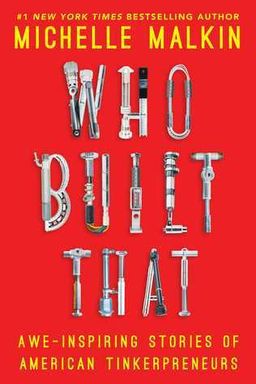
Who Built That cover

Who Built That

by Michelle Malkin

Who Built That unveils inspiring stories of America''s greatest inventors over the past 150 years. Learn how these ''tinkerpreneurs'' turned revolutionary ideas into successful businesses, driving societal progress and overcoming challenges. This book celebrates the spirit of innovation and the essential role of free market capitalism in nurturing creativity.

The Spirit of American Tinkerpreneurs

What makes American innovation distinctive? Michelle Malkin argues that it stems not from vast bureaucracies or grand institutions but from the restless energy of individual "tinkerpreneurs"—men and women who combine mechanical curiosity with pragmatic entrepreneurship. Her book traces how small-time inventors, machinists, and immigrant dreamers forged industries that transformed ordinary life. Through their hands-on experimentation and the legal protection of the U.S. patent system, everyday problems became billion-dollar enterprises.

Tinkerpreneurs: The American Archetype

Tinkerpreneurs are not ivory-tower scientists. They learn by doing: Tony Maglica machining flashlight parts in a garage, Michael Owens improvising glass-blowing devices in a basement, Willis Carrier solving humidity problems on shop floors. Across the centuries, they share key traits—mechanical aptitude, persistence through adversity, respect for intellectual property, and an intense focus on making useful things. Their motivations intertwine profit, craftsmanship, and faith in purposeful work.

This pragmatic ethos echoes Adam Smith’s observation that by seeking private gain, entrepreneurs often advance the public good. Through this lens, tinkerpreneurs become unwitting nation-builders, creating reliable light, clean bridges, sealed beverages, comfortable climates, and artificial limbs that restore dignity. Malkin’s narrative celebrates how their grit counters a culture increasingly enamored with top-down innovation stories.

From Workshops to World-Shaping Industries

The stories crisscross America’s industrial evolution: Tony Maglica’s Maglite transforms precision machining into a global brand; the Roeblings turn wire rope into the Brooklyn Bridge; Carrier and Lyle convert humidity control into modern comfort; William Painter’s crown cap launches global packaging empires. Each innovation begins as a small fix but cascades into wide systems—beverage factories, skyscrapers, malls, and urban migration patterns. The book insists that history’s turning points are often born of iterative prototypes, not eureka moments.

By contextualizing each story within its supply chains—the glass blowers displaced by Owens’ machine, the pulp mills behind the Scotts’ paper revolution, the machinists who enabled Maglite tooling—Malkin challenges myths of genius and highlights the social webs that turn tinkering into transformation.

The Moral and Legal Infrastructure

Beneath these biographies runs a constitutional current: America’s patent system, designed to reward disclosure and experimentation. From Lincoln’s “fuel of interest” speech to modern debates over the America Invents Act, Malkin documents how accessible patent rights nurtured small inventors. She fears that today’s first-to-file systems tilt toward corporate players, eroding the individual’s ability to protect and monetize an idea. For her, defending this legal infrastructure is as vital as celebrating the inventors themselves.

A Blueprint for Modern Builders

The book doubles as a practical manual. You’re asked to see problems as opportunities for iterative design; to treat the marketplace, not the lab, as the ultimate proving ground; and to respect patents as scaffolding for risk-taking. Every chapter provides usable lessons: pair technical mastery with smart partners (Carrier and Lyle); protect your idea legally and morally (Maglica’s IP battles); and systematize behind a simple product (Painter’s caps or the Scotts’ paper rolls). Malkin reframes the American Dream not as luck or entitlement but as disciplined invention fueled by autonomy.

Core Message

Innovation is not an institutional miracle—it’s the accumulation of small, protected, profit-seeking experiments carried out by individuals who refuse to let constraints define them. When ordinary citizens tinker, test, and persist, they build the infrastructure of modern civilization.

Read this book as both a history and a provocation: a reminder that ingenuity grows where freedom, property rights, and perseverance meet. If you understand the lives of America’s tinkerpreneurs, you see your own capacity to turn a small improvement into a legacy that endures for generations.


Inventing Everyday Life

Throughout the book, mundane inventions prove the most transformative. William Painter’s crown cap, the Scott brothers’ toilet paper rolls, and Charles Hires’ root beer formula all show that incremental mechanical ideas can reshape consumption and hygiene. Painter’s simple cap ended leakage and contamination in soda and beer, revolutionizing bottling. The Scotts normalized once-taboo products through patient marketing. Hires demonstrated that clever packaging and promotion can elevate an ordinary good into a national brand.

The Power of Solving Tiny Problems

Painter, Hires, and the Scotts all embody a truth: big markets hide behind small frustrations. A better seal, a softer texture, or an improved flavor can create entire supply chains. These stories differ from heroic myths of electricity or steel—they’re about tinkering with paper, cork, and syrup. And yet, collectively, they explain how consumer culture, advertising, and mass manufacturing intertwined to create twentieth-century abundance.

Building Industrial Ecosystems

Every invention generates dependencies. The paper roll requires pulp mills, chemicals, and packaging logistics. Crown caps need glass bottlenecks designed to fit them. The success of a commodity often depends on upstream materials science and downstream distribution. Malkin shows that inventors who think systemically—understanding not just their product but its ecosystem—create durable impact.

Lesson

When you design, look for bottlenecks, not brilliance. Fix a small inefficiency in a way that scales, and the world reorganizes around your improvement.

From paper mills to packaging giants, these “minor” inventions underscore Malkin’s thesis: great prosperity grows from mundane innovation, protected by clear property rights and nurtured by demand for practical solutions.


Mechanical Genius and Industrial Transformation

Willis Carrier, Michael Owens, and the Roebling family exemplify how engineering brilliance, persistence, and leadership blend to build new realities. Carrier’s understanding of humidity made controlled climates—and by extension, modern medicine and entertainment—possible. Owens’ automation turned fragile craft into standardized industry. The Roeblings’ wire ropes and bridge engineering redefined the architecture of cities while testing the limits of family endurance.

From Tinkering to Systems Engineering

Carrier’s 1906 patent for an apparatus that managed both temperature and humidity established psychrometrics as a discipline. J. Irvine Lyle commercialized that science, convincing skeptical industries that comfort could be an economic tool. Similarly, Owens’ “sucker-upper” automaton multiplied glass bottle production, eliminating drudgery and child labor. Such advances prove that real engineering mastery links theory and market usefulness, not just laboratory novelty.

Sacrifice and Social Progress

The Roeblings' Brooklyn Bridge became both a national symbol and a human drama. John Roebling’s death, Washington’s illness, and Emily Roebling’s unexpected leadership illustrate invention’s costs. Behind every monument stands a network of people who manage politics, safety, and morale as much as physics. Their story lends texture to Malkin’s larger point: invention is not isolated genius but cooperative tenacity under pressure.

Takeaway

Great builders integrate intellect with courage. They iterate through injury, opposition, and sabotage, forging progress as much through persistence as through patents.

Together, these case studies show how America turned experimental problem-solvers into social architects—engineering not just mechanisms, but possibilities.


Powering a Nation

Electricity’s rise—through Westinghouse, Tesla, and Lucien Nunn—shows invention scaling from concept to civilization. Tesla’s polyphase motor offered theoretical elegance; Westinghouse supplied manufacturing might. Their cooperation culminated in the 1893 Chicago World’s Fair and the Niagara project that electrified entire regions. Each phase—from the Telluride trials to Niagara’s turbines—demonstrates how field testing and entrepreneurial risk transform ideas into infrastructure.

Partnership and Risk

Westinghouse’s recognition of Tesla’s genius led to one of the century’s boldest bets. Amid financial assaults and “war of currents” propaganda from Edison’s camp, they persevered. At critical moments, Tesla’s idealism—renouncing royalties to save Westinghouse—kept the company alive and ensured AC’s supremacy. (This unselfish act underscores how moral choices can accelerate technological adoption.)

Demonstration as Catalyst

The Telluride experiment proved AC’s viability under harsh conditions, training new engineers and refining transformer design. Niagara then industrialized the proof, attracting aluminum, carborundum, and electrochemical industries. Once power could be transmitted miles efficiently, geography lost its limits; the Sun Belt, skyscrapers, and suburban sprawl followed.

Lesson

A laboratory discovery matters only when ruggedized and demonstrated in public. Field trials convert theory into credibility and gather the capital that builds enduring systems.

In electricity’s journey from workshop to waterfall, Malkin reveals the tinkerpreneurial formula for technological revolutions: collaboration, risk-taking, empirical testing, and property protection fueling exponential spread.


Grit, Patents, and Manufacturing Integrity

Tony Maglica’s Maglite story epitomizes immigrant determination, precision craftsmanship, and the defense of intellectual property. Starting from a rented garage with a single lathe and his mother’s pawned jewelry as capital, Maglica built a world-renowned brand from machined aluminum and laser-like discipline. Every feature—O-ring seals, pushbutton switches, anodized bodies—reveals an obsession with reliability rather than flash.

The Made-in-America Standoff

Maglica’s insistence on domestic production made him both proud and vulnerable. California’s labeling restrictions denied him the “Made in U.S.A.” mark due to minimal imported parts, despite all machining and assembly being local. When federal bans on incandescent bulbs shuttered his lab, he lost not just a product line but symbolic independence. Malkin reads this as emblematic of regulatory overreach that stifles homegrown making.

Patents as Defensive Strategy

Maglica understood that enforcement equals survival. He spent over $100 million protecting his designs, never losing a case. His IP duels with knockoff producers reinforced a central theme: innovation thrives where law shields creators from piracy. Without that bulwark, craftsmanship erodes into commodity chaos.

Moral of the Machine

Meticulous engineering plus moral conviction forge durable enterprise. When you protect your workmanship and make quality nonnegotiable, you turn utility into legacy.

For Malkin, Maglite exemplifies how immigrant labor, mechanical competence, and the defense of property rights crystallize the American Dream in aluminum and light.


From Wood and Wires to Bionics

The evolution of prosthetics—from James Hanger’s Civil War limb to Hugh Herr’s robotic leg—mirrors America’s technological arc. Each stage marries individual grief or need with inventive resolve. Hanger, an amputee himself, transformed trauma into entrepreneurship. A.A. Marks and later Van Phillips and Katherine Bomkamp continued this lineage, leveraging rubber, carbon fiber, sensors, and neural interfaces to restore movement.

Human Need as Innovation Engine

Unlike industrial-scale inventions, prosthetic breakthroughs arise from closeness to suffering. Veterans, accident victims, and clinicians collaborate in rapid iteration cycles—emotional urgency replacing market studies. The resulting tinkerpreneur culture fosters small firms like Willow Wood or United Prosthetics that merge craft with cutting-edge science.

The New Material Frontier

Material innovation fuels every leap: vulcanized rubber in the 1800s, aluminum frames mid-century, and carbon composites and processors now. Companies like Bally Ribbon adapt textile expertise to medical technology, producing woven carbon structures for sockets. The modern prosthetic is a fusion of engineering, empathy, and data—proof that invention’s soul remains human even as its components become digital.

Message

Innovation grounded in compassion sustains its moral legitimacy. The more you design for dependency or disability, the more you affirm technology’s human purpose.

By tracing prosthetics from hand-carved limbs to microprocessor-controlled bionics, Malkin closes her portrait of the tinkerpreneur as healer—a maker driven not just by curiosity or profit, but by empathy wielded through mechanics.


Protecting the Innovation Engine

At the heart of Malkin’s argument lies a defense of America’s patent system as both economic engine and moral contract. Article I, Section 8 enshrines this principle: by securing temporary exclusivity, inventors must disclose their knowledge, feeding a virtuous cycle of imitation and improvement. From Lincoln to modern tech voices, this blend of property and transparency explains America’s inventive advantage.

Patents as the Bridge Between Ideas and Markets

Every figure in her narrative depends on patents: Painter leveraged them for licensing, Owens built empires on them, and Maglica defended them fiercely. Patents transform experiments into investable assets, attracting the partners, financiers, and distributors who amplify creative individuals. Malkin sees them not as monopolies but as bridges connecting small inventors to industrial scale.

Modern Threats to Small Innovators

The 2011 America Invents Act’s shift to a first-to-file standard, she argues, threatens this equilibrium. Wealthy corporations can file faster, leaving garage inventors outmaneuvered. Programs that speed patents for high fees reinforce inequality. In her view, such policies erode the hard-won inclusivity that let self-taught mechanics rival institutions.

Key Argument

Without a fair, accessible patent system, the tinkerpreneur tradition collapses. Protecting individual inventors means protecting the roots of national prosperity.

Malkin concludes by urging you to see policy as part of innovation’s anatomy: creativity demands not just tools and talent, but laws that reward risk and revelation in equal measure.

Dig Deeper

Get personalized prompts to apply these lessons to your life and deepen your understanding.

Go Deeper

Get the Full Experience

Download Insight Books for AI-powered reflections, quizzes, and more.