
Idea 1
America's Class Story from Waste to Worth
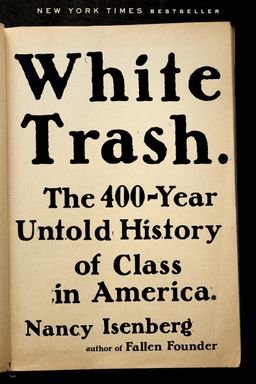
How did the United States, founded on ideals of equality and independence, also construct some of the world’s most enduring hierarchies of class and worth? This book traces that paradox from England’s earliest colonial ventures to twenty-first-century pop culture, showing that the label “white trash” and other markers of social inferiority are not accidents of slang but the product of centuries of policy, rhetoric, and imagination. From the start, America’s story about class was one of geography, labor, and biology—who worked the land, who owned it, and who was deemed fit to reproduce.
From Waste People to Settler Classes
In the seventeenth century, colonization was designed to drain England’s “sinkes” of idle, criminal, or surplus subjects. Figures like Richard Hakluyt and John White explicitly described the New World as an emunctory colony—a place to export the poor and convert them into resources. Indentured servants, vagrants, and convicts were shipped to Virginia and the Caribbean, while elites collected headrights for each transported body, alive or dead. This founding logic—treating humans and land alike as waste to be made profitable—laid the groundwork for the American myth of the land of opportunity built on disposability.
You watch Jamestown and other early settlements reveal how class and labor inequality were cemented into law. Masters accumulated acreages by transporting servants, women were commodified as breeding and labor assets, and the headright system transformed people into a unit of measurement. The colonial division between planter and servant evolved into a permanent hierarchy later hardened by race-based slavery.
Puritan, Proprietor, and Agrarian Orders
As England’s settlements diversified, two dominant models of order emerged. John Winthrop’s Puritan “Citty upon a Hill” imagined hierarchy as divine necessity—“some must be rich, some poor”—while John Locke and Lord Shaftesbury’s Carolina constitutions created a hereditary aristocracy with absolute power over slaves and bound peasantry. Together, these worldviews sanctified inequality: New England moral discipline on one side, southern aristocratic proprietorship on the other.
When Thomas Jefferson later praised the yeoman farmer as republic’s backbone, he inherited both dreams: labor was moral and productive, but only under property and discipline. His agrarian topography ranked people like soil layers—topsoil, subsoil, and “rubbish.” Despite reform attempts to broaden ownership and education, his policies preserved gentry power while romanticizing rural virtue. The link between pedigree, land, and moral worth persisted through centuries of reformist rhetoric.
Population, Breeding, and American Exception
Benjamin Franklin and Thomas Paine reimagined social order through natural history and population science. Franklin’s “happy mediocrity” praised a self-reproducing middle population whose fertility was civic virtue. Paine likewise claimed that America’s vast land would breed a new race of free people liberated from European corruption. Yet such optimism already contained a biological frame—class and national strength as forms of breeding—that Jefferson would extend, tying social improvement to selective reproduction and agrarian purity. These Enlightenment-era ideas later mutated into pseudoscientific eugenics.
Frontier Freedom and the Rise of the “Common Man”
Beyond the seaboard, squatters and “crackers” embodied both democratic promise and elite disdain. Andrew Jackson’s presidency celebrated the rough-hewn frontier hero, yet wealthy travelers like William Byrd II vilified backwoods settlers as lazy “lubbers.” The rhetoric of independence masked battles over land rights, as preemption laws turned illegal occupation into political energy while preserving stereotypes that the poor were chaotic and uncivilized.
By the antebellum era, “poor white trash” replaced “waste people” as the new insult for a degraded lower class. Writers such as Daniel Hundley medicalized poverty with language of degeneration—“clay-eaters” or “sandhillers”—while Hinton Rowan Helper weaponized class resentment against slavery. The very idea of whiteness as purity depended on inventing its own internal pollution.
War, Reconstruction, and Scientific Inequality
The Civil War and its aftermath turned class antagonism explicit. Confederate elites justified slavery through “mudsill” logic: society’s base must stay low. Yet poor soldiers, women rioters, and deserters exposed that hierarchy’s brittleness. Union propagandists reclaimed “mudsill” as honor, linking labor with civic virtue. After defeat, Reconstruction politics and later eugenic science reattached social stigma to heredity. Terms like “scalawag” and “degenerate stock” translated political rebellion into biological deviance.
By the early twentieth century, southern poverty became a laboratory for eugenics. Davenport’s Cold Spring Harbor surveys, IQ testing in World War I, and public-health photographs made “southern degeneracy” seem genetic. Legal sanction followed in cases like Buck v. Bell (1927), where the state’s power to sterilize “unfit” women was justified in the name of progress.
Media Myths and Modern Reinvention
The Great Depression reframed these lineages under the language of the “Forgotten Man.” New Deal resettlement and photojournalism treated the rural poor as a problem to fix, not a class to empower. After World War II, the suburban boom and pop culture sanitized class difference through sitcoms, country music, and redneck chic. Trailers and hillbilly humor provided comic relief while real exclusion persisted via zoning and mortgage policy.
By the late twentieth century, “white trash” was both insult and brand. Films like Deliverance, the political theater of Jimmy Carter and Sarah Palin, and shows like Honey Boo Boo turned class into spectacle. The same culture that canonized the “common man” continued to naturalize poverty as personal failure.
The book’s argument distilled
From “waste people” to “white trash,” labeling and hierarchy are the American default mode of defining identity. Each era substitutes new scientific or cultural masks for old economic divides. If you see poverty as pathology or spectacle, the book urges, you are replaying a script written at the empire’s birth.
The long arc of this narrative teaches that America’s class story is never only about wealth. It is about who qualifies as fully human, reproductive, and worthy of belonging. Tracing four centuries of policy, propaganda, and pop culture, the book shows that every “class problem” in U.S. history—from indentures to IQ tests, from trailer parks to reality television—repeats the same foundational equation: worth equals productivity, and deviation equals waste.