
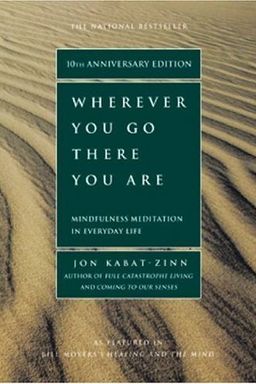
Wherever You Go, There You Are cover

Wherever You Go, There You Are

by Jon Kabat-Zinn

Wherever You Go, There You Are guides readers toward enjoying the present moment through mindfulness. Jon Kabat-Zinn offers practical meditation practices for everyday life, steering us toward inner peace and tranquility amidst the chaos of modern living.

Mindfulness: The Art of Being Where You Are

Have you ever rushed through your day only to realize you never truly experienced it? In Wherever You Go, There You Are, Jon Kabat-Zinn challenges our culture’s obsession with doing, achieving, and escaping by asking us to radically simplify: be here now. He argues that life unfolds only in the present moment—and yet, we often live lost in our thoughts about the past or anxious projections of the future. The antidote, he contends, is mindfulness: the active and non-judgmental awareness of what’s happening right here, right now.

Kabat-Zinn, a scientist and founder of Mindfulness-Based Stress Reduction (MBSR) at the University of Massachusetts Medical School, brings the ancient Buddhist art of mindfulness into the modern, secular world. He insists that you don’t have to be a monk or retreat into a monastery to practice meditation—you can integrate it into your everyday life, as you cook, parent, or even wash dishes. The heart of the book is his simple but profound thesis: you can’t escape yourself. No matter where you go, there you are. The challenge, then, is not about changing our circumstances but transforming our relationship to them through awareness.

The Problem of Mindlessness

Our minds constantly drift into autopilot, chasing thoughts and judgments instead of experiencing life as it is. Kabat-Zinn calls this “the robot mode.” We assume that our beliefs about reality are true, but they’re actually interpretations filtered through habit and assumption. In this trance of unawareness, we fail to notice our own thoughts shaping our experiences. He likens this state to being asleep while awake—a “dream of automaticity” that Buddhists describe as ignorance. The cost of this ignorance is huge: years can pass without us ever living them consciously. Mindfulness is the process of waking up from that dream. By observing the mind without judgment, you step out of the habitual narratives that control you.

Present-Moment Awareness as a Way of Living

For Kabat-Zinn, mindfulness is not a mystical experience or religious ritual but a way of being. He defines it simply as paying attention—on purpose, in the present moment, and without judgment. This kind of attention nurtures clarity, wisdom, and peace. It brings you back from the whirlwind of doing into the stillness of being. Meditation, then, is not about achieving some special state; it’s about meeting each moment with openness and curiosity. Every moment, no matter how ordinary, holds the potential for awareness.

Bringing Meditation into Everyday Life

Kabat-Zinn organizes the book into three parts: the first introduces mindfulness and its foundational attitudes—non-judging, patience, trust, non-striving, acceptance, and letting go. The second describes various forms of meditation, from sitting and walking to lying down and mindful movement. The third explores how mindfulness infuses daily activities: parenting, working, communicating, and simply living. The message is that meditation is not separate from life—it is life, observed more intimately. When he says, “You can’t stop the waves, but you can learn to surf,” he means that mindfulness does not eliminate life’s difficulties but teaches us to move gracefully with them.

The Practical and the Profound

What distinguishes Kabat-Zinn from traditional Buddhist teachers is his practicality. Drawing on Thoreau’s Walden and Emerson’s transcendentalism as much as Zen, he shows that mindfulness is the art of living deliberately, of reinhabiting each moment. He mixes ancient wisdom with modern science to show measurable benefits for health, stress reduction, and emotional well-being. But beyond healing, mindfulness calls you to your full humanity—to wake up to your life before it passes by unnoticed. “Only that day dawns to which we are awake,” he reminds readers, quoting Thoreau. Presence is not an escape from life; it’s how we finally engage with it.

Why It Matters Now

At a time when we are driven by busyness, technology, and distraction, Kabat-Zinn’s invitation feels more urgent than ever. Wherever you turn, he says, you can encounter yourself—your thoughts, emotions, and the pulsing aliveness of this moment. Mindfulness doesn’t ask you to change who you are; it simply asks you to pay attention to who you already are. Through that awareness, transformation happens naturally. This book, now a modern classic, serves as a guide to that journey—a manual for waking up to your own existence, one breath at a time.


The Meaning and Power of Mindfulness

Kabat-Zinn defines mindfulness as “paying attention in a particular way: on purpose, in the present moment, and non-judgmentally.” These few words summarize a radical shift in how we usually live. Most of the time, we are somewhere else mentally—thinking about what just happened or what will happen next. Mindfulness, by contrast, means anchoring awareness in now—the only moment that life actually happens.

Simple But Not Easy

Mindfulness sounds simple, but sustaining it is profoundly challenging. Our minds are torrents of thought—self-criticism, planning, replaying, worrying. Meditation teaches you to step out of that current and sit on the bank, observing thoughts as they flow by. Kabat-Zinn draws inspiration from Nisargadatta Maharaj’s advice: watch yourself “with alert interest, with the intention to understand rather than to judge.” This is the attitude of mindfulness: curiosity without reaction. When you simply notice what’s occurring, clarity and calmness arise on their own.

Clouds of Forgetfulness

The “clouds” that obscure mindfulness are our habitual thoughts and emotions. When you’re lost in planning, anger, or regret, you’ve drifted from the present. In Buddhist terms, this state of mindlessness is called ignorance—a kind of blindness to what is real. Yet Kabat-Zinn emphasizes that such lapses are not failures; they’re opportunities to return. Each time you realize you’ve wandered and gently come back, that moment of remembering is mindfulness. Like strengthening a muscle, each return to awareness builds stability and insight.

Modern Applications

Kabat-Zinn famously applied these principles to help patients suffering from chronic pain and stress. His Mindfulness-Based Stress Reduction program teaches that although you can’t eliminate pain, you can change your relationship to it. Pain may be inevitable, but suffering—your mental resistance—comes from clinging and aversion. Through mindful awareness, you can meet discomfort with curiosity instead of fear. The same principle applies to everyday life: when you stop fighting what’s happening, you gain freedom in the very midst of challenges.


Non-Doing: The Paradox of Effortless Effort

One of Kabat-Zinn’s most counterintuitive lessons is that meditation is not about getting somewhere. It’s about being where you already are. This teaching, drawn from Zen and Taoist traditions, runs against our productivity-driven culture. He calls this state non-doing: consciously stepping out of our constant striving to fix, improve, or attain. Paradoxically, it’s through non-doing that real transformation happens.

The Power of Stillness

Meditation, Kabat-Zinn writes, is “the art of stopping.” When you stop all outward movement—even briefly—you discover an inner stillness that is always there beneath the noise. In that stillness, insight and self-understanding emerge naturally. He recalls Thoreau’s practice of sitting by his cabin doorway for hours, simply watching the day unfold. This kind of presence is not idleness; it’s a receptive awareness that restores balance and creativity. He quotes the Zen saying, “Don’t just do something, sit there.”

Doing Non-Doing

Kabat-Zinn clarifies that non-doing isn’t laziness or apathy—it’s full engagement without grasping. Think of a dancer whose movements seem effortless after years of preparation. The Taoist story of “Prince Wen Hui’s cook,” who cuts an ox with perfect ease, exemplifies this. The cook explains that he no longer sees the whole ox; he just lets his knife follow the spaces between the joints. His action flows naturally, arising from deep attunement rather than force. This story captures mindfulness in motion: work and being merge, and the ego’s effort disappears.

The Practice in Modern Life

In our society, non-doing is revolutionary. We measure worth by action and progress, yet most of our problems stem from compulsive doing. Kabat-Zinn invites you to practice deliberate “non-doing moments”—pausing to breathe, listen, and simply exist. These pauses renew your energy and reconnect you to what truly matters. As paradoxical as it sounds, the most skillful doing arises from stillness. Just as a skilled surfer learns to move with the wave rather than fight it, mindfulness helps you flow with life instead of against it.


The Attitudes of Mindfulness

To sustain mindfulness, Kabat-Zinn outlines essential attitudes that serve as its moral and psychological foundation—patience, letting go, non-judging, trust, generosity, and simplicity. These aren’t techniques but ways of being that nourish awareness.

Patience and Letting Go

Patience recognizes that things unfold in their own time. Kabat-Zinn compares it to the natural seasons: spring doesn’t rush itself, and growth cannot be forced. Impatience stems from resistance—wanting reality to be different. By letting go of expectations and control, you align with natural flow. Letting go, a common cliché, here means releasing your mental grip on how things should be. It’s not passive resignation but full acceptance of this moment as it is, knowing that change will come when conditions ripen.

Non-Judging and Trust

Mindfulness is not another way to evaluate yourself. The judging mind constantly labels experience as good or bad. Kabat-Zinn describes judgment as a “suitcase of rocks” we carry unnecessarily. Letting it rest, even momentarily, brings lightness. Trust complements non-judgment by anchoring you in inner confidence. You learn to trust your experience—even confusion or pain—as part of the process. Quoting Kabir, Kabat-Zinn reminds us, “Be strong then, and enter into your own body; there you have a solid place for your feet.”

Generosity and Simplicity

Generosity, Kabat-Zinn writes, begins with yourself: giving time, compassion, and permission to be as you are. From that abundance flows kindness toward others. This generosity is linked to voluntary simplicity—doing less to experience more. Our culture celebrates accumulation, but true wealth, he suggests, lies in freeing yourself from excess: of possessions, tasks, or thoughts. When you slow down, doing one thing at a time, the world regains depth and clarity. Each of these attitudes strengthens mindfulness, turning it from a technique into a way of life.


Meditation in Motion: Everyday Practice

Kabat-Zinn democratizes mindfulness by showing that meditation can occur anywhere—walking, standing, lying down, or performing ordinary tasks. The point is not posture but presence. The breath, he says, is always available as a bridge to awareness. Anchoring attention to it during daily activities weaves mindfulness into the fabric of living.

The Body as Teacher

In sitting meditation, posture embodies dignity. Walking meditation links awareness to movement: each footstep an act of presence. Even washing dishes or cleaning a stove becomes practice. When Kabat-Zinn describes scrubbing his kitchen while listening to Bobby McFerrin, he illustrates that meditation isn’t separate from joy. In every mundane act lies an opportunity for sacred attention. The key is to feel what you’re doing while you’re doing it, instead of rushing through to what’s next.

Formal and Informal Practice

He distinguishes between formal meditation—dedicated time for stillness—and informal mindfulness, which infuses ordinary life. Both matter equally. He uses the metaphor of surfing: you can’t stop life’s waves, but you can learn to ride them. To meditate only when things are calm is like surfing only in still water. True skill develops when you remain present in the midst of turbulence. Even unpleasant moments—impatience in traffic or irritation at cat food in the sink—can become mindfulness opportunities if you watch reactions instead of feeding them.

Parenting, Work, and Relationships

For Kabat-Zinn, mindfulness extends to how we relate to others. In parenting, he calls children “live-in Zen masters” whose unpredictability continually tests our patience and compassion. In relationships, awareness means seeing people as they are, not as our thoughts about them. At work, mindfulness turns routine into artistry: presence transforms even ordinary action into care. Life itself becomes meditation—each act, a bow to the moment as it unfolds.


Emotions, Suffering, and Transformation

A major theme in Wherever You Go, There You Are is emotional alchemy—turning suffering into wisdom through awareness. Kabat-Zinn writes that pain is unavoidable, but suffering is optional. Suffering arises when we resist pain, cling to comfort, or identify with passing emotions as “me” or “mine.” By observing emotions like anger or fear without judgment, you disarm their power.

The Lesson of Anger

In one candid story, Kabat-Zinn recounts losing his temper when his daughter feared he would embarrass her. Only afterward did he realize that his “righteous indignation” cost something greater—her trust. He uses this to show how clinging to being right blinds us to what truly matters. Noticing anger as energy, rather than justification, allows it to dissipate. By learning to sense emotions’ physical manifestations—tight jaw, rushed breath—you gain freedom before they harden into reaction.

Letting Emotions Cook

His “cat-food lesson” at home furthers this point: irritation at dirty cat bowls becomes a field for practice. Instead of projecting anger outward, he observes it inwardly until it “cooks” in the pot of awareness. As the heat of attention transforms raw feeling into understanding, resentment melts into humor. This mindful cooking process prevents emotions from “boiling over” into harm. Through attention, feelings reveal their roots—usually unmet expectations or fear—not realities outside us.

From Reacting to Responding

Mindfulness doesn’t suppress emotion; it enlarges the space between stimulus and response. Kabat-Zinn reminds you that awareness can hold any storm—the sadness of parenting, the ache of aging, the anxiety of uncertainty—until clarity emerges. When you stop running from discomfort, you discover resilience. In that open space, even grief or pain becomes your teacher. “You can’t stop the waves,” he writes again, “but you can learn to surf”—and sometimes, in surfing, you find peace in the very sea that once scared you.


On Wholeness, Interconnection, and Spirituality

At its deepest level, mindfulness reveals not just peace but oneness. As Kabat-Zinn writes, “When we are in touch with being whole, we feel at one with everything.” Awareness uncovers the interconnected fabric of life—how each part mirrors the whole. Drawing from Emerson, Lao-Tzu, and modern science alike, he shows that mindfulness bridges the divide between self and world, body and mind, spiritual and secular.

Interconnectedness and Karma

Kabat-Zinn illustrates interdependence through Buddhist teaching on karma: every action shapes future experience. He likens life to a web of causes, each thread influencing the rest. Awareness allows you to see this interbeing directly—how breathing links you to plants, how your emotions ripple through relationships, how mindfulness itself changes collective consciousness. When you change your relationship to the moment, you change your karma. Each act of awareness plants seeds for clarity and compassion to grow.

Wholeness and Suchness

He distinguishes between wholeness—the unity underlying everything—and suchness—the individuality of each thing. Like jewels in Indra’s net, each moment and person reflects the whole. Appreciating both wholeness and particularity brings reverence for diversity. Quoting poets like Whitman and Hesse, Kabat-Zinn celebrates this paradox: the self is both infinite and fleeting, humble yet luminous. Experiencing wholeness firsthand quiets the ego’s endless striving, revealing peace in simply being alive.

Beyond Spiritual Labels

Though deeply rooted in Buddhist and Western contemplative traditions, Kabat-Zinn avoids religious terminology. He redefines spirituality as “wholeness and interconnectedness directly experienced.” Washing dishes, walking your dog, or feeling a breath can all be spiritual acts when performed with awareness. This inclusive vision bridges science and soul, grounding transcendence in the ordinary. True spirituality, he concludes, is not escape from the world but intimacy with it—seeing the sacred shimmering in each passing moment.

Dig Deeper

Get personalized prompts to apply these lessons to your life and deepen your understanding.

Go Deeper

Get the Full Experience

Download Insight Books for AI-powered reflections, quizzes, and more.