
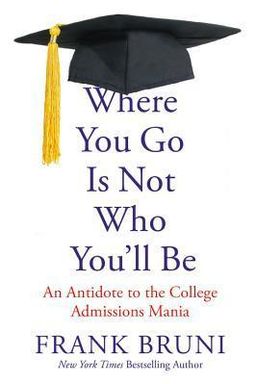
Where You Go Is Not Who You''ll Be cover

Where You Go Is Not Who You''ll Be

by Frank Bruni

Frank Bruni''s ''Where You Go Is Not Who You''ll Be'' challenges the college admissions frenzy, urging readers to look beyond prestige. Discover how success lies in personal growth, creativity, and finding the right educational fit, not just a name-brand degree.

Rethinking Success: Why College Prestige Isn’t Destiny

What if everything you’ve been told about success—the belief that only elite schools promise a great future—was wrong? In Where You Go Is Not Who You'll Be, journalist Frank Bruni dismantles one of America’s most deeply ingrained myths: that where you go to college defines how far you can go in life. Drawing on research, personal stories, and interviews with high-achieving individuals from public universities and lesser-known schools, Bruni argues that success depends far more on passion, resilience, and character than on institutional pedigree.

Bruni’s central claim is simple but radical: the name on your diploma does not determine your worth. He contends that America’s fixation on elite college admissions—driven by cultural status, misguided rankings, and fear of falling behind—has blinded students and parents to what actually builds success: self-discovery, effort, and adaptability. He asks why so many families spend years chasing Ivy League acceptance when its impact on long-term happiness and achievement is marginal. Instead, he spotlights the millions of graduates from state schools and lesser-known institutions who go on to lead meaningful, impactful lives.

The Myth of the Golden Ticket

College admissions have evolved into a cultural obsession that treats acceptance as the definitive measure of merit. This fever has led parents to invest thousands in tutors and consultants and children to feel existential despair over rejection. Bruni illustrates this mania through stories like that of Susan Bodnar, a psychologist whose son’s Ivy League rejections plunged their family into turmoil. The process, Bruni argues, has created a generation of anxious, risk-averse young adults who measure themselves against arbitrary standards rather than personal growth.

He contrasts this with individuals who found fulfillment beyond the Ivy gates. Howard Schultz, for instance, rose from poverty to become CEO of Starbucks after attending Northern Michigan University. Schultz’s story reflects Bruni’s theme: resilience and curiosity matter far more than prestige. Similarly, John Green, celebrated author of The Fault in Our Stars, flourished at Kenyon College, where mentorship and intimacy—not rankings—nurtured his craft.

The Power of Humility, Hunger, and Reinvention

A recurring idea throughout Bruni’s narrative is that “humbled and hungry” students at less exclusive colleges often work harder and learn more deeply. They don’t rely on name recognition to open doors—they build their own. Examples abound: Justin de Benedictis-Kessner, who reluctantly attended his “safety school” William & Mary, became a standout scholar and leader, later earning his doctorate at MIT. Similarly, Todd Martinez, who studied chemistry at a small religious college, Calvin College, discovered that smaller institutions offer hands-on opportunities larger schools often reserve for graduate students.

These stories reinforce Bruni’s central message: students thrive when they use their environment instead of simply occupying it. At lesser-known colleges, resources—though limited—are often more accessible, communities more personal, and professors more attentive. These qualities, when met with initiative, nurture confidence and independence. It’s not the institution that defines success but how fully you engage with it.

A National Reflection on Values

Bruni situates the college mania in America’s broader obsession with status and branding. From luxury products to exclusive memberships, people chase validation through labels—and college names have become another form of consumer prestige. Yet studies show the long-term earnings gap between elite and non-elite graduates largely disappears when other factors are controlled. The real differentiator isn’t pedigree but personal agency: drive, curiosity, and emotional intelligence.

The book also critiques the damage this mentality inflicts on students’ mental health and values. Admissions mania cultivates entitlement among the privileged and despair among those left out. It narrows curiosity and turns education—a process meant for exploring ideas—into a transactional contest. In essence, Bruni argues for restoring higher education’s true purpose: to help individuals understand themselves and contribute meaningfully to society.

Why This Message Matters

Bruni’s argument is a wake-up call for anyone caught in the prestige trap. Whether you’re a student planning college or a parent guiding one, this book insists that success has no single path. It’s an empowering shift—from judging life by where you start to measuring it by how you grow. By the end, readers see college not as a prize to be won but as a landscape to be explored, where curiosity and resilience, not exclusivity, determine the journey ahead.


Breaking the College Admissions Illusion

Frank Bruni dives deep into the chaos and illusions surrounding modern college admissions, portraying it as a circus of status anxiety. He captures how achievement-driven families treat elite universities like lottery tickets, believing a single acceptance will define their children’s entire lives. In stories of desperate parents and overprogrammed teens, Bruni exposes a culture where emotional well-being is sacrificed to the altar of prestige.

The Cult of Competition

Bruni traces how elite schools lowered acceptance rates to historic lows—under five percent at Stanford and under ten at Ivy League universities—fueling hysteria among applicants. College consultants charge up to $50,000 to “package” students, coaching them to appear flawless. Meanwhile, acceptance rates are manipulated for marketing purposes, creating an illusion that scarcity equals excellence. Parents hover anxiously over SAT prep courses and extracurricular résumés, convinced that failure to gain entry equals lifelong mediocrity.

From Childhood Branding to Exhaustion

The mania begins early. In affluent neighborhoods, parents push children as young as three to enter elite preschools—setting them on a conveyor belt lined with “gifted programs,” tutors, and summer pre-college camps. Bruni calls it consumerism disguised as ambition. Susan Bodnar’s son, Ronen, is one haunting example: at sixteen, his self-worth collapsed after Ivy League rejections. His mother, herself a psychologist, realized her family had become caught in a system that measured identity in acceptance letters rather than humanity.

Bruni’s interviews with admissions insiders reveal just how random the process is. Yale’s former officer Michael Motto recounts essays so bizarre they backfired—students writing about urinating on themselves to prove intellectual dedication or confessing trauma simply to stand out. The result is a generation skilled in self-promotion but lost in self-understanding.

The Hidden Costs

This frenzy, Bruni warns, doesn’t stop at emotional damage—it reinforces inequality. The wealthiest families buy tutoring, essays, and access, while less affluent students scramble for scholarships or places at community colleges. “Merit,” Bruni notes, has become an illusion conveniently aligned with privilege. Even in the Ivy League itself, 75 percent of students come from families in the top quartile of income.

Ultimately, Bruni urges readers to question what these rituals achieve. Does a single word—Harvard, Princeton, Yale—truly measure intellect or character? By revealing the absurdity behind the race, he gives parents and students permission to step off the treadmill.


Beyond Rankings: The U.S. News Fallacy

One of Bruni’s sharpest critiques targets U.S. News & World Report and the rankings industry that turned college choice into a pseudo-science of status. He explains how flawed metrics like acceptance rates, alumni donations, and endowments masquerade as measures of quality. In reality, they reward schools for exclusivity and wealth, not for educational impact.

Gaming the System

Bruni cites educators such as Adam Weinberg of Denison University and Condoleezza Rice of Stanford, both of whom denounce the rankings for warping priorities. Schools inflate selectiveness by encouraging extra applications or deferring students to spring semesters to keep numbers pristine. Professors’ salaries and alumni giving rates factor more heavily than mentorship or teaching quality. The result: universities spend lavishly on luxury dorms, climbing walls, and fitness centers—features that boost brand appeal but not learning outcomes.

Rice herself, who graduated from the University of Denver, argues that meaningful education depends on curiosity and initiative, not prestige. She tells students who ask how to become Secretary of State, “Start as a failed piano major.” Her point mirrors Bruni’s: life success rarely follows linear formulas, and rankings mislead by equating affluence with performance.

A Culture of Quantification

In a memorable comparison, Bruni quotes Yale’s former dean of admissions Jeffrey Brenzel, who calls rankings “less scientific than rating vacuum cleaners.” Brenzel argues that they turn universities into corporate brands selling exclusivity rather than scholarship. The emphasis on the lowest acceptance rates and highest wealth guarantees that public universities serving broader populations are punished for inclusion.

Bruni’s conclusion is clear: students must reclaim the right to define value for themselves. Choosing a college should never be about chasing numerical prestige but about locating a space that supports growth. Whether that’s Arizona State, Kenyon, or the University of North Carolina, the right fit will depend on how deeply you engage, not how highly it scores.


The Success Equation: Effort Over Prestige

Bruni’s interviews with leaders across business, science, and politics reveal a consistent truth: success stems from effort, not the Ivy League. His conversations with CEOs, governors, and entrepreneurs dismantle the notion that prestige automatically equals power.

Patterns of Perseverance

From Chris Christie, who attended the University of Delaware, to Starbucks founder Howard Schultz from Northern Michigan University, Bruni illustrates that resilience and adaptability are superior predictors of achievement. Schultz sold his own blood for college money and learned to thrive among unfamiliar peers—a formative experience that later shaped his empathetic corporate leadership. Christie emphasizes that he had to “work harder” because his school’s name didn’t open doors automatically, yet this grounded him in humility and grit.

Empirical Evidence

Research supports these anecdotes. Economists Alan Krueger and Stacy Dale found that students who applied to elite colleges but attended less selective ones earned virtually the same incomes later in life. The decisive factor wasn’t where they studied—it was their ambition. Those who thought themselves competitive enough to apply displayed the determination to succeed regardless of acceptance.

Bruni complements data with human insight. He recounts Britt Harris, a business leader, who tells Princeton students that intelligence isn’t the ultimate advantage: “If you are extremely smart but only partially engaged, you’ll be outperformed by someone sufficiently smart but fully engaged.” Engagement and energy outweigh pedigree. It’s a lesson that echoes Malcolm Gladwell’s concept in David and Goliath—success often comes from being a “big fish in a small pond” where you have space to grow.

The Real Formula

Bruni concludes that true success hinges on curiosity, perseverance, and active participation. Students who maximize their opportunities—joining research projects, forming mentor relationships, or volunteering—gain far more than those merely basking in elite reputation. Hard work, humility, and risk-taking become the great equalizers in life’s unpredictable equation.


The Hidden Advantages of “Ordinary” Colleges

Bruni’s most hopeful chapters illuminate what truly happens at schools beyond the Ivy League—places often dismissed as “safety options.” Through vivid stories, he shows how these environments cultivate confidence, creativity, and accessibility.

Small Ponds, Big Growth

Arizona State, frequently labeled a “party school,” becomes a symbol of reinvention. Its honors college students, like Wendy Zupac and Devin Mauney, discovered vast opportunity: mentorship, graduate-level classes, and access to professors that elite schools rarely offer. Zupac later graduated from Yale Law School; Mauney from Harvard Law. Their testimonies demolish stereotypes and highlight how smaller institutions can be incubators for early leadership and innovation.

John Green’s experience at Kenyon College mirrors this intimacy. A professor’s personal feedback transformed his writing by urging him to “write how he spoke”—a revelation that led to his bestselling novels. These are colleges where professors, not teaching assistants, guide students directly, making education deeply personal.

Freedom to Engage

At smaller or state institutions, students often enjoy freedom to explore across disciplines. Bruni recounts Todd Martinez from Calvin College, who could dismantle an NMR machine for hands-on chemistry practice—an impossible feat for an undergraduate at UCLA. The moral: opportunity flourishes in environments of accessibility. Martinez later became a MacArthur “genius grant” recipient and Stanford professor. His story underscores how curiosity and initiative turn any resource into a laboratory for success.

A Platform for Reinvention

Students like Justin de Benedictis-Kessner and Jillian Vogel found that attending “consolation” schools freed them from peer pressure and perfectionism. They became leaders, researchers, and creative risk-takers precisely because their environments allowed them to fail and grow without relentless comparison. As Bruni writes, “You become more of yourself when you’re not suffocating under prestige.”


The Dark Side of Elite Education

Bruni dedicates an entire section to exploring the unintended consequences of elite education. Drawing on William Deresiewicz’s Excellent Sheep, he reveals how the Ivy League often breeds conformity, fragility, and careerism rather than creativity and compassion.

Entitlement and Uniformity

Elite schools pride themselves on diversity, yet Bruni shows that it’s mostly demographic, not socioeconomic. Students hail from wealthy families and often share identical ambitions—consulting, finance, or tech. Harvard studies have found that over a third of graduates enter these fields, not out of passion but fear of diverging from prestige norms. Former admissions dean Bruce Poch calls them “fragile thoroughbreds”—brilliant but untested, unable to cope with setbacks after years of curated success.

MIT writer Junot Díaz echoes this critique. At Rutgers, a public university, Díaz discovered unexpected diversity and creativity that shaped his voice as a novelist. Teaching later at MIT, he found students choreographed for perfection but starved of imagination. “The idea that you would go to university for the education of your soul,” Díaz said, “is considered absurd.”

The Linear Trap

Bruni argues that students trained for elite paths become prisoners of linear ambition—checking boxes rather than pursuing curiosity. Career funnels, like Harvard’s tilt toward consulting, replace exploration with safe conformity. This system rewards technical excellence but suppresses empathy and creative risk—the very qualities society needs most.

Liberation Through Learning

Education, Bruni insists, should teach resilience rather than resume polish. He reminds readers that professors’ roles are to challenge assumptions, not validate superiority. When universities become customer service centers catering to students’ comfort, they lose their transformative power. The antidote, according to Bruni, is humility—a willingness to see education as process, not privilege.


Rediscovering College as a Journey

In his final chapters, Bruni reframes college as a lifelong metaphor—a journey rather than a destination. He argues that the point isn’t prestige or even immediate career payoff, but self-understanding, curiosity, and contribution to others.

Authentic Education

True education, Bruni writes, is about expanding one’s vision of the world. He reflects on his own experience at the University of North Carolina, where he discovered humility and independence far from Ivy privilege. His professor’s mentorship and the diversity of classmates shaped intellectual and emotional maturity that no ranking could measure. The goal of college, he insists, is reflection, exploration, and learning to connect with others—skills more enduring than any GPA.

Freedom from Status

Bruni wants readers to break free from the tyranny of status and understand that “education is not the brand you wear, but the person you become.” Whether at Texas A&M or Yale, the opportunity lies not in where you are but how you use it. College should help you test ideas, fail productively, and discover what you value—not serve as a trophy.

Living the Lesson

By the end, Bruni’s message transcends college. It’s a philosophy of life: status fades, but substance endures. He urges students to choose schools that help them ask bigger questions rather than simply deliver smaller answers. “Where you go,” he writes, “is not who you’ll be—it’s how you’ll begin.” That beginning, he reminds us, belongs entirely to you.

Dig Deeper

Get personalized prompts to apply these lessons to your life and deepen your understanding.

Go Deeper

Get the Full Experience

Download Insight Books for AI-powered reflections, quizzes, and more.