
Idea 1
Where Technology is Taking Humanity
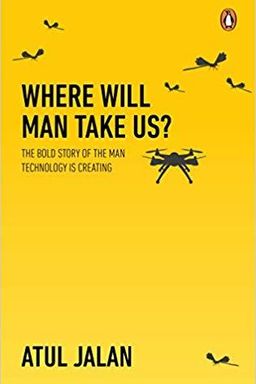
When you scroll through your phone, translate your voice into text, or let your GPS reroute you in real time, do you ever wonder what all this intelligence means for the species that created it? In Where Will Man Take Us?, technologist and futurist Atul Jalan poses exactly this question: as we merge the technology we build with the biology we inherit, what kind of humanity will we become?
Jalan argues that we are living in a transition as profound as when life first crawled out of the seas or when apes stood up to walk upright. We have begun to reengineer not just our surroundings but ourselves. Artificial intelligence, nanotechnology, genetics, and quantum computing—these four intertwined revolutions—are propelling us from Homo sapiens to something both familiar and alien: a data-driven, self-upgrading human species. In his words, we are the 'transitional generation'—inheritors of natural selection, yet midwives to a new age of artificial selection.
A Map of the Modern Evolutionary Moment
The book unfolds like a map of this transformation. Part I, “The Drivers of Change,” introduces the technologies flipping the human story: Alan Turing’s question “Can machines think?” becomes the starting point for artificial intelligence, while breakthroughs in genetics and nanoscience give us the power to reengineer life molecule by molecule. Jalan shows how quantum computing will expand our understanding of nature’s smallest scales, transforming both physics and cognition.
Part II, “The New Society,” asks what happens when this computational world reshapes politics, love, privacy, and economics. Data-driven elections, algorithmic matchmaking, and personalized micro-incentives reveal that the line between human choice and algorithmic design is dissolving. Blockchain emerges as a trust engine for a post-institutional age; AI redefines what work and ethics mean; and digital intimacy blurs the distinction between human and machine relationships.
The Math That Reveals, the Data That Defines
Jalan’s middle sections, “The Magic of Math” and “The End of Mystery,” turn philosophical. He makes the case that mathematics—the pattern language of the cosmos—is what underlies both science and beauty. From Mendeleev’s periodic table to fractal art and quantum equations, math is not sterile abstraction but the creative code of existence. Similarly, AI’s capacity to see patterns in astronomical data or ancient myths is dissolving boundaries between mystery and knowledge. Questions of astrology, extraterrestrial life, or even simulation theory are reexamined not as superstition but as data problems waiting for computational answers.
As AI learns to detect patterns beyond human intuition, Jalan notes, it doesn’t just change how we see the world—it compels us to rethink what consciousness is. To build intelligent machines, we must first understand our own intelligence. That’s why, he writes, “My greatest joy is that we will also have a lot more to say about ourselves.”
Creating the New Man—and God
In the final section, “The New Man,” Jalan asks the ultimate question: if technology can conquer suffering, aging, and even death, who or what will man become? From transhumanism to data religion, he examines our species’ urge to transcend—through DNA editing, neural implants, and AI gods of our own making. Drawing on Ray Kurzweil’s idea of the coming singularity, he predicts a future where biology and technology merge so fully that consciousness can be uploaded, replicated, or multiplied—blurring the limits between science, spirit, and identity.
“Behind us, is Homo sapiens. Before us, is a whole new species. We are the transitional generation. What a great place and time to be in!” —Atul Jalan
From the philosophy of AI to the ethics of love between humans and robots, from the fate of democracy in the age of surveillance to the search for meaning in a simulated universe, Jalan’s book is both a history of how we got here and a meditation on where we’re going. It invites you to imagine yourself not as a bystander but as part of evolution’s next leap—one where intelligence itself, human or artificial, is the universe’s way of knowing its own reflection.