
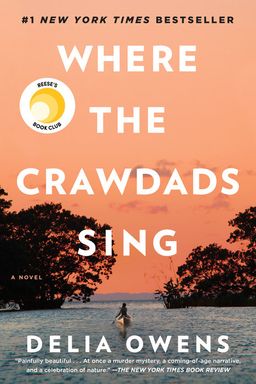
Where the Crawdads Sing cover

Where the Crawdads Sing

by Delia Owens

Where the Crawdads Sing is a captivating tale of survival, love, and mystery set in the marshlands of North Carolina. Follow Kya''s journey from isolation to self-discovery as she navigates her complex relationship with nature and uncovers the secrets of her past. Delia Owens weaves a compelling narrative that explores the profound impact of childhood and the quest for belonging.

The Wild Girl and the Language of Isolation

Have you ever wondered what happens when a child grows up completely cut off from the world, relying only on nature to teach her who she is? Where the Crawdads Sing by Delia Owens isn’t just a novel about loneliness—it's a meditation on survival, belonging, and the ways isolation can both wound and sustain the human spirit. Owens contends that when people are stripped of society’s safety nets, their instincts—especially those of observation, adaptation, and storytelling—become their truest tools of survival.

Through Kya Clark—the mysterious Marsh Girl of Barkley Cove—Owens creates a haunting portrait of what it means to grow up wild in a world that refuses to see you. The marsh in North Carolina is more than Kya’s home; it becomes her mother, teacher, and witness. Her story explores how trauma evolves into solitude, how connection reawakens the heart, and how knowledge, both scientific and emotional, becomes a way to build meaning in an otherwise desolate life.

Isolation as Identity

Set against the backdrop of the mid-20th century southern coast, Kya’s story begins in abandonment. Each family member leaves one by one—her mother first, then her siblings, and eventually her father. Alone at ten years old, Kya is forced to care for herself. Her survival depends not on human connection but on the ecosystem around her. While most readers imagine isolation as bleak and empty, Owens redefines it as fertile ground for growth. The marsh becomes a metaphor for resilience—a place that seems inhospitable but sustains breathtaking biodiversity, much like Kya herself.

Owens, a wildlife scientist by training, infuses Kya’s story with ecological consciousness. Every observation Kya makes—the feeding patterns of herons, the habits of shrimp, the mating rituals of gulls—parallels her understanding of human behavior. Just as she categorizes creatures, she later learns to categorize her own emotions. In this way, isolation gives birth to her identity. Where social neglect once diminished her, scientific curiosity restores her sense of agency.

The Dual Nature of Solitude

The marsh nurtures Kya, but it also imprisons her. Owens writes the landscape as both haven and trap. When Kya’s father disappears, she not only loses her last human tie; she also loses the possibility of childhood as others know it. Yet within that pain lies a paradoxical freedom. The same marsh that others dismiss as barren becomes her sanctuary—one where she learns not only to live but to think in tune with the rhythms of nature.

As readers, you begin to see how solitude can foster self-knowledge. Much like Henry David Thoreau’s Walden, Owens presents nature as the ultimate teacher, urging readers to look beyond noise and distraction for meaning. Yet, unlike Thoreau, Owens shows the darker undercurrent—how that same solitude can wound deeply, creating desperation for connection.

Loneliness and the Search for Connection

When Tate Walker enters the story, he becomes the embodiment of the world Kya both yearns for and fears. Tate teaches her to read—a symbolic act that bridges her isolate existence with collective human knowledge. The moment she reads her first word, she begins to master more than language; she begins to understand her own story. Education becomes liberation. Yet, like the tides of her marsh, love recedes as swiftly as it arrives. Tate’s departure leaves Kya crushed, reaffirming her instinct to retreat from humanity.

Enter Chase Andrews—the opposite of Tate in every way. Handsome, privileged, and careless, Chase represents the world that has always judged Kya. To him, she is exotic; to her, he is possibility. Through Chase, Owens reveals how loneliness can distort love, causing you to accept illusions simply to escape silence. Kya’s heartbreaking affair with Chase, coupled with his betrayal, becomes a crucible that hardens her independence and transforms her pain into purpose.

Knowledge as Survival

Throughout the story, Owens uses Kya’s curiosity to mirror her own background in zoology. For Kya, classification equals control. The ability to name feathers, shells, and insect species brings order to her chaotic emotions. It’s her way of reclaiming agency—of finding a logic to a world that has been nothing but unpredictable. When she becomes an amateur naturalist, her drawings and notes turn into her legacy, eventually gaining recognition from the same society that once scorned her. This transformation underscores Owens’s message that knowledge—especially self-acquired knowledge—can bridge even the deepest divides.

Why This Story Matters

Owens’s novel resonates because it speaks to a universal human truth: we all crave connection, yet fear its cost. Kya’s journey reminds readers that isolation doesn’t always destroy—it can also clarify. In a time when many people experience social disconnection despite digital connectivity, Kya’s story asks us to consider what sustains us when the world forgets us. Her life, stitched from solitude and discovery, ultimately teaches that survival is not just about food and shelter—it’s about finding meaning, however isolated we may be. The marsh, in all its harshness and beauty, becomes a mirror for the human condition.


A Childhood Shaped by Abandonment

Kya’s early years are defined by absence—of love, safety, and family. Her mother’s departure when Kya is just six leaves a wound that never fully heals. Each sibling’s subsequent flight deepens her sense of being disposable. Even her father’s inconsistent presence feels conditional. For anyone who has ever faced abandonment, Kya’s story offers a powerful portrait of how a young mind tries to make sense of loss.

The Marsh as Parent

In the vacuum left by her family, the marsh becomes Kya’s surrogate parent. The landscape feeds her, shelters her, and teaches her laws of adaption and observation. As she gathers mussels to sell to Jumpin’, she learns to read the language of tides and currents. Nature becomes her textbook; self-sufficiency, her curriculum. This relationship with the environment blurs the line between survival and spirituality—each mudflat and gull echoes with lessons in endurance.

Learning Beyond the Classroom

Kya’s one visit to school ends in humiliation, underscoring her alienation from human society. Her misstep in spelling “dog” as “G-O-D” reveals not ignorance but innocence—a world untutored in social rules but rich in intuition. Owens contrasts institutional learning with experiential knowledge, suggesting that true wisdom often comes from observation, not instruction. It is this self-created education that will later enable Kya to thrive where others would perish.

(In a similar vein, Mark Twain’s The Adventures of Huckleberry Finn presents a young protagonist learning morality from nature rather than society.)


Survival and Self-Reliance

After her father’s disappearance, ten-year-old Kya embodies radical independence. With no one left to rely on, she gathers food, navigates barter systems, and protects herself from scrutiny. Rather than succumb to despair, she transforms necessity into creativity. You watch a child turn survival into art.

Trading, Trust, and Dignity

Jumpin’ and his wife Mabel become the only adults who treat Kya with respect. Their small acts—buying her mussels, giving her gently used clothes—allow her dignity to survive. In a deeply segregated South, Owens subtly inverts expectations: it’s the Black couple on the margins who extend genuine humanity to the white outcast. Compassion, Owens suggests, often arises from shared struggles.

Nature as a Toolkit

For Kya, every plant, animal, and tide pattern becomes part of her survival toolkit. This mirrors Owens’s ecological view: interconnectedness sustains all life forms. When you’re alone, awareness becomes synonymous with safety. The key lesson here is one of mindfulness—seeing the world clearly enough to live harmoniously with it, not apart from it.

Owens’s scientific background turns Kya’s survival story into a vivid manual of coexistence. Knowledge isn’t just power—it’s protection.


The Awakening of Knowledge and Love

When Tate enters Kya’s life, love and learning arrive together. His offer to teach her to read opens a gateway to both intellectual and emotional intimacy. Through reading, Kya gains language to articulate what the marsh has always whispered to her. Her relationship with Tate mirrors her relationship with knowledge: both bring joy and risk.

The Transformative Power of Literacy

Each new word expands Kya’s world. Reading Ma’s old poetry books gives her glimpses of emotions she’s never dared to name. Biology textbooks deepen her scientific understanding. For readers, Kya’s transformation underscores how education—formal or not—grant us authorship of our own story. It’s reminiscent of Maya Angelou’s assertion that “words mean more than what is set down on paper.”

Love as Exposure

Yet, love also exposes Kya’s deepest wounds. When Tate leaves for college, his absence echoes her mother’s departure. Trust once again becomes betrayal. Owens uses this heartbreak to explore how trauma repeats itself, compelling us to either retreat or evolve. Kya retreats at first—but the pain fuels her later achievements. Solitude, strangely, becomes her forge for resilience.

(Compare this to Charlotte Brontë’s Jane Eyre, where love similarly becomes both liberation and test.)


Illusion, Desire, and Betrayal

Chase Andrews embodies everything dangerous about longing for belonging. To Kya, he represents a bridge into normal life; to him, she’s a passing fantasy. The resulting relationship is a study in asymmetrical desire—one seeks connection, the other exploitation. Owens captures how loneliness can cloud judgment, making illusions appear as salvation.

The Performance of Belonging

Chase promises marriage, speaks of homes and children, yet never introduces Kya to his world. His charm becomes a performance designed to extract trust. When Kya discovers his engagement to another woman, the devastation runs deeper than betrayal—it confirms her worst fear: that she’ll always be “the Marsh Girl,” never fully accepted. This heartbreak strengthens her self-reliance but also hardens her perception of society’s hypocrisy.

Loneliness’s Deceptive Pull

Owens presents Chase’s betrayal not as a failure of love but of empathy. Lonely people don’t just crave affection—they crave recognition. Kya’s vulnerability makes her prey to those who misunderstand her wildness as weakness. In this tension, Owens shows how social isolation and gendered expectations intertwine to endanger women ignored by their communities.

(The dynamic parallels Thomas Hardy’s Tess of the D’Urbervilles, another story where societal rejection and male entitlement create tragedy.)


Nature as Mirror and Redemption

Throughout Kya’s life, nature never abandons her. Every hardship finds echo and explanation in the rhythm of the marsh. Owens skillfully transforms ecology into metaphor: predators hunt, seasons change, and survival often comes at a moral cost.

The Marsh as Moral Landscape

Owens builds a direct parallel between natural law and human ethics. Just as weaker species develop camouflage, Kya learns emotional concealment. The lesson is neither sentimental nor cynical—it’s evolutionary. Surviving requires adaptation, but adaptation doesn’t erase pain. By the time she becomes a published naturalist, Kya hasn’t escaped her past, but she’s reframed it as part of a larger order of life.

Redemption Through Creation

Kya’s art and research become acts of redemption. Every illustrated feather or labeled shell rewrites her history of neglect into one of mastery. By documenting the marsh, she finally claims it—not as cage or wound, but as identity. Owens ends with a quiet assertion: creation heals what abandonment destroys. Through art, Kya leaves behind not her loneliness, but her legacy.

It’s a conclusion that resonates beyond its setting, reminding you that even the most solitary life can contribute beauty and understanding to the world.

Dig Deeper

Get personalized prompts to apply these lessons to your life and deepen your understanding.

Go Deeper

Get the Full Experience

Download Insight Books for AI-powered reflections, quizzes, and more.