
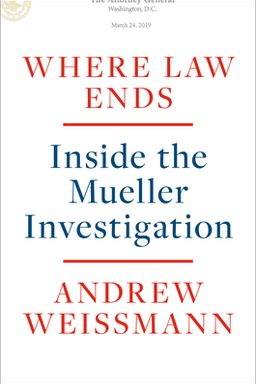
Where Law Ends cover

Where Law Ends

by Andrew Weissmann

Where Law Ends delves into the heart of the Mueller investigation, providing a comprehensive account of its findings and raising critical questions about the resilience of American democratic institutions in the face of unprecedented challenges.

Inside Mueller’s Investigation: Power, Law, and Restraint

How does truth survive inside a political storm? In Where Law Ends, Andrew Weissmann—senior prosecutor on Robert Mueller’s team—argues that the most important lessons from the Mueller investigation are not just about Russia or Trump, but about how legal institutions hold (or bend) when they operate under immense political pressure. The book is both memoir and dissection—a look at how investigations are built, how decisions get constrained by law and politics, and how subtle bureaucratic choices can redefine national accountability.

The ambition and the architecture

The story begins with structure. Mueller’s office—divided into Team R (Russia interference), Team M (Manafort’s finances), and Team 600 (obstruction)—was an elite but temporary institution. Each team operated semi-autonomously while reporting to Mueller and deputies like Aaron Zebley and Jim Quarles. As Weissmann explains, this structure wasn’t bureaucratic bloat; it was doctrinal discipline. Separate lanes allowed deep specialization, accountability, and the focus necessary for complex, high-stakes criminal work. Mueller’s leadership style—terse, precise, allergic to grandstanding—cultivated rigor but also a kind of institutional silence that later had political costs.

The investigative landscape

From the beginning, the Mueller probe straddled two worlds: intelligence and criminal law. You follow how Team R uncovered Russia’s “active measures”—operations led by the Internet Research Agency and GRU that aimed to manipulate voters through hacked emails and deceptive social media personas. Team M chased the money behind key figures like Paul Manafort, tracing offshore accounts and illegal lobbying under the Foreign Agents Registration Act (FARA). Team 600, meanwhile, explored whether President Trump’s actions—firing FBI Director James Comey, pressuring aides, and dangling pardons—constituted obstruction of justice.

This division of labor created a mosaic of interlinked cases: financial corruption yielding leverage for cooperation (Manafort and Gates), digital espionage exposing election interference (GRU indictments), and executive misuses of power illuminating systemic fragility. Each team’s discoveries informed the others, building a unified picture of vulnerability within American institutions.

The political constraints

But the investigation unfolded under constant existential threat. From early warnings by Aaron Zebley that “we could be shut down any day” to daily speculation about presidential firings, the Special Counsel’s Office operated under siege. Weissmann details how staff encrypted evidence, filed critical material in court to preserve it, and referred cases to U.S. Attorneys to ensure continuity. The ever-present possibility of termination—and the president’s pardon power—forced cautious, sometimes frustrating restraint. Certain lines of inquiry, such as the financial relationships of the Trump Organization or the Stormy Daniels matter, were deliberately handed off to avoid being accused of overreach.

These hard choices produce a paradox: prudence preserved the investigation’s survival but may have curtailed its ultimate impact. The constant tradeoff between scope and longevity defines the investigation’s legacy.

The core findings and the Barr problem

When the final report landed in March 2019, Mueller’s meticulous nonpartisan approach met Washington’s hyperpartisan reality. Attorney General William Barr’s four-page summary misrepresented the report’s nuance, declaring no collusion and no prosecutable obstruction. Weissmann recalls reading Barr’s letter in traffic and realizing the implications: tone and timing could outweigh a thousand pages of evidence. Mueller’s silence—born of institutional propriety—allowed others to define the narrative. Barr’s intervention reframed a careful legal record into political vindication, distorting public understanding and undercutting the investigation’s purpose.

The larger message

Across all of these elements runs a central theme: law operates through people and process, not myth. Weissmann invites you to see how institutional design, prosecutorial judgment, and human integrity shape the fate of legal truth. The book reveals how democratic accountability depends not only on evidence but also on how—and by whom—that evidence is communicated. The Mueller investigation succeeded in building an extraordinary factual record but failed to ensure that record’s meaning survived the political filters of its moment. For you as a citizen, lawyer, or policymaker, the lesson is profound: transparency, courage, and structural reform are as crucial to justice as fact-finding itself.


The Machinery of the Special Counsel

You can’t understand Mueller’s findings without understanding how his office functioned. Weissmann shows that organizational design is both a technical and ethical instrument. Three specialized units—Team R, Team M, and Team 600—gave the investigation focus and resilience. Each unit had prosecutors, agents, analysts, and experts whose collaboration mirrored a small law firm fused with an intelligence task force. This system balanced independence with accountability, ensuring each decision passed through legal and factual vetting. It’s a study in how governance works under pressure.

Mueller’s managerial minimalism

Mueller led as a general of restraint. He disdained grand speeches, favored one-page memos, and measured staff by efficiency and rigor. His mantra—“no lies, no spin”—defined the office’s culture. The internal joke “Stop playing with your food!” became a call to action: move fast, decide cleanly. Hiring was selective; most recruits were trusted veterans like Andrew Weissmann, Jeannie Rhee, Aaron Zebley, and Jim Quarles. This continuity bred confidence and exacting standards but sometimes insulated the team from public communication instincts the moment demanded.

Ethics and procedural guardrails

Strict adherence to DOJ policy defined every step—from grand jury use to press silence. Taking pains to respect prepublication review, classification, and privilege rules, Mueller refused political shortcuts. This self-restraint reinforced integrity but carried costs: when competing narratives filled the silence, the truth struggled to catch up. (Note: Weissmann later proposed a dual-track model allowing simultaneous transparency with confidentiality safeguards, similar to the 9/11 Commission’s approach.)

Lessons in institutional design

Through these operational details, you see how bureaucratic architecture shapes public outcomes. Precision of structure created investigative power; the same precision of silence enabled later distortion. The Special Counsel’s Office functioned as a model of prosecutorial excellence but also as a case study in how process and messaging are inseparable when truth meets politics.


Following Manafort’s Money

Weissmann calls Paul Manafort the “toehold”—the gateway to understanding how illicit foreign money seeped into American political space. As chairman of Trump’s campaign and longtime consultant to pro‑Kremlin figures like Viktor Yanukovych and Russian oligarch Oleg Deripaska, Manafort linked domestic politics to transnational corruption networks. Team M’s approach was classic prosecutorial strategy: follow the money, build leverage, and flip insiders.

Building the case

Four existing DOJ inquiries—tax, money laundering, FARA, and bank fraud—were consolidated when Mueller formed his office. Forensic accountants and international treaty channels (MLATs) helped trace funds from Cyprus shell entities to luxury assets: bespoke suits, real estate, and car payments. A “hot document”—an email where Manafort falsely denied foreign accounts—clinched intent. Evidence of willful falsification laid the foundation for the Virginia and D.C. trials that exposed the depth of Manafort’s schemes.

Flipping the insider: Rick Gates

Rick Gates, Manafort’s deputy, became pivotal. Under mounting evidence—including Cyprus banking records—he pivoted from loyalty to cooperation. Prosecutors used reverse proffers to show the hopelessness of his case, layered charges to ensure honesty, and protected him from external interference. Gates provided critical testimony about internal campaign communications, including the Grand Havana Room meeting with Russian-linked operative Konstantin Kilimnik. By flipping Gates, prosecutors created a bridge between financial crimes and political contact with foreign interests.

Inside the Grand Havana Room

Gates revealed that in August 2016, Manafort shared internal polling—highlighting Michigan, Wisconsin, Pennsylvania, and Minnesota—with Kilimnik via encrypted channels. That act matters because it suggests a possible conduit by which Russia’s disinformation machinery could tailor digital operations. Whether data was used this way remains partly speculative, but the episode underscores how campaigns’ internal analytics can become tools for foreign manipulation. Following the money and data, Team M mapped the mechanics of influence in the 2016 election and redefined how you think about “collusion.”


Russia’s Cyber and Influence War

To grasp the stakes of Mueller’s work, you must see what Team R uncovered: a military-style, multi‑front campaign to divide the U.S. electorate. Russian actors didn’t just hack emails—they engineered emotional contagion. The Internet Research Agency ran thousands of social media personas, while GRU operatives hacked and released troves of politically damaging documents. Weissmann writes that Facebook’s late disclosure of paid Russian ads opened the investigative floodgates, revealing direct financial and operational links to oligarch Yevgeny Prigozhin’s empire.

The anatomy of interference

The IRA’s tactics resembled a psychological operation. Fake activists, ad buys in rubles, and cross-platform memes targeted wedge issues—race, religion, and immigration. GRU’s spear-phishing and malware infiltrated Democratic systems; stolen materials leaked through fronts like DCLeaks and Guccifer 2.0, then amplified by WikiLeaks. Timing was surgical: WikiLeaks’ releases coincided with the Access Hollywood tape, diverting coverage and reshaping the 2016 narrative. The conspiracy wasn’t a single act but a choreography between cyber theft and media manipulation.

Legal and evidentiary tactics

Because suspects lived abroad, the team turned technical evidence into public indictments. By charging GRU agents, the office exposed detailed forensic trails—VPNs, Bitcoin payments, command‑and‑control servers—that documented how a foreign government weaponized digital influence. These indictments, like the Nuremberg records for the digital age, provided a permanent, judicially verified account of election interference even without arrests.

For you, the implication is clear: cybersecurity now defines democratic security. The law alone can’t deter such influence; it must be paired with public literacy and technological reform. Mueller’s record remains one of the most thorough legal chronicles of modern information warfare.


Obstruction, Power, and the Presidency

The legal drama at the heart of Where Law Ends centers on a question: can a president, vested with lawful authority, still commit obstruction if his motive is corrupt? Team 600’s investigation of James Comey’s firing, Trump’s pressure on Jeff Sessions, and his directives to White House Counsel Don McGahn test that boundary. Weissmann recounts the evidence—Comey’s memos, draft letters, phone logs, and McGahn’s notes—that exposed attempts to curtail the probe.

From Flynn to firing orders

It began with the President asking Comey to “let Flynn go,” progressed to efforts to have Sessions un‑recuse, and peaked when Trump ordered McGahn to call Rod Rosenstein to remove Mueller for “conflicts.” McGahn refused, viewing it as a Saturday Night Massacre replay, and documented every exchange. His resistance preserved a factual record of obstruction attempts—proof that ethical individuals can be guardrails when formal law falters.

Legal gray zones

Mueller’s team faced an unresolved dilemma: if DOJ policy forbids indicting a sitting president, could they even state a conclusion? They chose to document evidence without pronouncing guilt, effectively inviting Congress to decide. That restraint preserved procedural fairness but created interpretive ambiguity. Weissmann criticizes this as over‑deference—what he calls “where law ends,” echoing Hobbes’s warning that unchecked power sits beyond justice.

The pattern of pressure

When viewed collectively—public attacks on witnesses, praise for loyal silence, and pardon hints—the president’s conduct formed a mosaic of obstruction in spirit if not in a chargeable statute. The legal lesson: authority does not sanitize intent. Mueller’s factual narrative of obstruction is, in Weissmann’s words, “the roadmap we couldn’t complete.”


Trials and Political Crossfire

When cases left the investigative phase and entered courtrooms, legal strategy collided with media warfare. Manafort’s twin trials—in Virginia and D.C.—demonstrated how judicial persona and presidential influence can tilt the field. Judge T.S. Ellis’s open reprimands of prosecutors at the Virginia trial often rattled jurors; Trump’s public praise of Manafort (“brave man”) and comparisons to Al Capone sent unmistakable signals about loyalty and retribution.

Judicial temperament and evidence resilience

Weissmann’s takeaway is practical: anticipate bias, over‑document facts, and let exhibits speak louder than rhetoric. Redundancy in evidence insulated convictions against performative courtroom dynamics. The trials also exposed the fragility of juror independence in highly politicized settings.

Witness tampering and pardon signals

The specter of presidential pardon hung over every negotiation, dulling incentives to cooperate. Manafort’s refusal to flip—even after conviction—illustrated how political assurance can neutralize prosecutorial leverage. Weissmann argues that the pardon power, largely unchecked, became a shadow obstruction device. The trials thus became not just legal showdowns but morality plays on the boundaries of executive influence.


Decisions, Silence, and the Aftermath

The final chapters grapple with institutional restraint—most visibly, Mueller’s refusal to subpoena the president and his decision to end without explicit charges. Weissmann describes intense internal debates: Michael Dreeben and others thought the team could legally compel testimony; Mueller and Zebley feared a constitutional crisis and months of litigation. Prudence won, but at a cost. The absence of sworn testimony from the president and Mueller’s unwillingness to articulate prosecutorial judgment created a gap that Attorney General Barr filled with his own, misleading summary.

Process versus perception

Barr’s four‑page letter reframed two years of legal evidence in two sentences—declaring no collusion, no obstruction. The public absorbed that headline long before the redacted report emerged. Weissmann argues this demonstrated structural failure: special counsels depend on public‑minded political appointees to release findings fairly, a dependency ripe for abuse. The lesson is that transparency must be designed into law, not left to the goodwill of gatekeepers.

Toward reform

Weissmann calls for reforms: automatic public and congressional release of special‑counsel reports, more independent appointment authority, and permanent election‑interference units. The moral conclusion is sober: facts alone don’t guarantee truth’s survival. Institutions need procedural armor—rules that prevent silence from being weaponized. The Mueller investigation proved both the power and fragility of law when confronting a presidency willing to test its limits.

Dig Deeper

Get personalized prompts to apply these lessons to your life and deepen your understanding.

Go Deeper

Get the Full Experience

Download Insight Books for AI-powered reflections, quizzes, and more.