
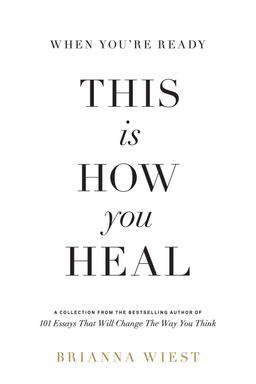
When You''re Ready, This Is How You Heal cover

When You''re Ready, This Is How You Heal

by Brianna Wiest

Brianna Wiest''s ''When You''re Ready, This Is How You Heal'' guides you through a journey of personal transformation. Discover empowering insights to overcome limitations, embrace change, and reclaim your true self. This book is your essential guide to healing and thriving authentically.

Healing as a Lifelong Journey of Awakening

Have you ever wondered why the same painful patterns keep reappearing in your life—why certain experiences feel like reruns of old wounds? In This Is How You Heal, Brianna Wiest argues that true healing is not a single event or epiphany but a lifelong practice of awakening. She contends that healing means remembering who you were before fear, ego, and conditioning obscured your true self. It’s a process of self-reclamation—not an escape from pain but an embrace of it as a teacher.

Wiest’s core message is radical yet comforting: healing doesn’t happen by fixing yourself, but by becoming yourself again. You heal not in the grand gestures or spiritual highs but through ordinary acts of awareness—breathing deeply, forgiving slowly, letting go, and trusting your heart more than your mind. Each moment is part of the unfolding, and if you answer the call to heal, you begin writing a new kind of story for your life. This book invites you to do just that: to turn inward and transform your perception of what healing looks like.

The Disruption That Starts Everything

Almost every healing journey begins with disruption: the job that ends unexpectedly, the relationship that dissolves, the loss that rattles your identity. Wiest writes that these moments wake us from our autopilot existence. They are not punishment but invitation—a “greater life pressing to be born.” The pain that feels arbitrary is actually a coded signal asking you to stop running from yourself. If you ignore the call, it repeats until your subconscious finally agrees to embark on the journey of becoming.

Healing Is Remembering

The author reframes healing as remembrance. You don’t “get better” by erasing your wounds; you expand your awareness to include them. You realize that sadness, grief, and fear aren’t flaws—they’re aspects of being human. Your healed self does not live without pain; it simply doesn’t allow pain to control you. Healing is not linear. Life contracts before it expands, retreats before it leaps forward. You learn to flow with that rhythm.

The Ordinary Magic of Growth

Wiest dismantles the myth that transformation is dramatic. Most of your healing happens in ordinary days—in deep rest, in writing your thoughts down, in drinking water and showing up for small moments. The “47 ways to practice micro-healing” remind readers that profound change often begins in mundane acts. You heal when you stop performing, when you unfollow voices that fuel self-doubt, when you start dreaming again. Healing is not found in the extraordinary; it’s unearthed in the deeply ordinary.

Self-Responsibility and Letting Go

The journey inward is also a journey toward responsibility. It’s far easier to blame others than to look in the mirror and admit where you’ve limited yourself. Wiest urges readers to reclaim power by recognizing that energy is more precious than time. Protecting your energy means stopping the cycle of giving love to people who can’t reciprocate. Letting go, she teaches, isn’t an event—it’s a practice of releasing thoughts, attachments, and expectations daily, just like you exhale. Each release restores freedom.

Why This Matters in Modern Life

In an era obsessed with instant fixes and “high-vibe” healing, Wiest’s philosophy stands out for its depth and humility. She bridges modern psychology and spiritual wisdom—echoing thinkers like Eckhart Tolle and Tara Brach—by merging acceptance with accountability. Her approach reminds readers that healing the self ripples outward to heal the collective. Every healed person improves the world, because as she writes, “We are all pieces of the whole.”

Key Takeaway

Your first purpose is to heal—because becoming the person you were meant to be is itself world-changing. You are not broken; you are awakening. Every time life dismantles your plans, it’s leading you toward truth. Healing is not a chapter of your story—it’s how you learn to write the whole book differently.


How to Begin Your Healing Journey

When you’re ready to heal, it rarely feels like readiness. As Wiest writes in “When You’re Ready, This Is How You Heal,” the first sign isn’t peace—it’s discomfort. You sense a dull ache, an anxiety you can’t name. You count all the things that should make you happy but don’t. That’s not failure; that’s the invitation. It’s your soul saying: it’s safe now—you can finally feel what’s been buried.

Seeing Feelings as Messengers

Instead of projecting fear stories onto those uneasy feelings, Wiest suggests you treat them like signals from your subconscious. They are not warnings of future disaster—they are leftovers from the past, emotional experiences you never finished processing. These carry nourishment and wisdom or, sometimes, debris. Either way, they are part of your freedom map. What hurts most shows where you are not yet free.

Facing the Emotional Fire

Wiest holds nothing back—she tells you to cry for your 13-year-old heartbreak and your teenage alienation, to revisit old memories and rewrite them by inserting your current self. Healing, she says, is not about changing time but rewriting your story. The process is physical: you might sweat, shake, stretch, surrender. Many teachers echo this—the body stores unprocessed memories (as psychologist Peter Levine argues)—and only movement can release them. When you stop fighting pain and fully feel it, you burn away the walls around your heart.

Reconnecting with the Soul

Eventually, the fog clears. Life changes externally—you call old friends, start a new class, refresh your space. But the real shift is internal: you reconnect with your soul, your truest self that was buried beneath layers of identity and fear. Wiest writes, “You were never lost. You were only hidden.” The pain was your inner voice whispering that there’s more to life than this.

Processing in Real Time

Through emotional processing, you also learn how to live differently moving forward. Healing isn’t just cleaning up the past—it’s cultivating presence. When you lose someone, you cry. When you’re angry, you express it. When you desire, you speak. You begin to metabolize experience as it happens rather than storing it away. Carl Jung once said that “what you resist, persists”—Wiest’s approach echoes that truth with gentleness. Resistance delays healing; acceptance enacts it.

Key Takeaway

Healing starts the moment you stop running from yourself. Every emotion you fear contains wisdom waiting to guide you home. When you stop projecting and start listening, life stops repeating lessons—it begins expanding you.


Letting Go and Protection of Energy

One of Wiest’s most practical lessons is learning to let go—especially of people who aren’t ready to love you. In chapters like “Let Go of the People Who Aren’t Ready to Love You” and “You Have to Practice Letting Go,” she reminds you that love is not about proving your worth to those who can't see it. It’s about conserving your finite energy for people and experiences that align with your truth.

Your Energy Is Your Currency

Wiest flips the script: it’s not your time that’s limited, it’s your energy. What you give your energy to every day defines the reality you create. If someone constantly drains or disrespects you, that exchange keeps you stuck. Letting go is not rejection—it’s realignment. Like nature pruning itself, you stop feeding relationships, jobs, or habits that no longer grow you.

Attachment vs. Love

She distinguishes true love from attachment: if a relationship survives only on your effort, it isn’t love. It’s emotional labor disguised as connection. Loving someone who can’t meet you halfway doesn’t make you virtuous—it makes you exhausted. Letting go isn’t cruelty; it’s kindness to yourself. In this, Wiest echoes self-help voices like Melody Beattie, who defines detachment as freedom from control, not indifference.

The Practice of Release

Letting go is continuous. Every day, you exhale old arguments, outgrown dreams, heavy expectations. Wiest normalizes the difficulty: we mythologize letting go as an enlightened act, when in truth, it’s as ordinary as breathing. You don’t “move on” because someone’s memory vanishes; you move on by looking toward your next creation. You stop clinging to the illusion of control—recognizing, as she writes, that release isn’t a loss; it’s growth.

Key Takeaway

Letting go is not forgetting; it’s acceptance. Each release reclaims your energy and redirects it toward what will heal you. The hardest part is not releasing the past—it’s believing you deserve peace in the present.


Transformation and the Phases of Change

Deep change rarely feels graceful. In “The 8 Phases of Deep Personal Transformation,” Wiest outlines how growth unfolds through chaos, uncertainty, and awakening—a map that reassures you when life feels like it’s falling apart. The phases resemble a spiritual metamorphosis, similar to Joseph Campbell’s hero’s journey or Eckhart Tolle’s awakening process.

Phase 1: The Catalyst

Transformation begins with disruption—a breakup, loss, or internal discontent. Something forces you to question the status quo. This “positive disintegration,” a term inspired by psychologist Kazimierz Dabrowski, breaks down your old identity so a new one can form. Life rarely changes without a disruptor.

Phase 2–4: Denial, Emotion, and Processing

You cycle through denial, anger, and fear. But as Wiest reminds you, these emotions are not regressions—they’re progress markers. Facing them helps you unpack buried stories. Each old emotion teaches its lesson, showing where you have been living below your worth.

Phase 5–8: Rebuilding and Purpose

After processing, glimpses of clarity appear. You make small adjustments, take leaps of faith, and ultimately recognize purpose in the pain. You realize the storm was preparation, not punishment. Wiest writes that “destiny cannot be denied”—everything uncomfortable was shaping you for the breakthrough. Seeing that pattern transforms fear into trust.

Key Takeaway

Your transformation isn’t chaos—it’s choreography. Every discomfort is part of a necessary unfolding. If you can recognize the phases, you stop asking “why me” and start asking “what’s next.”


Overcoming Resistance and Psychological Bias

Healing also requires confronting the unconscious biases that make you resist growth. In “7 Psychological Biases That Are Making You Resist Your Own Growth,” Wiest blends psychology and spirituality to explain why self-sabotage happens so naturally—and how to reverse it.

Comfort in Discomfort

Gay Hendricks calls it the “upper limit problem” (from The Big Leap): we have a threshold for happiness, and exceeding it triggers anxiety. Wiest expands this idea—positive change feels uncomfortable because familiarity is safety. To grow, you must normalize ease and allow yourself to feel good.

Biases That Hold You Back

  • Negativity bias: believing bad outcomes are more realistic than good ones.
  • Sunk-cost fallacy: staying loyal to what you’ve invested in even when it’s failing.
  • Anchoring bias: clinging to your first belief and ignoring new evidence.
  • Extrapolation error: assuming today’s struggle defines your entire future.

Each bias keeps you in cycles of fear. The antidote is awareness—observe the pattern and act against it. If you fear failure, remind yourself that failure is feedback. If you stay stuck out of loyalty, consider that endings often preserve your integrity.

Balance Reflection and Action

Wiest also warns against using self-reflection as escapism—getting addicted to epiphanies without implementation. True growth begins when insight becomes habit. She reminds you that discipline may seem boring, but consistency transforms lives far more than inspiration ever could.

Key Takeaway

Growth demands self-awareness and action. Recognize your mental biases, then do the uncomfortable thing anyway. Comfort is not safety—it’s stagnation disguised as peace.


Rediscovering Purpose and Self-Trust

Many readers of Wiest’s work arrive stuck, uncertain about their direction. In “Trust That Your Heart Knows the Truth” and “Sometimes Purpose Can Be So Subtle,” she reframes purpose as presence. You don’t need to chase destiny—it’s already within you, waiting to be recognized through daily acts of awareness.

The Heart Versus The Mind

Your heart communicates through intuition, not logic. The mind craves structure; the heart embraces mystery. When you feel drawn to something that defies reason—starting over, creating art, moving cities—that’s your soul speaking. Wiest teaches that following these inklings is how courage becomes clarity.

Purpose in Everyday Presence

Purpose doesn’t have to be grand. It’s the way you treat others, how you show compassion, how you bring love into mundane moments. The world changes when ordinary people act with extraordinary presence. Wiest reminds readers that your greatest calling may already be unfolding quietly in how you love, listen, and live.

Faith in Timing

She encourages trust: you may not see the full path because knowing would disrupt divine timing. When you surrender, your heart leads you. This echoes ideas from Marianne Williamson and Paulo Coelho—purpose unfolds when you dare to live the questions, not demand the answers.

Key Takeaway

Purpose isn’t found—it’s remembered. When you stop forcing life to fit your mind’s design, your heart guides you toward what was meant for you all along.


Starting Over and Recreating Yourself

Eventually, healing demands starting over—not by running away, but by renewing where you stand. In “This Is How to Start Over, Even If You’re Staying Right Where You Are” and “I Hope You Learn How to Gently Start Over,” Wiest teaches that renewal isn’t about changing everything at once. It’s about reimagining how you see yourself and your surroundings.

Ending Before Beginning

Starting over usually feels like an ending—a collapse of the familiar. The relationship ends, the job disappears, the dream fades. Initially, it feels like devastation, but Wiest reframes this as possibility: things don’t end because you failed; they end because you’ve outgrown them. Starting anew begins with pruning what no longer blooms.

Rebuilding From Within

She encourages staying grounded where you are. Clean your home. Make dinner. Tend to your body. Build routines of peace. “We cannot keep running in circles,” she writes. You start over by healing your foundation, not chasing escape routes. True transformation happens in stillness—the courage to stay long enough to mend.

Gentle Rebirth

In later sections, Wiest calls this the art of gentle rebirth. You will die and be reborn many times in life. Each death—the lost identity, the broken dream—is a portal to deeper authenticity. She invites you to celebrate regeneration as natural rather than tragic. Growth doesn’t erase who you’ve been; it carries their lessons forward.

Key Takeaway

Starting over is not failure—it’s mastery. Every ending is an initiation into your next becoming. Life teaches renewal through letting go and staying present, even when it’s uncomfortable.

Dig Deeper

Get personalized prompts to apply these lessons to your life and deepen your understanding.

Go Deeper

Get the Full Experience

Download Insight Books for AI-powered reflections, quizzes, and more.