
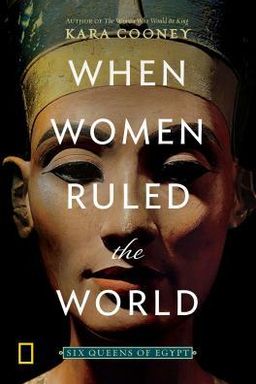
When Women Ruled the World cover

When Women Ruled the World

by Kara Cooney

When Women Ruled the World uncovers the reigns of six powerful queens of ancient Egypt, revealing how they navigated a patriarchal society to maintain authority. Through their stories, Kara Cooney provides timeless lessons on the strength and resilience of female leadership, offering a historical perspective that resonates with contemporary struggles for gender equality.

The Sacred Logic of Female Power in Egypt

Why could women rule ancient Egypt when nearly every other ancient society reserved kingship for men? The answer, the book argues, lies in religion, geography, and crisis. Egyptian myth, especially the divine drama of Isis, Osiris, and Horus, made female protection and regeneration central to kingship itself. The goddess Isis literally rebuilds the institution of kingship by resurrecting Osiris and enthroning her son Horus. That sacred script becomes political logic: when a royal boy is too young or no male heir exists, his mother—Isis’s earthly counterpart—is the most legitimate stabilizer of the throne.

Myth and Political Continuity

You see how theology becomes governance. In Egypt’s ideology, the king is Horus made flesh, but the royal house cannot survive without the feminine counterpart: the wife-mother who protects and regenerates divine lineage. Unlike Mesopotamia or early Israel, Egypt’s cosmic order (Ma’at) requires balance between masculine force and feminine fertility. This theological inclusion builds a conceptual space where queens—though exceptional—can be lawful rulers.

Practical politics reinforce this logic. Egypt’s stable Nile valley and isolated geography reduce civil‑war risk, allowing regency by mothers without provoking military coups. The religious ideal of the queen as protector aligns with pragmatic governance: she is least likely to harm her offspring and best equipped to safeguard dynastic continuity.

From Myth to Institution

As you move through Egypt’s history—from Merneith of Dynasty 1 to Cleopatra VII—the same logic recurs in different guises. Early queens operate as regents under sacred sanction; later rulers like Hatshepsut or Neferusobek adopt full royal titulary, transforming gendered norms into statecraft. Even Cleopatra’s claim to be Isis reborn repackages that ancient myth for Hellenistic diplomacy. Each of these women wields ideological instruments—priestly roles, divine imagery, selective masculinization—to make female rule both thinkable and legitimate.

When Religion Both Empowers and Constrains

Yet this theological scaffold also limits women. It enables queens to rise only as maternal protectors or divine stand‑ins, not as independent architects of policy. Their power often appears in moments of dynastic fracture rather than enduring stability. Egypt’s rulers—Merneith, Hatshepsut, Neferusobek, Nefertiti, Tawosret, Cleopatra—all illustrate the same paradox: divine sanction grants them access to the throne but also confines them to temporary roles meant to restore patriarchal order afterward. The myths that legitimize them also ensure their later erasure.

Core idea

Female rule in Egypt rests on a dual foundation: theological necessity and political pragmatism. Women become kings not to overthrow patriarchy but to preserve its divine façade when male succession falters.

The Book’s Arc

Across its chapters, the book traces how this sacred logic produces a pattern through 3,000 years: myth creates space for female sovereignty; crises activate it; success triggers erasure. You explore Merneith’s regency as early proof, Neferusobek’s dynastic last stand, Hatshepsut’s masterful propaganda, Nefertiti’s religious reinvention, Tawosret’s perilous kingship amid collapse, and Cleopatra’s fusion of sex, statecraft, and survival. In the end, Egypt’s story of female power teaches you that women could rule effectively within patriarchal systems—but always at the cost of being remembered only when memory itself faltered.


Regents of Crisis

The earliest queens—Merneith and Neferusobek—embody the prototype of crisis leadership. Both emerge in moments when dynastic continuity hangs by a thread. Their rule shows how maternal devotion becomes a political principle that holds the kingdom together.

Merneith’s Early Regency

Merneith of Dynasty 1 steps in after her husband Djet’s death, ruling for her young son Den. Her burial at Abydos, complete with royal insignia and sacrificial entourage, proves how seriously her contemporaries regarded her importance. But this world is brutal: hundreds of retainers die to secure the afterlife of kings. Merneith presides over these acts, using ritual violence to stabilize succession. She represents maternal legitimacy wrapped in terror and piety—the human enactment of Isis guarding Horus.

Neferusobek’s Dynastic Closure

Over a thousand years later, Neferusobek of Dynasty 12 repeats the pattern as Egypt’s last ruler of a fading family line. With no surviving male heir, she becomes pharaoh after Amenemhat IV. She feminizes royal titulary while invoking her father’s divinity and the crocodile god Sobek of the Fayum. Her short reign—just under four years—bridges dynastic collapse with grace. Like Merneith, she governs conservatively, drawing strength from religion and ancestor cults. Posterity records her name on the Turin King List, proving rare acknowledgment of a woman’s kingly identity.

Pattern

In crisis, Egypt chooses the least divisive leader—the mother or daughter of the dead king. Legitimacy comes not from conquest but from kinship and religious continuity.

Both Merneith and Neferusobek show how early and Middle Kingdom Egypt privileges conservatism over innovation. Women act as custodians, not revolutionaries, and their legitimacy depends on time-tested ritual rather than new ideology. That conservatism is precisely what keeps Egypt unified through succession gaps.


Hatshepsut and the Politics of Image

Hatshepsut transforms Egypt’s regency model into a stable kingship. As God's Wife of Amun, she controls temple wealth and priestly networks—the economic arteries of the state. When her husband Thutmose II dies leaving a child, she becomes regent and then king. Through temples, monuments, and propaganda, she recasts divine kingship in female form.

Religious Propaganda and Divine Authorization

You witness Hatshepsut’s genius for what modern scholars call political branding. In temple reliefs at Deir el-Bahri and Karnak, she stages her own divine birth from Amun himself. Obelisks proclaim “her majesty” with masculine and feminine pronouns deliberately intertwined. These narratives create sacred inevitability—she rules not by accident, but by godly design. (Note: this is one of the earliest uses of state-controlled storytelling to secure gender-transgressing power.)

Elite Patronage and Economic Control

Hatshepsut understands politics as patronage. She appoints loyal officials like Senenmut, shares wealth openly, and uses temple construction to bind elites to her rule. The prosperity of Egypt during her reign—the Punt expedition, temple expansions, and stability—proves that cooperation, not violence, can legitimate authority. Yet she masculinizes her image over time to placate expectations of what a “pharaoh” must look like: broad chest, false beard, short kilt. Her success coexists with performative conformity.

Aftermath

After her death, Thutmose III erases her names and usurps her monuments to rewrite continuity as masculine. Her very erasure underscores how memory itself becomes a political weapon against women.

Hatshepsut’s era proves that female rule was sustainable when backed by wealth, ritual legitimacy, and elite consensus—but never safe from historical rewriting. She sets the archetype for strategic gender performance in leadership: blend devotion, spectacle, and compromise to survive.


Nefertiti and the Amarna Experiments

Nefertiti lives through Egypt’s most radical religious reformation and becomes its co‑architect. As Great Royal Wife of Akhenaten, she helps construct Aten worship—a monotheistic solar theology that reshapes art, urbanism, and politics. When Akhenaten’s experiment collapses, she perhaps assumes a kingly role as Neferneferuaten or Smenkhkare, guiding Egypt from chaos to restoration.

Revolution of the Aten

The Amarna period overturns centuries of religious structure. Akhenaten suppresses Amun’s priesthood and builds a new capital at Akhetaten. Nefertiti is portrayed not as passive consort but as equal mediator with the god’s rays shining upon both rulers. Artistic reforms depict the royal family in intimate, androgynous poses—symbolizing spiritual partnership more than hierarchy.

Regency and Restoration

After plague, famine, and Akhenaten’s death, Nefertiti reorients policy. Archaeological evidence—reused royal grave goods, amended cartouches, and reactivated Amun temples—suggests she becomes Smenkhkare or Neferneferuaten to manage restoration and train the boy Tutankhaten. She masculinizes her regalia while retaining feminine features, embodying a transitional ruler between heretical past and orthodox future.

Archaeological Ghost

Debates about her tomb and identity (Nicholas Reeves’s theory linking her to hidden chambers in KV62) reveal how modern science still chases her disappearance. The erasure of her memory parallels the deliberate dismantling of the Amarna regime.

Nefertiti’s evolution—from queen to co‑king to vanishing sovereign—dramatizes how religion and power intertwine. She shows that innovation under sacred guise can redefine monarchy, but also that no experiment, however pious, escapes political backlash.


The Waning of Dynastic Women

As Egypt moves into the Ramesside age, the matrix that had once allowed women to rule contracts sharply. The sprawling families of Ramses II—scores of sons and daughters—turn royal lineage from a narrow divine line into political cacophony. Queens lose centralized religious power, and positions like God’s Wife of Amun become peripheral or ceremonial.

Tawosret’s Uphill Battle

Tawosret’s story in the late 19th Dynasty reveals this constriction. Initially regent for the crippled boy‑king Siptah, she holds the title God’s Wife to justify authority. Yet a bureaucrat named Bay wields economic control, even carving his image beside kings. Tawosret eventually executes him, asserting royal power, but once Siptah dies, her solo reign is doomed. Lacking blood legitimacy and surrounded by male rivals, she is overthrown by Setnakht, founder of Dynasty 20. Her tomb is reused; her legacy, suspect.

Lesson

By the late New Kingdom, structural decentralization—more heirs, more officials, more temples—erodes the framework that once sanctified female kingship. No woman will reign as pharaoh again until foreign queens like Cleopatra.

Tawosret thus marks the last native female king of ancient Egypt. Her rise and fall demonstrate how institutional design, not individual capacity, ultimately determines whether women can wield enduring power.


Cleopatra’s Calculated Empire

Cleopatra VII closes Egypt’s long experiment with female rule by wielding every available instrument—economic, diplomatic, religious, and sexual. She inherits a financially weakened Ptolemaic kingdom under Rome’s shadow. Her survival strategy is pragmatic: use charisma and alliances to anchor Egypt in Mediterranean geopolitics without direct conquest.

Crafting Power through Relationship

Cleopatra’s alliances with Julius Caesar and later Mark Antony are less about romance than political calculus. She provides ships, grain, and loyalty; in return she gains Rome’s protection and international recognition. Her children—Caesarion and Antony’s offspring—are instruments of foreign policy. The famous ‘Donations of Alexandria’ reimagine Egypt as a revived eastern empire led by her dynasty.

Religion and Image

Cleopatra fuses Hellenistic and Egyptian symbolism, styling herself as Isis incarnate and Antony as Osiris. On temple reliefs she nurses Horus, embodying divine motherhood; on Roman coins she appears as a ruler equal to male emperors. This dual imagery sustains her local legitimacy and confuses Roman gender norms. Yet Octavian’s propaganda weaponizes her femininity—depicting her as a corrupting eastern temptress—to justify conquest.

Afterlife of a Reputation

Cleopatra dies in defeat, but her political realism endures. She nearly builds an alternative Mediterranean power structure based on leverage and lineage rather than force—a model of soft power centuries ahead of its time.

Her suicide, whether literal or dramatized, seals both the end of Egypt’s sovereignty and the myth of the dangerous woman in power. The Rome that erased her also immortalized her.


Patterns of Power and Erasure

Stepping back, the book exposes a repeating structure across millennia: women’s authority surfaces in crisis, stabilizes the polity, then disappears in record‑keeping. Institutional need allows female kingship; patriarchal memory deletes it after use. The pattern is almost algorithmic.

Institutional Need

Egyptian elites resort to women not from ideology but pragmatism. A mother’s interest aligns with the dynasty’s survival. When order returns, gender norms resume their grip. Power shifts are remembered as anomalies, not precedents.

Gendered Adaptation

Each queen manipulates gender codes differently. Hatshepsut masculinizes; Neferusobek feminizes her kingly titles; Nefertiti merges gendered imagery; Cleopatra eroticizes divine motherhood. Language and iconography become flexible political tools, yet adaptation never transcends patriarchy—it merely navigates within it.

Memory Politics

Erasure—chiselled names, usurped tombs, missing king lists—is political revenge disguised as restoration. Successors rewrite history to masculinize continuity. Modern parallels abound: female leaders who stabilize nations only to be vilified afterward. The book asks you to see this as structural bias, not isolated misogyny.

Final Argument

Female governance in Egypt was systemic, not sporadic, and its suppression in memory is as informative as its exercise. To understand patriarchy, study when it momentarily lets women rule—and why it cannot bear to remember them.

The conclusion turns reflective: modern societies, too, summon women to manage crises and then critique them for compromise. Ancient Egypt becomes both mirror and warning—showing that gendered patterns of power and erasure are as enduring as stone.

Dig Deeper

Get personalized prompts to apply these lessons to your life and deepen your understanding.

Go Deeper

Get the Full Experience

Download Insight Books for AI-powered reflections, quizzes, and more.