
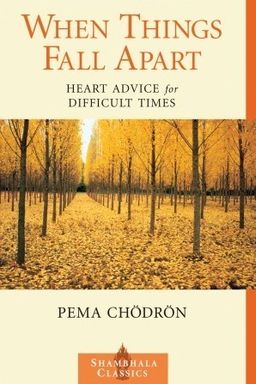
When Things Fall Apart cover

When Things Fall Apart

by Pema Chodron

When Things Fall Apart is a vital guide for navigating life''s toughest challenges. Pema Chodron shares transformative strategies like meditation, self-compassion, and embracing impermanence to build resilience and appreciate life more fully.

Embracing Chaos as the Path to Awakening

What if everything falling apart wasn't a sign of failure—but the start of something extraordinary? In When Things Fall Apart, Buddhist nun Pema Chödrön argues that the moments we most dread—loss, fear, pain, and uncertainty—are not barriers to awakening; they are the very gateways to it. Chödrön contends that when we stop trying to escape discomfort and instead lean directly into the chaos of life, we discover a raw, tender wisdom that is the foundation of compassion and joy.

This book isn’t about transcending suffering through denial or control. It’s about finding freedom within suffering by relaxing into the present moment of reality, however painful or ambiguous it feels. Chödrön offers a collection of Buddhist heart teachings that guide you through life’s breakdowns—not with promises of stability, but with the courage to stay on the edge of instability. She describes this approach as “leaning into the sharp points,” a phrase borrowed from her teacher Chögyam Trungpa Rinpoche, meaning that true spiritual growth emerges when you stop resisting the rough edges of existence.

The Core of the Teaching: Turning Toward Fear

From the first chapter, Chödrön frames fear not as an enemy but as a teacher. “Fear,” she says, “is a natural reaction to moving closer to the truth.” Her own encounters with fear—as when she arrived at Gampo Abbey and realized all her self-defenses were unraveling—demonstrate how meeting fear head-on transforms it into intimacy with truth. Like explorers crossing an unknown ocean, we must face fear’s vastness without guarantees. She insists the goal isn’t to eliminate fear but to become intimate with it—recognizing that every fearful moment holds the potential for openness.

In practice, this means staying with yourself when everything falls apart. You don’t look for a savior, a babysitter, or an escape. You learn to breathe through groundlessness—to let go of certainty and control. This realization echoes teachings from Zen, Tibetan Buddhism, and even Stoic philosophy (note: Seneca taught that tranquility arises when one stops demanding that life conform to expectations). All point to the same truth: suffering isn’t wrong—it’s reality revealing itself.

Groundlessness: The Heart of Spiritual Maturity

The book’s central motif is groundlessness—the absence of any permanent, secure foundation. Chödrön warns against our addiction to “hope,” which she defines as the belief that we can avoid uncertainty. In the chapter “Hopelessness and Death,” she calls for “ye tang che”—the total exhaustion of hope. Giving up this hope doesn’t mean becoming cynical; it means relaxing into the impermanence that pervades all things. Life is continually disintegrating and reforming, and our attempts to hold tight to stability create suffering. When you stop trying to get ground under your feet, you paradoxically find confidence—a vast, unrestricted connection with life as it is.

This concept resonates across many spiritual traditions. Chödrön’s “groundlessness” mirrors Eckhart Tolle’s present-moment consciousness and Alan Watts’s idea of “falling into being.” In the Buddhist view, recognizing impermanence and egolessness awakens compassion. When you see how everything changes—relationships, emotions, even identity—you stop clinging, and tenderness naturally arises.

Maitri: Unconditional Friendliness to Yourself

Underlying all of Chödrön’s teachings is maitri, or unconditional friendliness toward oneself. Without this foundation, she says, no spiritual path is sustainable. Many of her students, who wrote to her calling themselves “the worst person in the world,” illustrate our deep habit of self-condemnation. Maitri asks you to stop seeing yourself as a project to fix and instead cultivate gentleness toward every part of your being—the fear, confusion, anger, and longing. This kindness isn’t sentimental; it’s fierce compassion that refuses to abandon your own experience. Once you befriend yourself, empathy for others unfolds naturally.

The Path of the Warrior: Living with Open Heart

Chödrön often describes the practitioner as a warrior—someone brave enough to stay present with sorrow, boredom, disappointment, and uncertainty. “Getting the knack of relaxing in chaos,” she says, “is the spiritual path.” Through meditation, you learn this relaxation not as passivity but as active courage. Each breath becomes a return to openness. When you stop trying to make pain go away and instead allow it to exist, your mind softens, and joy emerges within the very space of vulnerability. The warrior’s strength is not in conquering life but in facing it with compassion and humor.

Beyond Solving Life: The Art of Transformation

Ultimately, Chödrön’s argument is radical: life doesn’t need solving. Things come together and fall apart again—that’s the dance of existence. We can use each collapse as a chance to wake up. Through stories of Buddhist masters like Naropa, Milarepa, and Tilopa, she shows that enlightenment always begins in confusion and failure. When you stop fighting “what is” and begin listening to it directly, suffering turns into insight.

“Only to the extent that we expose ourselves over and over to annihilation can that which is indestructible be found in us.” – Pema Chödrön

In summary, When Things Fall Apart teaches that your breakdown moments aren’t detours from spiritual growth—they are the path itself. By cultivating maitri, embracing hopelessness, practicing nonaggression, and relaxing with uncertainty, you turn suffering into awakening. This is the journey from fear to fearlessness—from trying to manage life to letting it transform you. In Chödrön’s words, “Chaos should be regarded as extremely good news.”


Making Friends with Fear

Fear, according to Pema Chödrön, is not a mistake in the human system—it’s a sign we’re stepping closer to truth. In the opening chapter, “Intimacy with Fear,” she redefines fear as the doorway into deeper awareness. Rather than fix or avoid it, she encourages you to study your fear like a scientist studies a specimen—curiously, directly, without aggression.

Accepting Fear as a Companion

You cannot live courageously unless you first learn to live with fear. Chödrön compares this relationship to explorers venturing into unknown seas—their fear is proof they’re moving beyond the familiar. She shares the story of a man who meditated in a hut in India and found himself face-to-face with a cobra. Frozen with terror, he finally began to cry—not out of despair, but gratitude. In that moment, fear stopped being his enemy; it became his greatest teacher. When dawn came, the snake was gone—but the transformation remained. Fear had introduced him to his heart.

The Courage to Stay on the Spot

Meditation is the training ground for learning this intimacy. When you sit down, all your instincts—running, fighting, controlling—arise. The practice is to stay still. “Being nailed to the spot,” as Chödrön calls it, means staying awake in the discomfort until it shows its true nature. This echoes Trungpa Rinpoche’s teachings on fearlessness: bravery isn’t the absence of fear; it’s moving forward with fear openly acknowledged. In everyday life, that might mean sitting with the anxiety before sending the email, walking into the difficult conversation, or saying yes when your heart trembles.

Fear as Buddha Nature

Each time you confront fear without fleeing, you discover tenderness underneath it. “Buddha nature,” says Chödrön, “cleverly disguised as fear, kicks our ass into being receptive.” That raw sensitivity is the foundation of compassion. It’s why, in Tibetan Buddhism, bodhisattvas face the monsters rather than destroy them. Fear isn’t a sign that you’re failing on the path—it’s a sign that your heart is opening.

“Usually we think that brave people have no fear. The truth is that they are intimate with fear.”

From this perspective, fear becomes sacred. Every time you allow it, you dissolve one more layer of self-protection. Every time you stay present in it, your compassion grows larger. And with practice, fear doesn’t vanish—it transforms. It ceases to dictate your choices and instead guides your awakening.


The Wisdom of Groundlessness

Groundlessness, or living without certainty, is the pulse of Pema Chödrön’s entire philosophy. In the chapter “Hopelessness and Death,” she invites you to give up hope—not because life is dark, but because hope and fear are the same chain binding you to suffering. In Tibetan, the phrase ye tang che means “completely fed up”—a recognition that chasing after stability never works. Only when you stop looking for solid ground do you discover freedom.

Giving Up Hope

Most of us cling to the idea that we’ll one day be “okay.” We imagine a future when pain disappears, when the confusion ends. Chödrön calls this addiction to hope “theism”—the belief that there’s always a hand to hold. Nontheism, by contrast, is trusting reality completely. When you stop waiting for rescue, life becomes vivid. This hopelessness is not despair; it’s confidence beyond conditions. “Begin the journey without hope,” she says. “Begin with hopelessness.”

Death in Everyday Life

We don’t fear life—we fear death, says Chödrön. Yet death is everywhere: the end of a day, the end of a breath, the end of a thought. Shunryu Suzuki Roshi described it as “getting into a boat that’s just about to sail out to sea and sink.” Accepting this truth softens everything. When you stop denying endings, you make peace with change. Chödrön recounts a story of cutting your finger—not just bleeding, but adding “style” to the drama. Instead of simple response, we panic, embellish, and amplify suffering. The invitation is to return to “bare bones”—to the minimal, honest state of just being alive.

Confidence in Impermanence

True confidence, Chödrön writes, comes from relaxing with groundlessness—not by building walls but by opening to wind. When you can rest in impermanence, you no longer resist death, endings, or failure. You live fully because there’s nothing left to guard. This realization turns fear into liberation. Hope and fear may have ruled your life before, but once hopelessness is embraced, joy and compassion emerge effortlessly. All ground disappears—and with it, the walls between you and everything else.


Maitri and the Practice of Loving-Kindness

Maitri—the Sanskrit word for unconditional friendliness—is at the center of Pema Chödrön’s teachings. It means befriending yourself completely, even the parts you most despise. “It’s never too late,” she tells the countless people who wrote to her calling themselves hopeless or evil. Maitri asks you to stop managing your humanity and start embracing it.

Making Peace with Your Demons

In a striking story, Chödrön recalls a friend who suffered nightmares about monsters. One night, instead of running, she turned around to face them. The monsters froze and faded. They weren’t dangerous—they were projections of fear. Maitri works the same way. When you stop fleeing your pain—your self-doubt, regret, jealousy—it loses the power to chase you. You learn to see even shame as part of your humanity, not proof of defect.

Gentleness Over Self-Improvement

Maitri isn’t self-improvement. It doesn’t mean convincing yourself you’re great. It means respecting yourself enough to stop violence against your own heart. This gentleness extends to meditation practice—sitting not to fix yourself, but to discover that you’re already whole. Each time you notice thoughts and return to breathing, you practice unconditional friendliness. You stop waging war with who you are and begin to relax.

The Courage to Live Without Armor

Chödrön says most of humanity is poisoned by self-doubt. We wear armor—a thick self-image—to protect from pain. Maitri melts this armor. It allows us to see life’s beauty again, like taking off a black hood in a field of wildflowers. When you treat yourself with kindness, your heart naturally extends that love outward. This, she shows, is how loving-kindness becomes compassion—not by trying to save others, but by dismantling your own interior war.


Learning from Pain and Chaos

Chödrön insists that pain isn’t something to avoid—it’s the curriculum for enlightenment. “Chaos,” she jokes, “should be regarded as extremely good news.” In chapters like “Secret Oral Instructions” and “Three Methods for Working with Chaos,” she outlines how discomfort itself teaches wisdom.

No More Struggle

Meditation reveals that struggle is optional. Whatever arises—anger, loneliness, restlessness—you can look directly at it and name it “thinking.” This simple pause dissolves aggression. In Chödrön’s philosophy, mindfulness is a form of nonviolence: rather than fighting the noise of life, you let it unfold. As Milarepa sang, “The demons came, and we should converse.” This openness transforms monsters into teachers.

Using Poison as Medicine

Pain can be recycled into healing through tonglen, a Tibetan practice of breathing in suffering and breathing out relief. When you stop rejecting discomfort, it becomes fuel for compassion. This insight echoes similar practices in Christian mysticism and Stoic resilience (note: Marcus Aurelius viewed adversity as material for virtue). By taking in your own and others’ suffering, you widen your empathy and dissolve the illusion of separateness.

Seeing Everything as Wisdom

Even the messiest parts of life—the “charnel grounds” of failure and death—can be seen as manifestations of enlightenment. The idea isn’t to beautify chaos, but to stop labeling it as impurity. When you face decay honestly, insight arises. Every heartbreak, every argument, every broken plan is sacred energy teaching you how to wake up.

Together, these methods form a radical practicality: you don’t need to escape chaos to grow, you only need to turn toward it. Pain becomes medicine; falling apart becomes the teacher.


Practicing Compassion Through Connection

For Chödrön, compassion means expanding the circle of concern until it includes everyone, even those we dislike—and the parts of ourselves we reject. In “Widening the Circle of Compassion,” she teaches that empathy starts with self-acceptance and grows through genuine communication.

Begin With Yourself

You can only meet others’ pain if you’ve met your own. Each time you stop blaming others, you touch softness instead of bitterness. Chödrön cites the Mahayana slogan, “Drive all blames into oneself.” But this isn’t self-punishment—it’s responsibility. When things hurt, it’s because we’re clinging to having it our way. Letting go of blame opens vast empathy for everyone struggling with the same tension.

Communication as Spiritual Practice

To communicate compassionately means being fully present rather than polarized. When you sit with someone and stop trying to make them “right” or “wrong,” conversation becomes sacred. Chödrön shares stories of helping students speak through anger by cultivating curiosity—not certainty. This nonaggression in speech heals relationships and transforms activism itself.

Patience with the Human Family

Roshi Bernard Glassman noted that helping the homeless wasn’t charity but reconnecting with ignored parts of himself. Chödrön echoes this truth: every act of compassion is an act of integration. When you face your shadows gently, you no longer separate yourself from anyone. Compassion isn’t moral perfection—it’s radical inclusion.


The Path Is the Goal

Chödrön concludes the book with the paradoxical truth that the path doesn’t lead anywhere—it is the destination. Enlightenment isn’t a distant summit but the practice of presence, moment by moment, within your existing life.

Everything is Workable

Borrowing from her teacher Trungpa Rinpoche, she writes: “Whatever occurs in the confused mind can be regarded as the path.” Every heartbreak, every argument, every fear is usable. The question isn’t “How do I escape this?” but “How can I wake up through this?” This mindset transforms pain into purpose. Life stops being something to fix and becomes a living meditation.

Now Is the Only Time

The future becomes irrelevant because wisdom exists only now. “If there’s any possibility of enlightenment,” Chödrön writes, “it’s right now.” You create your future through the state of mind you cultivate in this moment. Every choice, every breath plants a seed of awakening or confusion. The path unfolds naturally in the present.

Living Between Certainty and Openness

The art of living on the path is balancing gentleness and precision—being fully engaged and fully surrendered. Like Sartre’s statement that one can go to the gas chamber “free or not free,” Chödrön urges you to find freedom within the storm. When you embrace reality as it is, chaos becomes the teacher. Life ceases to push you around. You stop running and start residing in wakefulness itself.

Dig Deeper

Get personalized prompts to apply these lessons to your life and deepen your understanding.

Go Deeper

Get the Full Experience

Download Insight Books for AI-powered reflections, quizzes, and more.