
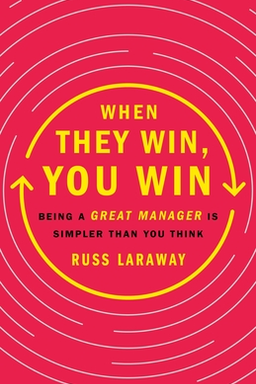
When They Win, You Win cover

When They Win, You Win

by Russ Laraway

In ''When They Win, You Win,'' Russ Laraway reveals how simple leadership principles can unlock employees'' potential and drive business success. Learn how to create engaged teams through clear direction, effective coaching, and meaningful career conversations, transforming management into a powerful catalyst for growth.

The Power of the Manager: Engagement and Results Through the Big 3

Have you ever wondered why some teams seem unstoppable while others constantly struggle? In When They Win, You Win, Russ Laraway argues that good management isn’t about charisma, innate leadership talent, or trendy corporate buzzwords—it’s about mastering a small set of repeatable behaviors that measurably drive employee engagement and results. Laraway’s message is disarmingly simple: managers explain 70 percent of the variance in engagement, and engaged employees deliver dramatically better performance. In other words, if you want exceptional business results, concentrate first on building exceptional managers.

Laraway, who’s led teams at Google, Twitter, and Qualtrics, distills nearly three decades of experience and data into a model he calls the Big 3—three core leadership practices that reliably produce what he calls “happy results”: Direction, Coaching, and Career. These are the behaviors high-impact managers practice consistently: ensuring clarity of expectations, coaching for success, and helping people grow their careers in meaningful ways.

Why Managers Matter More Than Anything

Laraway recounts how data from Gallup’s State of the Global Workplace report revealed an astonishing truth—companies in the top quartile of employee engagement outperform their peers by 21 percent in profitability and 17 percent in productivity. And yet, global engagement remains tragically low at around 15 percent. In the U.S., even though it's higher—about 33 percent—Laraway calls this “still abysmal,” pointing to a massive opportunity lost simply because most managers don’t know what good leadership looks like or haven’t been trained to deliver it.

Drawing on experience at Candor, Inc. (co-founded with Radical Candor author Kim Scott), Laraway discovered through interactions with over a thousand companies that while each firm claimed different problems—poor morale, high turnover, low productivity—they all traced back to the same root cause: low manager skill. Whether analyzing tech startups or Fortune 500 firms, it was clear that manager quality explained nearly three-quarters of engagement variance. Better engagement equaled better results. Worse managers led directly to worse outcomes.

The Big 3: A Simple but Proven Leadership System

Against the flood of confusing management advice, Laraway’s approach is refreshingly disciplined and minimalistic. He identifies just three levers that define an effective leader:

  • Direction: Ensuring every team member knows exactly what’s expected and when. This includes crafting a clear purpose, vision, quarterly goals (OKRs), and weekly priorities.
  • Coaching: Continuously helping employees improve and sustain good performance through frequent feedback and praise—both short-term correction and long-term growth.
  • Career: Investing in people as humans with long-term aspirations beyond their next promotion—helping them connect today’s work to future dreams.

At Google and Twitter, Laraway tested this Big 3 system during organizational crises. When he took over a large post-acquisition team at Google, culture and communication were broken, and time-to-delivery metrics were painfully high. Through the Big 3—clarifying new expectations, coaching through resistance, and investing in career paths—his group cut their delivery time from six months to under one month, raised engagement scores from below average to among the best, and ultimately won Google’s coveted Great Manager Award.

Data Meets Humanity

Laraway doesn’t rely solely on anecdotes. At Qualtrics, he empirically modeled what he calls the equation 3→E↔R—meaning the Big 3 (Direction, Coaching, Career) lead to Engagement (E), which is directly correlated with Results (R). Using the company’s data analytics tools, the team confirmed clear elastic relationships: a two-point increase in manager effectiveness predicted a one-point increase in engagement; and a five-point engagement bump correlated with a thirty-point increase in quota attainment or a five percent improvement in contract renewals. These relationships reinforced the Big 3 as a measurable system for organizational success—not just a feel-good philosophy.

Restoring Dignity to Management

At its heart, Laraway’s book is a manifesto for restoring dignity to the office of the manager. He dismantles the false dichotomy between “leaders” and “managers,” arguing that great managers must be both visionaries and tacticians—cartographers and navigators. Leadership only becomes magical when it produces real clarity and empowerment. Great managers, he writes, are “people empowerers.” Their job is not to command but to enable others’ success. When they do, everyone wins—the employees, the customers, and the company.

The book’s stories—from tech giants to marines to small teams—show that even in chaotic environments, managers hold the keys to engagement and excellence. With the Big 3 model, you don’t need to be charismatic or endlessly innovative; you just need to be deliberate. Every employee wants to be successful, Laraway says, and when you help them clarify what success looks like, coach them toward it, and connect it to their future, “problems such as low pride, poor retention, and missed targets take care of themselves.”

Ultimately, When They Win, You Win is both a management guide and a call to arms. Laraway believes that transforming how managers lead is a moral imperative: “People don’t leave bad jobs, they leave bad bosses.” Fix the managers, and you fix the world of work. When your people win, you win—every time.


Direction: Creating Clarity and Focus

If engagement starts with clarity, then Direction is the foundation of Laraway’s leadership model. Managers must become expert mapmakers—ensuring that every employee knows where they are, where they’re going, and how their work matters. Laraway’s four-part Direction framework—Purpose, Vision, OKRs, and Priorities—acts as a GPS for teams. It connects long-term meaning to short-term execution.

Purpose: The Team’s Reason for Being

Purpose answers a deceptively simple question: “Why do we exist?” In every team he’s led—from the Marines to Google—Laraway found that unclear purpose breeds confusion and burnout. He recommends managers run collaborative exercises with their teams to produce short, actionable purpose statements (like Disney’s “To make people happy”). The process matters as much as the product: when teams co-create purpose, ownership skyrockets. He illustrates this with examples from his own People Operations team at Qualtrics, which defined its purpose as “To power legendary experiences.”

Vision: The Hill Everyone Climbs

Vision is what Laraway calls “the common hill we’re all trying to climb.” It’s a clear, measurable picture of success at a future point. He cites JFK’s moonshot speech—“We choose to go to the moon”—as history’s clearest example of vision that both inspires and organizes effort. Great visions have one trait in common—they’re provable. Amazon’s “Earth’s most customer-centric company” or SpaceX’s “Enable people to live on other planets” each articulate future measurable states. Without vision, organizations become directionless; without purpose, they lose heart.

OKRs: Turning Vision into Measurable Goals

Objectives and Key Results (OKRs) transform lofty visions into quarterly, measurable commitments. Drawing on John Doerr’s Measure What Matters, Laraway explains that OKRs unite accountability and autonomy—people call their shot, then own it. At Google, he taught thousands to write OKRs that were outcome-oriented rather than input-loaded. He warns against common pitfalls: too many OKRs (the arms race), fuzzy success criteria, and meaningless “activity goals.” The solution? Create “output OKRs” with binary success metrics and collaborate with employees to ensure buy-in.

Prioritization: The Art of Subtraction

Laraway calls prioritization “an exercise in subtraction.” Inspired by Rick Rubin’s production mantra—“Time invested is irrelevant; the only criterion is, ‘Is it great?’”—he teaches managers to help employees ruthlessly focus on what matters most. At Qualtrics, this took the form of “snippets”—weekly lists of top-three priorities shared companywide. As CEO Zig Serafin reminded his leaders: “Your job is to create clarity and to be a simplifier.” Laraway adds: “If you have more than three priorities, you have none.”

Direction isn’t about commanding from above; it’s about ensuring clarity from within. When everyone knows both their purpose and priorities, ambiguity vanishes. Employees stop guessing what success looks like—and start achieving it.


Coaching: Building Better People Every Day

Coaching is Laraway’s second pillar of great management—the discipline of helping people succeed through continuous feedback, guidance, and praise. He believes most feedback systems fail because managers fear discomfort or lack the skill to coach effectively. Great coaching, he insists, is not a rare art—it’s a set of learnable habits built on listening, specificity, and honest care.

Improve: The Courageous Conversation

Drawing lessons from his Marine Corps days, Laraway recounts how his colonel taught him to own everything his unit did—or failed to do. When a subordinate caused an international incident, Laraway learned painfully that responsibility begins with communication. That story anchors his teaching on improvement feedback: managers must directly address observed behaviors using the SBI model (Situation–Behavior–Impact). He tells managers to start with “I noticed something that may be getting in your way. Are you in a place to hear it?” and proceed with clarity, not apology. Bill Walsh’s dictum applies here: “The score takes care of itself” once you fix behaviors systematically.

Continue: Praise as a Coaching Tool

Most managers underuse praise, treating it as fluff rather than data. Laraway counteracts that by promoting “continue coaching”—specific, behavioral praise aimed at reinforcing what works. Inspired by the Positive Coaching Alliance’s five-to-one praise-to-criticism ratio, he shares stories from coaching little league baseball where recognizing small wins transformed performance. At Qualtrics, top managers scored far above average on the metric: “My manager provides specific praise for good work.” Praise, when detailed and sincere, is an accelerator for engagement.

Coaching the Boss and Asking for Feedback

Feedback shouldn’t flow in one direction. Laraway dedicates chapters to teaching employees how to safely give feedback up the chain, using a four-step process: assess risk, gather context, ask permission, and deliver directly. For managers, he inverts the responsibility: ask for feedback often, listen without defensiveness, and always follow up. He shares how Twitter CEO Dick Costolo modeled candor by expecting unfiltered honesty—“I’d rather be wrong and fix it fast than hear polite silence.” Managers who solicit feedback signal humility and build trust.

Care Personally: Time, Help, Success

Laraway extends Kim Scott’s Radical Candor by revealing how to actually “care personally.” After six hundred leadership workshops, he found a pattern. Employees feel cared for when their manager takes time to help them be successful. Not when they ask about families or host forced happy hours. “Time, help, success,” he summarizes—the only universal recipe for care at work. When employees believe you’re investing real energy in their growth, loyalty and engagement become the natural outcome.

Coaching is about constant course correction—improvement and continuation woven together with compassion and candor. When you coach well, you convert discomfort into development, and results follow.


Career: Conversations That Transform Lives

Laraway’s third pillar—Career—is about helping people connect today’s job to their lifelong vision. In most companies, career conversations are either nonexistent or shallow, revolving around promotions. Laraway calls this the “Career Fight Club” problem: the first rule about career conversations is that they rarely happen at all. To fix it, he introduces a three-part process for authentic career dialogue that can transform relationships and retention: Life Story, Dreams, and Career Action Plan (CAP).

Life Story: Discovering Values through Dialogue

Managers start by asking employees to tell their life story—from childhood to present—and listen for patterns, choices, and turning points. “Every patient lies,” he jokes, borrowing from Dr. House, but they don’t lie about their life story. From these stories, extract five to ten core values. When one employee realized she switched from cheerleading to swimming because she loved tangible outcomes from hard work, the insight became foundational. Another discovered her joy in “building something from nothing.” These values later guide career planning.

Dreams: Defining the Lighthouse

Next comes vision. Laraway asks: “What’s your dream job?” Skeptics protest they don’t know what they want to be, but he insists everyone has a dream—it’s just fuzzy. Using what he calls the lighthouse metaphor, he helps managers and employees clarify three dimensions of the dream: industry, company size, and role. He describes helping Larry, an engineering leader at Google, articulate his aspiration: to become CEO of a midsize consumer tech company. Without that vision, Laraway says, Larry’s development would have remained random. With it, every step became deliberate.

Career Action Plan: Connecting Today to Tomorrow

Finally, translate dreams into action. The CAP has four components—make changes to the current role, develop skills formally, identify the next job, and activate networks. Laraway compares this to breaking down a boulder into gravel: each strategic goal must split into smaller, tangible pieces. For his future CEOs, the “big rocks” included building global operations experience and product management expertise. For others, it might mean leading new projects or pursuing certifications. “Your job,” he tells managers, “is to be a gravity-assisted slingshot, launching your people toward their careers.”

Career conversations are not soft perks—they’re high-leverage management tools. At Qualtrics, employees whose managers completed Career Action Plans scored 19 percent higher on overall manager effectiveness and 48 percent higher on growth support. These dialogues turn abstract corporate talk into human investment.

Laraway sums up the Career pillar with a profound truth: every person wants to be successful. Your role is to make that success meaningful—by aligning what they do today with who they want to become. The result is engagement that lasts well beyond annual reviews.


Restoring Dignity to Management

One of Laraway’s most passionate arguments is that modern workplaces have villainized managers. They’re portrayed as bureaucrats, while “leaders” enjoy all the glamour. He insists that management is not lesser—it is leadership in action. Managers are responsible for aligning outcomes and enabling people’s success. “It’s only when they win that you win,” he declares.

Leadership vs. Management: A False Divide

Laraway dismantles the common myth that leadership is inspiration while management is administration. Citing scholar Mats Alvesson’s satire on leadership grandiosity, he shows how companies fall for “cultures of grandiosity” where everyone wants to be a visionary and no one wants to run the trains. He recalls General Magic, a historical Silicon Valley startup bursting with geniuses but allergic to management—no structure, no accountability, and total collapse. Leadership without management becomes chaos.

Deliver and Enable: The Manager’s Two Jobs

Managers must master two duties: deliver an aligned result and enable others’ success. These are the heartbeats of managerial dignity. Whether you’re running a startup or a platoon, Laraway reminds you that you’re responsible for everything the team does or fails to do. When things go wrong—as in the Mann Gulch firefighting disaster of 1949—it’s the absence of communication and clarity that kills teams. Restoring dignity means elevating management to its rightful place as the craft of enabling performance, not merely tracking tasks.

Companies like Gusto, which renamed managers “people empowerers,” capture this essence. Laraway argues the best title isn’t about hierarchy; it’s about mission—to empower. Management is leadership with sleeves rolled up.

When you stop treating management as a fallback career and start treating it as a noble pursuit, everything changes. Laraway’s mantra rings through the book: Managers must lead. Empower people, clarify expectations, coach with courage, and build their futures. That’s dignity—and that’s leadership.


Data-Driven Leadership: Measuring What Works

Laraway’s approach is distinct from many leadership books because it’s relentlessly empirical. He doesn’t just propose ideals; he measures whether they work. By combining behavioral data (manager actions) with engagement and business performance metrics, he and his team at Qualtrics built a quantifiable link between good management and real results.

The Manager Effectiveness Index

To verify the Big 3’s impact, Laraway created a twelve-question Manager Effectiveness (ME) Index, asking employees to rate their managers on behaviors like clarity of expectations, responsiveness, soliciting feedback, and career support. The results were striking: high-performing managers outscored peers on every behavior and dramatically outperformed on two—seeking feedback and providing specific praise. These dimensions became predictors of engagement and revenue attainment.

Quantified Relationships

Using Qualtrics data, Laraway proved what many only suspected: a two-point rise in manager effectiveness corresponds to a one-point rise in engagement; a five-point rise in engagement brings thirty-point quota attainment and five percent higher renewal rate. These metrics bridge the gap between “soft” people practices and hard financial outcomes. They validate that empathy and structure aren’t opposites—they’re mutually reinforcing.

Turning Insight into Systems

Laraway encourages People Ops teams to institutionalize these insights using his STAC framework: Select managers carefully for disposition, Teach the leadership standard formally, Assess them using employee feedback, and Coach them toward continuous improvement. When companies measure leadership like any other business process, they protect against fads and ensure sustainable culture change. (Comparable approaches echo John Doerr’s metrics-driven management or Jim Collins’s disciplined people systems in Built to Last.)

Data doesn’t dehumanize management—it dignifies it. By tying behavior to outcomes, Laraway turns the art of leadership into a practiced science, creating a culture where caring and clarity drive measurable success.


The Manager’s Moral Imperative

Ultimately, Laraway insists that good management isn’t just effective—it’s ethical. Poor leadership spreads misery, while good leadership multiplies meaning. If managers explain 70 percent of engagement, they also explain 70 percent of joy or frustration in people’s work lives. He calls it a moral responsibility: to lead well is to improve human lives.

“You Can’t Suck as a Manager”

In one of his bluntest chapters, Laraway declares, “You just can’t suck as a manager.” Most poor managers weren’t malicious—they were undertrained, promoted for the wrong reasons, or overwhelmed by unclear expectations. But ignorance doesn’t absolve responsibility. Clarifying direction, coaching truthfully, and supporting careers are learnable duties. Every manager must “renew their license” regularly, he writes, because leadership affects lives.

Fix Managers, Fix Work

Bad management creates a cascade of disengagement—from burned-out employees to lost customers. Laraway connects this to the growing movement toward freelance work and self-employment: people flee bad bosses, not bad jobs. In an age of limitless mobility, the only sustainable competitive advantage is exceptional management. Fixing managers means fixing work itself—making organizations places of dignity, growth, and motivation instead of control and fear.

Laraway’s call to arms in his epilogue sums it up: “People deserve to be led well.” Management isn’t just about output—it’s about humanity. When you help others win, you elevate them, yourself, and the entire organization. That’s why his vision goes beyond companies—it’s about changing how the world works, one good manager at a time.

Dig Deeper

Get personalized prompts to apply these lessons to your life and deepen your understanding.

Go Deeper

Get the Full Experience

Download Insight Books for AI-powered reflections, quizzes, and more.