
Idea 1
A Murder, a Mystery, and Our Need for Certainty
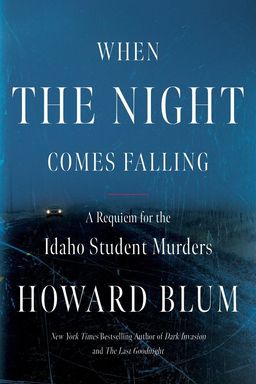
Have you ever felt the ache of not knowing—the way uncertainty gnaws at you long after the headlines fade? In When The Night Comes Falling, Howard Blum argues that the Idaho student murders are more than a sensational true-crime story; they’re a stress test of how modern America seeks truth when facts feel partial, institutions stumble, and grief won’t yield to easy answers. Blum contends that the case exposes a collision between old-school policing and new-school forensics, between official secrecy and crowdsourced speculation, and between a community’s yearning for justice and the courtroom’s demand for proof beyond reasonable doubt.
Blum structures his narrative as an odyssey—from a father–son road trip shadowed by secrets, to a small-town investigation, to a tech lab in Texas where twenty cells of DNA are spun into a family tree. Along the way, you follow portraits of the four victims whose lives were brimming with ordinary joys—football games, sorority formals, a new Range Rover surprise—and you sit with the parents whose lives split in two at the moment of the crime. The book’s core assertion is simple but unsettling: in a case like this, certainty arrives late, if at all, and often with costs you don’t anticipate.
What Blum Argues
Blum argues that the investigation, for all its missteps, ultimately weaves together three strands—video forensics, cell-site analysis, and investigative genetic genealogy (IGG)—into a cumulative case against Bryan Kohberger. But he also emphasizes the fragility of each strand: grainy cameras misclassify cars; cell towers cast wide nets; IGG is inferential and, by policy, can’t be the sole basis for arrest. This is not In Cold Blood certainty; it’s modern mosaic-building where gaps remain visible (a contrast worth noting with Truman Capote’s confident omniscience).
What You’ll Explore
- How early investigative errors—an inaccurate car year in a BOLO, a slow start on canvassing, a chief who reassured too quickly—nearly derailed momentum.
- How a knife sheath with trace DNA, a Linda Lane security camera, and a helpful gas-station manager nudge the case forward.
- How a father and son’s cross-country trip becomes the spine of a surveillance operation and, later, a pivotal trash-DNA match in Pennsylvania.
- How families—especially Steve Goncalves—push, probe, and sometimes collide with official narratives and social-media noise.
- How the defense tests every rivet in the state’s evidentiary bridge: touch-DNA reliability, motive gaps, cell data precision, and the possibility of some other dude did it (SODDI).
Why This Matters (to You)
You live in a world where investigations unfold in public, not just in court. You scroll body-cam clips and grainy surveillance grabs in near-real time, long before jurors ever see them. That changes how communities react, how rumors calcify, and how families grieve. Blum shows you what happens when the search for justice plays out across town halls, TikTok feeds, and Quantico pods—the way authority must now persuade in layers, not just prosecute in court (see also the modern arc traced in Michelle McNamara’s I’ll Be Gone in the Dark around DNA-enabled breakthroughs and public trust).
How the Story Unfolds
You begin with the house on King Road: six young women sign a lease and fill it with parties, study sessions, and Good Vibes neon. Then a Saturday split-screen: Xana and Ethan at a Sigma Chi event; Kaylee and Maddie at the Corner Club, where the bartender is Kaylee’s ex’s best friend. By 4:20 a.m. Sunday, a white sedan streaks from the street; by late morning, police find four students dead and a goldendoodle alive behind a bedroom door.
The middle act is a study in friction. A corporal named Brett Payne leads packed 7 a.m. briefings. Chief James Fry leans on the FBI, even as his early public comments (“no ongoing threat”) age badly. A gas-station night manager scrubs hours of video to spot a white car at 4:30 a.m.; an apartment rooftop camera on Linda Lane captures a similar blur; and the FBI’s Operational Technology Division, in a sandstone box at Quantico, first says Nissan, then Hyundai—finally, likely a 2014–2016 Elantra.
When CODIS can’t match the sheath DNA, Idaho ships twenty or so cells to Othram, a Texas lab founded by David and Kristen Mittelman (seeded, intriguingly, with money raised by investor John Burbank via a controversial middleman). The lab builds a profile, FBI genealogists plant it into public databases (GEDmatch, FamilyTreeDNA), and the branches lead to a PhD student in Pullman. Still, the Bureau holds the name close, launches a “hatbox” surveillance, and follows a father–son drive east—until two Indiana tailgating stops spook everyone. In Pennsylvania, Trooper Brian Noll snags trash from Albrightsville, and the lab reports a 99.9998% paternal match to the sheath DNA. Hours later, a SERT team finds the suspect awake at 1:30 a.m., packing personal garbage in Ziplocs with latex gloves.
The Hardest Part
Blum leaves you with the question law can’t finally answer: why. You hear the prosecution sketch a motive of wounded pride and spiraling academic stress; you watch the defense punch at gaps—no murder weapon found, no direct link to the victims, multiple alternative strands (including a nearby drug micro-economy) left unexplored. And you sit with an author who says, in essence: a killer needs someone to love and someone to hate—and sometimes the same person supplies both. That is not a legal conclusion; it’s a human one. And it’s why this book reads not just as a case file, but as a meditation on what happens to people when the night comes falling.