
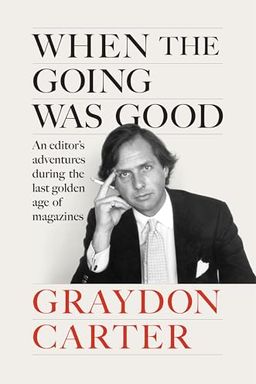
When The Going Was Good cover

When The Going Was Good

by Graydon Carter With James Fox

The co-creator of Spy and former editor of Vanity Fair retraces his storied career.

Editing As Cultural Leadership

What does it actually take to build a magazine that shapes culture instead of chasing it? In this memoir of a life in magazines, Graydon Carter argues that great editing is part craft, part logistics, and part diplomacy—anchored by a stubborn belief in narrative truth and a willingness to spend social and financial capital to get it right. You see an editor’s job not as line-by-line polish but as cultural stewardship: picking the right writers, backing them with legal and editorial muscle, designing events that amplify the brand, and navigating powerful owners and subjects without losing moral bearings.

You follow Carter’s arc from a frostbitten Canadian childhood and a bruising railroad apprenticeship to New York’s weekly machine at Time, the insurgent satire of Spy, the high-wire act of Vanity Fair, and finally the digital reinvention of Air Mail. Along the way, you watch how choices about people (writers, fixers, assistants), processes (fact-checking, legal review, kill decisions), and presentation (covers, photography, events) cohere into a magazine’s public authority. The lesson is portable: whether you run a newsroom, a start-up, or a festival, the same habits—clarity of point, meticulous execution, and fierce protection of your team—are nonnegotiable.

The Editor’s Four Jobs

First, you set the voice. Carter learned at Spy that a magazine without a sharp point will drift; a strong voice (Private Eye’s venom, Time-ese density, and Mad’s explanatory satire) can focus reporting and signal purpose. Second, you build an ecosystem of talent: recurring writers who serve as the franchise (Dominick Dunne, Marie Brenner, Michael Lewis), fixers who unlock access (Henry Porter), and senior editors who recruit heavyweights (Cullen Murphy bringing Joseph Stiglitz, William Langewiesche, Mark Bowden). Third, you engineer the process: a 15-foot planning board, two dozen fact-checkers, legal editor Robert Walsh, and “dotters” give you the infrastructure to publish bravely and survive scrutiny. Fourth, you convert cultural capital into public moments—covers, photographs, and live events (the Vanity Fair Oscar party) that project the magazine’s sensibility into the world.

Courage With a Safety Net

Carter’s account of the Deep Throat revelation shows the calculus behind a high-risk scoop. Vanity Fair had 95 percent confidence that Mark Felt was Deep Throat, based on family confirmations, lawyer John O’Connor’s article, and clues in Felt’s past—yet they built redundant safeguards: a locked room, an external server, a micro-circle of trusted staff (David Friend, Chris Garrett, Robert Walsh, Susan White), and a quiet photography workaround (Gasper Tringale instead of Annie Leibovitz). They choreographed a pre-press media rollout with ABC’s Beth Kseniak while awaiting corroboration from Bob Woodward and Carl Bernstein (Ben Bradlee ultimately nudged confirmation). The insight: you can move fast only if you’ve done the slow work—fact patterns, legal review, and airtight logistics.

Owner Dynamics and Long Leashes

Editors live or die by proprietors. Si Newhouse, both tastemaker and bankroll, gave Carter time and resources to build Vanity Fair—even as losses approached $100 million early on. He rarely interfered with editorial choices, yet he had principled boundaries (cartoons belong to The New Yorker; he backed the Iraq invasion while Carter opposed it). The tacit deal: the editor delivers cultural value; the owner provides runway and respects autonomy. (Note: this “benevolent patron” model—think Katharine Graham with Ben Bradlee—remains rare but transformative.)

Culture Is Also Hospitality

Magazines exist in rooms as well as on pages. The Oscar party at Morton’s used a single-room philosophy, egalitarian seating, rigorous gatekeeping (Sara Marks as field marshal), and a choreographed arrival spectacle. Diplomacy with power brokers (a truce lunch with Mike Ovitz), bright lines with bullies (Harvey Weinstein warned of a lifetime ban), and honoring old Hollywood (Tony Curtis, Artie Shaw) turned a party into an institution. This hospitality instinct later informed restaurants (the Waverly Inn with Sean MacPherson and Emil Varda) and stage/screen projects (Gonzo with Alex Gibney and Brett Morgen; Jerry Weintraub: His Way for HBO; Bette Midler in John Logan’s Sue Mengers play).

Principles, Not Posture

Investigations attract lawsuits. Carter’s team fought Mohamed al-Fayed in a plaintiff-friendly U.K. system by documenting everything (a nanny in the Himalayas faxed affidavits) and refusing to destroy records. The Roman Polanski dispute shows how a small anecdote (Lewis Lapham recollecting an Elaine’s dinner) can spiral when legal teams overcomplicate simple corrections. The rule: apologize cleanly when wrong; fight hard when right; preserve the evidentiary record either way.

A working credo

“Hire for trust and taste, spend where it matters (writers, legal, visuals), and build rituals that make excellence repeatable.”

In the end, Carter shows you how an editor’s life is a relay across mediums. The same taste that scouts Marie Brenner for the tobacco industry story (The Insider’s origins) can curate a documentary or seed a digital weekly. Air Mail—built with Alessandra Stanley, Angela Panichi, John Tornow, and backers like Jim Coulter, Barry Diller, David Geffen, and Lord Rothermere—proves that if you preserve voice, protect the reading experience, and pay contributors well, you can migrate authority from glossy paper to a Saturday-morning inbox without losing the plot.


Grit Before Gloss

To understand Carter’s editorial instincts, you start in Ottawa, not midtown Manhattan. The Canadian winters—with frost-laced windows and thermostats at 45—taught resourcefulness and humor about human folly (his father’s woodpile raids and the infamous plywood fence collapse). That muscle for making do, and for laughing through embarrassment, later becomes an editorial superpower: you don’t panic when a cover story falls apart or a big subject turns prickly; you pivot, reframe, and carry on.

Sports, Shame, and Story Sense

Hockey nights and outdoor rinks grounded him in community ritual and democratic hero worship (Gump Worsley, Maurice Richard). The culture prized toughness and candor, which maps to newsroom grit and the appetite to tell stories about lovable misfits. Family comedy—the whistling, the bridge nights with the Maclennans, the fence debacle—trained him to spot narrative beats: setup, stumble, recovery. Early failures, he writes, are instructive; they furnish a thick skin for the editor who must disappoint writers, push back on owners, and weather public spats.

Cultural Hunger as Apprenticeship

Carter devours Hemingway while sidestepping Beowulf, watches The Naked City and Sweet Smell of Success, and sits in jazz-folk cafes like Le Hibou. That mix—laconic prose, urban noir, and improvisational music—shows up later in his preference for cinematic magazine storytelling paired with clean, muscular prose. If you want editorial taste, he suggests, you have to train it: read broadly, watch widely, and let films and magazines teach you structure and pacing. (Note: like Joan Didion and Tom Wolfe, he credits cinema and city life with sharpening narrative instincts.)

Railroad Summer: Hard Lessons in Teamwork

As a lineman in Canada’s Symington Yard, he trades desk boredom for telegraph poles and blackflies. He straps on pole gaffs, hauls wire, takes a skin-scraping fall, and jokes that it finally gave him chest hair. The crew—Craig Walls, Ernie, Errol—forms a tribe: melted reefer-ice showers, mosquito hats, water fights launched from motorcars. That camaraderie becomes the template for newsroom chemistry: long hours, messy logistics, and gallows humor. He learns humility under foreman Herb Harzbeck and the discipline of rigid timetables—the same tempos that rule magazine deadlines.

From Amateur Press to Professional Factory

At The Canadian Review, he teaches himself layout and typography, fights over poetry versus prose, and wrestles with printers and loans until the magazine folds—mailing list sold to pay debts. That failure becomes a brutal, invaluable P&L seminar. The Sarah Lawrence program opens doors to Lewis Lapham, Otto Friedrich, Ray Cave; persistence and a touch of audacity (“No, I need a job now”) leads to Jason McManus’s last-minute offer at Time. Inside Time’s weekly factory, he learns to float between desks, write crisp People pages, and navigate expense-account temptations without losing editorial priorities.

A portable takeaway

“Use hard, unglamorous jobs to clarify what you want; treat small-firm collapse as tuition; and cultivate a wide cultural palate.”

The summer epiphany—watching a couple dine in a Super Continental car, vowing to be on the other side of that window—becomes an editor’s north star: don’t just observe scenes, create them. That sensibility will drive everything from Spy’s stunt reporting to Vanity Fair’s picture-book covers and, later, the staging of the Oscar dinner. You carry that scene-making instinct into your own projects: build rooms people want to be in, and build pages people want to live inside.


Finding A Point: Spy To VF

Clarity of purpose changed Carter’s career. The Canadian Review failed in part because it lacked a sharp point. Spy, founded with Kurt Andersen and Tom Phillips, corrected that by taking dead aim at New York’s self-importance—combining Private Eye–style satire with reporting dense enough to feel like Time. The formula worked because it was specific: recurring targets (media mandarins, hedge-fund pretenders, cultural grandstanders), recurring forms (Party Poop, J.J. Hunsecker riffs), and a literate visual language (floating heads, PR silhouettes) that signaled brains rather than mere snark.

Voice With Veracity

Spy’s bite only landed because the reporting had teeth. The magazine infiltrated Bohemian Grove and surfaced Creative Artists Agency’s client lists; it branded Donald Trump a “short-fingered vulgarian,” a label that stuck precisely because it grew out of shoe-leather reporting and pattern recognition. The lesson for you: satire without fact is Twitter noise; satire with receipts can change the way people see the powerful. (Compare to The Daily Show’s best years—jokes embedded in research.)

Raising Money, Herding Eccentrics

Financing Spy looked like a caper: promises from John Goelet vanished; Carl Navarre swept in late; a constellation of heirs and media figures joined the cap table. That volatility previewed an iron law of editorial entrepreneurship—you are always one eccentric benefactor away from ruin or rescue. The edit team learned to pitch their point, not just their spreadsheets; people backed them for the voice as much as the plan.

Crossing to Vanity Fair

When Carter took the helm at Vanity Fair, he imported Spy’s insistence on a point but married it to Condé Nast resources. He built a planning board that forced hard choices, expanded fact-checking to industrial scale, and made covers into cultural statements through photography (Annie Leibovitz) and elegant design. Crucially, the owner—Si Newhouse—understood cultural ROI. He invested tens of millions in losses and gave Carter freedom, intervening rarely and on principle (cartoons stay in The New Yorker; defend Iraq if you must, but editors can dissent).

Expense Culture With Ethics

Vanity Fair ran on a certain glamour—Concorde flights, eyebrow ladies, long lunches—that bought access and soothed egos. Carter enjoyed the tools but drew lines: perks exist to enable journalism, not to replace it. That balance preserved credibility with readers while keeping doors open in Hollywood, Washington, and Wall Street.

Why the point matters

“A magazine’s authority starts with a clear target and tone—without those, money and talent scatter.”

If you’re plotting your own venture, borrow Carter’s two-part playbook: set a point you can articulate in one sentence, then build reporting that justifies your tone. Be ready to spend political capital corralling investors and to defend editorial priorities even when accounting says otherwise. With that spine in place, you can graduate from cult status (Spy) to a mainstream institution (Vanity Fair) without sanding off your edge.


How To Make A Monthly

Long-form magazines win by discipline, not luck. Carter operationalized Vanity Fair with an analog brain—a 15-foot planning board that revealed story arcs months out—and a human exoskeleton of editors, fact-checkers, and lawyers who could absorb shocks. You learn a practical choreography: commission bravely, protect reporters during the long middle, and refuse to publish until the facts sing. And if a story fails late? Pay the writer anyway. The humane rule (“no kill fees—full fees”) made risk-taking possible.

Commissioning For Arc

Carter looks for narrative arc, access, conflict, and disclosure. Dominick Dunne’s O.J. Simpson serials turned a daily-TV bonanza into monthly must-read drama by supplying what broadcasts couldn’t—courtroom texture, gossip, and social x-rays from a victim-centric lens. Marie Brenner’s tobacco reporting (with Lowell Bergman and whistleblower Jeffrey Wigand) and later Enron work showed how patience plus legal scaffolding can alter public debates and spawn films (The Insider). Michael Lewis translated opaque finance into human-scale stories (Iceland, Greece, Flash Boys), proving that a writer’s voice is itself a franchise.

Build The Ecosystem: Writers, Fixers, Editors

Treat writers as the magazine’s core product. Create support beams: Wayne Lawson at the desk; legal editor Robert Walsh; and a fixer network abroad. Henry Porter in London doubled as writer, editor, and cultural translator—he walked New York writers through Europe and opened doors. Cullen Murphy, imported for his Atlantic-honed intellect, recruited Joseph Stiglitz and helped land writers like William Langewiesche and Mark Bowden. The blend—gloss, heft, and access—kept Vanity Fair broad without losing coherence.

Assistants, Rituals, Morale

Assistants make the engine run. Aimée Bell exemplifies anticipatory competence; Dana Brown graduates from barback to editor; the lesson is to hire unflappable gatekeepers and promote from within. Cultural rituals—Closing Dinners (funded with barter credits), Secret Santa, weekly thank-you books—convert deadline grind into team identity. When necessary, act decisively: Carter’s tough-week firings (Marina Schiano, Sarah Giles, Michael Caruso) relieved ambient tension and reset norms.

Words And Pictures

Covers are arguments you can hang on a wall. Carter obsesses over layouts, coverlines, and photography that can sit on a coffee table without embarrassment. Annie Leibovitz’s portraits function as narrative frames; inside, design serves meaning rather than decoration. The monthly cadence demands you choose stories that will age—pieces that bridge the gap between yesterday’s urgency and tomorrow’s context.

The operating rule

“Process is a form of courage—fact-checkers, lawyers, and planning boards let you commission boldly and say no when it counts.”

Apply this to any creative shop: visualize the pipeline (planning board), overinvest in quality control (fact-checking, legal), and reward the risks your people take (full fees, public praise). That’s how you ship ambitious work repeatedly without burning the building down.


Risk, Secrecy, And Law

Big stories require nerves and protocols. The Deep Throat scoop—naming Mark Felt after decades of mystery—captures the newsroom calculus between speed and certainty. With only indirect confirmations (family, lawyer John O’Connor’s bylined piece, hints from Felt’s book, suggestive calls to Woodward), Vanity Fair built a secrecy bubble: a locked room, an external server, and a tiny circle (David Friend, Chris Garrett, Robert Walsh, Susan White). Photo logistics were rerouted to avoid leaks (Gasper Tringale shot Felt), and a pre-press media plan staged confirmation pressure on the Washington Post duo (Ben Bradlee finally greenlit Woodward/Bernstein to confirm).

Rollout Is Part Of Reporting

Carter coordinated ABC and wire services, then waited—famously at Nassau airport just after his wedding—for the nod from Woodward/Bernstein. The timing shaped reception as much as the facts did. In an age before Twitter dictated pace, a monthly needed allies (broadcast partners, wires) to achieve liftoff. The meta-lesson: publication is a performance; choreograph it like one.

Libel Literacy: U.S. vs. U.K.

Investigations trigger legal warfare. In the U.S., public figures must prove falsity and actual malice; in the U.K., you must prove truth. Mohamed al-Fayed exploited Britain’s plaintiff-friendly venue, forcing Vanity Fair into years of discovery after Maureen Orth’s “Holy War at Harrods” detailed harassment, surveillance, racism, and intimidation. The defense held because the reporting was deep, sources documented, and discovery preserved (a nanny in the Himalayas faxed affidavits). Carter rejected any settlement demands that required destroying evidence—principle over convenience.

Apologize Smart, Fight Clean

The Roman Polanski dispute began as a correctable anecdote (Lewis Lapham recalling a dinner at Elaine’s) and snowballed when lawyers added clauses Polanski would never accept. Sometimes the hardest editorial call is to get out of your own way: issue precise corrections, avoid prideful escalations, and separate legal theater from ethical responsibility.

Protocols For Risk Teams

Staff up with jurisdiction-savvy counsel; train teams for intimidation (bribes, anonymous calls); duplicate and lock down discovery files; and budget for multi-year fights. Keep a seasoned legal editor at the table (Robert Walsh) and empower research chiefs (John Banta on other projects) to treat documentation as sacred.

Editorial ethic

“Move at 95 percent only if your process covers the missing 5; when wrong, be exact in correction; when right, defend the record.”

Apply this beyond magazines: any high-stakes release—product, policy, or report—needs secrecy zones, red teams, legal readiness, and a staged launch. Build the scaffolding before you climb.


Culture Is A Room You Design

Carter treats hospitality as editorial practice. Taking over Swifty Lazar’s mantle, he reimagined the Vanity Fair Oscar party as a democratic room with an exclusive threshold. Morton’s—one room under a Francis Bacon triptych—guaranteed no A/B zones. Outside, bleachers for TV crews, roaming photographers, and a revolving press slot turned arrival into theater. Inside, everyone was equal—and seated with social chemistry in mind.

Execution Wins Trust

Sara Marks ran operations like a general: Patrick Woodroffe’s lighting, Cuban orchestras, temporary structural tweaks to Morton’s, and ironclad door control. Staggered invitation times (8:30, 9:00, 9:30), speed lanes for winners, and a senior host outside (Carter introducing guests) synchronized logistics with grace. Gatecrashers—from men with pigs to luminaries without invites—met a polite brick wall.

Diplomacy With Teeth

Power politics followed naturally. A transactional truce with Mike Ovitz neutralized a potent critic of Spy-era barbs. When Harvey Weinstein abused the doorway team, Carter threatened a lifetime ban, betting that staff protection mattered more than a mogul’s tantrum. Honoring old Hollywood (Tony Curtis, Sue Mengers) alongside new fame made the room feel like a real community rather than a red-carpet rerun.

From Parties To Platforms

That same hospitality instinct fueled other extensions. The Waverly Inn—built with Sean MacPherson and Emil Varda—translated magazine ambiance into a living salon with flattering light and Greenwich Village mythos. On stage and screen, Carter partnered well: Gonzo (with Alex Gibney and Brett Morgen), the Naudet brothers’ 9/11, Jerry Weintraub: His Way (HBO), and Bette Midler in John Logan and Joe Mantello’s Sue Mengers show. The rule: keep the human narrative at the center; match medium to story; and collaborate with experts who know the terrain.

Reinventing Digitally: Air Mail

Planning his exit deliberately (learning from cautionary tales like Art Cooper’s), Carter launched Air Mail with Alessandra Stanley, creative lead Angela Panichi, tech head John Tornow, and loyalists Nathan King and Chris Garrett. Investors—Jim Coulter/TPG, Barry Diller, David Geffen, Lord Rothermere, Standard Industries—provided runway. The product distilled his morning habit of scanning foreign papers into a Saturday digital dispatch—clean design, minimal ads, smart creative partnerships (Hermès, LVMH), and a subscriber-first model that pays contributors promptly.

Design principle

“Make entry hard; make the inside generous. Whether a party, a restaurant, or a newsletter, protect the experience.”

For your own projects, think like a host. Curate who enters, engineer serendipity inside, defend your staff, and build formats that carry your voice—across rooms, screens, and inboxes. Culture, in Carter’s hands, is a room you keep designing.

Dig Deeper

Get personalized prompts to apply these lessons to your life and deepen your understanding.

Go Deeper

Get the Full Experience

Download Insight Books for AI-powered reflections, quizzes, and more.