
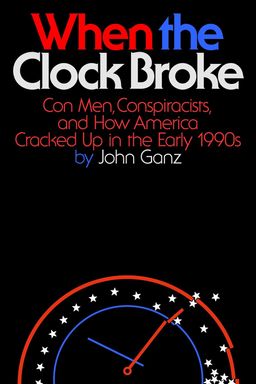
When The Clock Broke cover

When The Clock Broke

by John Ganz

How discontent at the end of the 20th century led to our current era of polarization and extremism.

Interregnum and Crisis of Authority

How do you make sense of a moment that feels like both victory and collapse? In this book, John Ganz argues that 1988–1992 is an American interregnum: the old order loses consent while no new settlement commands belief. Elites declare triumph at the Cold War’s end, but everyday life delivers bank failures, layoffs, policing scandals, and a widening gap between rhetoric and reality. Borrowing Antonio Gramsci’s language, Ganz shows that when ruling ideas no longer persuade, “morbid symptoms” appear—outsider candidacies surge, culture wars displace policy talk, and fringe intellectual projects migrate into mainstream politics.

Ganz’s core claim is straightforward: economic dislocation, institutional decay, and media transformation combined to make a combustible politics. You see that formula play out across case studies—David Duke’s Louisiana insurgency, Pat Buchanan’s “New Nationalism,” Ross Perot’s techno-populist crusade, the Rodney King beating and 1992 Los Angeles uprising, the Ruby Ridge siege and militia recruitment, and even the spectacle of John Gotti as a fantasy of decisive authority. The result is a portrait of a country testing new languages of grievance and new mechanisms of mobilization.

The interregnum: victory without authority

You feel the oddness of the age: Francis Fukuyama talks about the “End of History,” yet Christopher Lasch warns that liberalism’s social foundations are cracking. Reagan’s “shining city” glow fades as inequality spikes and deindustrialization hollows out towns. The middle shrinks, the S&L crisis reveals elite impunity, and a “jobless recovery” tells workers the game is rigged. Suspicion of Washington widens (term limits, anti-incumbent waves), and both parties struggle to speak credibly to a fraying middle class. (Note: Ganz’s framing echoes Gramsci but also resonates with Thomas Frank’s later analyses of populism channeled through culture.)

Economy as accelerant

The Reagan-era policy mix—tight money, deregulation, tax cuts skewed upward, and labor’s weakening—produces broad fragility: the top prospers, the middle wobbles, and the poor bear shocks first. Local downturns (Louisiana’s oil bust) foreshadow national strains. The S&L collapse and junk-bond real-estate boom turn taxpayers into crisis insurers. By 1991, with unemployment rising and wages flat, you have a country primed for anti-elite narratives. (George F. Will calls the era’s policy “class war”—Ganz uses that to illuminate the lived experience behind the statistics.)

Media changes the game

Ending the Fairness Doctrine and loosening ownership caps supercharges talk radio and syndicated TV. Rush Limbaugh, Howard Stern, Don Imus, Larry King, and Crossfire turn outrage and combat into genres. Audiences form “tribes” with parasocial bonds—“dittoheads” who don’t just listen; they organize. Perot buys prime-time infomercials to teach the deficit with pie charts; Clinton plays Arsenio’s sax to humanize policy with charisma. Media stops being a mirror and becomes a motor—manufacturing attention and converting grievance into movement.

Populism finds its voices

David Duke reframes white resentment as homeowner protection in Jefferson Parish, polishing a Klan pedigree into cable-friendly “respectability.” Pat Buchanan plants paleoconservative ideas—Middle American Radicals against a “New Class”—into a campaign of tariffs, border fortification, and cultural restoration. Ross Perot fuses executive competence with nationalist theater, turning private wealth and tech mystique into a volunteer army and debate-stage surprise. These figures are not aberrations; they are products of the interregnum’s vacuum.

Policing, culture, and backlash

The Rodney King tape and Los Angeles riots reveal an insulated, paramilitary police culture—from William Parker’s “thin blue line” to Daryl Gates’s SWAT-era machismo. Acquittals in Simi Valley trigger six days of upheaval, then national reframing: Dan Quayle blames Murphy Brown, Bill Clinton stages a Sister Souljah rebuke, and the policy debate turns into a culture war about responsibility and families. Meanwhile, Ruby Ridge transforms an enforcement debacle into a militia recruitment bonanza, teaching extremists how to weaponize state overreach.

1992’s verdict and its afterlife

James Carville’s sign—“It’s the economy, stupid”—captures the winning formula: speak plainly to middle-class anxiety with credible plans. Clinton’s “New Covenant” and a deft media cadence beat George H.W. Bush’s “it’s not that bad” tone; Perot siphons discontent and spotlights the debt; Weinberger’s Iran-Contra indictment dents White House authority. Clinton wins a plurality but an Electoral College landslide. The deeper settlement, Ganz suggests, is unfinished: the same ingredients—inequality, media-driven mobilization, policing legitimacy, and nationalist grievance—will recur in more potent forms later. (Compare to Theda Skocpol’s work on civic erosion for complementary institutional analysis.)

Thesis in a sentence

When elites lose consent amid economic fracture and a deregulated media, new populisms—racial, nationalist, techno-managerial—rush in, and policing failures plus culture wars provide the spark and the story.


Neoliberal Shock and Middle-Class Erosion

Ganz argues you can’t read the politics of 1988–1992 without first tracing the 1980s’ distributional earthquake. The Reagan-era formula—deregulation, upper-end tax cuts, anti-inflation tight money, and a rollback of labor power—creates winners at the top and precarity down the income ladder. The top 1% see income gains approaching 75% across the decade, while the mid-tier stalls or declines. The “middle” (roughly $18,000–$55,000) shrinks by 20%. That’s not abstract: it’s your neighbor’s plant closing, your mortgage strain, and your kid’s uncertain path.

From deindustrialization to job polarization

Manufacturing towns lose anchors, and routine mid-wage office work—clerks, tellers, secretaries—gets automated or offshored. Jobs bifurcate: high-skill winners and low-wage service work. Ganz points to local harbingers, like Louisiana’s oil bust hitting Jefferson Parish early, hollowing wages and revenues before the national charts catch up. In the broader economy, the S&L crisis and a junk-bond real-estate bubble expose financialized fragility. When these ponies fall, taxpayers hold the reins—and the bill.

A jobless recovery and political fuel

The 1990–91 recession bites hard, but even as growth returns, jobs don’t bounce back quickly. Bankruptcies and foreclosures pile up; personal debt climbs. People conclude that “the system” protects rentiers, not workers. Into that breach step interpreters of pain: Buchanan blames NAFTA-like trade and immigration; Perot blames a runaway deficit and managerial incompetence; Duke blames welfare and affirmative action, reframing racial hierarchy as taxpayer fairness. The point is not that their diagnoses are equal—it’s that they speak to the same felt betrayal.

Triumphalism as ideological cover

Post–Cold War rhetoric—“there is no alternative,” “the end of history”—lets elites avoid domestic reckoning. Deregulation looks like modernization; financial innovation reads as progress. But the social contract frays. George F. Will once quipped that Reaganism resembled class war from above; Ganz uses this to capture how many voters processed the era: not as creative dynamism, but as official permission for their bosses to cut them loose. (Note: Scholars like Jacob Hacker later call this the “Great Risk Shift,” a useful complement to this narrative.)

From numbers to narratives

Data alone don’t move people; stories do. In neighborhoods with shuttered plants, anti-incumbent crusades and term-limit referenda feel practical. In suburbs with rising crime and shrinking wages, “law and order” and welfare critiques connect. In TV studios, debt charts and “giant sucking sound” lines become folk knowledge. Ganz insists you see the straight line: inequality and insecurity feed anti-elite, nativist, and authoritarian experiments—unless a credible reformer can re-knit a common story of fairness and shared prosperity.

Takeaway

Economic structure isn’t backdrop—it’s accelerant. When the middle sees rules tilted and futures dim, populism becomes the most available language of politics.

(Parenthetical note: Compare to Piketty’s work on inequality trends; Ganz’s distinctive move is to connect distributional change to specific political entrepreneurs—Duke, Buchanan, Perot—who weaponize those shifts in real time.)


Media Engines of Mobilization

Media doesn’t just carry messages in this era—it fabricates political actors and movements. Ganz shows how FCC deregulation (the Fairness Doctrine’s end and ownership liberalization) allows syndication to nationalize personality-driven shows. The result is a new infrastructure for grievance: talk radio tribes, combative panel TV, and big-tent infotainment that rewards theater over policy detail. If you want to see how Buchanan, Perot, and even Clinton scale, follow the microphones.

Talk radio’s intimacy and power

Rush Limbaugh perfects a style that translates economic and cultural anxiety into a confident, caustic narrative. His “dittoheads” aren’t passive; they organize phone trees, “Rush Rooms,” and turnout. Don Imus and Howard Stern blend provocation with politics, keeping the outrage loop humming as ratings climb. The medium’s magic is parasocial: you feel the host knows you—and that makes you more likely to act when he asks. (Note: This anticipates social media influencers by decades.)

Television’s performative agora

Larry King’s open chairs, The McLaughlin Group’s theatrical interruptions, and Crossfire’s duels craft a new normal: politics as sport. Pat Buchanan becomes a star here, mastering cadence and confrontation. Perot rides daytime and prime-time shows (Donahue, Larry King) to sidestep party gatekeepers and rally volunteers. Bill Clinton, understanding tone as much as content, plays Arsenio Hall, morning shows, and debates with an ease that humanizes him while reinforcing message discipline.

Infomercials, charts, and volunteer swarms

Perot’s 30-minute infomercials turn policy into spectacle. With pie charts and folksy precision, he makes deficits feel solvable if only “we ran government like a business.” Volunteers pour in—coordinated via early bulletin boards, direct mail, and phone trees. But media lift can hide organizational fragility; when Perot centralizes control and deploys “whiteshirts,” the volunteer base sours, proving that charisma can jumpstart movements but can’t substitute for trust and structure.

Culture as political producer

Cultural production doesn’t sit outside politics. Hip-hop (Public Enemy, Ice Cube) narrates urban rage, prompting some commentators to treat rap as cause rather than chronicle of crisis. Dan Quayle weaponizes a sitcom—Murphy Brown—into a moral referendum on single parenthood. Sister Souljah’s quotes become a pivot for Clinton’s centrist signaling. You see the loop: media highlights culture; politicians reframe culture as policy proxy; audiences absorb culture as politics. (Chuck D’s “rap is the CNN of Black America” crystallizes this insight.)

Lesson

Regulatory choices created a media market that monetizes grievance and rewards performance—shaping who rises, which issues surface, and how emotions become mobilization.

(Parenthetical note: Compare Neil Postman’s Amusing Ourselves to Death; Ganz shows not only how entertainment swallows news, but how new “performers” convert airtime into political organization.)


Racialized Populism in Louisiana

David Duke’s rise is not a curiosity; it’s a case study in how economic strain, institutional weakness, and racial hierarchy can produce a market for a cleaned-up demagogue. Louisiana’s political soil—Bourbon oligarchy, the 1897 disenfranchisement constitution, and Huey Long’s patronage populism—normalizes personalist, punitive politics. Duke harnesses this legacy in reverse: “Huey in reverse,” as Ganz suggests—redistribution of status to white homeowners threatened by change.

From Klan pedigree to cable-ready candidate

Raised in New Orleans and steeped in Citizens’ Council tracts and Carleton Putnam’s Race and Reason, Duke learns to toggle between extremist networks and public respectability. He rebrands with suits, cosmetic polish, and the NAAWP label; he pushes homestead exemptions, welfare attacks, and anti–affirmative action as “fairness” for taxpayers. The trick is translation: old racism into new suburban grievance.

Weak parties, open lanes

Louisiana’s GOP and Democratic machines are divided and compromised; the oil bust creates visible pain in Jefferson Parish. Duke slips through special elections (1989), then grows bolder—scoring 59% of the white vote in the 1990 Senate race and 55% of whites in the 1991 governor’s runoff. National media magnify him; local Republicans hesitate to fully repudiate; and Duke’s message proves “bulletproof” with a base that hears validation of white dispossession.

Defeat and prophecy

Edwin Edwards ultimately beats Duke in 1991 thanks to massive Black turnout and a defensive coalition. But the warning holds: if economic decline persists and elites waffle, a polished racist can approach statewide power. Ganz stresses that institutions matter—strong parties, clear norms, and civic investment can foreclose such bids. Without them, “Duke-ism” can travel.

Why it matters

Duke shows how demagogues thrive when economic shock meets institutional drift and elite equivocation—turning resentment into votes under a veneer of “respectability.”

(Parenthetical note: Ganz invokes Huey Long not to equate agendas but to trace a pattern: charismatic rule, patronage logics, and a politics that punishes out-groups while promising protection for “our own.”)


From Think Tanks to Caesarism

Behind Buchanan’s chants and Duke’s dog whistles sits an intellectual realignment: paleoconservatism’s bid to turn conservatism from “no” to “seize.” Samuel T. Francis—once at Heritage—becomes the movement’s theorist-in-chief. Drawing on James Burnham’s elite-conflict theory and Gramsci’s hegemony analysis, Francis reframes politics as a struggle of “Middle American Radicals” against a managerial “New Class,” demanding a strong executive to smash the oligarchy.

Paleos vs. neocons: patronage and identity

Paleos (Francis, Thomas Fleming, Paul Gottfried) argue that neocons—ex-liberals clustered around funding “Four Sisters” foundations—commandeer the right’s purse and tone, dampening nationalism and tradition. Fights over Israel, immigration, and cultural modernity double as battles over grants and magazine mastheads. Mel Bradford’s scuttled nomination and Joe Sobran’s ouster from National Review are teaching moments: ideas follow money, and patronage polices boundaries.

A revolutionary conservative program

Francis urges a “Caesarist” presidency to overturn managerial rule—less Burke, more Machiavelli. He welcomes alliances with paleolibertarians like Murray Rothbard, immigration restrictionists, and culture warriors to build a mass movement. Chronicles (magazine) and later The American Conservative house this thought style, which mixes anti-globalism, anti-immigration, and executive maximalism. It’s a blueprint for later nationalist turns in the GOP.

Normalization through networks

Ganz shows how intellectual networks can launder fringe ideas into conference panels and campaign platforms. “Middle American Radical” frames give rhetorical cover to hard-edged policies; “managerial elite” talk reframes class anger as anti-bureaucratic revolt. Even when paleos lose institutional turf to neocons in the early 1990s, they seed a cadre, lexicon, and set of enemies that later campaigns adopt with fewer apologies.

Bottom line

Ideas matter because they organize grievance. Paleoconservatism turns diffuse anger into a strategy—nationalism plus strong executive—ready for a charismatic carrier.

(Parenthetical note: If you’ve read Corey Robin’s The Reactionary Mind, you’ll hear echoes; Ganz roots those abstractions in the concrete squabbles, magazines, and campaigns that carried them into the 1990s.)


Buchanan’s New Nationalism

Pat Buchanan’s 1992 insurgency is the paleoconservative program in motion. A veteran of Nixon and Reagan messaging battles, Buchanan brings TV-honed force and a populist growl to a platform mixing protectionism, immigration restriction, and uncompromising social conservatism. He speaks for “Middle American Radicals,” promising to buy the country back from globalists and bureaucrats—then proves it can draw blood in the primaries.

A performer-politician

On The McLaughlin Group and Crossfire, Buchanan dominates with pugnacious timing. That mastery turns into votes: he shocks New Hampshire with 37%, rattling George H.W. Bush and signaling an open lane for nationalist conservatism. He invokes Southern symbols (Stone Mountain, Confederate echoes) to fuse cultural nostalgia with economic grievance, while courting blue-collar regions like Michigan hard hit by global competition.

Platform as coalition signal

His planks are blunt: tariff walls against Japan and trade deals; tight borders and cultural cohesion; anti-abortion absolutism and family values. Behind him stand paleos (Samuel Francis), paleolibertarians (Murray Rothbard), and culture warriors seeking a “counterrevolution.” Bay Buchanan wrestles the RNC for platform space and prime-time convention visibility. The Houston convention speech aims to define a moral realignment—a culture war from the podium.

Ceilings and spillovers

Buchanan hits demographic walls—weakness with women voters, suburban moderates alarmed by rhetorical ferocity. Some supporters drift to Perot’s managerial populism; others return to Bush in November. But Ganz argues the key is transmission, not tally: Buchanan normalized a vocabulary and a personnel pool that would later power nationalist surges. He turned a TV persona into a faction and a future.

What you learn

Charisma plus grievance can transform a minority current into a party-wide argument. Even in defeat, an insurgency can reset the terms of debate.

(Parenthetical note: Think of Barry Goldwater’s 1964 run seeding Reaganism; Ganz places Buchanan similarly—as a catalyst whose language outlives his numbers.)


Perot’s Techno‑Populist Revolt

Ross Perot embodies a different insurgency: managerial salvation wrapped in patriotic showmanship. He’s a Navy officer turned IBM rainmaker turned founder of Electronic Data Systems (EDS), a firm that thrived by computerizing public functions like Medicare claims. Perot argues he can fix government because he has already made government systems work better—ironically by privatizing them. Ganz treats him as a bridge between private power and public authority.

Business-state entanglement

EDS wins huge, often noncompetitive contracts as agencies scramble to digitize. The company’s white-shirt, polygraph culture promises discipline and execution—at high margins. GAO audits probe the arrangements, but Perot’s legend grows: he rescues hostages (Iran), crusades for POW/MIAs with wax cages and private jets, and shames bureaucrats. It’s privatized foreign policy and public administration— and it sells.

A movement by media

Announcing on Larry King, Perot triggers a volunteer wave: 40,000 petition signatures in Kentucky alone, tens of thousands elsewhere. Early electronic bulletin boards, phone banks, and living-room meetups turn curiosity into lists. Then come the infomercials: 30-minute blocks of deficit charts and moral exhortation about the $4 trillion debt. Debates amplify him further; he briefly contends for the lead.

Centralization and crack-up

Yet the very managerialism that builds the brand hurts the movement. Perot centralizes, deploys corporate “whiteshirts,” and orders background checks on volunteers. He exits the race in July, shocking loyalists who weep at gatherings, then reenters in the fall. Trust frays. Still, on Election Day, he wins nearly 19% of the popular vote—an astonishing showing for a third-party bid.

The paradox

Perot is an outsider built by insider contracts; a democratizer who centralizes ruthlessly; a technocrat who campaigns like a revivalist. In the interregnum, that cocktail is potent.

(Parenthetical note: Perot foreshadows later entrepreneur-politicians who leverage media reach, private wealth, and “run it like a business” tropes to bypass party structures.)


Policing, Culture Wars, and Militia Backlash

Law enforcement failures and culture-war reframings define the era’s most explosive moments. In Los Angeles, the LAPD’s paramilitary lineage—William Parker’s insulated “thin blue line,” Daryl Gates’s SWAT-era bravado—meets a camcorder. The Rodney King beating (videotaped by George Holliday) seems unambiguous; the Simi Valley acquittals don’t. Six days of fires and fear follow, exposing both operational paralysis and political evasion.

Institutional insulation, public explosion

Commissions (Christopher, Webster) later catalog systemic problems: tolerance of excessive force, weak civilian review, failed command during crisis. The city votes for charter reform (Proposition F) to curb the old model. Nationally, George H.W. Bush’s first response (“the brutality of a mob, pure and simple”) misses structural context; Jack Kemp pitches enterprise zones; Dan Quayle blames cultural decay. The debate splinters into law-and-order, economics, and morality—without a coherent repair plan.

From sitcoms to Sister Souljah

Dan Quayle turns Murphy Brown into a parable of permissiveness, collapsing urban disorder into family values talk. Bill Clinton counters with a “New Covenant”: responsibilities paired with rights, future preference, and a very public rebuke of Sister Souljah at Jesse Jackson’s Rainbow Coalition event—a signal to centrists that he won’t be captured by the left. Media coverage swings; Perot’s dominance ebbs; culture becomes the shortcut through which voters judge candidates’ mettle. (Clinton’s rhetoric nods to Carroll Quigley, his Georgetown mentor.)

Ruby Ridge and the militia turn

In Idaho, a botched enforcement saga turns into a myth-making machine for the far right. Randy and Vicki Weaver, formed by the 1980s farm crisis and apocalyptic theologies (Hal Lindsey, Christian Identity currents), retreat to the mountains. After entrapment claims and a U.S. Marshals firefight kill a deputy and their son Sammy, an FBI sniper (Lon Horiuchi) kills Vicki Weaver holding an infant. Acquittals on most charges and censure of rules of engagement follow. Bo Gritz, Richard Butler (Aryan Nations), and Louis Beam convert “Ruby Ridge” into a martyrdom tale, recruiting militias and preaching “leaderless resistance.”

Crime, spectacle, and authority’s temptation

Even organized crime becomes a screen for anxieties: John Gotti’s swagger draws flag-waving crowds in Brooklyn as New York suffers over 2,200 murders per year. Some neighborhoods, fed up with municipal dysfunction, romanticize a “protector” who can deliver order. Rudy Giuliani, the mob-busting U.S. attorney, channels that longing into law-and-order politics against Mayor David Dinkins’s pluralist governance. The lesson is uneasy: when institutions falter, more brutal forms of authority gain cultural appeal.

Core insight

Policing culture and state overreach don’t just cause scandals—they reorder politics, fueling culture wars on the center-right and recruitment sprees on the far right.

(Parenthetical note: This chapter reads like a prequel to the 1995 Oklahoma City bombing milieu; Ganz’s contribution is to connect the dots between city policing crises and rural paramilitary growth.)


1992’s Settlement and Its Limits

The 1992 election doesn’t end the interregnum so much as manage it. Economic pain sets the frame: unemployment near 7.8%, layoffs (Aetna), regional fiscal crises (California), and scandal hangovers (Iran-Contra, with Caspar Weinberger’s indictment). James Carville’s mantra—“It’s the economy, stupid”—enforces discipline inside Clinton’s war room; every message serves middle-class recovery and investment without ideological sprawl. Voters reward clarity over triumphalism and managerial theater.

Three-way dynamics

Perot’s debates and infomercials make deficits a moral crisis; he bleeds support from both parties while spotlighting elites’ fiscal irresponsibility. Buchanan pushes the GOP rightward, sharpening culture-war edges that scare moderates but galvanize a base. George H.W. Bush struggles to square a statesman’s victory lap with bread-and-butter anxiety—his Truman-style whistle-stops read as nostalgic rather than urgent.

Clinton’s “New Covenant” pitch

Clinton blends empathy (“I feel your pain”) with responsibility rhetoric steeped in Carroll Quigley’s “future preference.” He triangulates culturally (Sister Souljah moment) while promising practical repair—education, jobs, targeted tax relief. Media savvy—Arsenio Hall, morning shows, deft debate performances—makes the messenger feel proximate and plausible. He wins a popular-vote plurality and an Electoral College landslide, with Perot capturing nearly one in five voters.

An incomplete reset

Ganz cautions that the settlement is fragile. Inequality’s drivers remain, media incentives for outrage intensify, paleocon networks persist, and policing legitimacy is only partially repaired. The politics of national despair has been contained, not cured. Many themes—managerial anti-elitism, border nationalism, culture-first campaigning—will return with greater force later.

Election lesson

Objective economic distress plus a credible, culturally deft messenger beats incumbency and insurgent theatrics—but only for a time, unless structural repair follows.

(Parenthetical note: For a policy-focused sequel, read Jacob Hacker and Paul Pierson on rebuilding middle-class security; Ganz’s story explains why voters demanded it in the first place.)

Dig Deeper

Get personalized prompts to apply these lessons to your life and deepen your understanding.

Go Deeper

Get the Full Experience

Download Insight Books for AI-powered reflections, quizzes, and more.