
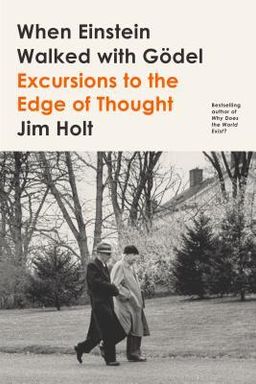
When Einstein Walked with Godel cover

When Einstein Walked with Godel

by Jim Holt

When Einstein Walked with Godel takes you on an intellectual adventure through the lives and theories of history''s greatest minds, unraveling the complexities of reality from relativity to quantum mechanics. This insightful narrative blends science, philosophy, and history, offering a profound understanding of the universe''s mysteries and the geniuses who dared to explore them.

The Human Quest to Understand Reality Through Mathematics and Mind

What do time, logic, infinity, and creativity have in common? They are all frontiers where human thought meets its own limits—and its deepest beauty. Jim Holt’s book is a grand tour of minds who dared to ask ultimate questions using mathematics, physics, philosophy, and neuroscience. You move from Gödel’s logic to Einstein’s time, from Mandelbrot’s geometry of roughness to Turing’s machines, tracing how abstract reasoning becomes a mirror for human meaning.

Across these stories Holt explores a single theme: the interplay of precision and imagination. Each thinker—Einstein, Gödel, Mandelbrot, Dehaene, Turing, von Neumann, and others—uses mathematics not merely to measure reality but to reconceive it. Yet their achievements also expose boundaries: incompleteness, nonlocality, moral corruption of science, and the fragility of genius. You learn that the pursuit of ultimate truth requires both intellectual rigor and ethical reflection.

From Time and Logic to the Nature of Truth

Einstein shattered our everyday notion of time, revealing that simultaneity is observer-dependent. His four-dimensional space-time replaces the flowing present with a static universe. Gödel then extended that revelation inward: his incompleteness theorems showed that even pure logic cannot contain all truth. And by applying relativity to cosmology, Gödel constructed a universe in which time could loop back on itself—making the passage of time an illusion. Together they invite you to see that science itself grows metaphysical when it faces the concept of eternity.

From Numbers and Patterns to Human Cognition

Next Holt turns to how you make sense of numbers. Stanislas Dehaene reveals that you are born with a basic number sense—neurons in the intraparietal sulcus approximate quantities long before formal arithmetic. Cultural inventions like numerals and algorithms refine that ancient ability. This blend of biology and culture demonstrates the cooperative design between evolution and education: learning mathematics is not just symbolic but embodied, shaped by neural architecture and language structure.

From Structure to Irregularity: Fractals and Chaos

Benoit Mandelbrot’s fractals show that irregularity itself has order. Clouds, coastlines, financial markets—once dismissed as noisy—obey self-similar rules. His fractal dimension lets you quantify roughness and blur traditional distinctions between geometry and nature. (Note: Fractals redefine beauty as complexity, a theme echoed by Riemann’s zeta function where primes—the canonical symbols of order—behave like chaotic music.) Holt draws parallels between Mandelbrot’s visual mathematics and Riemann’s harmonic primes: both uncover deep structure beneath apparent disorder.

Logic, Machines, and Morality

Alan Turing and John von Neumann transformed logic into technology. Turing’s universal machine anticipated the computer; von Neumann’s stored-program architecture made it real. Yet Holt reminds you that the same logic powering codebreakers also enabled nuclear warfare. The MANIAC machine at Princeton calculated hydrogen bomb parameters. That duality—intellect serving both creation and destruction—runs through the book. Turing’s persecution and death underline the moral cost of genius amid social injustice. Von Neumann’s managerial success reveals how scientific institutions entwine knowledge and power.

Infinity, Reference, and Meaning

From Cantor’s towers of infinity to Kripke’s theory of reference, Holt explores how abstraction redefines meaning. Cantor’s hierarchy of infinities challenged intuition; Robinson later rescued infinitesimals within logic. Kripke reimagined how words anchor reality: names rigidly designate objects across possible worlds. Those mathematical and philosophical revolutions highlight a shared insight—that human language, like mathematics, connects finite minds to infinities of meaning while demanding humility about certainty.

Creativity, Technology, and the Mind’s Limits

In later chapters, Holt turns empirical. Nicholas Carr’s “The Shallows” shows how internet habits reshape your neural circuits, trading depth for breadth. Digital tools amplify attention but may weaken long-term memory integration—the same cognitive substrate creative insight depends on. This tension echoes Gödel’s warning about mechanical reasoning: intelligence may exceed computation only when it engages intuition and reflection. The web thus becomes the latest experiment in how technology rewires thought.

Ethics, Truth, and Cosmic Perspective

Holt concludes with reflections on truth itself—Frankfurt’s analysis of bullshit, the erosion of sincerity in public discourse, and cosmological musings on how the universe may end. Whether you face intellectual dishonesty or cosmic indifference, the moral remains the same: clarity and truthfulness are intellectual virtues. In epistemology, ethics, and cosmology alike, meaning arises not from certainty but from disciplined inquiry. The universe may not ensure purpose, but your pursuit of understanding becomes itself a source of it.

Compact takeaway

Across logic, physics, and cognition, Holt weaves a human story: our equations describe the world, but our questions define us. Understanding reality means confronting both its mathematical elegance and its moral depth.

You finish with the sense that the pursuit of truth—whether through equations, neurons, or ethical clarity—is the most human act of all. This book invites you not only to admire the minds that mapped reality but to continue the exploration within your own.


Time, Relativity, and Gödel’s Logical Cosmos

When you picture Einstein and Gödel walking together, you glimpse two subtly different approaches to timelessness. Einstein tested nature with equations; Gödel tested equations with logic. Their friendship frames one of Holt’s most profound discussions: how physics and mathematics jointly dissolve the everyday sense of time.

Einstein: The End of “Now”

Einstein’s relativity erased absolute simultaneity. Events that seem “now” for you may be future or past for another observer. When you accept that, the universe becomes a “block”—a four-dimensional manifold where all events coexist. Philosophers like Parmenides and Spinoza glimpsed similar eternalism long before: motion and change become appearances of deeper structure.

Gödel: Rotating Universes and Time Loops

Gödel brought logical precision to metaphysical speculation. His rotating-universe solution allows closed time-like curves: you could trace a path to your own past. Whether or not such a universe describes reality, Gödel’s point was methodological—if physics tolerates time travel without contradiction, the flow of time is not fundamental. Einstein admired but was disturbed: the equations that liberated physics might abolish its intuitive anchor in temporality.

Human Dimensions

Their companionship illustrates another truth: great discoveries can emerge from conversation as much as calculation. Einstein sought Gödel’s logical rigor; Gödel found in him empathetic friendship amid paranoia. Their walks remind you that metaphysical insight thrives in dialogue. Together they model how science and philosophy enrich each other—and how friendship can be an instrument of discovery.


Gödel’s Incompleteness and Mathematical Truth Beyond Proof

Gödel’s incompleteness theorems show that mathematics, for all its rigor, cannot prove everything true within itself. Holt translates this austere logic into human terms: sometimes reason encounters the horizon of reason.

Self-Reference and Limits of Systems

Gödel numbered statements so they could refer to themselves. From that encoding he built a sentence asserting its own unprovability inside a formal system. If proven, the system contradicts itself; if not, the statement remains true yet unprovable. Thus every consistent formal system is incomplete. Proof cannot capture all truth, and consistency cannot prove itself.

Philosophical Implications

Gödel’s Platonism sees mathematical truths as independent entities discovered rather than invented. (Roger Penrose later extended this—arguing that consciousness, too, must transcend algorithm.) The broader insight is humbling: mechanisms of deduction never exhaust intuition. Mathematics turns out to be creative art under logical constraints.

The Human Lesson

For you, Gödel’s result reshapes the concept of knowledge. Rigorous systems can illuminate—yet never finish—the quest for truth. The boundaries of formal reasoning become invitations for imagination, intuition, and humility about what even logic cannot reach.


From Fractals to Primes: Patterns in Chaos

Mandelbrot and Riemann both uncovered harmony inside apparent disorder. Holt pairs their stories to illustrate how mathematics listens for music within chaos.

Mandelbrot: Geometry of Roughness

Fractals reveal self-similarity across scales: coastlines, clouds, or markets repeat patterns endlessly. Mandelbrot’s fractal dimension quantifies roughness and destroys the illusion that nature is smooth. His computer-generated Mandelbrot set shows infinite complexity emerging from simple rules, illustrating that beauty can be algorithmic.

Riemann: The Music of the Primes

Bernhard Riemann discovered that prime distributions resonate with zeros of the complex zeta function. The Riemann hypothesis proposes perfect alignment—nontrivial zeros on the critical line—creating an “arithmetic symphony.” Experimental evidence supports it aesthetically rather than conclusively, reminding you that even mathematics entertains faith in beauty.

Shared Insight

Both thinkers dissolve the line between randomness and pattern. The world’s roughness, whether physical or numerical, is not noise but design. Learning to recognize that structure teaches creativity: in complexity you find simplicity waiting to be described.


Logic Becomes Machine: Turing and Von Neumann

Alan Turing conceived computation; John von Neumann institutionalized it. Their work marks the turning point where mathematical abstraction transformed human history.

Turing: Uniting Thought and Mechanism

Turing’s universal machine can simulate any other machine through coded instructions—an abstract embryo of software. During WWII his bombes cracked Enigma, saving thousands of lives. Yet his later persecution for homosexuality shows how moral blindness can destroy genius.

Von Neumann: Architecture and Power

Von Neumann carried Turing’s logic into engineering. His MANIAC computer computed hydrogen bomb physics—the dawn of computational warfare. He standardised memory, control, and input as a pragmatic architecture now universal in computing. His story underscores technology’s dual role: instrument of creation and destruction.

Intellectual Legacy

From these figures arises the digital age’s moral paradox. Rational systems magnify human power, but ethical decisions determine its use. Understanding the logic behind machines means also understanding responsibility.


Infinity and Language: Cantor to Kripke

Infinity challenges comprehension; language defines it. Holt connects Cantor’s mathematical audacity with Kripke’s linguistic precision to show how conceptual frameworks alter metaphysics.

Cantor and Robinson: Infinite Hierarchies

Cantor demonstrated that some infinities outsize others—revealing the continuum’s immensity. Abraham Robinson later reintroduced infinitesimals rigorously using model theory. Their ideas together reflect mathematics’ oscillation between invention and discipline.

Kripke and Marcus: Naming and Necessity

In philosophy, Saul Kripke showed that names rigidly pick out individuals across possible worlds. Ruth Barcan Marcus anticipated some aspects, sparking debates on attribution and originality. The moral lies in intellectual humility—truth often evolves collaboratively.

Broader Meaning

Both infinity and reference expand your view of meaning itself. Whether in set theory or semantics, human reason keeps building structures that stretch beyond intuition, reminding you that abstraction is not escape but exploration.


Brains, Technology, and Creativity in the Digital Age

Nicholas Carr’s inquiry into the Internet’s cognitive impact complements Dehaene’s neuroscience. Together they map creativity’s neural economy in the modern era: how attention, memory, and tool use shape innovation.

Biological Foundations of Number and Thought

Dehaene’s experiments show that your numerical intuition is embodied—written in the parietal cortex. Cultures refine it through language. Recognizing this helps you design better educational approaches: structure learning to match brain architecture rather than defy it.

Digital Distraction and Creative Depth

Carr warns that hyperlinked environments overload short-term memory, weakening the slow associative processes behind insight. Creativity requires incubation; online multitasking dissolves continuity. The challenge is balance—use digital tools to expand reach while carving spaces for concentrated reflection.

Cognitive Adaptation

Your brain rewires with habit, proving that self-discipline and context design are forms of cognitive engineering. Understanding how the mind learns empowers you to direct attention intentionally, rather than surrender it to algorithms.


Ethics, Truth, and the Fate of Civilization

Holt closes his panorama with moral and cosmic questions. From Galton’s misuse of statistics to Frankfurt’s battle against bullshit, he insists that truth and ethics are inseparable from scientific progress.

Galton’s Fallacies and Modern Genetics

Francis Galton’s creation of correlation and regression birthed eugenics. His methodological brilliance and moral blindness demonstrate how quantitative tools become dangerous when ideology is mistaken for causality. Modern genetic engineering revives similar temptations—raising new ethical tests for scientific integrity.

Frankfurt and Truthfulness

Harry Frankfurt contrasts lying with bullshit—the latter being indifference to truth. In an age of viral misinformation, that indifference erodes public reason itself. Philosophers like Bernard Williams and Simon Blackburn defend truth’s necessity for cooperative life.

Cosmic Closure

Finally, cosmology frames humility on a universal scale. Dyson’s hibernating civilizations, Tipler’s Omega Point, and Weinberg’s stoic nihilism remind you that cosmic meaning may vanish—but human understanding remains its own purpose. Whether the universe ends in chill or collapse, the act of knowing situates you ethically in the immensity.

The moral thread tying Holt’s book together is simple yet radical: reason gives power; ethics gives direction. Protecting truth—be it scientific, logical, or personal—is civilization’s most enduring task.

Dig Deeper

Get personalized prompts to apply these lessons to your life and deepen your understanding.

Go Deeper

Get the Full Experience

Download Insight Books for AI-powered reflections, quizzes, and more.