
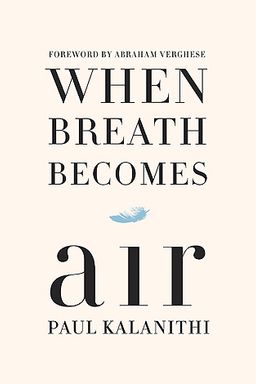
When Breath Becomes Air cover

When Breath Becomes Air

by Paul Kalanithi

When Breath Becomes Air is the moving memoir of Paul Kalanithi, a neurosurgeon facing terminal cancer. His story is a profound meditation on the intersection of life, death, and meaning, revealing insights into the human condition through his dual passions for literature and medicine.

Facing Mortality to Find Meaning

What would you do if you learned you were dying, and all the ambitions you’d built your identity around suddenly evaporated? In When Breath Becomes Air, neurosurgeon and writer Paul Kalanithi asks this question not only as a dying man but as a lifelong seeker of what makes a life meaningful. The book captures his journey from studying literature and philosophy to treating patients at the intersection of life and death—and finally becoming a patient himself, confronted with his mortality at thirty-six.

Kalanithi argues that human meaning is not found in our accomplishments or our control over life’s outcomes but in our relationships and moral choices. Through his dual lenses as physician and patient, he contends that to live fully is to face death honestly—to understand that existence derives its richness from its finitude. He writes, “Death may be a one-time event, but living with terminal illness is a process.” It’s that process—his transformation from doctor to dying man—that becomes the heart of his book.

Literature, Medicine, and the Search for Meaning

Throughout the narrative, Kalanithi reflects on how his early love of literature and philosophy shaped his understanding of human life. As a boy growing up in Arizona, he devoured books like 1984 and Brave New World, drawn to their moral questions rather than their plots. While studying English at Stanford, he became obsessed with how language connects lives and meaning—how literature builds a bridge between minds.

Later, medicine became his new vocabulary for the same question: what makes life worthwhile? As a neurosurgeon, he worked in the crucible where identity itself was tested—the brain. (In similar spirit to Viktor Frankl's Man’s Search for Meaning, Kalanithi uses clinical encounters as metaphors for existential questions.) Operating on the brain wasn’t merely mechanical; it was a moral act that forced him to confront what constitutes “self” and “living.”

Doctor, Then Patient: The Collapse of Control

The central turning point comes when Kalanithi, at the peak of his training, scans his own CT images and sees the cancer that will claim his life. Within moments, he becomes both healer and sufferer. His shift from diagnosis-giver to diagnosis-receiver illuminates the fragility of identity built on professional striving. The man who once judged success by surgical precision suddenly finds meaning in simply sitting beside his wife Lucy and holding her hand.

This reversal—doctor to patient—produces profound insight into the universality of suffering. Emma Hayward, his oncologist at Stanford, becomes both colleague and guide, reminding him to focus not on survival curves but on values: “What’s most important to you?” she asks. Her refusal to define his remaining time mathematically forces him to seek meaning beyond metrics.

Redefining a Life When the Future Collapses

If you’ve ever faced the dismantling of a plan—a career lost, a relationship ended—Kalanithi’s dilemma will feel familiar. He writes about adjusting to the redefinition of self: his body’s decline erases his identity as surgeon, husband, and athlete. Yet through illness, he finds a new identity—as father and writer. The act of writing this book becomes his way of performing surgery on his own soul, shaping narrative as his last act of creation.

When he and Lucy decide to have a child despite uncertainty, it becomes a radical affirmation: to choose life, knowing it will end. His daughter Cady’s birth reframes death not as annihilation but as continuity. The book closes not with despair but with gratitude—his final words a blessing to his child: she filled his dying days “with a joy that does not hunger for more but rests, satisfied.”

Why This Matters to You

Kalanithi’s story urges you to examine your own sense of purpose. Whether you’re facing illness or everyday uncertainty, it asks: where is your center? His realization that “the physician’s duty is not to stave off death but to take your hand and help you face it” resonates as deeply outside the hospital as within it. We all walk between breath and air, between living and dying, between striving and surrender.

Ultimately, When Breath Becomes Air argues that mortality isn’t merely the end point of existence—it is the lens that brings life into focus. By accepting finitude, you learn to embrace meaning not as something far off, but as something found right here, in small acts of love, service, and creation.


The Moral Depth of Medicine

For Paul Kalanithi, medicine was a moral calling long before it was a technical discipline. His transition from studying literature to performing neurosurgery was motivated by one question: how can we understand and serve the human experience? Through the intense world of residency, he discovered that healing wasn’t just about physiology—it was about moral insight.

Healing and Humanity

As a neurosurgical resident, Kalanithi entered that liminal space where identity and survival intersect. He describes surgeries where a millimeter could mean the difference between speech and silence, between a full life and a life of dependence. To him, medicine demanded both scientific precision and moral courage. Every procedure forced him to ask: what kind of life will this patient have afterward? What makes life worth saving?

Empathy Over Efficiency

Kalanithi’s training exposed him to the bureaucracy of modern healthcare—paperwork, time constraints, and exhaustion. Yet, as he recounts the death of patients like Mrs. Harvey, who crashed after a minor surgery, he realizes that true medicine lies in empathy. He begins to shift from seeing patients as problems to seeing them as narratives. This transformation helps him understand the emotional burden that accompanies technical mastery.

His realization mirrors that of Atul Gawande in Being Mortal: being a good doctor means sharing moral responsibility for a patient’s whole life—not merely the clinical outcome. For Kalanithi, this responsibility becomes almost sacred.

Medicine as a Mirror for Mortality

The paradox of being both healer and witness to suffering shapes Kalanithi’s worldview. He recognizes that medicine doesn’t conquer death—it clarifies life. In one powerful moment, he tells families facing catastrophic brain injuries that the surgeon’s job is not to save a breathing body but to help them discern what kind of life their loved one would have wanted. Medicine becomes a dialogue between science and spirit, between what can be done and what should be done.

“When there’s no place for the scalpel, words are the surgeon’s only tool.”

This line encapsulates his moral philosophy: compassion is itself a form of medicine. Even when faced with the futility of treatment, the act of honest communication carries healing power.


Becoming a Patient

When Paul Kalanithi’s own chest X-ray revealed his lungs covered in tumors, he stepped across the invisible line separating doctor from patient. Everything he had believed about control, certainty, and medicine inverted. Through this experience, he revealed the emotional disorientation of illness and the gradual rediscovery of self within vulnerability.

Identity Unraveling

The moment of diagnosis shattered his professional persona. He writes about sitting in the same hospital where he had treated patients, now wearing a patient’s gown and waiting for his own oncologist. The man who had once explained mortality to others now faced the doctor’s inability to quantify his own prognosis. Emma Hayward, his oncologist, refuses to reduce his survival to numbers—an act that both frustrates and liberates him.

Learning to Surrender

Illness transforms his understanding of agency. Before cancer, he saw his profession as proof of mastery over life’s chaos. Now the simplest acts—standing from bed, eating breakfast—require enormous will. He calls the experience “falling from actor to acted upon.” Yet he begins to see surrender not as defeat but as clarity. Lucy, his wife, becomes his partner in learning to live within fragility; their marriage deepens under the weight of shared vulnerability.

Like Joan Didion in The Year of Magical Thinking, Kalanithi finds that confronting loss expands rather than contracts love. In his illness, he learns to depend without shame, to let others carry part of his suffering.

Living in Two Worlds

Even as his health improves briefly under treatment, Kalanithi straddles dual perspectives—doctor and patient, scientist and philosopher. This dual awareness helps him write his most penetrating reflections on mortality. With characteristic humor, he even jokes about making his own clinical decisions in collaboration with Emma. She reminds him, gently, that sometimes he can “just be the patient.”

Ultimately, this phase leads to one of the book’s central insights: life is not a linear sum of choices or achievements but a continual act of finding meaning amid uncertainty. The patient’s world, he learns, runs on faith, humility, and repetition—on simply getting up each day despite knowing how finite those days might be.


Finding Meaning Through Suffering

How do you live when the entire future collapses? For Kalanithi, the answer lies not in escaping suffering but in inhabiting it. His slow physical deterioration parallels his deepening philosophical awareness: suffering, rightly faced, can reveal meaning rather than erase it.

The Discipline of Acceptance

Suffering teaches him discipline—the kind learned not through ambition but through endurance. He forces his frail body through physical therapy, returning gradually to the operating room despite pain and nausea. Each motion becomes symbolic of a new definition of success: showing up, doing one small thing well. Hope isn’t denial, he learns; it’s courage to act within limitation.

Redefining Achievement

Kalanithi’s suffering reshapes how he sees achievement. Where medicine once rewarded perfection, illness teaches acceptance of imperfection. His father’s insistence to “always score one point higher” in life fades into irrelevance. Instead, meaning comes from commitment—to love Lucy fully, to write truthfully, to hold his daughter despite weakness. He tells Emma that his career trajectory no longer matters; his focus becomes to “just keep living.”

Suffering as Connection

By revealing his brokenness, Kalanithi connects deeply with others. His patients once taught him the moral importance of presence; now he lives it. The shared vulnerability between him and his medical team—especially Emma—creates mutual compassion. “Doctors need hope, too,” he observes after seeing her plead for his recovery.

“Death comes for us all… but it teaches us how to live.”

Through suffering, he concludes that integrity isn’t about avoiding pain—it’s about choosing values that outlast pain. Whether through faith, love, or creativity, what matters most is how we respond when life breaks open.


The Bridge Between Science and Faith

Kalanithi’s intellectual journey from scientific materialism to spiritual understanding forms one of the book’s most powerful arcs. After years of studying evolutionary biology and neuroscience, he confronts the poverty of a world explained only by science. Facing death reveals its limits: science can describe the mechanics of dying but not its meaning.

Beyond Reductionism

He once believed, as many scientists do, that the universe could be fully explained through physics and chemistry. But in the ICU and during his own illness, he sees that human life resists reduction. Love, despair, forgiveness—these experiences can’t be graphed or measured. In discussing this crisis of meaning, he joins thinkers like Thomas Browne and William Osler, physicians who found spiritual truth in the body’s fragility.

The Rebirth of Faith

Kalanithi revisits Christianity, not as dogma but as metaphor and moral truth. He finds solace in passages where Jesus teaches that mercy trumps justice. For him, faith is less about belief in heaven and more about acknowledging mystery. This realization rescues him from nihilism—the idea that life is only matter in motion. He sees, instead, that science and faith must coexist: one explains how; the other explains why.

His final months become an experiment not of physics but of hope—a recognition that endlessly seeking certainty blinds you to grace. Accepting mortality becomes his greatest act of belief.

The Doctor as Priest

This bridging of science and faith leads Kalanithi to redefine medicine itself as a pastoral vocation. Like priests, doctors escort souls through transformation—whether into healing or death. In this sense, medicine becomes “holy and wholly impossible,” as he writes. To care for life is to bear its sacred weight, even knowing you’ll fail against mortality every time.

By recognizing that science and compassion are two halves of one truth, Kalanithi restores wholeness to both reason and spirit. His conclusion: you can believe in the laws of biology while still affirming the mystery that makes being human worthwhile.


Legacy of Love and Literature

Paul Kalanithi’s final legacy is not in surgical procedures but in words. Writing becomes his way to heal, to teach, and to transcend. The book itself—edited and completed posthumously by his wife Lucy—serves as a continuation of his life’s dual devotion to science and storytelling.

Writing as Survival

Even as his health erodes, Kalanithi writes relentlessly, typing through chemotherapy with silver-lined gloves. Each paragraph refines his understanding of mortality. Writing, for him, is not an escape but a discipline—his way of naming what otherwise would dissolve into silence. He writes not to inspire pity but to illuminate: “Sooner or later, you’ll walk this road too.”

Love as Redemption

The epilogue, written by Lucy, extends his voice with tenderness. Their marriage, tested and reshaped by illness, becomes an example of love purified by suffering. When they decide to have their daughter, it’s not denial but defiance: a refusal to let death monopolize meaning. Lucy describes holding him as he died—her head on his chest, his breath slowing—as an act of faith in their continuous love. She writes that bereavement “is not the truncation of married love but one of its regular phases.”

Words That Outlast Breath

Kalanithi’s closing message to Cady—the hope that she will remember how she filled his dying days with joy—is both heartbreaking and luminous. His words become his breath’s second life. Literature has always sought immortality through memory; in his case, it succeeds. When Breath Becomes Air is not his obituary but his continuation: the story of how language can turn mortality into meaning.

Through the joining of medicine, philosophy, and love, Kalanithi’s final gift is a reminder that our lives, short or long, find completeness not in duration but in depth. As Lucy writes, “Paul was proud of this book… and he would have continued to be a good person and a deep thinker.” His words remain, breathing where his lungs could not.

Dig Deeper

Get personalized prompts to apply these lessons to your life and deepen your understanding.

Go Deeper

Get the Full Experience

Download Insight Books for AI-powered reflections, quizzes, and more.