
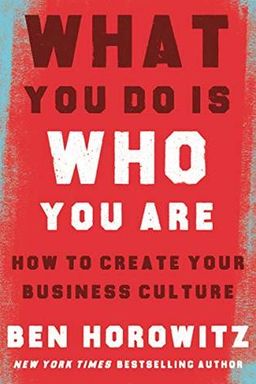
What You Do Is Who You Are cover

What You Do Is Who You Are

by Ben Horowitz

What You Do Is Who You Are offers a groundbreaking approach to business culture, blending historical wisdom with modern examples. Ben Horowitz reveals how leaders can craft unique cultures that reflect their personal values and strategic goals, ensuring lasting success.

What You Do Is Who You Are: The Power of Culture in Leadership

Have you ever wondered why some organizations thrive with integrity and passion, while others slowly decay despite great strategy? In What You Do Is Who You Are, venture capitalist and entrepreneur Ben Horowitz argues that the invisible driver behind every lasting success or failure is culture—what you actually do, not what you say. Horowitz contends that culture defines how people behave when you’re not around, how they make decisions under pressure, and how an organization sustains its values over time. Ultimately, your culture is the reflection of your actions—because, as the title emphasizes, what you do is who you are.

Horowitz’s key claim is bold: culture isn’t about posters of corporate values, perks like free lunches, or inspirational speeches. Instead, it’s a set of actions and behaviors that must be consciously designed, reinforced, and, when necessary, corrected. Drawing on stories as diverse as Haitian general Toussaint Louverture’s revolution, the code of the samurai, Genghis Khan’s empire, and the transformation of prison leader Shaka Senghor, Horowitz explores how enduring leaders shaped the values of entire civilizations by taking specific, decisive actions—not by writing mission statements.

Culture as the Strong Force

Horowitz opens by describing how culture operates as the “strong force” of organizations and societies. Like gravity, it is invisible but omnipresent. Strategy or product may win the short-term battles, but culture wins or loses the long-term war. He illustrates this with vivid examples: hip-hop’s raw honesty reshaped global music and identity, while Silicon Valley’s egalitarian ethos—born from Bob Noyce and Andy Grove at Intel—redefined modern business management. Both movements used action and participation, not slogans, to transmit cultural values.

He contrasts this with companies that failed because their culture ignored ethical conduct or failed to evolve—Enron being an example of deadly misalignment between proclaimed values and real actions. Horowitz’s message: culture isn’t static. It must be adjusted as conditions change, or it will ossify and break.

Values vs. Virtues

One of Horowitz’s most striking insights is the distinction between values and virtues. Values are what you believe; virtues are what you do. The samurai called their guiding principles “virtues” because belief alone meant nothing in battle—only consistent action and discipline did. Applying this to modern leadership, Horowitz argues that companies confuse aspiration with implementation. Listing “integrity” on a wall doesn’t make people honest. Creating actions and systems that reward honesty (and punish deceit) does. Your culture must translate virtues into tangible behaviors, measurable choices, and visible leadership.

Learning from Unlikely Cultural Architects

To illustrate the universality of cultural creation, Horowitz looks beyond business. Toussaint Louverture transformed a population of enslaved people into the world’s only successful slave-resistance state through discipline and ethics. Shaka Senghor rehabilitated a violent prison gang into a community uplift movement. The samurai sustained an empire through honor, loyalty, and self-control. Genghis Khan unified warring tribes into a meritocratic empire by focusing on inclusion and pragmatism. Each of these figures faced impossible conditions but succeeded by designing culture as a living code—a consistent set of actions that others could imitate and follow.

Why This Matters for You

For any leader—whether of a company, team, or community—the book demands self-reflection: Are you designing culture consciously, or letting it happen by accident? Horowitz insists that every organization has a culture, whether intended or not. If you don’t teach people how decisions get made, they’ll learn it by watching inconsistent behavior. If you overlook misaligned actions, you’ve just sanctioned them as normal. He reminds readers that shaping culture means being deliberate about norms, incentives, stories, and rituals—then living them personally.

Finally, Horowitz issues a humbling challenge. A great culture won’t make a bad product succeed, but a bad culture will eventually destroy even the best product. Like nutrition to a professional athlete, culture nourishes an organization’s ability to sustain greatness. It’s not about perfection but progress; not about words but deeds. And when all is said and done, people will remember less what you built and more how it felt to work with you—because your daily behaviors, collective decisions, and hard choices define who you truly are.


Designing Culture Through Action

Horowitz insists that leaders cannot delegate culture—they must design it through action. In the Haitian Revolution, Toussaint Louverture faced the impossible: molding traumatized slaves into disciplined soldiers capable of defeating Europe’s strongest armies. How did he do it? Not by words alone, but by specific cultural engineering. He kept what worked (African communication through voodoo songs), created shocking rules (officers forbidden from taking concubines), and personally lived the standards he preached. His actions taught warriors loyalty and discipline, transforming chaos into unity.

Cultural Rules That Shock

Louverture’s method demonstrates Horowitz’s concept of “shocking rules”—unexpected constraints that force people to ask “why?” and thereby engrain principles. For example, forbidding leaders from infidelity may sound irrelevant to war, but it made “keeping your word” a sacred organizational value. Amazon’s founder Jeff Bezos uses similar principles—door-desks that symbolize frugality and no PowerPoint in meetings to promote clarity. Shocking rules draw attention, teach purpose through paradox, and create vivid memory anchors for culture.

Incorporate Outside Leadership

Louverture successfully integrated former enemies—French and Spanish officers—into his army, blending expertise from the very culture he fought. Horowitz parallels this with Diane Greene at VMware and Mary Barra at GM, both who used outsiders or surprising internal changes to redefine norms. Bringing in leadership from another culture helps the organization evolve faster than copying slogans. At Opsware, Horowitz himself introduced sales head Mark Cranney, a cultural misfit whose aggressive discipline saved the company because his new behaviors rewired Opsware’s team norms around urgency and accountability.

Making Priorities Visible

Leaders prove what matters through decisions. Louverture’s radical forgiveness of slave masters—who kept their plantations but paid wages—was an unforgettable signal that prosperity, not revenge, defined the revolution’s moral center. Similarly, Reed Hastings at Netflix showed what cultural priorities look like by kicking DVD executives out of core meetings to focus on streaming. As Horowitz writes, “The more counterintuitive the leader’s decision, the stronger its cultural impact.” Words mean nothing unless backed by sacrifice and visible change.

The lesson? You design culture by doing hard things that symbolize long-term values, even when they're unpopular. Integrity, discipline, inclusion, and customer obsession don’t survive by declaration—they survive through leaders who embody them in moments of conflict.


The Way of the Samurai: Virtues Over Values

Horowitz explores the samurai’s moral code, bushido, as a timeless model for leadership. The samurai ruled Japan for seven centuries through eight interlocking virtues: rectitude, courage, honor, loyalty, benevolence, politeness, self-control, and sincerity. These values weren’t ideas—they were daily practices reinforced by stories, rituals, and consequences. Each virtue defined action, not belief. Leaders were judged not by their words but by whether they embodied their conduct with consistency and clarity.

Death and Discipline

At the heart of bushido was an obsession with death—not morbidity, but awareness. “The way of the warrior is found in dying,” wrote Yamamoto Tsunetomo in Hagakure. Warriors who accepted mortality could act fearlessly and honorably. Horowitz translates this to modern companies: accept worst-case scenarios—like failure or bankruptcy—so that you can act decisively without fear. When leaders and teams embrace impermanence, they stop avoiding hard truths and start focusing on meaningful work and integrity.

Politeness, Sincerity, and Honor

Politeness, the code of expressing love and respect through behavior, paired with sincerity to create authenticity. The samurai taught that politeness without sincerity is hypocrisy. They combined formal gestures with genuine intent, producing cultures built on empathy and human dignity. Horowitz connects this approach to his own company’s respect-based culture at Andreessen Horowitz, where punctuality was enforced as respect for entrepreneurs. Arriving late to meetings cost employees ten dollars per minute—a small but powerful behavioral ritual that turned politeness into action.

Virtues as Living Systems

Horowitz emphasizes that the samurai’s system endured because it was comprehensive and narratively encoded. They taught virtue through vivid stories—like a retainer who saved his lord’s genealogy by slicing open his stomach and hiding the scroll in his body during a fire. That bloody lesson embedded loyalty more deeply than any speech. Likewise, modern corporate cultures live through stories: Cisco’s founder John Morgridge’s motto “If you can’t see your car from your hotel room, you’re paying too much” taught frugality far more effectively than policy manuals.

Values fade; virtues persist. To create a culture that lasts centuries—or just a resilient organization—you must translate ideals into daily disciplines, emotional storytelling, and clear behavioral expectations.


Genghis Khan and the Culture of Inclusion

What can a warlord who conquered half the known world teach about inclusion? Plenty, according to Horowitz. Genghis Khan’s culture was founded on meritocracy, loyalty, and inclusion. He unified nomadic tribes by treating people according to competence, not lineage or religion. Where other rulers enslaved conquered populations, Genghis executed corrupt aristocrats and integrated common soldiers into his army. His model replaced hereditary privilege with shared purpose and opportunity—for Christians, Muslims, and Buddhists alike.

Meritocracy in Action

Genghis Khan promoted talent from any background. Shepherds became generals; conquered scholars became administrators. He even outlawed aristocratic inheritance and demanded that future leaders be elected. He led by example—walking, eating, and dressing like his soldiers. This egalitarianism generated loyalty and agility. Horowitz draws parallels to how visionary CEOs like Jeff Bezos and Reed Hastings build meritocratic systems where decisions depend on logic and data, not rank or privilege.

Inclusion as Strategic Advantage

Genghis Khan’s genius lay in cultural assimilation. His mother adopted children from conquered tribes to symbolize unity; he encouraged intermarriage between former enemies; and he elevated women’s roles and religious freedom. This wasn’t charity—it was strategy. As Horowitz writes, inclusion served empire. By integrating diverse people into one culture of merit, Genghis turned potential resistance into strength. Modern leaders, from Don Thompson of McDonald’s to Maggie Wilderotter of Frontier Communications, echo this wisdom by closing class gaps and recognizing every contributor as valuable.

Seeing People for Who They Are

Horowitz connects this historical philosophy to the modern workplace: true inclusion means seeing individuals, not categories. Hiring by demographic quota can backfire, perpetuating division; hiring by authentic qualities—helpfulness, collaboration, curiosity—builds cohesion. Andreessen Horowitz applied this by revising its hiring process to focus on people’s relational and learning skills, drawing diverse talent organically. The lesson from Genghis: inclusion isn’t a program—it’s a worldview where every person is a potential ally if given a fair chance and shared mission.


Be Yourself, Design Your Culture

Culture begins with authenticity. Horowitz urges leaders to ground culture in their own personality and values—not borrowed templates. Quoting Chance the Rapper’s “Be Yourself,” he warns that mimicry is fatal. If you try to be Jack Welch or Steve Jobs, you’ll end up performing values you don’t believe. When the talk contradicts the walk, culture collapses. Authenticity sustains credibility because people follow who you are, not who you pretend to be.

Know Yourself, Then Design

Horowitz tells stories of leaders who lost themselves after promotion—like the friendly coworker who became insufferable as “Manager Stan.” He contrasts this with CEOs such as Dick Costolo at Twitter, who modeled his natural habit of working late, inspiring others to do the same. Your habits create the tone. If you genuinely value frugality, efficiency, or learning, your culture will mirror those instincts. But you must also recognize flaws worth counterprogramming. Horowitz admits his own tendency for discursive conversations hurt efficiency, so he instituted tight meeting agendas to discipline himself and the organization.

Culture and Strategy Together

Horowitz challenges Peter Drucker’s famous quote “Culture eats strategy for breakfast.” He argues culture and strategy must cohere. Genghis Khan’s egalitarian troops matched his decentralized strategy; Amazon’s frugality fits its low-cost model; Apple’s obsession with design fits its premium identity. A culture detached from strategy is empty idealism. To succeed, align your virtues—like customer empathy, innovation, or discipline—with the objectives of your business.

The Universal Element: Caring

Ultimately, Horowitz concludes that all effective cultures share one trait: what you do must matter. Employees need to see that their actions make a difference. When HP’s staff stopped caring, bureaucracy replaced energy, and decisions evaporated. Upon joining HP, Horowitz reversed the trend by promising to make every stalled decision within a week. This small commitment reignited engagement because it rewarded caring over apathy. Culture thrives when effort is noticed and decisions affirm purpose.

Be yourself, but edit yourself wisely. Embed your authentic strengths, correct your weaknesses, and ensure every rule and ritual reinforces meaningful work. People don’t follow posters; they follow the consistent daily behaviors that reflect real belief.


Edge Cases and Object Lessons: When Culture Breaks

Horowitz acknowledges that culture isn’t perfect—it’s tested in crises and edge cases. Leaders must learn when to bend rules, repair breakdowns, and reinforce lessons through dramatic action. His concept of the object lesson—a symbolic act that redefines the standard after a violation—is crucial. Cultures become clearer through conflict, not avoidance.

Breaking and Rebuilding Rules

Horowitz recounts how Andreessen Horowitz’s no-internal-promotion rule initially protected cultural integrity but later threatened it by blocking talent. Promoting Connie Chan to general partner broke the rule yet restored bigger values of fairness and growth. Sometimes preserving culture means violating old dogma in service of its deeper purpose—a paradox reminiscent of Senghor’s reforms in prison and Louverture’s forgiveness in revolution.

Object Lessons and Fairness

The most dramatic example comes from Sun Tzu, who publicly executed disobedient concubines to establish military discipline. While extreme, it shows how one decisive, even uncomfortable act can define culture forever. Horowitz translates this to business: if sales fraud occurs, don’t just fire the culprit—remove their entire chain of command to ensure moral clarity. These symbolic acts reset standards in ways memos never can.

Dealing with Cultural Outliers

Finally, Horowitz outlines characters who break culture from within—the heretic, the flake, the jerk, and the prophet of rage. Each tests a leader’s tolerance. The prophet of rage, hyperproductive but abrasive, may deserve patient coaching because their intensity hides insecurity. Managing these personalities means reinforcing the team’s mission while adapting approaches that channel energy instead of destroying morale.

Culture fails at its edges—in ethical gray zones, personnel conflicts, and governance pressures. Leaders who face those edges openly, act decisively, and teach through example can transform breakdowns into defining stories of resilience.


Trust, Loyalty, and the Art of Meaning

In the book’s conclusion, Horowitz returns to the virtues that no culture can succeed without: trust, openness, and loyalty. Telling the truth, he notes, isn’t instinctive—it demands courage and judgment. Transparency must coexist with responsibility: don’t destroy morale by blurting fears, but assign honest meaning to hard realities. He evokes Abraham Lincoln’s Gettysburg Address as the greatest “reframe” in history—a speech that turned tragedy into national purpose. Leaders must do the same when breaking bad news, giving people not just facts but hope.

Encouraging Bad News

In every company, something is failing quietly. Horowitz teaches CEOs to reward honesty by celebrating problem revelation. At Opsware, he required executives to confess at least one issue “on fire” before entering meetings. This made candor a badge of ownership rather than shame, turning secrecy into collaboration. Cultures that welcome bad news fix problems faster and retain trust longer.

Loyalty as Mutual Commitment

Loyalty, Horowitz writes, isn’t permanence—it’s reciprocal reliability. Patrick Collison of Stripe defines it as helping employees do the most meaningful work of their lives; Ali Ghodsi of Databricks defines it as promise transparency: no surprises. Loyalty emerges when leaders respect people’s dignity through honest communication and fair treatment, not lifetime contracts.

Checklist for Cultural Design

Horowitz closes with a cultural checklist that distills all lessons: align culture with personality and strategy; start strong with cultural orientation on day one; create shocking rules; use object lessons; make ethics explicit; walk the talk; and make decisions that demonstrate priorities. Above all, remember the simple truth: even imperfect cultures can succeed if leaders are self-aware, consistent, and morally clear in what they do.

Culture is not a mission statement but a living organism—sustained by trust, tested by adversity, and evolved through action. As Horowitz writes, shaping it well is the ultimate act of leadership.

Dig Deeper

Get personalized prompts to apply these lessons to your life and deepen your understanding.

Go Deeper

Get the Full Experience

Download Insight Books for AI-powered reflections, quizzes, and more.