
Idea 1
Reimagining Business for the Google Age
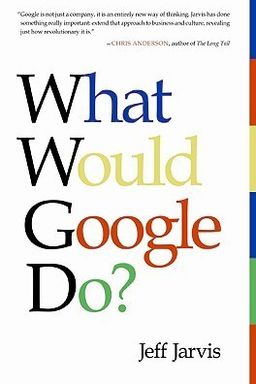
What if you ran your business, your classroom, or even your government like Google? That playful yet profound question is at the heart of Jeff Jarvis’s What Would Google Do? Jarvis takes Google not merely as a company but as a mindset—a model for understanding how the Internet reshapes power, relationships, and value creation in every sphere of modern life. Through stories, case studies, and a mix of journalistic insight and personal experience, he argues that survival in the 21st century depends on adopting Google’s worldview: open, collaborative, distributed, and customer-driven.
The book explores how Google’s principles—such as transparency, generosity, trust, and innovation—rewrite the old rules of business and society. Jarvis contends that while Google may be uniquely successful, its approach offers universal lessons for businesses, institutions, and even individuals trying to navigate the new digital landscape. The question, he writes, isn’t just what Google would do—but what you can learn from how Google thinks.
From Control to Collaboration
Jarvis’s central premise begins with a reversal of control: the era of top-down command is over. The Internet has given power to the public, shifting authority from corporations and institutions to communities and individuals. Google thrives because it trusts users—crowdsourcing the world’s knowledge through links, clicks, and contributions. Businesses that cling to control—companies that ignore their customers or hoard information—face extinction in the wake of democratized communication. The fall of Yahoo and the rise of Google illustrate this paradigm shift: one tried to be a portal, controlling traffic, while the other became a network, enabling users to find what they truly wanted.
Reversing the Rules of Value
Traditional economics depends on scarcity: limited space in newspapers, a finite number of TV channels, and costly physical distribution. Google’s world runs on abundance—unlimited digital space, near-zero distribution cost, and endless access. In this economy, power no longer comes from owning pipelines, printing presses, or airwaves. Instead, it flows from managing knowledge and enabling connections. Jarvis emphasizes that in this new world, value is created by platforms that facilitate participation rather than by gatekeepers that restrict it.
In place of control, the new currency is collaboration. Companies like Facebook, Wikipedia, Amazon, and Craigslist thrive by empowering their communities to create and share. Google’s brilliance, Jarvis argues, lies not in “having all the answers” but in building an infrastructure where the world can find them. Business today, he warns, must adapt from thinking in products to thinking in platforms.
Living by Google’s Laws
Jarvis identifies key principles—what he calls “Google’s Laws”—that define how successful organizations now operate. These laws include ideas such as: “Give the people control and we will use it,” “Do what you do best and link to the rest,” “If you’re not searchable, you won’t be found,” and “There is an inverse relationship between control and trust.” These principles form a new social contract between businesses and the public, where openness breeds credibility, and conversation replaces marketing.
Each chapter applies these laws to real-world examples. From Dell’s humiliating customer backlash (“Dell Hell”) to Starbucks’s reinvention through customer participation, Jarvis demonstrates the rewards of transparency and the perils of arrogance. Google’s “mutual learning” with its users becomes a universal model for how institutions—from airlines to universities to governments—can modernize by listening and responding in real time.
The Broader Vision
Jarvis doesn’t limit Googlethink to the economy. He reimagines entire sectors through this lens: how a “Google hospital” might share data to improve care, how a “Google government” could function transparently, how “Google universities” could open learning beyond the classroom, and even how manufacturing might become open-source. Across all these domains, the message is consistent—information wants to be shared, and those who resist openness risk irrelevance.
Ultimately, What Would Google Do? is not about Google itself, but about us. It urges individuals, entrepreneurs, educators, and policymakers to ask the same question every day: How can we think, act, and lead in ways that embody the web’s essential values—transparency, trust, speed, and connection? If we dare to answer that question honestly, Jarvis says, we might all become as transformative in our fields as Google has been in its own.