
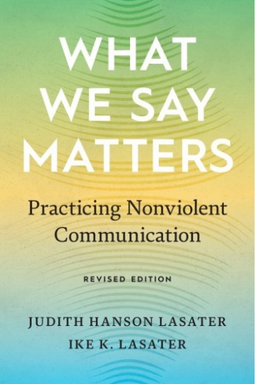
What We Say Matters cover

What We Say Matters

by Judith Hanson Lasater, Ike K Lasater

What We Say Matters is a transformative guide to mastering nonviolent communication. Learn to express your feelings and needs with compassion and honesty, fostering deeper connections while avoiding harm. Elevate your personal and professional relationships through empathy and understanding.

The Transformative Power of Compassionate Speech

Have you ever said something you instantly regretted—or wished someone would simply understand what you meant without judgment? In What We Say Matters, yoga teacher Judith Hanson Lasater and conflict mediator Ike K. Lasater argue that speaking truthfully and compassionately isn’t only a communication skill—it’s a spiritual practice capable of transforming how you relate to yourself, your loved ones, and the world. They show that every word we utter carries energy that reverberates throughout relationships, workplaces, and communities. If our speech can heal or harm, then the way we choose to speak—and listen—becomes one of life’s most profound yogas.

This book is a marriage of East and West: ancient Eastern teachings on satya (truthfulness) and Buddhist right speech entwined with Western psychology and Marshall Rosenberg’s model of Nonviolent Communication (NVC). At its heart is a simple but radical assertion: words matter because they create reality. As we speak, we frame how we see the world and how the world sees us. The Lasaters contend that learning to speak with awareness—first connecting with ourselves, then with others—can dissolve conflict, deepen empathy, and foster what they call “spiritual speech.”

Speech as Spiritual Practice

Drawing from Patanjali’s Yoga Sutra and Buddhist philosophy, the authors explore speech as part of the moral and meditative path. Satya (truth) and right speech are not merely about factual honesty but about speaking words that serve life. In yoga, the injunction against harmful speech stems from ahimsa—nonviolence. In Buddhism, right speech excludes gossip, slander, and falsehoods because they obstruct clarity and compassion. Yet both traditions, the Lasaters note, are long on values and short on practical techniques. Nonviolent Communication fills that gap: it translates lofty ideals into daily habits, offering tools to connect authentically through observation, feeling, need, and request.

As Judith explains, our words mirror our inner consciousness: “My words reflect my thoughts, my thoughts reflect my beliefs, and my beliefs, especially the unexamined ones, run my world.” To speak truly, we must first examine the mental filters that distort perception. Both yoga and NVC demand mindfulness, a pause between stimulus and response. When we express anger or judgment, we are usually reacting from learned patterns, not from truth. Spiritual speech begins when we listen inwardly—to the feelings and needs beneath those patterns—and then speak from that awareness.

Learning a New Language of the Heart

The Lasaters’ journey started awkwardly—Judith jokes that early attempts to use NVC with their teenagers were “a perfect example of how not to communicate.” But through years of practice, they came to see that NVC is less a set of words than a way of being. Instead of the habitual language of blame (“You never listen!”) or judgment (“You always do that wrong”), NVC trains us to speak through empathy: “When that happened, I felt hurt because my need for respect wasn’t met. Would you be willing to talk about how we could change this?” The phrasing may sound stilted at first, but the intention—to connect rather than coerce—unlocks deeper understanding.

The authors admit learning NVC feels like learning a foreign tongue—the “language of compassion.” Yet with practice, the structured formula leads to authentic fluency. They compare it to yoga or meditation: repetition builds awareness. Over time, syntax gives way to intuition, and empathy becomes second nature. The book’s exercises—journaling feelings, converting judgments to observations, “duck index” self-checks, and “please/thank you” translations—encourage the reader to integrate clarity and kindness into everyday conversations.

Why This Matters in Modern Life

The Lasaters’ message is urgent for our fragmented age. We live amid reactive speech—tweets, debates, arguments—that prize being right over being present. They invite you to reclaim speech as a spiritual discipline, to turn ordinary interactions into opportunities for connection. Whether in marriage, parenting, workplace meetings, or social activism, conscious language can transform conflict into compassion. Ike, a lawyer turned mediator, describes using NVC even in courtrooms with astonishing effect: clarity disarms defensiveness and invites cooperation.

Ultimately, What We Say Matters offers hope. It teaches that beneath every harsh word lies a yearning to be understood. When we recognize that universal need, our speech becomes a bridge rather than a weapon. Through satya and NVC, we learn to speak truth that is kind, and kindness that is true. In doing so, we not only change relationships—we change ourselves and the world we inhabit.


Practicing Satya and Right Speech

Judith Hanson Lasater begins the book by exploring satya (truthfulness) and the Buddhist concept of right speech. Although both traditions value truthful and nonharmful words, she notes that neither provides detailed guidance on how to speak truth kindly. That’s where Nonviolent Communication becomes invaluable: it acts as a bridge between spiritual intention and practical action.

From Thought to Speech

Speech, Lasater explains, reveals the entire architecture of our mind. Words arise from thoughts, and thoughts arise from beliefs. If those beliefs go unexamined—like the belief that we are worthless or undeserving—they unconsciously shape our world. She urges us to cultivate mindfulness about this chain reaction so our words can reflect awareness rather than conditioning. Both yoga and NVC help us pause between impulse and expression. Just as yoga teaches that the body is not the self, NVC teaches that we are not our thoughts. We have thoughts, but they don’t have to rule us.

The Threefold Connection

Right speech, according to the Lasaters, connects three dimensions: ourselves, others, and the task at hand. Culture usually inverts this order—we focus first on the task, then the other person, and finally ourselves. Spiritual speech reverses it. Unless you’re connected with your own feelings and needs, your words will ring hollow or defensive. When connection is internal first, external relationships naturally clarify.

An Example of Suffering through Speech

The authors illustrate how careless speech can create suffering. Imagine someone waiting for a partner to arrive home at 7 p.m.—the partner walks in late. Instead of expressing fear or concern, the waiting person blurts, “Where in the heck were you?” The conversation quickly devolves into blame. Both feel unheard, and connection vanishes. Through NVC, that moment can shift: “When you didn’t arrive at seven, I felt worried because my need for reliability wasn’t met. Would you be willing to call next time you’ll be late?” The same truth—spoken with awareness—transforms conflict into understanding.

Satya as Nonharming

The key insight is that truth cannot exist apart from compassion. In the Yoga Sutra, satya is listed among the restraints (yamas) that prevent harm. Without ahimsa, truth becomes weaponized. Right speech requires emotional restraint and empathy, ensuring honesty serves connection rather than dominance. As Swami Veda told Lasater, “Something cannot be true and unkind at the same time.” NVC helps us embody that paradox, making speech not just accurate but awakening.

By fusing mindfulness and communication, practicing satya and right speech becomes a living yoga. What you say, and the way you say it, reflects the state of your consciousness. Every utterance can then become a choice—toward suffering or toward love.


Nonviolent Communication: The Four Steps

The Lasaters translate Marshall Rosenberg’s Nonviolent Communication into an accessible spiritual practice by breaking it into four trainable components—observation, feeling, need, and request. They call this “training wheels” language to guide beginners through compassionate expression.

1. Observation vs. Judgment

An observation reports what the camera would see; a judgment adds interpretation. Saying “You arrived ten minutes after the agreed time” is neutral and grounding. Saying “You’re always late” triggers defense. The Lasaters urge you to notice “pseudo-facts”—statements that sound factual but are actually evaluations.

2. Feeling vs. Thought

Feelings are signals about needs being met or unmet, distinct from thoughts or analysis. “I felt lonely when you left” invites empathy; “You abandoned me” provokes argument. Like yoga asanas, feelings stretch awareness—they pull attention into the present moment. When you name a feeling without blame, you return to presence.

3. Need vs. Strategy

Needs are universal expressions of life—connection, peace, autonomy, safety—while strategies are specific ways to meet them. Most conflicts arise when people cling to strategies (beach vacation vs. mountain trip) instead of the underlying shared needs (rest and fun). Distinguishing the two opens creative solutions. The authors emphasize that love is not a feeling but a need; multiple strategies exist to fulfill it, liberating relationships from dependence.

4. Request vs. Demand

Requests are specific, present-tense, and voluntary: “Would you be willing to make your bed now?” Demands use coercion or guilt: “You must make your bed, or else.” The difference is revealed in your reaction to hearing “no.” If you feel anger or resentment, it was a demand; if you feel curiosity, it was a request. This nuance turns speech into partnership rather than power play.

Together these four steps form the syntax of empathy. Over time, they dissolve the old habit of moralistic judgments and replace it with compassionate observation. As Rosenberg taught, feelings are “flares from the unconscious.” When you honor them through need-based dialogue, you stop creating violence and start practicing truth.


The Four Choices of Communication

Judith and Ike outline four conscious options in any conversation. These choices move communication away from reaction and toward empathy, helping you decide where your attention should rest: on yourself or on the other person.

Choice 1: Self-Empathy

Before responding to anyone, pause and ask, “What am I observing, feeling, and needing right now?” Silent self-empathy transforms emotional DNA—the scripts inherited from family and culture. When you name what’s alive in you, old patterns dissolve. The authors liken this to meditation: the inner shift is felt bodily, sometimes through tears or relief. Self-empathy restores curiosity about others, an indicator that compassion has begun.

Choice 2: Self-Expression

Once grounded, you speak aloud what’s true for you using concise, nonjudgmental wording: “When I heard you close the door with more force than I like, I felt irritated because my need for peace wasn’t met.” Limit words to under thirty, followed by a clear request. This brevity avoids disconnection and reflects intention.

Choice 3: Giving Empathy

Then shift outward: guess what the other person might be feeling or needing. You can do this silently or aloud. The Lasaters recount Ike’s powerful experience offering empathy to Afghan refugee leaders after 9/11; as he guessed their unmet needs for respect and understanding, anger melted into connection. Empathy, whether verbal or silent, crosses cultural boundaries because needs are universal.

Choice 4: Making a Request

Finally, clarify what action or feedback you’d like. Action requests ask for something concrete (“Would you send the report today?”); process requests invite reflection (“Would you tell me what you heard me say?”). In workplaces or families, making these explicit reduces confusion and builds mutual respect. Requests rooted in empathy, not demand, create cooperation rather than compliance.

These four choices together form spiritual speech in motion—a dialogue of awareness. Each begins with presence and ends with connection, transforming everyday talking into inner yoga.


Listening to Yourself and Others

Listening is the hidden half of spiritual speech. Lasater emphasizes that self-awareness comes first: how you listen to your own inner voice determines how you hear others. Many of us, she says, grew up believing that having needs was selfish or unspiritual. This leads to self-denial and resentment.

Breaking the Circle of Judgment

We often judge ourselves for having judgments, creating a “hall of mirrors.” The way out is silent self-empathy—acknowledging feelings and needs without evaluation. By listening inwardly, you liberate others from carrying the weight of your unspoken expectations. This inner clarity stops violence before it begins.

The Duck Index

Judith introduces her playful “duck index,” inspired by Rosenberg’s image of a joyful child feeding ducks. She rates desires from 1 to 10 and refuses to act unless it’s at least a 6. This ensures that actions come from authentic willingness, not guilt or fear. “Seduce me with your needs” becomes her mantra for mutual choice—an invitation to co-create joy rather than obligation.

Translating ‘Please’ and ‘Thank You’

Lasater teaches hearing every statement as a request—either a “please” or a “thank you.” When someone insults you, imagine them saying, “Please hear my pain.” When someone praises you, hear, “Thank you for meeting my needs.” This reframing dissolves defensiveness and promotes compassion. It recognizes that all speech is an attempt to meet needs, whether gracefully or clumsily.

Listening with empathy—and interpreting others through their needs—turns irritation into insight. You stop hearing criticism and start hearing humanity. This simple shift is the essence of mindful communication.


Transforming Anger and Judgment

Anger, Judith admits, is perhaps the hardest test of spiritual speech. In NVC, anger is not an enemy but a messenger—it points to unmet needs and hidden judgments. By peeling back anger’s layers, we discover the hurt or fear beneath it.

Unmasking Anger

Lasater once counted sixty-seven moments of irritation in a single day, realizing how automatic anger had become. She practiced tracing each flare-up to its source. Beneath “He shouldn’t have said that!” lay fear of rejection or desire for respect. When she named the true feeling, the anger lost power. Like yoga’s breath work, self-empathy transforms contraction into release.

Empty Rowboats and Righteous Fury

She retells a Buddhist story of a monk who erupts when another boat hits his—but the other boat is empty. The parable reveals that our rage depends on believing there’s someone to blame. Seeing every provocation as an “empty rowboat” frees us from moralistic anger. Even righteous anger, fueled by being right, blocks compassion. To serve justice, we must act from empathy, not fury.

Enemy Images

We perpetuate violence by projecting enemy images onto others—bosses, politicians, or even ourselves. These judgments leak through words and body language, eroding connection. Transforming them requires patience: weeks of self-empathy and silent compassion until curiosity arises. Seeing others as humans with unmet needs replaces moral labeling with healing awareness.

Interrupting and the Joy of Truth

Lasater redefines interruption: rather than rudeness, it can be a moment of honesty. Pretending to listen while disengaged is more harmful than politely saying, “I want to hear you fully, but I’m tired right now. Can we talk later?” True kindness means daring to speak your satya with presence. Likewise, when others repeat painful stories, respond with empathy to the feelings behind them rather than impatience—helping both of you return to the present.

Through these practices, anger and judgment become portals into compassion. Every conflict, seen clearly, becomes spiritual training.


Communication in Relationships

Few places test conscious speech like intimate partnership. The Lasaters share vivid stories from their marriage to show how empathy and clarity reshape connection over decades.

From Hidden Needs to Honest Requests

Judith recalls asking Ike, “Are you thirsty?” when she meant “I’m thirsty—can we stop for water?” Growing up believing women shouldn’t have needs, she disguised them as questions. NVC helped her unlearn this pattern: “I’m thirsty. Would you be willing to stop for water?” Simple, direct truth replaced resentment. The shift honored satya and deepened safety in their relationship.

The Gift of Requests

Rosenberg’s insight that “requests are gifts” inspired their mantra “become Santa Claus.” When you ask for what you want, you offer your partner the joy of contribution. Seeing needs as gifts turns self-expression from burden into generosity. Demands breed guilt; gifts fuel love.

Handling Repeated Conflicts

Couples often fight about the same issue—Lasaters joke their ongoing battle is about room temperature. Rosenberg claimed any long-standing conflict can dissolve within twenty minutes once partners truly hear each other’s needs. Empathy, not strategy, ends circular arguments. When both feel heard, creativity replaces defensiveness.

Avoiding Unconscious Patterns

Relationships thrive on awareness. The Lasaters recommend agreeing on a gentle signal—like a raised finger—to remind each other when old defensive habits arise. Presence replaces reaction. They also warn against hearing criticism; instead, listen for the heart behind the words. “It’s not what they said that caused my pain; it’s how I chose to hear it.”

From Independence to Interdependence

Western culture prizes independence, but the Lasaters reveal its loneliness. True freedom lies in interdependence—the understanding that needs intertwine. When both partners honor each other’s wellbeing, love becomes collaboration rather than control.

In relationships, every word becomes an act of creation. When spoken with empathy, it builds safety and possibility; when spoken reactively, it erodes trust. Through conscious speech, partners can learn to meet both sets of needs—and in doing so, meet life itself.


Parenting and Family Communication

Parent-child communication, the authors admit, is “graduate-level” empathy work. Power dynamics complicate love, often turning guidance into control. The Lasaters illuminate how shifting from “power over” to “power with” restores harmony.

Power Over vs. Power With

Marshall Rosenberg taught that parents cannot make children do anything—they can only make them wish they had, and then wish they hadn’t. True influence comes through collaboration. Judith recounts negotiating with her teen daughter about attending a late-night concert. Instead of forbidding, she said, “Let’s brainstorm strategies that meet both our needs for fun and safety.” They agreed on safety measures together, ending with laughter rather than rebellion. Power with generates connection; power over breeds resistance.

Protective Use of Force

Nonviolence isn’t passivity. Parents must sometimes act to prevent harm—the “protective use of force.” In the Indian parable of the sadhu and the snake, when the snake practiced nonviolence too literally, children abused him; the teacher reminded him, “I told you not to bite, but never said you couldn’t hiss.” Compassion can assert boundaries without aggression.

Respecting Autonomy

Lasater calls autonomy the holy grail of family life: every person, child or parent, needs respect for choice. From toddlers’ “No!” to adult children’s independence, autonomy signals growth, not defiance. She cites the film One Fine Day where George Clooney’s character wins his daughter’s cooperation by hearing her needs instead of bribing or commanding. Empathy dissolves rebellion.

Reframing Approval and Praise

Instead of praise—which manipulates through judgment (“You’re such a good boy”)—the Lasaters advocate appreciation. Tell children how their actions met your needs: “When I saw the kitchen clean, my need for help and order was met.” Appreciation affirms contribution without control. As educator Alfie Kohn has shown (in Punished by Rewards), rewards backfire; genuine gratitude nurtures self-worth.

Parenting through NVC turns authority into empathy. Each exchange becomes a chance to model truth, compassion, and respect—the foundations of peaceful family life.


Workplace and World Applications

Ike Lasater’s legal and mediation background provides real-world proof that conscious speech works beyond yoga studios. In offices, courtrooms, and global conflicts, NVC reshapes environments of fear into collaboration.

Using NVC at Work

Professionals often fear revealing vulnerability, equating emotional honesty with weakness. Ike recounts daring to use NVC during a tense cross-examination of a government witness. He spoke candidly: “I’m concerned about time—would you be willing to answer briefly?” Instead of objection, he received cooperation. Authenticity respected both participants’ needs for efficiency and respect.

Clear Requests and Efficient Speech

Work settings suffer from vague communication—meetings where no one asks specific actions. Ike teaches asking, “Would you tell me what you want me to do with this information?” This simple question redirects talk from analysis to clarity. NVC, he adds, increases efficiency by reducing word count; empathy minimizes repetition and misunderstanding.

Evaluations and Gossip

Annual reviews and gossip are two workplace traps of judgment. The former cloaks opinions in objectivity; the latter seeks empathy through complaint. Ike suggests translating both into needs language. In evaluations, name observable behavior and the needs behind it: “Reports arrived after deadline; my need for reliability wasn’t met.” When hearing gossip, guess feelings instead of agreeing: “Are you feeling frustrated because your need for fairness wasn’t met?” This turns gossip into growth.

Talking to the World

In the final chapters, Judith extends NVC to global compassion. Her exercise of empathizing with Osama bin Laden after 9/11 demonstrates radical empathy: seeing shared needs (respect, power) beneath horrific actions without condoning them. Similarly, Ike’s street encounter with an aggressive beggar de-escalated through empathy and clear requests—turning potential violence into connection.

The Lasaters conclude with dual practices: mourning for actions that miss the mark and celebration for those that embody compassion. Instead of guilt, we say “How human of me,” affirming growth. In the worldly domain—from boardrooms to refugee camps—speech remains our most spiritual instrument for healing collective wounds.

Dig Deeper

Get personalized prompts to apply these lessons to your life and deepen your understanding.

Go Deeper

Get the Full Experience

Download Insight Books for AI-powered reflections, quizzes, and more.