
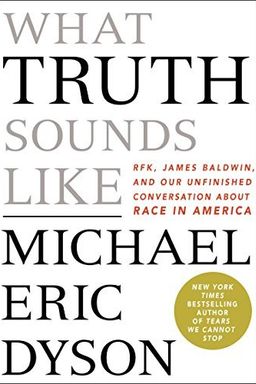
What Truth Sounds Like cover

What Truth Sounds Like

by Michael Eric Dyson

What Truth Sounds Like delves into a crucial 1963 meeting between Robert Kennedy and black artists, revealing its profound impact on Kennedy''s political evolution. Michael Eric Dyson connects past conversations on race to present-day challenges, urging empathy and action for genuine progress.

What Truth Sounds Like: The Conversation America Still Needs

What happens when a powerful white politician walks into a room and is forced to truly listen to Black pain? In What Truth Sounds Like, Michael Eric Dyson examines one of the most explosive and transformative meetings in American history—when Attorney General Robert F. Kennedy met with writer James Baldwin and a group of Black intellectuals and artists in 1963. Dyson argues that this encounter, which began as a political consultation, evolved into a moral confrontation that forever changed Kennedy and forced him—and the nation—to face what Baldwin called “the fire next time.”

Dyson contends that the exchange between Kennedy and Baldwin reveals a pattern that still defines America today: the inability of power to understand the witness of suffering until it is forced to confront it. Robert F. Kennedy entered that room seeking policy advice; he left it awakened to an entirely different kind of truth—the human, moral, and emotional reality of racism. Dyson’s central argument is that progress toward racial justice emerges only when witness pierces the armor of policy, when listening replaces defensive talking, and when truth sounds louder than politics.

The Fire That Sparked a Revolution

Dyson revisits the May 1963 meeting between Robert F. Kennedy and James Baldwin, Lorraine Hansberry, Lena Horne, Harry Belafonte, Kenneth B. Clark, and other Black thinkers. The participants didn’t mince words. Freedom Rider Jerome Smith told Kennedy that after years of beatings and violence, he was close to taking up arms. Lorraine Hansberry sharply rebuked Kennedy’s political defensiveness, insisting that he listen to Smith—the embodiment of real suffering. Baldwin served as interpreter between Black rage and white power, revealing the gap between moral urgency and political caution. The emotional rawness of that encounter laid bare the spiritual sickness that haunted America, a sickness that no legislation alone could cure.

Witness vs. Policy: The Moral Collision

Dyson identifies the meeting as the moment when two fundamentally different languages collided. Kennedy spoke the language of policy, procedure, and political pragmatism—what could be passed, voted on, and televised. Baldwin and his peers spoke the language of witness—the moral truth transmitted through lived experience, pain, and memory. This chasm remains America’s central racial divide. Policy seeks measurable reform; witness demands moral recognition. To Baldwin, changing laws mattered little if the society’s heart remained whitewashed. Dyson argues that this tension between bureaucracy and empathy still defines racial discourse, from civil rights legislation to Black Lives Matter activism.

From Hearing the Truth to Becoming Its Messenger

Though Kennedy initially dismissed the meeting as hysterical and futile, its reverberations transformed him. Over time, he moved from defensiveness to empathy—from wanting to lead the conversation to learning how to listen. Dyson traces how this shift made Kennedy a moral witness himself, opening him to the pain of America’s racial wounds. This evolution mirrors Baldwin’s own notion of “witness”: the courage to tell the truth even when it hurts, and especially when others refuse to hear it. The book makes clear that the meeting’s ultimate legacy wasn’t just in political outcomes, but in the moral awakening it inspired—a transformation mirrored in Kennedy’s later speeches, advocacy, and compassion for the poor.

Why It Still Matters

Dyson shows how the deeper lessons of that confrontation echo today in new forms of advocacy and artistry. He connects Baldwin’s prophetic witness to modern voices like Ta-Nehisi Coates, Cornel West, and #BlackLivesMatter activists who insist that justice must also be felt. The same fault lines—between policy and empathy, between respectability and raw truth—continue to shape America’s struggle with race. Dyson compels you to realize that the sound of truth isn’t polite; it is disruptive, emotional, and exacting. Real listening, he suggests, demands vulnerability—it requires the powerful to risk being changed by what they hear.

The Enduring Conversation

Ultimately, Dyson’s book is about unfinished conversation. The 1963 meeting was not the end of dialogue—it was the beginning of a debate that stretches across generations. He traces this lineage through politicians (Robert Kennedy, Barack Obama), intellectuals (Cornel West, Ta-Nehisi Coates, Erin Aubry Kaplan), artists (Harry Belafonte, Beyoncé, Jay-Z), and activists (Black Lives Matter and #MeToo founder Tarana Burke). Their work, Dyson reminds you, continues the essential task that Baldwin began: speaking truth to power through witness, art, and intellect. The question isn’t whether truth sounds like policy or protest; it’s whether we’re still willing to hear it.

Michael Eric Dyson’s argument reaches beyond history: until we learn to hear each other’s pain with honesty and humility, America will remain trapped in the dissonance between what it says and what it is. The question he leaves you with is haunting—can we bear to listen when truth finally speaks?


Witness Versus Policy: The Soul of Activism

At the heart of Dyson’s narrative lies the clash between two kinds of activism—witness and policy. Witness is personal, emotional, prophetic; policy is structural, legal, procedural. Understanding their tension is crucial because it shapes every social movement from civil rights marches to Black Lives Matter hashtags. Dyson illustrates how Robert F. Kennedy’s pragmatic focus on legislation met the fierce moral urgency of Jerome Smith and Baldwin’s insistence on truth-telling.

Policy Without Heart

Kennedy thought civil rights could be achieved through rational reform: voting laws, housing acts, education funding. He saw racism as political malfunction. Yet Baldwin forced him to see its moral rot—to understand that America’s “problem” wasn’t Black people’s suffering, but white people’s denial. When Kennedy spoke of progress, Smith countered with fury: “I’m close to the moment where I’m ready to take up a gun.” That outburst stripped the politeness from politics. Policy that ignores pain, Dyson explains, becomes empty bureaucracy.

Witness as Moral Authority

Baldwin, Hansberry, and Belafonte embodied what Dyson calls existential witness—a testimony that fuses intellect and emotion. They weren’t advocates analyzing statistics; they were prophets exposing hypocrisy. Witness demands empathy, not evidence. It tests the heart instead of the system. Baldwin’s voice anticipated contemporary movements like Black Lives Matter, which emerged not merely to lobby for reform but to proclaim human dignity. Their slogan—#SayHerName, #IAmTrayvonMartin—echoes Baldwin’s mantra of visibility: to be seen, heard, and believed.

A Modern Revival of the Debate

Dyson draws a parallel between the Kennedy-Baldwin meeting and Hillary Clinton’s 2015 encounter with Black Lives Matter activists. Clinton insisted that change comes through laws, not hearts. Activists replied that without transformed hearts, laws fail. Like Kennedy, Clinton defended policy while the activists demanded witness. Both moments reveal how enduring this disconnect remains. Dyson doesn’t side entirely with one camp; he argues for the fusion of both—policy informed by empathy and witness driving legislation.

“The solutions proffered in the name of progressive racial faith—change in law, change in policy—have no answer for the hate that trumps law.” —Michael Eric Dyson

Bridging Heart and System

Dyson’s insight is practical as well as philosophical. To create durable progress, activists and politicians must learn each other’s languages. Witness without structure leads to burnout; policy without compassion leads to injustice. Kennedy eventually reached this synthesis. He saw that listening to pain could guide political reform, and his later advocacy for the poor proved that empathy can become effective governance. For you, this means that real activism begins when you stop arguing about methods and start integrating heart with system—feeling with strategy, outrage with outcome.


Whiteness and the State

Dyson dissects one of Baldwin’s most radical claims—that America’s democracy was built on whiteness itself. Racial injustice, Baldwin wrote, isn’t a deviation from American values; it’s woven into the nation’s founding documents. Dyson expands this idea to show how the state operates as a defender of white interests, from the Constitution’s three-fifths clause to modern political movements that disguise privilege as populism.

The Architecture of Whiteness

American politics was constructed to protect a particular identity—white, male, property-owning. Black people were counted but not considered, recognized but not represented. Dyson traces this from Jefferson’s suspicion of Black intelligence to Trump’s modern ignorance of it. Even well-meaning leaders like Kennedy operated within the assumption that “white interests are American interests.” It’s why progress often appears as concession rather than correction.

Obama and the Paradox of Representation

When Barack Obama entered the White House, he embodied Baldwin’s paradox—a Black man representing an institution that had historically erased his people. Dyson calls him a “walking legitimation crisis,” since his presence challenged the logic of whiteness while confirming America’s ideal of meritocracy. Trump’s rise, Dyson argues, was a backlash to that contradiction: a reassertion of whiteness wearing populist clothing. Trump's birtherism symbolized the refusal to see Black authority as legitimate citizenship.

The Modern Face of Whiteness

Dyson compares Trump’s worldview to Bernie Sanders’s blind spots. Though politically opposed, both revealed discomfort with race discussion—Trump through hostility, Sanders through reductionism (“We must go beyond identity politics”). Dyson warns that calls to ignore race in favor of class solidarity perpetuate white centrality. White populism, whether liberal or conservative, still assumes a universal perspective that erases Black experience. True democracy, Dyson insists, must interrogate whiteness as identity, not invisibility.

The Confederacy of Memory

Through examples like Charlottesville and Chief of Staff John Kelly’s praise of Confederate “honor,” Dyson exposes the nation’s nostalgia for racial hierarchy. He critiques historical revisionists like Shelby Foote and cultural productions that romanticize compromise. In these myths, white supremacy becomes sentimentality rather than systemic terror. Dyson argues that facing history’s truth—not the sanitized memory—remains essential to dismantling whiteness as the default setting of citizenship.

“Donald Trump treats the entire nation as ‘the nigger.’ He has confused his pronouns.” —Michael Eric Dyson

Dyson’s provocative analysis reframes whiteness as a cultural addiction—the refusal to see reality without racial filtering. To heal the state, he argues, we must detox from the illusion that one group’s experience defines the national character. Without truth, democracy becomes merely polite segregation.


The Artists: Art as Liberation

Can art tell the truth when politics fails? Dyson’s chapter on Black artists explores how figures like Harry Belafonte, Lorraine Hansberry, Jay-Z, Beyoncé, Lin-Manuel Miranda, and Jordan Peele use creativity as moral resistance. For Black creators, art is never merely expression—it is a testimony against dehumanization, a form of survival, and a weapon against silence.

Art as Witness

James Baldwin argued that the artist must be a “disturber of the peace.” For Black artists, Dyson writes, every painting, performance, or lyric carries racial weight because Black existence itself is political. Belafonte and Horne used their celebrity to challenge segregation in entertainment; Hansberry’s A Raisin in the Sun transformed domestic life into political theater. Their art existed as moral argument—the belief that beauty and justice are inseparable.

From Belafonte to Beyoncé: Evolution of Representation

Belafonte risked his career to support civil rights, while Beyoncé risked hers to unveil Black pride on a global stage. Her Black Panther–themed Super Bowl performance and visual homage to “Stop Shooting Us” extended Belafonte’s legacy into the visual language of empowerment. Jay-Z, meanwhile, embodies the complexities of capitalism and consciousness—using wealth as both armor and amplifier for racial truth. Dyson notes that respectability politics gave way to hip-hop’s unapologetic realism: the truth of the street became the new stage for witness.

The Generational Divide

Dyson captures the tension between older activists like Belafonte and younger ones like Jay-Z—a clash between stereotype, archetype, and antitype. Belafonte sought virtue; Jay-Z tested irreverence. Yet both, Dyson argues, perform the same spiritual labor: redefining Blackness against the backdrop of cultural distortion. Art becomes theology—a way to confess pain, assert identity, and imagine a freer future, from Harlem stages to Wakandan screens.

From Stage to Screen: Reinventing Black Futures

Dyson explores Jordan Peele’s Get Out and Ryan Coogler’s Black Panther as modern successors to Baldwin’s moral art. Peele’s satire exposes liberal racism through horror; Coogler’s Wakanda reimagines Black excellence without colonial shadow. Both works prove Baldwin’s claim: fantasy and fear are mirrors of truth. Dyson calls Black Panther Afro-futurism’s moral cathedral—a place where Blackness exists without apology or permission.

“We love Wakanda because Wakanda loves us.”

For you, Dyson’s meditation on art insists that creativity can be activism. To make art is to declare worth in a world that denies it; to tell stories is to shape moral understanding. Whether through song, poem, or performance, the artist’s witness remains America’s most truthful sound.


The Intellectuals: Baldwin, Coates, and West

Dyson’s analysis of Black intellectual life tracks how thinkers from James Baldwin to Ta-Nehisi Coates and Cornel West wrestle with race, truth, and power. He portrays Baldwin as both prophet and scholar—a thinker whose moral clarity transcended academic jargon. Baldwin’s debates with Kennedy and later with philosophers like Sidney Hook revealed his insistence that America’s crisis wasn’t sociological but spiritual—a sickness in whiteness itself.

Baldwin’s Philosophy of Whiteness

In the 1964 “Liberalism and the Negro” roundtable, Baldwin shocked scholars by reframing racism as moral rot rather than mere policy failure. He countered ethical liberalism with existential realism: “You can’t teach morality in schools that will be destroyed in the streets of Harlem.” His ordinary language, free of jargon, carried prophetic force. Dyson calls him America’s clearest moral voice—a witness whose truth still burns through movements like Black Lives Matter.

Coates, the Modern Baldwin

Dyson explores Ta-Nehisi Coates as Baldwin’s contemporary heir. His Between the World and Me revived Baldwin’s epistolary form and moral intensity. Toni Morrison’s comparison of Coates to Baldwin triggered debate with Cornel West, who accused Coates of neoliberalism and cowardice. Dyson defends Coates, noting that his “fear-driven self-absorption” is not weakness but moral honesty. Like Baldwin, Coates writes from vulnerability—the body as testimony to history’s wounds.

Cornel West and the Prophetic Tradition

Dyson turns his lens on Cornel West, the self-styled prophet whose public feuds reveal the hazards of ego in moral discourse. West’s descent from visionary scholar to bitter critic of Obama and Coates mirrors Baldwin’s disputes with peers—but lacks Baldwin’s grace. Dyson argues that West misunderstood prophecy, mistaking self-righteous anger for sacred calling. True prophets, he reminds, are accountable to humility, community, and love—not applause or martyrdom.

The Future of Black Thought

Dyson concludes that Black intellectual life thrives when it unites policy analysis with moral passion. Today’s thinkers—Coates, Erin Aubry Kaplan, Imani Perry—extend Baldwin’s witness through gender, sexuality, and digital platforms. Their resistance to pessimism keeps the conversation alive: truth must evolve, not ossify. For you, Dyson’s message is simple—read Baldwin not only as history but as instruction. To think critically about race, you must first feel it.


The Activists and the Legacy of Protest

Dyson links Baldwin’s generation of civil rights activists to twenty-first-century movements like Black Lives Matter and #MeToo, showing how moral witness has adapted to digital age activism. The question underlying both eras is timeless: does change come through legislation or through disruption? Dyson argues it’s both—but disruption must expose the heart before healing the system.

From Freedom Riders to Hashtags

Jerome Smith’s anger in 1963 and Tarana Burke’s empathy in 2017 share a common root—the refusal to silence pain. Burke’s description of “empowermental empathy” echoes Baldwin’s witness: shared trauma transforms pity into solidarity. Similarly, Alicia Garza, Patrisse Cullors, and Opal Tometi’s founding of Black Lives Matter reclaimed visibility through technology, forcing the public to “see” injustice on screens as Kennedy once saw it in person.

Disruption as Moral Practice

Dyson defends protest as sacred noise—the sound of truth interrupting comfort. He cites Frederick Haynes’s description of “the politics of disruption” as America’s real progress. From the Boston Tea Party to Ferguson, radical interruption exposes hypocrisy. Yet Dyson balances this with respect: listening validates outrage. Activism must oscillate between fury and dialogue, between shouting and hearing. Otherwise, protest becomes performance instead of transformation.

Policy as Moral Healing

While Dyson honors BLM’s raw urgency, he urges integration with policy. The Movement for Black Lives’ 2016 Vision document does just that—channeling witness into reform on incarceration, education, and economy. Dyson argues that passion without structure risks becoming nihilism, echoing Cornel West’s warning that Black America’s greatest ailment isn’t racism but hopelessness. To heal despair, protest must become purpose.

“Disruption is the sound of democracy breathing.” —Michael Eric Dyson

For you, the takeaway is clear: activism isn’t just marching—it’s moral listening, policy building, and people loving. Every era needs its Baldwin and its Bobby, its outrage and its empathy, until truth finally sounds like justice.

Dig Deeper

Get personalized prompts to apply these lessons to your life and deepen your understanding.

Go Deeper

Get the Full Experience

Download Insight Books for AI-powered reflections, quizzes, and more.