
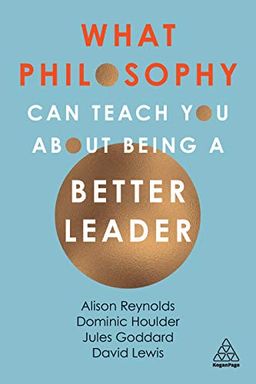
What Philosophy Can Teach You About Being a Better Leader cover

What Philosophy Can Teach You About Being a Better Leader

by Jules Goddard

What Philosophy Can Teach You About Being a Better Leader reveals how philosophical insights can revitalize leadership approaches. Drawing from ancient and modern thinkers, it offers transformative strategies for communication, strategy, and empowerment, applicable to anyone aiming to excel in business and beyond.

Philosophy as the Secret to Human Leadership

Have you ever felt like a cog in a corporate machine—useful, efficient, but somehow less than fully human? The authors of What Philosophy Can Teach You About Being a Better Leader argue that this sensation of being mechanized or alienated is not simply modern burnout—it's the loss of our humanity at work. Alison Reynolds, Dominic Houlder, Jules Goddard, and David Lewis contend that the modern workplace, obsessed with efficiency and driven by economics and psychology, has forgotten an essential third dimension: philosophy. Philosophy, they believe, guides us beyond productivity and positivity to the deeper question of what truly makes life—and leadership—good.

The core argument is that great leadership, and indeed the humanization of work, depends not on doing things right (as management does) or even persuading others to feel good (as psychology often aims), but on doing the right things, guided by moral and philosophical reflection. Echoing Peter Drucker’s claim that “management is doing things right; leadership is doing the right things,” the authors suggest that philosophy is uniquely suited to help us define what’s right. This book, therefore, is an invitation to turn workplaces from soulless systems into communities of moral, creative, and reflective human beings where people, ideas, and performance can flourish together.

The Problem: The Dehumanized Workplace

Drawing on Karl Marx’s early writings, the authors open with a vivid image of alienation. Marx observed in 1844 that industrial workers denied themselves in their labor—they did not fulfill themselves through their work but instead felt homeless at work and alive only outside it. Today’s “white-collar” workforce, they argue, faces the same fate under new guises: middle managers trapped in global systems, professionals reduced to process executors, and employees treated as data points. The relentless pursuit of efficiency has turned us into tools used for productivity rather than humans capable of creation and meaning. The Faustian bargain we made for wealth and technology has cost us our sense of self.

This existential emptiness affects not only front-line workers but also executives. A senior banker who once took joy in creative problem-solving now feels like a salesman for opaque products. A consultant realizes she’s become “a cog in the machine” of corporate processes that no one truly owns. These examples reveal how our spiritual and intellectual autonomy is traded for procedural compliance—echoing what Marx called “alienation from one’s essence.”

Why Philosophy Matters Now

Philosophy, say the authors, asks the questions that economics and psychology cannot: What is good? What does it mean to flourish? When is work truly human? Psychologists might tell you how to feel engaged; economists, how to be efficient. But philosophers—from Aristotle to Nietzsche to the Buddha—ask how to live and act in ways worth living and doing. These are questions not just about personal happiness but moral and collective well-being. They are as relevant to boardrooms as they are to monasteries.

The book, therefore, brings ancient and modern philosophy to the practical dilemmas of work: How do we empower others ethically? What makes a strategy humane? How do we communicate without losing authenticity? Each chapter aligns a leadership challenge with a philosopher’s insight: Aristotle and Nietzsche teach about human flourishing; the Buddha humanizes strategy; Karl Popper sharpens creative thinking; Hobbes and Kant redefine authority; Epictetus and Hume reimagine communication; and Buber restores genuine human connection.

Philosophy as a Lens for Leadership

The authors argue that leadership must move from a technical field to a moral and philosophical art. They call for leaders who think like philosophers—those who are self-aware, curious, empathetic, and guided by principle rather than compliance. Instead of managing resources, these leaders cultivate environments where reason, creativity, and compassion thrive together. They lead not through control, but by example and inquiry.

Through this lens, leadership becomes less about status or scale and more about fostering human flourishing. Whether you lead a global corporation or a small team, the question is the same: are you helping others become more fully human, or turning them into smarter machines? The book argues that the measure of leadership success should not be profit or satisfaction scores, but the degree to which people flourish—using Aristotle’s concept of eudaimonia (the good life through the full exercise of one’s reason and character).

The Path Toward a Humanized Workplace

To heal our dehumanized systems, the authors call for a transformation at both personal and organizational levels. Individually, you must develop self-knowledge and moral awareness—recognizing when you’re acting as a tool rather than a person. Collectively, organizations must become ecosystems of empowerment, creativity, fairness, and dialogue. Philosophy, they say, is not abstract theory but a daily practice of asking deeper questions about purpose, relationships, and decisions.

Ultimately, this book teaches that work need not alienate; it can liberate. The workplace can become a site of flourishing if leaders see their role as ethical stewards rather than efficiency managers, and if every individual takes responsibility not only for what they achieve but for how they act. Through the wisdom of philosophers—Aristotle’s reason, Nietzsche’s courage, the Buddha’s compassion, Kant’s duty, and Buber’s encounter—you can reclaim your humanity at work and help others do the same.

“This book reminds us that leadership is not about having more power over others, but about using the power we’re given to create conditions where others can flourish.”


Reason and Passion: The Balance of Flourishing

To become a better leader, you must first become more fully human. In Chapter 2, the authors pair two unlikely philosophical allies—Aristotle and Friedrich Nietzsche—to show that flourishing requires both reason and passion. Together, they reveal that the good life and the good workplace depend on balancing disciplined thinking with creative instinct. Aristotle’s clear logic meets Nietzsche’s fiery individuality, forming the twin pillars of a “humanized workplace.”

Aristotle’s Middle Way: Flourishing Through Reason

Aristotle believed that human beings differ from animals and slaves because they possess reason—the ability to reflect, deliberate, and act freely. True happiness, or eudaimonia, comes from exercising reason well, finding what he called the “golden mean” between extremes. Courage, for example, lies between recklessness and cowardice; generosity between wastefulness and stinginess. In the workplace, Aristotle’s middle way invites you to lead with balance—firm but fair, ambitious but measured, empathetic but disciplined.

A reasonable workplace, Aristotle might say, is one where people are encouraged to think for themselves. Yet the authors note that many organizations still treat employees like slaves—rewarded for obedience, not judgment. An IT company that pressures its staff to “get the numbers up this quarter come what may” stifles moral and intellectual growth. Following orders replaces moral reasoning. Aristotle would call this the tragedy of modern slavery. Without reflection and dialogue, leaders risk creating obedient machines rather than self-determining humans.

Nietzsche’s Higher Man: Flourishing Through Passion

If Aristotle teaches moderation, Nietzsche champions transformation. Writing two millennia later, Nietzsche rejected calm reason for the vitality of passion and creation. He urged each person to overcome the “herd mentality” of conformity and become a “Higher Man”—someone who creates meaning, rather than borrowing it from tradition. For him, flourishing is a work of art: you sculpt your life with courage, risk, and self-discipline to express your true potential.

The authors apply this philosophy to modern business life. Many workplaces, they argue, still preach “values” like humility, teamwork, and compliance—traits Nietzsche would mock as a “slave morality.” In one example, a corporate ethics program required employees to sign a pledge not to engage in corruption. To some, it felt like surveillance rather than empowerment—a checklist version of virtue. Nietzsche reminds us that real ethics can’t be mandated; they must be lived. When people internalize passions like excellence and integrity, not because they’re told to but because they believe in them, the workplace becomes alive with creative energy.

Integrating Reason and Passion

While Aristotle emphasizes reason and Nietzsche passion, their teachings converge on one principle: flourishing demands self-awareness. Whether through reasoned reflection or courageous creativity, you must actively shape your moral and professional life. The authors suggest that organizations should accommodate both Aristotelians and Nietzscheans—those who prefer stability and cooperation alongside those who thrive on innovation and disruption.

One practical metaphor comes from business today: Sir Martin Sorrell’s S4 Capital, a flexible, creative network that rejects rigid hierarchies in favor of fast-moving collaboration. It mirrors Nietzsche’s call for freedom while maintaining Aristotle’s rational structure. Similarly, educator Sumantra Ghoshal’s question—“Does your organization feel like the forest of Fontainebleau or Calcutta in August?”—asks whether your workplace encourages joy and vitality or suffocates under rules and routines. The answer defines whether people will flourish.

The Humanized Workplace

The essence of leadership, then, lies in creating conditions for both reason and passion to co-exist. Too much control breeds compliance (the Aristotelian danger); too much chaos breeds burnout (the Nietzschean risk). A truly human workplace, argue the authors, is one where structure supports creativity, and freedom is exercised with purpose. As a leader, your role is not to impose values from above, but to cultivate environments where individuals can think, feel, and act as whole human beings—rational yet passionate, disciplined yet daring.

“Flourishing requires both Aristotle’s reason and Nietzsche’s fire. One keeps us grounded; the other keeps us alive.”


The Buddha’s Playbook for Strategy

Most business strategies, the authors argue, are designed like military campaigns—focused on winning, dominating, and controlling. Chapter 3 asks a radical question: Can strategy become more human? By drawing on the ancient wisdom of the Buddha, they show that good strategy, like good living, should seek not conquest but connection. Strategy should create value, not merely capture it; it should heal suffering, not produce it.

From Military Victory to Human Flourishing

The modern strategist, say the authors, is the “high priest” of corporate life—worshipped for analytical firepower and competitive prowess. Yet this worship hides a dehumanizing logic. The dominant model of business success, rooted in economist Michael Porter’s idea of “sustainable competitive advantage,” assumes that organizations thrive by overpowering rivals and exploiting bargaining power. But sustaining advantage, they argue, is just another word for creating monopolies that stifle innovation and breed mistrust. Strategy has become a way to win at the expense of cooperation.

The authors illustrate this with stories that blend humor and insight: management consultants dazzled by PowerPoints yet ignorant of the industries they advise, middle managers playing “buzzword bingo” during strategy presentations, and executives locked in toxic cycles of competition and fear. All echo Oliver Williamson’s view of human nature as “self-interest seeking with guile”—a bleak picture of people as predators. Against this backdrop, they introduce a radically different strategist: Siddhartha Gautama, the Buddha.

The Buddha’s Strategy: Ending Suffering Through Connection

The Buddha’s “strategy,” surprisingly practical for modern leaders, begins with a diagnosis of suffering (fear, greed, and delusion) and a path toward liberation. For the workplace, this means recognizing how competitive, fear-driven behavior creates alienation. Suffering in business, as in life, arises when we see ourselves as separate—us versus them, company versus competitor, function versus function. To counteract this, the Buddha’s insight of interdependence teaches that organizations, like people, exist in networks of mutual reliance. Victory achieved through domination creates long-term loss; collaboration creates shared value and sustained vitality.

The authors show this through inspiring stories. In Argentina’s “Malbec Miracle,” winemakers, farmers, distributors, and universities transformed an industry—not by crushing competitors but by cooperating on shared goals, building quality and reputation together. Similarly, in the tech world, ARM’s collaborative ecosystem thrives on open sharing and mutual trust, proving that value creation can outperform value capture. These examples embody the Buddha’s metaphor of Indra’s Net: an infinite web of jewels where every node reflects and sustains all others. When leaders act with empathy and awareness of interconnection, their strategies create prosperity for all.

Humility, Empathy, and Learning Loops

The Buddha also offers practical tools for uncertain times—namely mindfulness and humility. Traditional strategy assumes control over the future through rigid plans and metrics, but the world doesn’t behave that neatly. Instead, leaders should embrace emergent strategy—a continuous learning loop of sensing, acting, and reflecting. Just as meditation teaches you to observe your thoughts without judgment, emergent strategy invites organizations to observe changing realities, adjust course, and learn. Humility replaces arrogance; reflection replaces reaction.

The authors connect this to real-life examples like the Cuban Missile Crisis, where empathy and nuanced understanding averted disaster. A single empathetic advisor, Tommy Thompson—who understood the Soviet perspective—helped John F. Kennedy interpret events humanely. Likewise, in business, empathy is not soft—it’s strategic. The ability to understand others’ intentions and fears fosters collaboration and innovation that pure logic cannot.

Humanizing strategy, then, is not about rejecting ambition but about aligning it with ethical awareness. Before your next strategy meeting, the authors suggest a simple Buddhist meditation: pause, recognize your competing emotions, and focus on kindness. Ask: “Are we trying to defend or to connect? To capture or to create?” In that mindfulness lies not only peace, but better strategy.

“Strategy, at its most human, is not about winning over others—it’s about discovering how we can win together.”

Dig Deeper

Get personalized prompts to apply these lessons to your life and deepen your understanding.

Go Deeper

Get the Full Experience

Download Insight Books for AI-powered reflections, quizzes, and more.