
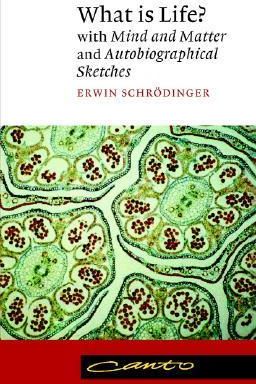
What is Life cover

What is Life

by Erwin Schrodinger

In ''What is Life,'' Erwin Schrodinger bridges physics and biology, exploring the mysteries of life, genes, and consciousness. This influential work inspired breakthroughs in genetics, challenging readers to think critically about evolution and the universe''s complex order.

The Physics of Life: Bridging Matter and Mind

What if the deepest mysteries of life—how we inherit traits, sustain order, and even think—could be understood using the same physical laws that govern atoms and stars? In What is Life?, physicist Erwin Schrödinger (famous for his quantum cat) set out to answer perhaps the most audacious question of the 20th century: can life be explained by physics alone, or does it require new laws of nature?

During World War II, Schrödinger gave a series of public lectures in Dublin that became this slim but revolutionary book. His inquiry bridged fields that, until then, barely spoke to each other—quantum mechanics and biology—and inspired a generation of molecular biologists, including James Watson and Francis Crick, to search for life’s fundamental building blocks. Schrödinger's central argument is elegantly simple yet profound: living organisms are physical systems that defy entropy by maintaining order through the extraction of "negative entropy" (or negentropy) from their environment. This, he suggests, is the key to understanding life’s persistent complexity amidst an otherwise disorderly universe.

Physics Meets Biology

At the time, biology was descriptive and experimental, while physics sought unifying mathematical principles. Schrödinger, a theoretical physicist, dared to apply the latter to the former. He asked: how can living cells maintain such intricate organization when physics tells us that systems naturally degrade into chaos? His answer lay in statistical physics and quantum theory—showing how the laws that explain atomic behavior might also illuminate genetic stability and mutation. This cross-disciplinary leap sparked the birth of molecular biology as we know it.

Order, Entropy, and the Aperiodic Crystal

Schrödinger proposed that life’s hereditary mechanism is encoded in a physical structure he called an aperiodic crystal—a stable, but non-repetitive molecular arrangement capable of carrying complex genetic information. Though DNA had not yet been identified when he wrote this, his description astonishingly prefigures its double-helix structure. An aperiodic crystal, unlike repetitive crystals of salt or quartz, has the stability to endure and the variability to encode the blueprint for life. This idea convinced biologists that genes must be molecular and information-bearing.

Life’s Thermodynamic Trick

In a universe governed by the second law of thermodynamics (which dictates that entropy always increases), Schrödinger saw a paradox: living beings constantly generate and maintain order. How? His answer: they feed on "negative entropy" by importing ordered energy from their surroundings—through food, sunlight, or chemical reactions—and exporting disorder back into the environment. This insight linked physics and metabolism, giving a physical explanation for why organisms must eat, grow, and interact with their surroundings to stay alive.

Toward a Unified View of Life and Mind

Schrödinger did not stop at biology. In the companion essays Mind and Matter, he extended his inquiry to consciousness and free will. Drawing from both physics and Eastern philosophy, he proposed that the separation between mind and world is an illusion—the observer and the observed are part of one unified reality. This radical view anticipates later discussions in quantum theory and philosophy of mind.

In sum, What is Life? was not merely an attempt to apply physics to biology. It was a call for synthesis—a reminder that to comprehend life, we must cross boundaries between disciplines. Schrödinger’s ideas about heredity, entropy, and consciousness continue to echo in genetics, systems biology, and even cognitive science today. As you explore the key ideas ahead, you’ll see why this modest little book became one of the most influential scientific manifestos of the 20th century.


Organisms as Statistical Systems

Schrödinger begins by comparing living organisms to physical systems governed by statistical laws. Physics, he explains, does not deal with individual atoms or molecules, but with their collective behavior. Yet organisms seem to display precise, law-like regularity—heartbeat rhythms, inheritance patterns, even growth processes—all emerging from a foundation built on random atomic motion. How can this be? The answer lies in numbers—and the law of large averages.

The Scale of the Atom and the Body

You and every living thing are composed of countless atoms—so many that random thermal fluctuations average out into stability. Schrödinger notes that this stability is what allows biological systems to function predictably. If we were made of only a few atoms, our behavior would be wildly unpredictable, like Brownian dust particles. But with astronomical numbers of atoms, physical laws become accurate approximations, and our bodies can sustain ordered motion and thought. He illustrates this with examples like paramagnetism and diffusion, showing that the regularity of nature arises statistically from disorder.

The √n Rule

A key quantitative insight in this analysis is the √n rule: statistical fluctuations shrink relative to the total number of elements as one over the square root of that number. For instance, if a physical property depends on a million interacting particles, its fluctuations will average out to only about one part in a thousand. This law explains why large biological systems—like cells or entire organisms—can operate smoothly even though their parts obey probabilistic laws. Order, then, is not a violation of statistical physics, but a triumph of scale.

Why Atoms Must Be Small

Schrödinger’s playful question, “why are atoms so small?”, reveals a profound truth: the size of the atom determines the precision of physical laws in macroscopic systems. Only because atoms are so tiny do their random motions smooth out when combined by the trillions into an organism’s structure. If atoms were larger, the nervous system would behave erratically—no thought, no perception could persist in the noise. Consciousness itself, he argues, depends on the cooperation of numerous atoms obeying approximate laws.

By grounding life’s reliability in statistics, Schrödinger rescues biology from vitalism—the idea that life runs on special nonphysical forces—and places it firmly within the laws of physics, though in a uniquely organized form of matter. Life’s apparent precision is not miraculous; it is the emergent stability of vast numbers in motion.


The Hereditary Code and the Aperiodic Crystal

Long before the double helix, Schrödinger imagined heredity as a molecular code inscribed in an “aperiodic crystal.” To him, the chromosomes inside the cell nucleus contained a “code-script” for the organism’s development—a stable, miniature archive that somehow directed life’s unfolding. His intuition, remarkably prescient, described the essence of DNA a decade before its discovery.

Genes as Molecular Code-Scripts

Working from what was known of chromosomes and cell division, Schrödinger reasoned that heredity must be carried by distinct molecular units—genes—whose unique atomic arrangements determine traits. Each gene, he wrote, is like a “law-code and executive power” in one: it not only stores instructions but performs them, coordinating the cell’s growth and division. The nucleus, in this view, is a physical script for life’s architecture. When he called the gene a “miniature code-script,” he was imagining, in physical language, the later concept of genetic information.

Meiosis, Recombination, and Variation

Drawing from advances in genetics, he explained meiosis and fertilization as mechanisms that preserve and shuffle these scripts across generations. Each parent passes half a set of chromosomes, recombined through the process of crossing-over, ensuring both stability and diversity. The statistical independence of such recombination, he noted, ensures variability within strict molecular control—a perfect balance between permanence and creativity. These concepts, still central to genetics, stem from his synthesis of physics-like precision with biological complexity.

The Aperiodic Crystal

Here lies the conceptual masterpiece of his book: the hereditary material, he argued, must be an aperiodic solid—ordered but non-repetitive—capable of carrying a vast amount of encoded information. Unlike a regular crystal whose pattern repeats endlessly, the aperiodic crystal varies from molecule to molecule, allowing unique sequences to represent genetic information. When Watson and Crick later identified DNA’s structure, they cited Schrödinger as their inspiration. The double helix, with its specific pairing and sequence variation, was the physical realization of Schrödinger’s hypothesis.

Schrödinger’s synthesis of physics and genetics thus gave science a new vision: heredity is not a mystical force, but the physical unfolding of organized atomic order—a library built of molecules whose language we could, in principle, decode.


Mutations and Quantum Jumps

Having established that heredity is molecular, Schrödinger turned to how it changes. Mutations, he explained, are not smooth, gradual alterations but sudden “quantum jumps” within the gene molecule. Here, physics and biology meet at the smallest scales: evolution, in Schrödinger’s eyes, is ultimately rooted in quantum events.

From de Vries to Quantum Mechanics

Building on Hugo de Vries’s discovery of discrete hereditary mutations, Schrödinger showed that each mutation must correspond to a precise, localized change in one molecule. Classical physics could not account for such molecular stability amid intense thermal motion. Only quantum mechanics, he argued, explains how atoms remain locked in specific configurations for centuries—until discrete energy quanta trigger rearrangements. The gene’s permanence, and its rare but abrupt changes, are quantum phenomena.

X-Rays and Experimental Evidence

He drew on research by Max Delbrück and others, showing that mutations can be induced by X-rays in predictable, quantifiable ways. A given radiation dose increases mutation frequency exactly in proportion to exposure—evidence that each mutation represents a single localized ionization or excitation. Schrödinger likened this to knocking a single atom in a molecule into a new configuration. Such discrete energy thresholds, measured in electron volts, revealed the quantum stability that underpins life’s continuity.

The Quantum Mechanism of Evolution

By identifying the quantum origin of mutations, Schrödinger reframed evolution as the large-scale consequence of microscopic chance events filtered by natural selection. The randomness of quantum jumps provides the raw material, while selection sculpts the outcomes. This view reconciles biological variability with deterministic physical laws, making evolution itself a statistical process grounded in quantum stability and fluctuation.

In linking mutation to quantum theory, Schrödinger transformed our understanding of evolution’s mechanism—from a purely biological phenomenon into one of nature’s fundamental physical processes.


Life, Entropy, and Negative Entropy

Perhaps the most haunting section of What is Life? explores how living organisms resist the inexorable march toward disorder dictated by the second law of thermodynamics. Entropy—the measure of randomness—always increases in isolated systems. Yet life builds order. How?

Feeding on Order

Schrödinger proposed that living matter avoids decay by “feeding on negative entropy.” This phrase, seemingly paradoxical, means that organisms maintain their organization by importing order from outside themselves. Food, light, and energy sources supply low-entropy material—molecules arranged in specific structures—which living systems absorb, transform, and degrade, exporting disordered waste and heat back to the environment. In doing so, they maintain internal order while respecting the laws of physics.

The Physical Meaning of Entropy

To grasp this, Schrödinger explains entropy as a measure of uncertainty or disorder in the microscopic configuration of a system. When a solid melts or a mixture diffuses, entropy increases: more possible arrangements exist, and order is lost. Living systems counteract this by constantly exporting entropy. We stay alive, in other words, by keeping the universe slightly messier than it would otherwise be.

The Universality of the Law

This view made metabolism—the constant flow of energy and matter through the organism—a thermodynamic process. You, like a flame or a whirlpool, are a dynamic system maintained by continuous turnover. Life is temporary order in motion, borrowing from the sun’s ordered energy to stave off equilibrium. Plants use sunlight to create order; animals feed on the order created by plants. In both cases, life is physics playing an extraordinary trick within thermodynamic rules.

By recasting biology in the language of entropy, Schrödinger gave scientists a powerful metaphor still used in complexity theory, ecology, and information science: living systems are islands of order sustained by the flow of energy through them.


Are New Laws Required for Life?

Does life obey the same physical laws as everything else, or does it demand new ones? Schrödinger’s bold answer is nuanced: life is not exempt from physics, but it may reveal principles not yet formalized within it. Organisms, he wrote, are physical systems that produce and maintain order from existing order—unlike inanimate systems, which derive order from disorder through statistics.

Order from Order vs. Order from Disorder

In most physical systems, order arises statistically from large numbers of random interactions—“order from disorder.” But in living systems, the guiding principle seems different: preexisting order (the genetic code within molecules) produces further order in offspring, metabolism, and behavior. This “order from order” requires no new energy source, only the transmission of a well-structured pattern. DNA replication is a perfect modern example: instructions replicate order directly, not statistically.

Life and the Clockwork Metaphor

To illuminate his point, Schrödinger compares the organism to a clock. A clock maintains order by controlled transfers of energy but ultimately runs down; a living system, continually refueled, sustains its motion indefinitely. Both obey physical laws, yet the organism also encodes instructions for self-renewal. This blend of mechanical and informational order suggests that new physical principles—especially those involved in quantum coherence—might underlie biology’s apparent defiance of entropy.

A Prelude to Systems Biology

Schrödinger’s speculation foreshadowed modern systems biology and quantum biophysics. He proposed that our existing physical theories might need extension to describe self-organizing systems operating far from thermodynamic equilibrium—a prediction realized later in the work of Ilya Prigogine and others. Life, then, was not a violation of physics, but a deeper instance of it, hinting that physics itself was incomplete.

Thus, far from separating life from physics, Schrödinger invited physicists to expand their laws until biology naturally fits within them. The organism, he insisted, is not a mystery beyond science but a new frontier for it.


Mind, Matter, and the Unity of Consciousness

In Mind and Matter, Schrödinger turned his physicist’s lens toward one of humanity’s oldest questions: what is consciousness, and how does it relate to the physical world? His answer, drawn from both scientific reasoning and Eastern philosophy, is startlingly modern. Consciousness, he argued, is not an emergent property of matter but a fundamental aspect of reality itself.

The Oneness of Mind

Schrödinger’s famous “arithmetical paradox” begins with the observation that while there appear to be billions of separate conscious beings, consciousness itself is never experienced in the plural, only in the singular. Every conscious individual says “I,” and no one experiences another’s consciousness directly. From this, he concludes that all conscious experience is one and the same reality seen from different perspectives. This view echoes the Upanishadic idea of Atman = Brahman—that the self and the cosmos are one.

Against Mechanistic Dualism

Schrödinger rejected the Cartesian separation of mind and matter. To him, the division between observer and observed is an artifact of our method of objectivation—a “trick” science uses to describe the world. By excluding the subject from the object of study, modern science creates a colorless, lifeless “shadow world” devoid of the very qualities—color, feeling, awareness—that make reality vivid. Mind and matter, he insisted, are not two substances interacting but two aspects of one underlying unity.

Ethics, Evolution, and Self-Overcoming

In exploring ethics, Schrödinger linked consciousness to evolution: self-awareness, he suggested, emerges where life is still learning and transforming itself. Ethical striving—self-overcoming, altruism, the struggle against our primitive instincts—reflects humanity’s ongoing evolution from isolated individuals toward unified awareness. The command to act selflessly, he argued, is not imposed by religion but is nature’s own teleology toward greater integration.

This holistic philosophy, steeped in both science and mysticism, presents mind not as a byproduct of brain chemistry but as the fundamental canvas upon which both matter and perception are painted. For Schrödinger, to understand mind is to rediscover the unity underlying all things.


Science, Time, and the Meaning of Existence

In his later essays, Schrödinger turned to the philosophical implications of science—particularly time, causality, and immortality. He asked: what does modern physics reveal about our existence and the possibility of continuity beyond death?

The Illusion of Time and the Immortality of Mind

Drawing from Kant, Plato, and Einstein, Schrödinger observed that time is not an independent flow but a mode of human perception. In relativity, space and time merge into a single continuum in which all events coexist. This implies that the notion of “before” and “after,” or “life and death,” may be artifacts of our limited experience. The mind, always present in the now, cannot be said to “begin” or “end.” As he put it, “the over-all number of minds is just one.”

Entropy, Evolution, and the Arrow of Time

Schrödinger also revisited entropy from the perspective of time’s direction. He discussed Ludwig Boltzmann’s statistical explanation: the arrow of time points toward increasing disorder because there are incomparably more ways for things to be disordered than ordered. Yet, paradoxically, life and consciousness emerge as local reversals of that trend, fleetingly creating order in the flow of entropy. For Schrödinger, this interplay gave the existence of mind its cosmic significance—it is through consciousness that the universe becomes aware of itself.

Beyond Science’s Shadow World

In his final reflections, Schrödinger criticized the “colorless, cold, mute” world created by scientific objectivity—a world of measurements and equations stripped of sensual quality. Science, he argued, is not wrong, but partial: it omits the subjective element that gives life meaning. Reconciling science and spirituality requires reintegrating the observer into the observed, recognizing that the world we study and the self that studies it are inseparable.

For Schrödinger, this realization—shared by the mystics from East to West—offered a vision of immortality not as endless personal survival but as participation in the timeless unity of consciousness. Life, viewed through this lens, becomes the universe contemplating itself through countless eyes.

Dig Deeper

Get personalized prompts to apply these lessons to your life and deepen your understanding.

Go Deeper

Get the Full Experience

Download Insight Books for AI-powered reflections, quizzes, and more.