
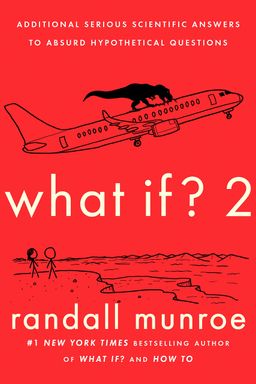
What If 2 cover

What If 2

by Randall Munroe

What If? 2 by Randall Munroe takes readers on an entertaining scientific journey, answering bizarre questions with serious analysis. From galactic territories to oceanic depths, this book provides a delightful mix of humor, curiosity, and knowledge, perfect for anyone intrigued by the wonders of science.

Imagination Meets Physics: Exploring the Absurd to Understand the Universe

What if the solar system were filled with soup—or the Earth spun once per second, or pigeons could lift skyscrapers? In What If? 2, Randall Munroe—creator of the XKCD webcomic and former NASA roboticist—invites you to explore these impossible yet oddly illuminating scenarios. But beneath the humor and absurdity lies something profound: our curiosity about how the world works, and how even ridiculous questions reveal genuine scientific truths.

Munroe’s central argument is simple but powerful: asking absurd, unanswerable questions is one of the most honest ways to learn how the universe operates. Ridiculous questions let us drop pretensions and approach science with childlike wonder. Instead of worrying about what’s practical or possible, he encourages us to follow curiosity to its logical—or illogical—limit. By doing so, we find that humor and physics share a common trait: both are deeply rooted in clarity and surprise.

Curiosity as a Gateway to Scientific Thought

Munroe opens his introduction by explaining why he loves ridiculous questions. A serious question can make you feel ignorant or nervous—like being graded on a pop quiz. But an absurd one removes that pressure. Nobody knows how much all the electrons in a dolphin weigh, so it’s safe to ask. (For reference, he calculates that number at about half a pound.) This playful framing models scientific thinking without intimidation. For Munroe, confusion isn’t failure—it’s the start of inquiry.

This approach echoes the pedagogy of Carl Sagan and Neil deGrasse Tyson, who also framed awe as a scientific tool. Munroe brings that mindset to comics and calculations, bridging accessibility and accuracy. Through stories of collapsing soups, exploding helicopters, or solar-powered refrigerators, he teaches the laws of thermodynamics, gravity, and probability without ever calling them that. You learn because you laugh—and because your brain, like his, can’t resist solving puzzles once they’re posed.

Playful Scenarios as Serious Lessons

Across dozens of scenarios, Munroe answers wild hypothetical questions sent by readers—ranging from “What if the Earth were made entirely of protons?” to “Could the world’s bananas fit into all of its churches?” He uses real data and equations to test the edge of physical laws. In doing so, he demonstrates how big ideas in physics can emerge from small, silly thought experiments.

In the opening story, “Soupiter,” a five-year-old asks what would happen if the solar system were filled with soup out to Jupiter. Munroe’s answer is equal parts child’s fantasy and astrophysics lecture. After walking through the numbers, he concludes the soup would collapse into a black hole. Then, riffing on the “no-hair theorem,” he notes that all black holes look the same—meaning “it doesn’t matter what ingredients you put into a black hole soup.” The humor lands, but so does the science.

Similarly, in “Helicopter Ride,” he calculates the exact rate at which your fingers would tear off if you clung to a helicopter blade as it spun up, illustrating rotational forces more vividly than any classroom could. Or in “Dangerously Cold,” when asked about a cube of iron at absolute zero, Munroe explains radiation and thermodynamics by imagining your house literally freezing and catching fire simultaneously.

Humor as a Pedagogical Engine

The tone of the book is conversational and mischievous. Every scenario ends with an unexpected comedic twist—often involving destruction, dismemberment, or being flung into orbit. But these jokes double as mnemonic tools. You might not remember Planck-scale physics formulas, but you’ll remember that filling the solar system with soup creates a “soupermassive black hole.” (It’s a pun and a physics concept in one.)

Munroe’s background at NASA adds rigor to this playfulness. He backs every punchline with references, consulting astrophysicists, chemists, and engineers to ensure accuracy. His humor never mocks science—it celebrates it. He’s not just shouting “what if?” for attention, but to encourage deeper questions: how do we know what we know, and what happens when the rules bend?

Why Ridiculous Questions Matter

At its core, What If? 2 is more than trivia—it’s a playful meditation on the boundaries of human understanding. Munroe’s maps of destruction and wonder remind you that science isn’t a rigid textbook—it’s a creative act. Whether imagining an Earth-Moon fire pole or dogs that outnumber the universe, each scenario reveals a balance between imagination and the immutable rules of nature. By following ridiculous questions to their logical conclusion, you glimpse the beauty—and power—of curiosity itself.

Core Message

The world isn’t made meaningful simply by rules, but by the questions that stretch them. Asking “What if?” isn’t just play—it’s science at its most human.


The Physics of the Impossible

When you read about filling the solar system with tomato soup or putting a block of iron at absolute zero in your living room, you’re not just reading jokes—you’re learning how physics behaves under extreme conditions. By exaggerating reality, Munroe brings abstract laws down to earth (and sometimes obliterates the planet in the process).

From Soup to Black Holes

In “Soupiter,” five-year-old Amelia wonders what would happen if the solar system were filled with soup. Munroe treats the question seriously. He calculates the amount of soup required (2 × 10³⁹ liters), translates it into calories, and finds it exceeds the Sun’s lifetime energy output. The key takeaway isn’t just scale—it’s the concept of gravitational collapse. By treating “soup” as matter with mass, he leads readers step by step to the idea that too much mass in one place creates a black hole. He even sneaks in the “no-hair theorem,” showing that black holes don’t retain the characteristics of the matter they swallow. The joke morphs into a mini astrophysics class.

Playing with Thermodynamics

In “Dangerously Cold,” there’s nothing funny about 0 Kelvin—unless you’re Munroe. He explains that cold objects don’t emit “cold radiation” but instead absorb surrounding heat. In a scene straight out of a science comic, your supercooled iron cube condenses the air around it, causing liquid oxygen to form—and then ignite. The humor disguises serious lessons about heat transfer, phase change, and energy conservation.

This is classic Munroe: take an absurd premise, push it with math until reality explodes, then pause with deadpan understatement: “A really cold object can set your house on fire.” The emotional whiplash makes scientific principles unforgettable.

Imagination as a Thought Experiment

Munroe’s humor echoes the techniques of Einstein, Feynman, and other greats who used playful mental experiments to probe physics. Asking “what if?” is how relativity itself emerged—Einstein once pictured chasing a beam of light. Munroe channels this spirit for a general audience. Through levity, he reminds you that even the strangest scenarios abide by the same natural laws. As he shows in “Ironic Vaporization,” boiling iron isn’t just about heat—it’s about understanding material limits, chemical reactions, and energy density. And yes, it will also set your house on fire.

Key Lesson

You don’t need to visit a lab to explore the universe’s extremes—calculated curiosity can take you there. The physics of the impossible turns out to be a mirror for the world we live in.


Scale as a Comedy of Catastrophe

If What If? 2 has a recurring theme, it’s this: scale is everything. Whether thinking about driving to the edge of the cosmos or stacking pigeon stages to reach the top of a skyscraper, Munroe shows that when you multiply human ideas by astronomical scales, familiar logic collapses—often with hilarious or apocalyptic results.

Cosmic Road Trips and Billion-Story Buildings

In “Cosmic Road Trip,” he asks how long it would take to drive to the edge of the universe at 65 mph. The answer? 35 million times the current age of the universe. But Munroe doesn’t stop at the math; he imagines the logistics—trillions of oil changes, quadrillions of snacks, and the inevitable demise of every star along the way. By turning a single numeric abstraction into a story of endurance, he gives you intuitive understanding of cosmic scale—and of human insignificance.

In “Billion-Story Building,” a question from a four-year-old leads to an architecture and engineering lesson. Why can’t we build a tower to space? The answer involves material strength, wind resistance, elevator design, and—most devastating—budget. When Munroe calculates that one child’s dream skyscraper would require more mass than the galaxy, he turns absurd curiosity into an instinct for physical constraint.

The Mathematics of Too Much

“Dog Overload,” for instance, begins with a simple biological question: how fast would dogs multiply if they all reproduced freely? The result escalates into cosmic horror—within 150 years, dogs outweigh Earth itself, forming a gravitationally collapsing “dog sphere.” The progression is simultaneously terrifying and funny because Munroe wields exponential growth like a comedic weapon—teaching you, almost subliminally, about the power of compounding.

Likewise, “Lose Weight the Slow and Incredibly Difficult Way” explores how much of Earth you’d need to eject to lose twenty pounds. The calculations spiral into absurdity as the protagonist uses a Dyson sphere to peel off Earth’s crust layer by layer, accidentally destroying the planet. Underneath the punchline lies the conservation of mass and gravity’s stubborn refusal to cooperate with human vanity.

Takeaway

By exaggerating everyday scenarios beyond reason, Munroe reveals the hidden math shaping reality. Scale is both the universe’s punchline and its most humbling truth.


The Humor of Disaster

Disaster is Randall Munroe’s favorite teaching aid. In nearly every chapter, the answer ends in destruction—the Earth vaporized by soup, cities buried under sugar, or you personally obliterated by physics. But the destruction isn’t gratuitous; it’s instructive. Catastrophe pushes every principle to its breaking point.

Learning Through Doom

Take “Niagara Straw,” where a reader asks about sucking Niagara Falls through a straw. Munroe patiently walks through fluid dynamics, choked flow, Bernoulli’s principle, and pressure limits before concluding that the result would destroy the planet. The absurdity grabs your attention, but the logic walks you through real-world engineering limits. You laugh, but you also understand why turbines, valves, and engines behave the way they do.

When Comedy Illuminates Consequence

In “Lemon Drops and Gumdrops,” a playful question about candy rain evolves into planetary annihilation. Replacing water with sugar triggers runaway greenhouse effects, collapsing ecosystems, and a final conclusion: “Earth would be a scorched, lifeless rock.” It’s the funniest climate-change parable ever written. Munroe transforms sweetness into tragedy, and in doing so, confronts humanity’s own sugary self-destruction with wit sharper than any editorial.

Destruction as Empathy

Even when he vaporizes you, Munroe cares. His catastrophes are always described from your point of view—the reader clinging to a helicopter blade, freezing beside a 0 Kelvin cube, or trying to ride a fire pole from the Moon. By centering you in the destruction, he ensures the science feels personal. You come away thinking, “Physics can kill me—but now I understand why.”

Insight

Humor makes annihilation safe. By laughing at destruction, you learn how fragile life—and science—really is.


When Everyday Questions Turn Deep

Not all of Munroe’s questions go boom. Some turn inward, asking about meaning, morality, and the limits of human knowledge. These quieter essays reveal the philosopher beneath the comic.

Reading Every Book

In “Reading Every Book,” a reader wonders when there were too many English books to read in a lifetime. Munroe transforms the question into a data-driven history of publishing, writing speed, and human curiosity. He discovers that by Shakespeare’s time, the literary flood had already surpassed human capacity. Beyond the math lies a lesson in humility: the world creates faster than we can comprehend.

Other essays like “Read All the Laws” mirror this idea in civic terms. To read every law that applies to you would take half a lifetime—and still wouldn’t guarantee understanding. These chapters expose the comedy of bureaucracy, but also the existential weight of complexity. No human can grasp it all; curiosity must become selective.

The Poetry of Bananas and Churches

Some questions are elegantly mundane. Can all the world’s bananas fit in all the world’s churches? Munroe answers yes—after calculating pew space, floor area, banana densities, and religious attendance rates from Pew Research. The absurd precision makes you grin, but the underlying message is joyful: even nonsense problems can be solved with reason. It’s rational optimism disguised as slapstick.

Core Idea

Behind the laughter, Munroe reminds you that curiosity—no matter how trivial—connects numbers to meaning. It’s the spark that turns data back into wonder.


The Beauty of Limits

One of Munroe’s most recurring lessons is acceptance: every system, from physics to bureaucracy to pigeons, has limits. Whether he’s failing to heat a house with toasters or collapsing Jupiter into a fireball, the message is the same—reality always wins.

Physical and Human Boundaries

In “Airliner Catapult,” a reader wonders if we could launch passenger planes like aircraft carriers to save fuel. The answer is an emphatic no—limited by physics, runway length, and comfort. A similar boundary appears in “Swing Set,” where kids pumping their legs on ever-bigger swings discover that air resistance beats strength. Nature, Munroe shows, is a patient enforcer of balance.

The Sociology of the Ridiculous

Limits also appear in human systems. In “Sisyphean Refrigerators,” Munroe compares open refrigerators to Greek myths about eternal struggle, showing that our attempts to cool the world actually heat it. Similarly, in “$2 Undecillion Lawsuit,” he computes that even if an entire galaxy’s lawyers worked for millennia, they couldn’t pay a single impossible debt. Limits, physical or economic, define meaning.

Across these examples, you start to sense Munroe’s subtext: certainty is an illusion. The real joy of science lies in confronting boundaries, not pretending they don’t exist.

Lesson

The laws of nature are the ultimate punchline. Ignoring them is comedy; understanding them is wisdom.


Curiosity as a Moral Act

Beneath its explosions and equations, What If? 2 whispers an ethical message: curiosity is a form of care. To wonder about the impossible is to pay attention—to notice that the world, even at its edges, deserves to be understood.

Science with Empathy

Munroe’s disclaimers—“Do not try any of this at home”—aren’t hollow. They’re affectionate reminders that knowledge can be dangerous when divorced from compassion. His mock warnings about blowing up kitchens and collapsing planets double as statements about responsibility. In a media landscape obsessed with certainty, Munroe models humility. He shows that being wrong, even spectacularly, is just part of learning.

Curiosity and Connection

By answering children’s questions alongside those from scientists, Munroe dissolves hierarchies between expert and amateur. He treats every questioner—from Amelia, age five, to engineers and doctors—with the same respect. This democratic approach to knowledge echoes writers like Richard Feynman or Mary Roach: science belongs to everyone who’s ever asked “why?”

What makes What If? 2 feel profound is that its humor never punches down—it invites you in. Every absurd hypothesis starts with “you,” pulling the reader directly into the experiment. By the end you realize: you’ve been doing science all along.

Final Reflection

In a world that often tells us to stop asking questions, Munroe reminds us to keep wondering. The universe may not always make sense—but curiosity is how we make peace with that.

Dig Deeper

Get personalized prompts to apply these lessons to your life and deepen your understanding.

Go Deeper

Get the Full Experience

Download Insight Books for AI-powered reflections, quizzes, and more.