
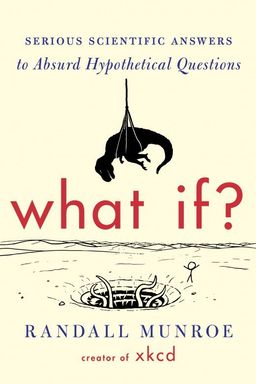
What If cover

What If

by Randall Munroe

In ''What If'', Randall Munroe delivers scientifically sound answers to bizarre questions, transforming curiosity into an entertaining journey of discovery. With humor and insight, he tackles everything from escaping tiny planets to the economics of printing Wikipedia, making science accessible and fun.

Serious Science for Absurd Imagination

Have you ever wondered what would happen if you threw a baseball at 90% the speed of light? Or if everyone on Earth jumped at once? In What If?: Serious Scientific Answers to Absurd Hypothetical Questions, Randall Munroe—physicist, former NASA roboticist, and creator of the webcomic xkcd—transforms ridiculous and often impossible queries into gateways to real scientific exploration. Munroe’s central argument is that even the most ludicrous ideas can unlock profound insights into physics, engineering, biology, and the sheer strangeness of our universe. He contends that by treating absurd questions seriously, we can rediscover the wonder and humor buried inside science itself.

Why the Absurd Matters

Science, at its heart, begins with curiosity—and Munroe’s approach reminds you that curiosity doesn’t need to be polished to be meaningful. By asking questions that seem pointless (“What if you drained all the oceans?”), Munroe demonstrates how physics and math can illuminate both the limits of reality and the vastness of imagination. Absurdity becomes a portal to learning. The author’s background in physics gives him authority, but his humor makes these explorations accessible, playful, and deeply human.

How Munroe Answers the Impossible

Munroe’s method is straightforward and rigorous while delightfully mischievous. Each chapter begins with an outlandish reader-submitted question—like “What if everyone on Earth jumped at once?” or “What if we built a periodic table out of actual elements?” Then, he applies real scientific principles to see what would genuinely happen. He calculates mass, velocity, heat, gravity, and radiation with precise formulas—but his commentary turns those numbers into stories. You laugh at the chaos of the “One Soulmate” scenario or the horror of the “Mole of Moles,” yet underneath the absurdity, you’re learning how statistics, chemistry, and astrophysics actually govern our world.

A Bridge Between Wonder and Knowledge

The book’s deeper message is that science isn’t cold calculation—it’s the interpretation of reality through curiosity. When Munroe models how a neutron-dense bullet might behave on Earth or predicts how a spaceship-submarine could survive in orbit, he encourages you to respect logic while embracing play. The tone is conversational and light, but the content is grounded in careful reasoning. Like Stephen Hawking’s Brief History of Time, it layers humor beneath cosmic insight—only here, the questions are framed through comic absurdity instead of theoretical philosophy.

Why It Matters to You

For readers, What If? is more than science trivia; it’s an invitation to think creatively about problem-solving. Munroe’s attitude—bold curiosity mixed with humility—shows how you can approach any challenge, scientific or personal, by asking better “what if” questions. As you move through scenarios like surviving lightning strikes, boiling tea by stirring, or determining who was the “loneliest human,” you realize that science can be a lens of empathy as much as discovery. By taking each absurd question to its logical extreme, Munroe redefines what it means to explore. It’s not about knowing all the answers—it’s about being brave enough to ask impossible ones.

In this summary, you’ll explore key ideas like physics beyond everyday limits, mathematical ways to measure loneliness and love, humorous catastrophes in biology and chemistry, and what they reveal about our human fascination with the unknown. You’ll see why the absurd, when taken seriously, can be the most powerful catalyst for curiosity—and perhaps the most entertaining way to rediscover science itself.


Exploding Logic: Physics of Catastrophe

Munroe delights in turning physical reality into spectacular disaster, and nowhere is this clearer than in chapters like Relativistic Baseball, Hair Dryer, or Global Windstorm. He shows that when you push physics far beyond human scale, it stops being familiar and starts being both hilarious and terrifying. You learn what happens when momentum, friction, and gravity act without restraint—and how our assumptions about safety collapse under real physics.

The Relativistic Baseball

Imagine a pitcher throwing a ball at 90% the speed of light. Munroe calculates that it would cause a miniature atomic bomb—the air molecules ahead of the ball would fuse, creating a thermonuclear explosion. In a few nanoseconds, the stadium would vaporize, leaving a crater where the batter once stood. It’s ridiculous, but it’s accurate. The humor lies in the contrast between our beloved sport and the violent consequences of real physics. This blend of whimsy and precision is a hallmark of Munroe’s storytelling.

Everyday Objects, Cataclysmic Power

He applies similar exaggeration to a hair dryer inside a sealed box—ramping its power from 1,875 watts to gigawatts until it melts metal, then vaporizes everything nearby, eventually destroying the planet. The argument is both pedagogical and comic: it teaches you about heat transfer, energy equilibrium, and radiation pressure by transforming a household item into a doomsday machine. It’s science education disguised as absurd tragedy.

When Earth Becomes the Experiment

In “Global Windstorm,” Munroe imagines the planet’s rotation stopping while the atmosphere keeps moving—a scenario that would flatten buildings, scorch oceans, and ignite the air. Yet, after everyone dies, the atmosphere stabilizes and the Moon eventually restarts the planet’s spin. His message: even the end of the world would obey the laws of physics. You start to grasp that destruction doesn’t mean meaninglessness—it can be mathematically beautiful.

These catastrophes aren’t written for shock value—they reveal the elegance behind chaos. They teach that physics is indifferent yet poetic, a system that governs everything from thunderstorms to baseballs to the apocalypse. (Similar to Brian Greene’s The Elegant Universe, Munroe makes extreme physics approachable, but with far more laughter.) You leave these chapters understanding that to comprehend nature’s power, you must sometimes blow it up—on paper, at least.


Mathematics of Human Absurdity

Munroe’s genius lies in applying math not just to cosmic questions but to human quirks—love, loneliness, social connection, and probability. In chapters like Soul Mates and Facebook of the Dead, he transforms sentimentality into statistics, exposing how math can describe even the most emotional aspects of life.

The Math of Romance

In “Soul Mates,” Munroe mocks the romantic trope that there’s exactly one perfect person for everyone. He shows through probability that if your soulmate exists as one random person among billions, you’d have a one-in-ten-thousand chance of meeting them—even with lifetime eye contact speed dating. Society would collapse under the pressure to find “the one.” The result isn’t cold cynicism—it’s liberation. By turning love into logistics, Munroe frees you from perfectionism and makes randomness strangely romantic.

Social Media and Immortality

In “Facebook of the Dead,” he predicts when Facebook will contain more profiles of dead people than living ones—around the 2060s if growth slows, or the 2130s if it continues. It’s macabre but enlightening: even digital life obeys demographic curves. The essay merges data science and mortality, forcing you to see online identity as part of evolutionary math. (It echoes Nick Bostrom’s work on digital consciousness but replaces existential dread with wry humor.)

Loneliness As a Constant

When he calculates “The Loneliest Human,” he concludes it was likely Apollo astronaut Michael Collins, orbiting the Moon while his crewmates slept below. Yet even there, scientific reasoning merges with empathy. Collins wasn’t lonely, Munroe explains—he felt peaceful. Physics may quantify solitude, but human emotion resists calculation. It’s a tender reminder that numbers describe motion, not meaning.

Through these mathematical meditations, Munroe redefines the boundary between quantitative and qualitative. He proves you can measure absurd things—love probabilities, virtual ghosts, isolation in orbit—and still preserve their humanity. In his calculus, curiosity itself becomes the most human constant.


Curiosity as a Method

One of Munroe’s recurring arguments is that asking stupid questions is an essential scientific skill. Throughout What If?, he elevates childlike inquiry into a rigorous method of discovery. Chapters like “A Mole of Moles” or “Stirring Tea” show that behind every absurd thought lies a structure of logic waiting to be explored.

From Silly to Scientific

When a reader asks what would happen if you gathered a mole of moles, Munroe doesn’t dismiss it—he calculates the result: an 80-kilometer-deep planetary ocean of living meat. It’s gruesome but illuminating. You grasp Avogadro’s number intuitively, not as abstract notation but as catastrophe. In “Stirring Tea,” he proves that stirring cannot boil water no matter how insanely fast you move. The math, simple but precise, transforms intuition into understanding.

The Joy of Dangerous Curiosity

Munroe’s disclaimer admits he’s not a safety expert—he likes when things explode. But that admission is a pedagogy: to learn deeply, you must dare foolishness. Asking about neutron bullets or orbital submarines isn’t reckless—it’s creative engagement with complex systems. Each “what if” turns scientific laws into puzzles instead of prohibitions.

Curiosity as a Democratic Discipline

What If? democratizes scientific thinking. You don’t need to be a physicist—just someone who wonders about bananas, tornadoes, or time machines. Munroe’s tone models intellectual humility. (Much like Carl Sagan’s approach in The Demon-Haunted World.) He shows that you can play with knowledge respectfully, transforming “dumb” questions into smart insights. In your own life, cultivating curiosity—without fear of being wrong—is more powerful than memorizing facts.

Munroe turns childish imagination into methodology. By chasing absurdity with math and wit, he teaches you a scientific stance far more enduring than any formula: wonder first, calculate later, and never apologize for asking impossible questions.


Human Fragility in Cosmic Context

Beneath the humor, Munroe never forgets how small we are in the cosmos. Chapters like “Sunless Earth,” “Drain the Oceans,” and “Raindrop” serve as cautionary thought experiments about planetary physics and environmental vulnerability. You laugh, but you also feel awe—and perhaps fear—at how delicate our planet truly is.

When the Sun Goes Out

In “Sunless Earth,” Munroe analyzes what would happen if the Sun simply switched off. He notes absurd silver linings—no more parsnip burns, no time zones—but ends with a blunt truth: “We would all freeze and die.” This mordant humor underscores how dependent life is on precise cosmic constants. It’s existential physics disguised as comedy.

Water as Doom and Salvation

The linked chapters “Drain the Oceans” and “Drain the Oceans: Part II” imagine Earth emptied into space (and Mars accordingly flooded). The maps, warped and witty, reveal just how dynamic our watery boundaries are. Munroe’s humor hides a reverence for Earth’s balance—how geography, gravity, and biology co-create stability. The absurd premise becomes an oblique warning about human disruption of natural systems.

Cosmic Microscopes and Giant Raindrops

In “Raindrop,” he visualizes a storm condensed into a single kilometer-wide drop obliterating Kansas—mixing meteorology with storytelling. You learn fluid dynamics the hard way. These planetary-scale jokes remind you that Earth’s forces are both beautiful and ruthless. The humor lets you imagine destruction without despair.

Munroe’s cosmos isn’t nihilistic—it’s humbling. By mapping humor onto catastrophe, he builds empathy for the fragility of systems. (Similar to Neil deGrasse Tyson’s perspective in Astrophysics for People in a Hurry.) Science, he shows, isn’t just prediction—it’s appreciation for everything holding us precariously together.


Technology, Energy, and the Scale of Possibility

Munroe often asks technology questions so extreme that you rediscover basic engineering through absurdity. In chapters like “FedEx Bandwidth,” “Orbital Submarine,” and “Machine-Gun Jetpack,” he explores why physical laws—mass, power, and momentum—set limits on human invention. The humor lies in watching these limits break.

Bandwidth with Wings

“FedEx Bandwidth” compares the speed of shipping hard drives with the global Internet’s data flow. His conclusion? A fully loaded FedEx 747 still beats the Internet by two orders of magnitude. It’s a hilarious but serious insight: sometimes, physical transportation outpaces digital information. You glimpse a truth the tech world forgets—physics can still humble progress.

Weapons as Flight Engineering

In “Machine-Gun Jetpack,” Munroe shows how downward-firing AK-47s could theoretically lift a person. The lesson isn’t militaristic—it’s about Newton’s third law. Recoil equals thrust, whether you’re flying or firing. He transforms combat mechanics into rocket science. Combining humor and real engineering math, Munroe exposes the creative potential in constraints.

Absurd Transportation

“Orbital Submarine” features a nuclear submarine launched into orbit—proving it would survive intact, while its crew would suffocate. It’s funny, tragic, and deeply instructive about pressure differentials, heat transfer, and orbital mechanics. Munroe’s elegance lies in how he connects physics and empathy—you learn to care about the people inside the math.

Together, these thought experiments create a living scale of what machines can do. It’s engineering reframed through imagination—showing that every miracle of technology still answers to the immutable poetry of physics.


Comedy as a Scientific Language

The distinctive voice of What If? lies in how Munroe uses humor not to evade complexity but to explain it. His stick-figure wit, deadpan disclaimers, and playful moral lessons give you permission to laugh while learning. The book proves that science needn’t be sterile—it can be the funniest form of honesty.

Deadpan Pedagogy

Munroe begins with a disclaimer: he’s not a health expert—he likes explosions. This comic humility becomes a teaching strategy. It removes intimidation and turns abstract formulas into relatable curiosity. You feel comfortable being wrong, which is a powerful frame for intellectual growth.

Jokes as Cognitive Maps

Every chapter’s humor—whether in the sarcasm of “Don’t try this” or the understatement after apocalypse—acts as a cognitive anchor. You remember the physics through the laughter. (Similar to Mary Roach’s Stiff, Munroe makes comedy a pedagogical tool.) The absurdity makes logic stick because emotion reinforces memory.

Laughing at Mortality

Even when discussing mass extinction or cosmic doom, Munroe’s humor comforts you. Jokes become a coping mechanism for cosmic insignificance. His laughter never trivializes—it humanizes. Reading him, you learn that humor and reason share the same goal: surviving bewilderment.

Comedy doesn’t dilute science—it deepens it. When you laugh at a neutron bullet or a lonely astronaut, you’re practicing wonder. What If? teaches that humor isn’t distraction—it’s discovery dressed in joy.


Learning to Think Like a Scientist

Across its questions, What If? becomes an exercise in scientific thinking. Munroe teaches you how to visualize unseen systems, respect quantitative reasoning, and separate evidence from intuition. His world may be absurd, but his process embodies the discipline of science itself.

Modeling the Improbable

You learn techniques of estimation, like using dimensional analysis or back-of-the-envelope math. When Munroe calculates the odds of calling someone who sneezed or the energy of all lightning on Earth, he’s demonstrating how to construct models in uncertain conditions—a skill vital in physics and decision-making alike.

Critical Thinking Through Curiosity

Each absurd question disguises a critical thinking exercise: identify assumptions, define parameters, and reason through cause and effect. The silliness lowers your guard; the logic sharpens your mind. It’s how Munroe sneaks philosophy into comedy—reason emerges as curiosity structured by math.

Science as Participation

Finally, Munroe invites you to participate. The book’s tone mirrors conversation, not lecture. You feel like you’re beside him at a whiteboard, scribbling absurd diagrams. The result is empowerment: science isn’t an elite domain—it’s a way of noticing, calculating, and laughing at the world.

By the end, you’ll think like Munroe—not because you memorized numbers, but because you’ve learned how to turn confusion into computation. That’s the quiet mastery hidden beneath the jokes: learning to see the world as a problem set whose answers are equal parts physics and wonder.

Dig Deeper

Get personalized prompts to apply these lessons to your life and deepen your understanding.

Go Deeper

Get the Full Experience

Download Insight Books for AI-powered reflections, quizzes, and more.