
Idea 1
Making Your Place in the World
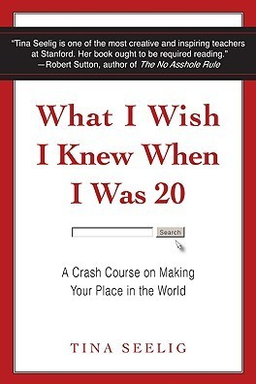
What would you do if you were dropped into the world with nothing but a few dollars, no rules, and a wide-open horizon? In What I Wish I Knew When I Was 20, Tina Seelig challenges this exact question—and by extension, every assumption you’ve ever made about success, creativity, and opportunity. She argues that the key to thriving in the real world isn’t about waiting for permission or following established paths; it’s about learning to reinterpret every problem as an opportunity, to make something out of almost nothing, and to constantly question the limits others place on you.
Seelig, a Stanford professor and executive director of the Stanford Technology Ventures Program, has spent years teaching engineers, entrepreneurs, and students how to think creatively and operate with an entrepreneurial mindset. Her experiences—from classroom experiments to real-world case studies—reveal that the rules that govern life in school are completely different from those that drive success after graduation. The classroom rewards right answers, fixed hierarchies, and obedience to instructions. The real world rewards curiosity, initiative, resilience, and the willingness to fail, learn, and try again.
Reframing Problems and Challenging Constraints
Seelig opens with a transformative experiment—the famous “Five-Dollar Challenge”—where students are given only five dollars and two hours to make as much money as possible. The highest-performing teams don’t even touch the money. They realize that the money is a constraint that limits imagination, so they look beyond it. One team sells restaurant reservations, another sells its presentation time to recruiters. Each team reframes the problem to uncover hidden opportunities. These lessons form the foundation of the book’s philosophy: remove constraints, challenge assumptions, and notice that opportunities are everywhere if you change your lens of perception.
From the Classroom to Life’s Open-Ended Test
In school, teachers determine what’s important, exams have one right answer, and failure is punished. But life, as Seelig reminds us, is an open book exam. There are infinite sources of information and countless correct answers. The true test isn’t about memorization—it’s about observation, experimentation, and adaptation. She introduces concepts like creative confidence (borrowed from the Design School at Stanford), showing that everyone can be creative once they learn to shift from fear of failure to curiosity about possibility.
Why This Mindset Matters
At its heart, Seelig’s book is an invitation to reprogram how you think about value, rules, and success. She contends that the most precious resource we have isn’t money or time—it’s perspective. Once you learn to see constraints not as walls but as springboards, you unlock infinite creative potential. This mindset matters because, in a rapidly changing world, traditional career paths and predictable solutions no longer guarantee success. Because life’s problems rarely follow the models taught in school, Seelig encourages readers to treat life itself as an innovation laboratory—filled with experiments, learning through failure, and collaboration across boundaries.
A Crash Course in Creative Living
Across her chapters, Seelig explores how to turn problems upside down (“The Upside-Down Circus”), how rules can—and often should—be broken (“Bikini or Die”), and how failure is not the opposite of success but its foundation (“The Secret Sauce of Silicon Valley”). She offers stories about innovators like Jeff Hawkins, who transformed failure into revolutionary products, and entrepreneurs like Linda Rottenberg of Endeavor, who broke conventions to ignite entrepreneurship in emerging economies. Each story reaffirms that success comes from embracing uncertainty and giving yourself permission to act boldly.
Ultimately, Seelig’s message is profoundly empowering: you don’t need a map to make your place in the world—you need a lens. By adopting an entrepreneurial mindset, reframing failure, crafting your own opportunities, and refusing to wait for permission, you can convert constraints into creativity, transform setbacks into learning, and find meaning amid chaos. Life isn’t a test you pass—it’s an adventure you design.