
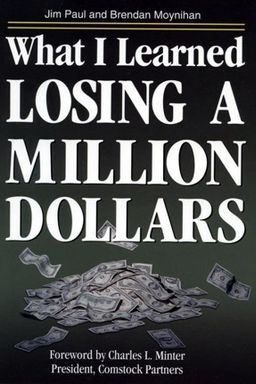
What I Learned Losing a Million Dollars cover

What I Learned Losing a Million Dollars

by Jim Paul, Brendan Moynihan

What I Learned Losing a Million Dollars explores the psychological dynamics of market trading. Jim Paul narrates his journey from financial success to disaster, revealing crucial lessons about avoiding losses, emotional decisions, and strategic planning, offering timeless wisdom for traders and investors.

The Psychology of Losing: Why Success Breeds Failure

Have you ever wondered why people who achieve spectacular success often end up failing just as spectacularly? In What I Learned Losing a Million Dollars, Jim Paul and Brendan Moynihan explore exactly that paradox. The book weaves together the real-life story of Jim Paul—a once-celebrated Chicago commodities trader who lost over $1.6 million in seventy-five days—with a powerful psychological analysis of why losing money is rarely about bad math and almost always about bad thinking.

The authors argue that there are as many ways to make money in the markets as there are participants, but very few ways to lose it. Nearly all devastating losses stem from one source: the human tendency to personalize success, internalize failure, and let emotions rule decision-making. The book is both a memoir and a psychological manual—a story of hubris, collapse, and recovery that reveals how investors, entrepreneurs, and decision-makers can protect themselves from the one thing that most consistently destroys wealth: ourselves.

The Rise Before the Fall

Jim Paul’s story reads like a modern cautionary tale. From humble beginnings as a golf caddy in Kentucky to a glamorous trading career in Chicago, he always believed success was about being smarter than everyone else. By defying rules and still succeeding, he concluded that he was different—that the rules simply didn’t apply to him. When his streak of good fortune culminated in a huge soybean oil trade, that sense of invincibility transformed from confidence into arrogance. And just like Henry Ford’s fall in the 1930s or IBM’s humbling after decades of dominance, Paul’s collapse was inevitable. The authors suggest this is known as the “Midas Touch Syndrome”: success breeds overconfidence, which blinds people to risk until disaster strikes.

Why Losing Matters More Than Winning

The book’s defining insight is counterintuitive: studying how to make money won’t protect you, but studying how not to lose money will. Jim Paul discovered this after he lost everything and tried to analyze how the pros succeeded. He found that every master of markets—whether Warren Buffett, Peter Lynch, or Paul Tudor Jones—had conflicting methods for making profits. Some diversified, others concentrated. Some followed technical charts, others relied on fundamental data. But every one of them agreed on one thing: control your losses. Buffett’s two rules (“Never lose money, and never forget rule number one”) encapsulate a truth most books on getting rich ignore.

Paul realized the real danger isn’t losing; it’s refusing to acknowledge loss. He saw that we translate market losses into personal failures and confuse an external event (a market fluctuation) with an internal reality (our self-worth). The lesson: until you separate your ego from your outcomes, you cannot stay rational.

Hubris, Emotion, and the Crowd

The book moves beyond one man’s downfall to a broader psychological map of why everyone is vulnerable. Moynihan and Paul delve into the emotions of fear, hope, denial, and herd behavior that drive financial decisions. Drawing from psychological research like Elisabeth Kübler-Ross’s five stages of grief, they show how investors facing a loss go through denial, anger, bargaining, depression, and acceptance—exactly like patients confronting death. The longer you stay stuck in earlier stages, the greater your losses mount.

They also compare market mania to crowd psychology, borrowing from Gustave Le Bon’s The Crowd. In markets, you can be “a crowd of one”—overcome by the collective emotions of fear and greed even while sitting alone. The key to survival is to resist joining the crowd mentally, which means consciously designing a plan before emotion takes over.

From Autopsy to Antidote

The second half of the book turns prescriptive. It argues that while analysis and knowledge can inform decisions, only psychological discipline prevents ruin. The antidote is what the authors call a plan—a prewritten set of rules defining when to enter and exit a position. This plan converts the chaotic, continuous process of trading into something finite and manageable—what they compare to turning a casino game into a business plan. It removes emotion and forces objectivity, so decisions are no longer about being right but about following procedure.

Ultimately, What I Learned Losing a Million Dollars is not about markets—it’s about decision-making under uncertainty. The book concludes that hubris, denial, emotionalism, and attachment to being “right” are the real enemies of success. Just as Henry Ford’s ego blinded him, or Steve Jobs’s brilliance led him to overreach with NeXT, any entrepreneur or investor can fall prey to success’s illusion. You don’t have to be a trader to lose your fortune to pride; you just have to forget that rules exist for a reason.

If you take one thing from this book, it’s this: Stop asking how to make millions, and start asking how not to lose them. True wisdom, Jim Paul discovered, comes not from winning, but from surviving.


Personalizing Success: The Midas Touch Trap

Jim Paul’s early life shows how success subtly changes self-perception. Growing up poor in Kentucky, he equated money with respect and learned early that working smart beat working hard. Each stage of his career—from bluffing his way into a fraternity to being elected to the Chicago Mercantile Exchange’s Board of Governors—reinforced a dangerous message: breaking the rules pays off. Every victory deepened his conviction that he was destined to succeed. This mindset, the authors argue, is not unique to traders—it’s a universal human tendency to confuse luck with skill and success with intelligence.

When Success Blinds You

Paul’s confidence grew into what management experts call hubris born of success. He began to treat success as a personal reflection of his abilities rather than the product of timing, opportunity, or even luck. The book quotes business legends like Peter Drucker, who warned, “Success always obsoletes the behavior that achieved it.” In the 1920s, Henry Ford’s unyielding belief in himself destroyed his own empire after years of dominance. Paul’s collapse followed the same pattern—his prior victories made him dismiss risk, ignore dissent, and double down even when signs of danger appeared.

From Confidence to Arrogance

By the early 1980s, Paul was making hundreds of thousands of dollars a year and living lavishly—a Porsche, expensive suits, and a self-image of invincibility. His badge on the trading floor even read LUCK. The turning point came with his massive soybean oil position in 1983. What began as a rational bet became a test of identity. When the market turned against him, instead of cutting his losses, he took it personally: exiting would mean admitting he was wrong. That mindset—personalizing the trade—transformed a business decision into a moral struggle. Within months, his $1.6 million fortune evaporated.

The Lesson Beyond Trading

What Paul calls “the Midas Touch” extends beyond markets. It afflicts CEOs, athletes, and politicians—anyone who begins to see success as self-validation. As An Wang (founder of Wang Laboratories) once said, “All too often a meteoric rise triggers a precipitous fall.” The takeaway: never confuse good outcomes with good processes. You can be brilliant and still be lucky, or wrong and still get rich. Success, ironically, is one of the most dangerous things that can happen to you if it convinces you that you can’t fail.


The Psychology of Loss: From Denial to Acceptance

Losing in markets isn’t about mathematics; it’s about psychology. Jim Paul discovered that market losses feel like personal failures because we internalize them. The book explains that the difference between normal investors and self-destructive ones is their ability to distinguish between external losses—money lost in a trade—and internal losses—ego, pride, self-worth tied to that trade.

The Five Stages of Internal Loss

Building on psychiatrist Elisabeth Kübler-Ross’s stages of grief, Paul realized that traders go through the same cycle when facing a bad position:

  • Denial—“The market must be wrong.” Ignoring or rationalizing small losses.
  • Anger—Blaming the broker, the news, or the market.
  • Bargaining—Promising to exit as soon as prices return to breakeven.
  • Depression—Exhaustion, self-doubt, sleeplessness, and avoidance.
  • Acceptance—Finally closing the trade, often when forced to by a margin call.

These stages mirror how people deal with any painful change. The problem, Paul notes, is that markets are continuous processes—they never end. A basketball game ends; a losing position can last indefinitely. Without a stopping rule, you can stay stuck in denial, looping through these stages and losing more money each time.

Turning Emotion Into Action

The authors argue that success depends on transforming a continuous loss into a discrete event—deciding to take the loss. By externalizing losses—seeing them as business expenses, not moral judgments—you free yourself from emotional paralysis. In their words, “Loss is part of the business, not a verdict on who you are.” Accepting this truth marks the difference between those who survive inevitable losses and those who let ego destroy them.


Risk, Gambling, and the Illusion of Control

Paul’s night at a Las Vegas baccarat table taught him as much about markets as any trading floor. The book uses this story to distinguish between inherent risk and created risk. Inherent risks are natural to business and markets—like a manufacturer risking money on future sales. Created risk exists only because we invent it, such as betting on sports or cards. Markets can involve both—but what determines whether you’re investing, speculating, or gambling is not the activity itself but your behavior and motivation.

Five Types of Risk Takers

  • Investors seek steady returns and accept long-term risk for income.
  • Traders profit from small price imbalances by buying and selling quickly.
  • Speculators bet on price movements using analysis and foresight—they think before acting.
  • Bettors trade to be right, not to profit—their ego is on the line.
  • Gamblers seek emotional thrills, not rational rewards.

Most people, Paul argues, confuse these categories. They call themselves investors while behaving like gamblers—riding risk for excitement, not for strategy. The danger compounds because markets are continuous; there’s no clear “game over.” Unless you create exit rules, you keep playing indefinitely—and eventually lose.

The Prophet Motive

One of the book’s cleverest distinctions is between the profit motive and the prophet motive. Are you in the market to make money or to prove you’re right? The bettor seeks validation; the speculator seeks gain. Paul’s revelation was that his biggest losses came when he turned markets into self-affirmation games. You don’t get paid for being prophetic—you get paid for acting rationally and cutting losses fast. The moment you substitute pride for probability, you’ve crossed from speculator to gambler.


Crowd Psychology and Emotional Contagion

Why do smart individuals behave stupidly in groups? Building on Gustave Le Bon’s classic work The Crowd, the authors show that markets magnify social emotions—hope, greed, and panic—until reason disappears. The “crowd” isn’t just masses on the trading floor; it’s an emotional state you can enter alone in front of a laptop. Once you lose objectivity, you’ve become a crowd of one.

The Mechanics of the Crowd

  • Invincible Power—Feeling unstoppable, believing the improbable cannot happen (just like Paul before his crash).
  • Contagion—Ideas spread like viruses; you “catch” excitement or fear from others, even digitally.
  • Suggestibility—Under emotion, you accept tips or “hunches” without reasoning, like a hypnotized subject obeying commands.

Paul demonstrates these mechanisms through his soybean oil mania—when he and everyone he knew bought into the same illusion. His story resembles historical bubbles from Tulip Mania to crypto frenzies. Each time, people think “this time is different,” but group emotion overrides logic.

Hope and Fear: Two Faces of the Same Emotion

The authors dissect the hope/fear paradox: when you’re winning, you hope profits last but fear they’ll fade; when you’re losing, you hope to recover and fear deeper losses. Either way, emotion drives you to act in reverse—selling winners too soon and holding losers too long. The cure is not suppressing emotion (impossible) but structuring rules that prevent emotional decisions.

As they conclude, “The market doesn’t reward courage or conviction—it rewards discipline.” By recognizing when you’ve been swept into crowd behavior, you regain the detachment that separates speculators from victims of mania.


Turning Chaos into Control: The Power of a Plan

If markets are designed to test human weakness, the only defense is structure. In the final chapters, Paul and Moynihan offer a practical framework: replace emotion with a plan. A plan isn’t a prediction—it’s a prewritten set of rules for decision-making under uncertainty. It defines when to enter and, more importantly, when to exit. Without it, you’re gambling; with it, you’re speculating.

Building the Plan

Their process involves five steps: decide what type of participant you are, select your analytical method, establish rules, set loss controls, and commit it to writing. The key insight: choose your stop-loss before you enter a position. This turns the open-ended uncertainty of markets into something finite—a discrete event. As Peter Drucker advised, “If we were not committed to it today, would we go into it? If not, how can we get out—fast?”

This technique mirrors how elite firms like Morgan Stanley operate. Their teams write “blue books” documenting hypothetical scenarios and exit triggers—exactly what traders should do on a smaller scale. Writing the plan externalizes emotion; it replaces gut instinct with accountability.

Discipline Over Emotion

The plan also keeps you out of the ego trap. Once you predefine losses, you can’t rationalize staying in a bad position simply to be “right.” Thinking before acting (deduction) replaces thinking after acting (rationalization). If you’re bullish because you’re long, you’re already in trouble. The plan ensures objectivity even under stress—the same way a pilot’s checklist prevents rash improvisation in a storm.

As Paul’s story shows, discipline is what remains when emotion, pride, and hope collapse. You can’t predict markets, but you can control yourself. In that sense, a plan is not just a trading tool—it’s a psychological safety mechanism, anchoring you in a chaotic and uncertain world.

Dig Deeper

Get personalized prompts to apply these lessons to your life and deepen your understanding.

Go Deeper

Get the Full Experience

Download Insight Books for AI-powered reflections, quizzes, and more.