
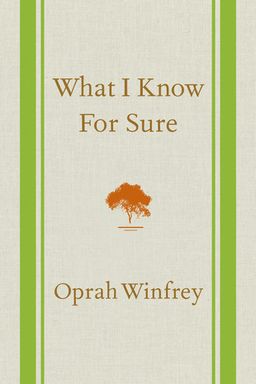
What I Know for Sure cover

What I Know for Sure

by Oprah Winfrey

What I Know for Sure by Oprah Winfrey delves into the pivotal moments that shaped her extraordinary success. Through personal stories, Oprah shares how overcoming hardships, embracing self-love, and practicing gratitude can help anyone unlock their full potential and find true contentment.

Living with Gratitude, Joy, and Purpose

When was the last time you paused to ask yourself: What do I truly know for sure? Oprah Winfrey’s What I Know For Sure began with that exact question, asked by film critic Gene Siskel. The question became the spiritual thread of Oprah’s life—one that weaves through every joy, heartbreak, triumph, and transformation she’s experienced. In this book, she contends that clarity and fulfillment don’t come from money, fame, or success but from awakening to the small moments that teach us to live with gratitude, joy, and integrity. Her central argument is simple yet profound: your greatest power comes from knowing and living as your truest self—fearless, grateful, aware, and fully engaged.

Throughout What I Know For Sure, Oprah reflects on lessons from decades of interviewing extraordinary people, enduring private struggles, and discovering spiritual truths that expanded her understanding of what it means to live well. From learning to love her body to embracing aging and setting boundaries, Oprah’s credo emphasizes personal responsibility: you are the artist of your own life, painting it choice by choice, with gratitude as your brush and purpose as your palette.

The Power of Awareness

Oprah’s journey begins and ends with awareness. She claims that life’s greatest teacher is attention itself—learning to see what’s really happening around you rather than racing through in autopilot. Gratitude, she says, anchors awareness by bringing your focus to the abundance already in your life. In 1996, when Oprah found her old gratitude journal, she realized that despite having more fame and wealth than ever, her happiness had faded because she had stopped recording simple daily blessings. Reclaiming gratitude restored her joy and reminded her that “you radiate and generate more goodness for yourself when you’re aware of what you have.”

(Note: This aligns with positive psychology research, such as that by Martin Seligman, which shows that daily gratitude increases well-being and resilience.)

Resilience Through Gratitude and Faith

Winfrey repeatedly turns moments of suffering into acts of healing through gratitude. A seminal story in the book recounts Maya Angelou telling her, through tears, to “say thank you” when life felt unbearable. That command transformed Oprah’s perspective—teaching her that faith and gratitude are inseparable. Even in pain, she learned to say thank you, believing there is “a rainbow in the clouds.” Gratitude, she writes, “is the quickest, easiest, most powerful way to effect change in your life.”

This spiritual approach to gratitude connects deeply to her broader philosophy of resilience. She reminds readers that pain will pass and every storm eventually gives way to light—a recurring theme shared by spiritual teachers like Eckhart Tolle and Marianne Williamson, whose works also explore faith as the root of inner peace.

The Journey Toward Self-Acceptance

One of Oprah’s most vulnerable lessons comes through her lifelong relationship with her body. From early dieting and public scrutiny to her eventual recognition that loving her body as it is was the key to wholeness, Oprah describes gratitude as the foundation of self-love. After suffering heart palpitations in 2001, she began thanking her heart for every beat, realizing how she had failed to honor the miracle inside her. “There is no need to struggle with your body when you can make a loving and grateful peace with it,” she writes.

Her awakening reframes beauty and aging as spiritual transformation—similar to perspectives shared by authors like Don Miguel Ruiz (The Four Agreements) and Buddhist teacher Pema Chödrön, who emphasize acceptance of impermanence as a spiritual practice.

Living Joyfully and Authentically

Living fully, Oprah teaches, means embracing the dance of life instead of sitting it out. She recalls performing with Tina Turner on stage, realizing mid-song that she was too self-conscious to enjoy herself. In that moment, she decided to “throw my head back and dance.” It became a metaphor for her life’s philosophy: choose joy, surrender fear, and live every moment as though it might be your last.

Throughout the book, she encourages readers to take their pleasures seriously—to savor laughter with friends, delicious food, books, silence, and nature. Pleasure, she notes, is “energy reciprocated: what you put out comes back.” This echo of universal law—what we give returns tenfold—runs through every section of What I Know For Sure, mirroring the karmic principle she first embraced after reading The Seat of the Soul by Gary Zukav.

Learning, Giving, and Awakening

Finally, Oprah’s wisdom culminates in the idea of service and growth. Every chapter reveals her belief that to live in truth, you must give, learn, evolve, and open yourself to grace. Whether sharing harvest vegetables from her Maui garden, giving gifts to strangers, mentoring young women through her Leadership Academy, or accepting age with pride, she celebrates giving as the path to abundance. “What you focus on expands,” she writes, reminding readers that joy and grace multiply when shared.

What matters most, Winfrey concludes, is living intentionally—choosing awareness, gratitude, compassion, and authenticity every day. Because when you know who you are, and act in alignment with that truth, your life itself becomes the answer to Gene Siskel’s timeless question: “What do you know for sure?”


Gratitude as a Transformative Force

Oprah Winfrey’s most enduring message is the power of gratitude. She writes that being consciously thankful changes the vibration of your entire life. When you express gratitude, even through difficulty, you shift from fear to faith, from lack to abundance. Oprah chronicles her experience of keeping a gratitude journal for a decade, noting how it altered her perception of daily life. She learned that joy doesn’t come from acquiring more—it comes from appreciating what already is.

Learning from Maya Angelou

A crucial turning point in this lesson came from her mentor Maya Angelou. During a moment of despair, Oprah called Angelou in tears. Angelou demanded she stop crying and “say thank you.” That directive confused her until Maya explained: gratitude isn’t denial—it’s assertion of faith. You say thank you because you trust there’s a rainbow even in the eye of the storm. This became a spiritual cornerstone for Oprah, reshaping the way she approached hardship and uncertainty.

Gratitude and Ego

To truly feel gratitude, she says, your ego must take a backseat. That humility opens the way to compassion and connection. Instead of resenting challenges, you can appreciate what they teach. This echoes lessons from Eckhart Tolle’s A New Earth, which also emphasizes transcending ego as the gateway to spiritual enlightenment.

Practical Gratitude

Practicing gratitude daily can be simple: writing three things that delight you, saying thank you aloud in moments of difficulty, or pausing to appreciate small wonders—the taste of fruit, a friend’s laughter, the gift of another sunrise. Oprah uses technology to capture these “grateful moments,” noting that awareness itself generates more goodness. The message is clear: make gratitude a ritual, not a reaction.

Oprah’s takeaway:

“Whenever there’s a grateful moment, I note it. I know for sure that appreciating whatever shows up for you in life changes your whole world.”

Practiced over time, this discipline redefines happiness—not as a byproduct of success but as the foundation of it. Gratitude turns ordinary days into sacred acts of grace.


Self-Love and the Body You Live In

For decades, Oprah fought an exhausting battle with her body—dieting, shaming, and critiquing herself in pursuit of perfection. But what changed her relationship to health wasn’t a new diet; it was self-acceptance. The shift began when health issues forced her to notice the miracles of her body. “I took my heart for granted until it reminded me it was there,” she writes. The lesson: your body thrives when your attitude toward it becomes one of gratitude and respect.

Breaking the Cycle of Shame

Oprah recounts years of self-criticism—sleeping with clothespins on her nose as a girl, dieting through countless fads, and viewing food as an enemy. That mindset of scarcity extended to her identity itself. Recognizing that external dieting was only deepening internal discontent, she learned that starving the body often starves the spirit. Her transformation began when she looked in the mirror, free of makeup, and felt love instead of judgment.

Gratitude as Healing

Instead of waging war against imperfections, she started acknowledging her body’s resilience—the way her heart beats, lungs breathe, muscles work. This gratitude rewired her self-image. Inspired by poet Carolyn M. Rodgers’s phrase “a root revival of love,” Winfrey began loving herself piece by piece, from the cellulite on her thighs to the lines in her face. “Love what you’ve got,” she says. That act of peace with her body became spiritual liberation.

Freedom in Acceptance

Her acceptance does not mean complacency. Rather, it’s learning to nourish the body as one nourishes the soul. Later in life, Oprah embraced fitness and mindful eating not to change appearance but to honor function. “Taking care of my heart—the life force of my body—became my priority.” This mirrors Brené Brown’s theory that true confidence emerges from wholeheartedness, not perfection.

For you, the lesson is clear: Self-love doesn’t come after transformation—it fuels it. When you treat your body with gratitude and respect, you align your physical and spiritual health, reclaiming harmony between the two.


Overcoming Fear and Choosing Courage

Oprah defines courage not as the absence of fear but as the decision to move forward despite trembling knees. She admits she spent years confined by fear of rejection—agreeing to things she didn’t want, minimizing her success to please others, and enduring exhausting relationships. But the turning point came when she recognized a truth echoed by Neale Donald Walsch: “So long as you’re still worried about what others think of you, you are owned by them.”

The Weight of Fear

As a young woman, Oprah lived in bondage to fear—fear of not being loved, fear of failure, fear of being “too much.” She writes that fear itself has power only when you give it yours. Each submission to fear weakens your spirit. Her journal became a mirror of anxiety—daily entries asking “What am I afraid of?”—until she realized that acknowledging fear was the first step toward dismantling it.

Choosing Growth Over Comfort

Every major transformation in Oprah’s life began with a brave leap. She left her job as a Baltimore anchor to become a Chicago talk show host, despite being told she’d fail. “You’re right,” she told her boss, “I may fail. But if it doesn’t kill me, I’ll keep growing.” That act of courage changed her destiny. Like Joseph Campbell’s call to adventure, she describes fear as the guardian at the gate of your best self; each time you push past it, life expands.

Fear as Illusion

Oprah’s most liberating realization: “Whatever you fear most has no power—it is your fear that has the power.” Problems rarely destroy us; it’s the paralysis of anticipation that does. When you stop identifying with fear, you reclaim your energy for creation. That’s how she learned to sit inside uncertainty, wait for clarity, and then act with intention—a habit she calls “listening to my inner GPS.”

Her advice? When faced with doubt, pause and breathe until your inner self responds with a resounding “Yes.” Courage, practiced repeatedly, builds resilience. It’s not about becoming fearless—it’s about becoming free.


The Art of Giving and Connection

Connection, according to Oprah, is life’s ultimate currency. “We all yearn to feel valued,” she writes. Through decades of conversation, she discovered that beneath every action—from infidelity to success—lies the craving to feel heard, loved, and acknowledged. Yet she warns that intimacy isn’t found in others who complete you; it’s found in honoring yourself first. A lack of connection is not emptiness between people—it’s neglect of self.

Self-Worth as the Foundation of Love

Oprah describes how she once confused love with validation. As a young woman, she begged for affection, even clinging to toxic relationships. “I thought I was worthless unless a man loved me.” It wasn’t until her mentor role on The Oprah Winfrey Show and her friendship with Gayle King that she realized genuine love begins internally. When you stop seeking approval, you can give without expectation—a lesson mirrored by psychologist Nathaniel Branden’s work on self-esteem.

Giving as Joy

Winfrey’s stories of giving—from cars to handwritten notes—embody selfless generosity. She emphasizes intention: “What matters is how much of yourself goes into the giving, so that when the gift is gone, the spirit of you lingers.” Whether it’s sharing vegetables from her own garden or creating her famous Legends Ball to honor women trailblazers, Oprah finds fulfillment not in the object given but in the spirit exchanged.

Connection and Community

Later in life, Oprah built authentic community—hosting neighbors for dinner, making her home a gossip-free zone, and learning that connection deepens when we eliminate negativity. This choice echoes Goldie Hawn’s “Words Can Heal” pledge, which replaced hurtful speech with uplifting conversation. In relationships, she practices active empathy by asking, “What do you really want here?” and responding with “I hear you.” That simple act turns misunderstanding into human connection.

Her conclusion: the best gift we can offer others is ourselves—whole, present, and honest. When giving comes from abundance, connection becomes effortless, and love, in all its forms, thrives.


Aging, Acceptance, and Freedom

In a youth-obsessed culture, Oprah Winfrey offers a radical counter-narrative: aging is not decline—it is expansion. When she met women afraid to admit their age, she realized how deeply society equates youth with worth. Through candid conversations—with icons like Barbra Streisand and Maya Angelou—she came to see aging as a privilege denied to many. “All the angels of 9/11 who won’t get there,” she muses, remind us that every birthday is grace.

Rejecting Cultural Myths

Oprah challenges the myth that older means less attractive or valuable. “Getting older doesn’t equal getting uglier,” she says. This belief is one of the lies Don Miguel Ruiz calls “a distortion of reality.” Oprah’s mentors defy this narrative—Maya Angelou touring in her eighties, Sidney Poitier writing novels at 85, Quincy Jones creating globally. Their lives prove that vibrancy and creativity grow with age when nurtured by curiosity.

Owning the Present

To deny your age, Oprah says, is to reject the truth of who you are. “Only by owning every moment can you step into the fullness of life.” Each year teaches and transforms you—that’s its purpose. Aging, then, becomes a spiritual practice of self-revelation. Instead of chasing youth, she celebrates wisdom, grace, and perspective—the wealth that time brings. Her mantra: “The way to your best life isn’t denial. It’s owning every moment.”

Her reflections remind us that freedom comes from authenticity. When you honor your age, you release fear, and life expands into its richest form—a lived gratitude for every breath and sunrise you’re blessed to witness.


Finding Stillness and Spiritual Awakening

Oprah’s spirituality isn’t confined to religion—it’s awareness of divine energy in all creation. Her most transcendent moments are described as encounters with stillness. One night in Hawaii, pausing on a mountain with her friend Bob Greene, she felt the world stop: total silence, where even breathing seemed too loud. She calls it “the sound of nothing and everything”—a timeless instant of peace that revealed the essence of life itself.

Stillness as Connection

For Oprah, stillness is not emptiness—it is connection to the infinite. She quotes Psalm 37:4: “Delight thyself in the Lord, and He will give you the desires of your heart,” translating “delight” as living with compassion and joy. Through practices like meditation, gratitude, and mindful breathing, she cultivates an inner sanctuary that guides every decision. “Your breath,” she writes, “is your anchor—the gift you’ve been given to center yourself in this very moment.”

Recognizing Miracles

Oprah redefines miracles not as supernatural events but as ordinary wonders seen through spiritual eyes—a peach so sweet it evokes childhood, a sunset turning from gold to raspberry, or a stranger’s kindness. “Open your eyes,” she says, “and you’ll begin to see them.” This perspective transforms everyday life into sacred expression, echoing mystic poets like Rumi and contemporary teachers such as Ann Mortifee, whom she quotes: “Let ecstasy erupt. Rapture is needed now.”

Being the Poem

Later, in correspondence with poet Mark Nepo, she learns that poetry is “where the soul touches the everyday.” His words inspire her to not just write or read poems, but to be the poem—to live as grace in motion. Through meditation and spiritual study with Eckhart Tolle, she embraces the lesson that “you don’t live your life, life lives you.” Aligning with this flow is enlightenment itself.

Oprah’s spirituality calls you to pause, breathe, and notice the miracle of existence—because the sacred essence you seek is already within you, waiting in stillness for recognition.

Dig Deeper

Get personalized prompts to apply these lessons to your life and deepen your understanding.

Go Deeper

Get the Full Experience

Download Insight Books for AI-powered reflections, quizzes, and more.