
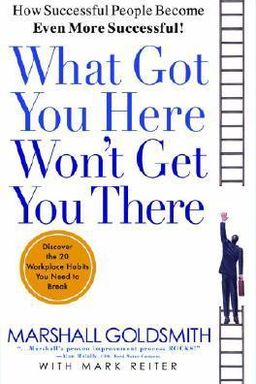
What Got You Here, Won’t Get You There cover

What Got You Here, Won’t Get You There

by Marshall Goldsmith

In ''What Got You Here Won’t Get You There,'' Marshall Goldsmith reveals how successful individuals can transcend their limits by identifying and transforming detrimental habits. This insightful book offers practical techniques for enhancing people skills, receiving critical feedback, and fostering a culture of mutual appreciation.

Why Success Can Hold You Back

What if the very qualities that made you successful were the same ones preventing you from reaching the next level? This is the central question Marshall Goldsmith poses in What Got You Here Won’t Get You There. Drawing on decades of experience as an executive coach for Fortune 100 leaders, Goldsmith challenges high achievers to confront a paradox: the habits and behaviors that propelled their careers may actually sabotage their future success. The issue isn’t lack of intelligence or skill—it’s the blind spots in behavior that erode relationships, alienate colleagues, and limit upward growth.

Goldsmith’s argument is startlingly simple yet deeply unsettling: success deludes people into believing they’re always right. People who’ve ‘made it’ often start to confuse success because of their behavior with success in spite of it. The higher they rise, the less honest feedback they receive, the fewer truths they hear, and the more entrenched their habits become. Over time, these habits—impatience, arrogance, or the need to win at everything—create invisible ceilings that stunt growth. As Goldsmith puts it, “What got you here won’t get you there.”

The Executive Coach’s Discovery

Goldsmith learned this truth through experience. Early in his coaching career, a CEO hired him to fix an extremely talented but difficult executive—a man described as brilliant, charismatic, and results-driven, yet arrogant and unpleasant. Goldsmith’s job wasn’t to make this executive smarter; it was to help him be someone whom others actually wanted to follow. Over and over, Goldsmith encountered the same pattern among high performers: world-class ability paired with blind spots in behavior. His coaching method evolved into a simple but rigorous process—solicit honest feedback, apologize, advertise your intention to change, follow up consistently, and practice gratitude and feedforward (asking for guidance rather than judgment). In other words, behavior, not intellect, becomes the defining edge of great leadership.

Success and Its Traps

Goldsmith’s most provocative claim is that success is itself a barrier to change. He identifies four ‘success beliefs’ that help people rise—and then limit them once they’re at the top: (1) I have succeeded; (2) I can succeed; (3) I will succeed; and (4) I choose to succeed. These beliefs foster confidence, control, and resilience, but they also breed resistance: if something is working, why change it? This cognitive dissonance, reinforced by constant affirmation from subordinates and peers, dulls self-awareness. Ironically, the same self-assurance that once drove achievement becomes the ego that stops growth.

Success breeds what Goldsmith calls “superstition.” Just like pigeons that keep repeating a random twitch that once led to food, successful people repeat behaviors that seem correlated with success, even if those behaviors—such as interrupting or taking credit—are counterproductive. The challenge, therefore, is to distinguish between the habits that cause our success and those that coexist with it. Without that awareness, we cling to toxic behavior because we mistake it for strength.

From Skill to Behavior

At the upper levels of an organization, the difference between “good” and “great” rarely lies in technical skill; it lies in behavior. As Peter Drucker famously said, “We spend a lot of time teaching leaders what to do; we don’t spend enough time teaching leaders what to stop.” Goldsmith takes this insight further, cataloguing twenty-one specific habits that derail success—ranging from “Winning Too Much” and “Adding Too Much Value” to “Failing to Express Gratitude.” These are not grand ethical failings; they’re small, repetitive irritations that accumulate into reputational damage. Leadership success, he argues, is built not on doing more but on stopping what harms.

Each bad habit—like playing favorites or failing to listen—can be fixed not through therapy or deep analysis, but with awareness, humility, and follow-up. Goldsmith’s message is disarmingly practical: it’s not about transforming your soul, it’s about adjusting your behavior so others experience you more positively. The goal isn’t perfection—it’s progress that others can see and feel.

Why This Matters

In an age where leaders are expected to inspire, not just execute, Goldsmith’s insights are crucial. Organizations rise and fall on the quality of relationships, and relationships hinge on behavior. It doesn’t matter how brilliant your ideas are if no one wants to work with you. What Got You Here Won’t Get You There provides a playbook for closing the gap between self-perception and how others actually experience you. It’s a book about growth that begins where most success stories end—after you’ve already “made it”—and dares you to ask the toughest question of all: Am I willing to change myself to become the leader everyone else deserves?


The Success Delusion

Marshall Goldsmith argues that our achievements plant the seeds of our future failures. When we succeed, we tell ourselves comforting lies about why. We assume that we deserve our wins, that our behaviors directly caused them, and that we can repeat the formula indefinitely. But these very beliefs—while empowering—make us resistant to change. Goldsmith calls this the Success Delusion: the mistaken conviction that “I am successful; therefore, everything I do must be good.”

Four Beliefs That Block Growth

Goldsmith identifies four core beliefs behind every successful leader’s resistance: (1) I Have Succeeded: We replay our highlight reels and forget our missteps. Because we interpret our past through rose-tinted glasses, we overestimate our contributions and undervalue others. (Studies show that 80–90% of professionals rate themselves in the top 20% of performance.) (2) I Can Succeed: With an internal locus of control, we believe effort conquers all—which means we assume that if something goes right, it must be because of how we behaved. (3) I Will Succeed: Exuberant optimism keeps us moving but blinds us to our limits. Overcommitment—being “drowned in a sea of opportunity”—is the hidden downside of confidence. (4) I Choose to Succeed: Our strong need for self-determination makes us hate being told what to do. When told to change, we feel manipulated and resist even when the advice is sound.

Combined, these beliefs create cognitive dissonance. The more we identify with our habits, the harder it becomes to admit they might be flaws. As Goldsmith writes, “The more we believe something is true, the less likely we are to believe that its opposite is true—even if evidence shows we’re wrong.” This is why, as leaders climb higher, behavioral change becomes excruciatingly difficult.

The Superstition of Success

Goldsmith borrows from B.F. Skinner’s work on superstition to explain another danger: confusing correlation with causality. Just as pigeons who accidentally twitch before being fed will repeat the twitch forever, successful people repeat behaviors linked to positive outcomes—whether or not the behaviors caused those outcomes. For instance, an executive who interrupts because “it keeps meetings efficient” may be successful despite that habit, not because of it. This superstition fuels arrogance and rigidity. “I’m successful, therefore I must be right” becomes the mantra of stagnation.

Natural Law: Motivation Through Self-Interest

Goldsmith concludes this section with realism: people only change when it serves their self-interest. This “natural law” isn’t cynicism—it’s psychology. No one reforms purely out of moral duty; we change because something we value—money, status, power, happiness, legacy—is at stake. Effective coaching, leadership, or persuasion must begin there. For example, one executive stopped berating subordinates only after realizing his sons were imitating his sarcasm at home. His legacy, not HR compliance, motivated him to behave differently. The Secret: find someone’s “hot button.” Appeal to what they truly value, and change follows.

The antidote to the success delusion is humility—the courage to see that you’re not succeeding because of every trait you display, but often in spite of many of them. Goldsmith’s advice: constantly ask yourself, “Is this behavior legitimate or am I kidding myself?” It’s a deceptively simple question that can save careers, marriages, and reputations.


The Twenty Habits That Hold You Back

To fix what’s keeping us from greatness, Goldsmith offers a remarkable inventory: twenty everyday habits that successful people display—and that drive others crazy. These aren’t ethical failings or personality disorders, but subtle interpersonal behaviors that alienate colleagues, team members, and friends. Each habit, left unchecked, diminishes trust and cooperation. As Goldsmith notes, “Half the leaders I’ve met don’t need to learn what to do; they need to learn what to stop.”

Stop Doing, Not Just Start Doing

Organizations often reward ‘doing’—new initiatives, bold strategies, busyness—but rarely celebrate what people stop doing. Yet, leadership improvement often means subtraction, not addition. Goldsmith advises creating a “To Stop List,” an inventory of counterproductive behaviors more damaging than any missed opportunity. Being nicer, for instance, may not mean doing dozens of positive acts—it could simply mean “stop being a jerk.”

Some of the Core Habits

  • Winning Too Much: The compulsion to win in all situations—even trivial ones. A CEO who insists on winning an argument about restaurant choices is prioritizing ego over relationships.
  • Adding Too Much Value: Leaders can’t resist improving others’ ideas. By adding “just a few tweaks,” they steal ownership from subordinates. A 5% improvement in idea quality costs 50% of commitment.
  • Passing Judgment: Offering opinions on everything—even when none are needed. A simple “thank you” often trumps critique.
  • Making Destructive Comments: Sarcasm and “just kidding” insults can erode trust faster than overt hostility.
  • Starting With ‘No,’ ‘But,’ or ‘However’: These words silently scream, “You’re wrong.” Just noticing and stopping them transforms communication.

He also exposes subtler habits—failing to thank people, not listening, punishing the messenger, playing favorites, and the grand finale: the excessive need to be “me.” Leaders often defend flaws (“That’s just who I am”) as authenticity, when it’s actually arrogance. Authenticity should never be an excuse for stubbornness.

Why Behavioral Problems Matter More at the Top

At higher levels of leadership, technical competence is assumed. Everyone is smart and skilled. The differentiator is behavior. Goldsmith emphasizes that minor flaws become magnified as authority increases. A CEO’s “suggestion” sounds like a decree; a sarcastic joke hits like a dagger. Thus, leadership growth depends less on new skills and more on self-awareness and restraint.

Fixing these habits doesn’t require deep therapy—it requires humility, structured feedback, and consistent follow-up. As Goldsmith summarizes: “Stopping destructive behavior gets noticed much faster than learning new tricks.”


Feedback and Feedforward

One of Goldsmith’s greatest contributions is distinguishing between feedback and feedforward. Traditional feedback focuses on the past—what went wrong, who’s to blame. It sparks defensiveness. Feedforward, on the other hand, asks for ideas about the future: “What can I do better next time?” This shift turns judgment into possibility and avoids the emotional baggage of blame.

The Limits of Feedback

Most feedback fails because it violates human nature: successful people hate being told they’re wrong. Goldsmith calls the attempt to “prove people wrong” futile. He also notes that, in large organizations, subordinates rarely give honest feedback to those in power. Even handled gently, negative feedback triggers defensiveness. People don’t like to relive failure—they want to improve the future. Thus, feedback provides awareness but not motivation.

How Feedforward Works

The feedforward process is remarkably simple: pick one behavior you want to change, explain it clearly to others, and ask for two future-focused suggestions. You’re not allowed to criticize, judge, or even reward suggestions—just listen and say “Thank you.” Then, ask another person for two more. Repeated frequently, it creates a culture of constructive sharing instead of complaint.

Goldsmith’s Buddhist influences shine here: he believes in “leaving the past at the stream.” He tells the parable of two monks who carry a woman across a river even though their vows forbid touching women. One monk frets for hours, while the other says, “I put her down at the river—you’re the one still carrying her.” Like the monk, we must stop carrying old grievances and focus on what’s next.

Why It Works

  • It’s proactive, not punitive—it seeks solutions, not blame.
  • It removes hierarchy—two people collaborate as equals.
  • It emphasizes learning rather than defending.

Feedforward thus reflects a profound shift: from ego to empathy, from judging to listening. In practice, leaders who adopt it foster trust, humility, and open communication. It’s less about being right and more about getting better together.


The Seven-Step Process for Change

Goldsmith’s coaching method reduces personal transformation to a repeatable, disciplined process. Change isn’t mystical—it’s behavioral science coupled with accountability. Each step reinforces the next, turning self-awareness into visible improvement that others can measure.

1. Feedback

Gather 360-degree feedback from everyone you work with—superiors, peers, subordinates, even family. Ask not only “What am I doing wrong?” but “What should I stop doing?” The goal is awareness, not agreement.

2. Apologizing

The “magic move.” Apology closes the gap between perception and intention. A sincere “I’m sorry. I’ll try to do better.” rebuilds trust faster than justification ever could. Adding explanations dilutes impact—say less, mean more.

3. Advertising

Tell people what you’re working on. By sharing your goals, you prime others to notice your progress and hold you accountable. “You have to get 100% better to get 10% credit,” Goldsmith warns, because perception lags performance.

4. Listening

Active listening—thinking before speaking, asking “Is it worth it?” and demonstrating respect—builds credibility. Goldsmith cites Bill Clinton’s ability to make each person feel like “the only one in the room” as the gold standard of attention.

5. Thanking

Gratitude disarms defensiveness. Saying “Thank you” provides closure in any conversation and encourages continued dialogue. Goldsmith’s near-death airplane story leads him to write 50 heartfelt thank-you notes—transforming gratitude into daily practice.

6. Following Up

Consistent follow-up distinguishes effort from intent. Like New York’s Mayor Ed Koch asking, “How’m I doing?” regular follow-up demonstrates humility and seriousness. Goldsmith’s research shows direct correlation between follow-up frequency and perceived improvement.

7. Feedforward

Finally, integrate lessons into the future by inviting new ideas from others. Continuous dialogue turns change from an event into a lifestyle. As Goldsmith concludes, “Follow-up shows you care; feedforward shows you will.”


Overcoming Goal Obsession

A surprising addition to Goldsmith’s list of derailing traits is goal obsession. Having goals isn’t the issue—it’s when meeting targets eclipses the larger purpose. Driven leaders, he warns, often mistake the objective for the mission. When that happens, integrity, empathy, and balance vanish.

When Winning Becomes Losing

Goldsmith illustrates this with the story of Candace, a brilliant marketing executive who delivered record-breaking results but alienated her team through relentless self-promotion. Like many overachievers, she equated personal recognition with success. Her employees fled, drained by her “me-first” ambition. Candace didn’t need more goals; she needed perspective. (“You can’t be a great leader unless you make other people winners too,” Goldsmith reminds us.)

The Colonel Nicholson Effect

In a brilliant analogy, Goldsmith cites Colonel Nicholson from The Bridge on the River Kwai. Nicholson, an honorable British officer, becomes so obsessed with building a perfect bridge that he forgets the war’s purpose—defeating the enemy. Only at the end does he cry, “What have I done?” Goal obsession makes us lose context, turning noble efforts into absurd contradictions.

Overcommitment, stress, and misplaced loyalty often accompany this mindset. Goldsmith’s research shows that most executives drown not in crises but in “a sea of opportunity.” Every new project looks exciting; saying no feels like losing. The antidote is regular reflection: “Am I achieving a task and forgetting my mission?”

Looking Beyond the Moment

True leaders align goals with purpose. They remember that metrics—sales, ratings, deal volume—serve people, not the other way around. It’s a reminder echoed by psychologists like Viktor Frankl (Man’s Search for Meaning): chasing outcomes without purpose leads to emptiness. Goldsmith’s twist is both humane and humorous—he insists that you can still aim high, just don’t forget why you’re aiming.


Leadership and Change at the Top

Once you understand personal change, Goldsmith turns to the unique burden of those in charge. As influence grows, so does scrutiny. Power amplifies one’s smallest behaviors—turning mild quirks into major liabilities. The higher you climb, the more your success depends on others’ perception.

Memo to Staff: How to Handle Me

Goldsmith humorously suggests every leader write a “Memo to Staff: How to Handle Me.” Like radio host Don Imus telling listeners to ignore his rants unless he says “You have to stop that now,” leaders should preempt misunderstandings by naming their triggers. One public relations executive did exactly that, writing: “I hate paperwork, get bored quickly, and like ideas. Please stop me when I ramble.” By confessing flaws, he empowered his assistant to manage him effectively—and employee turnover vanished.

You’re Not Managing You

Another lesson: stop assuming your staff thinks and works like you. Goldsmith calls this “The Golden Rule Fallacy.” Treating others as you’d like to be treated fails if they aren’t you. One CEO loved debating ideas; his subordinates found the duels intimidating. Once he understood that “it’s not a fair fight,” he learned to ask, not argue.

The Free Agent Workforce

Goldsmith also warns leaders against outdated prejudices about employees. Today’s professionals are “free agents” choosing fulfillment over loyalty. They’re not motivated purely by money but by meaning, growth, and autonomy. Treat them as partners, not possessions. As he writes, “The company may sign your paycheck, but your people sign your reputation.”

Know When to Stop Coaching

Finally, know your limits: don’t waste energy coaching people who won’t change. Some don’t see a problem, some are miscast for their role, others blame everyone else. As Goldsmith’s father once said to his constantly lecturing wife, “Honey, I’m 70 years old—let it go.” Change is a choice, not a punishment. Great leaders focus their efforts where change is possible.


Getting From Here to There

Goldsmith closes with a meditation on purpose. Imagine you’re 95, he says, and you can speak to your younger self. What would you regret? In interviews with people near death, the answers are startlingly consistent: they wish they had sought happiness now, cherished family and friends more deeply, and followed their dreams boldly. The Great Western Disease—the belief that “I’ll be happy when”—keeps people chained to future achievements. The truth is that meaning exists only in the present.

Personal Fulfillment and Professional Growth

In Goldsmith’s research with Accenture’s top high-potential leaders, the reasons people stay with a company mirror the regrets of the dying: they stay because the work is meaningful, the people feel like family, and the job lets them pursue their dreams. Happiness, relationships, and purpose—these are the universal currencies of leadership and life.

Ultimately, “there” isn’t a place—it’s a mindset: grounded, grateful, growing. The book ends where it began, with those simple words: You are here. You can get there. But only if you change yourself first.

Dig Deeper

Get personalized prompts to apply these lessons to your life and deepen your understanding.

Go Deeper

Get the Full Experience

Download Insight Books for AI-powered reflections, quizzes, and more.