
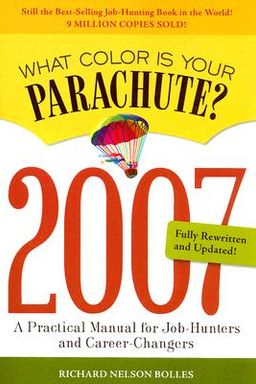
What Color is Your Parachute cover

What Color is Your Parachute

by Richard N Bolles

What Color is Your Parachute? delivers essential strategies for job hunters and career changers in the digital age. Learn to enhance your online presence, ace interviews, and negotiate salaries effectively to land your dream job. Updated for the modern job market, this guide provides invaluable insights for success.

The New Rules of Finding Meaningful Work

Why does job-hunting feel harder than ever? Richard N. Bolles’ What Color Is Your Parachute? argues that the world of work has changed profoundly since 2008, yet the essence of hiring and fulfillment remains constant: two human beings deciding whether they want to work together. The old playbook of mass résumé submissions and waiting for a call no longer works. You must treat job-hunting as a process of self-discovery, relationship-building, and value communication.

Understanding the post-2008 landscape

After the Great Recession, employers became risk-averse and inundated with applicants—about 118 per job on average. Hiring cycles lengthened, screening intensified, and temporary and gig roles multiplied. The search process migrated online: LinkedIn, Google, and social media became primary hiring channels. Yet Bolles stresses that technology changes only the surface of hiring. Beneath the algorithms, hiring remains a human process driven by affinity, trust, and fit.

The Parachute mindset

Bolles’ enduring insight is simple but radical: start with yourself, not the job market. Most people begin by asking “What jobs are open?” The Parachute approach begins with “Who am I? What do I love? Where do I belong?” The key tool is the Flower Exercise, a seven-petal self-inventory that clarifies your skills, motives, and mission. Once you know your design, you approach employers that fit it—whether or not a vacancy is posted—using informational interviewing and bridge people to connect.

From self-discovery to strategic approach

Every later stage of job-hunting builds on that foundation. Your online presence becomes your public résumé. Informational interviews become your research and relationship machine. Networking, interviewing, and salary negotiation all flow more naturally once you know what you bring and what you seek. Bolles’ research shows striking differences in results: passive résumé submissions succeed as little as 4–7% of the time, while direct, self-informed approaches like the Parachute Method succeed 65–86% of the time.

A human-centered philosophy

At its heart, Parachute is a book about agency and hope. Bolles argues that meaningful work exists for everyone who persists and learns to translate their strengths into employer language. Even in a digital world, the job hunt is ultimately about relationships. Whether you’re a new graduate, a veteran, someone with a visible handicap, or an encore-career seeker, the path is personal but navigable. You move from confusion (“What can I possibly do?”) to clarity (“Here’s who I am and who needs that”).

Structure of this guide

This synthesis explores how to master that process. You’ll learn (1) how the job market and digital platforms changed hiring; (2) how to know yourself through the Flower and skills grid; (3) how to apply the Parachute approach to find and contact employers; (4) how to interview and negotiate effectively; (5) how to overcome barriers, handicaps, or shyness; and (6) how to evolve your career through reinvention, business ownership, or purpose discovery. Together these principles form a comprehensive, humane blueprint for navigating work in the twenty-first century.


Knowing Yourself through the Flower Exercise

Every successful job hunt begins with clarity about who you are. Bolles’ Flower Exercise is the book’s core tool for understanding and articulating your design. This seven-petal diagram helps you identify your favorite knowledges, people, transferable skills, working conditions, salary level, location, and mission. The finished Flower becomes a living map—the foundation of every decision and conversation to follow.

Petal by petal: your self-inventory

You begin with stories—times you accomplished something and enjoyed it. From these, you extract verbs (skills) that animate you. You then explore environments and people-types you thrive around, fields you care about, and locations or missions that inspire you. By sorting and ranking your preferences with Bolles’ “Prioritizing Grid,” you transform vagueness into a set of guiding insights.

Skills, not job titles

The Flower frees you from your old job title. Instead of asking “What else can a teacher or engineer do?”, you ask, “Where could I use my top five favorite skills?” This shift multiplies possible markets. (Note: this parallels modern “transferable skills” frameworks used by O*NET and career coaches worldwide.) The exercise also helps you communicate vividly—when you tell specific, skill-based stories, employers see how you add value.

Turning self-knowledge into strategy

Once completed, your Flower becomes both a compass and a filter. You evaluate opportunities by matching them to your petals. It also powers other key steps—choosing which employers to target, crafting LinkedIn summaries, preparing interview stories, and even identifying business ideas if you decide to work for yourself.

Core truth

You can’t find your ideal work until you understand the pattern of your own joy and competence—and the Flower draws that pattern in color for you to see.

The Flower Exercise is slow but transformative work. Those who complete it bring clarity and conviction into every job conversation. Employers respond to that confidence because it signals direction and fit. In a world overloaded with vague applicants, a person who knows themselves stands out immediately.


From Strategy to Action: The Parachute Way

Once you know who you are, the next step is to find where you belong. Bolles distinguishes between two job-hunting methods: the Traditional Way and the Parachute Way. The first depends on advertised vacancies and résumés; the second depends on self-knowledge, personal contact, and discovery conversations. The latter yields far better odds because it reaches opportunities before they’re public.

Why the traditional path fails

Online job boards promise convenience but deliver fierce competition. With hundreds of applicants per posting, employers filter ruthlessly—often by arbitrary proxies such as current employment. Success rates are dismal: studies Bolles cites show 4–7% outcomes through job boards. The average résumé sent to a giant company may vanish unread among 1,000 others.

How the Parachute Path works

The Parachute approach starts with clarity (your Flower), moves outward to identify employers that fit your pattern, and reaches them through bridge-people or direct contact. You ask for informational interviews to learn how they work and what problems they face. When the chemistry and skills align, roles often appear around you—sometimes created specifically for you. Bolles’ studies report 65–86% success rates among those who use this integrative method.

Bridge-people and informational interviews

A bridge-person knows both you and someone inside your target organization. LinkedIn makes such bridges visible. You can request a brief meeting—Bolles recommends nineteen minutes—and listen closely, asking smart questions about the work, culture, and direction of the organization. Send prompt thank-yous, stay in touch, and expand your web of relationships. This steadily builds visibility in places that matter most to you.

Focused targeting and territory narrowing

Using the Flower, you reduce the vast world to roughly ten potential organizations. Research them through their websites, directories like ReferenceUSA, and by conversing with employees. Concentrating deeply on a short list beats applying shallowly to hundreds. The targeted approach converts anonymous searching into intelligent opportunity design—showing that, in job-hunting as in marketing, relevance wins over reach.


Your Online Reputation Is Your New Résumé

Today your Google results speak before you do. Bolles urges job seekers to treat their online presence as a living résumé that employers audit before making contact. In one survey he cites, 91% of employers screen social profiles; 69% reject candidates based on negative findings, while 68% hire because of positive ones. Managing your digital footprint is thus not optional—it is the new front door of your career.

The four-step reputation audit

Bolles’ fourfold strategy—Edit, Fill In, Expand, Add—provides a simple framework. First, Edit damaging or outdated content. Second, Fill In your professional profiles, especially LinkedIn, with complete, current information and a welcoming photo. Third, Expand your presence by posting brief, substantive content related to your strengths. Fourth, Add a central portfolio site or résumé PDF that unifies your professional narrative.

LinkedIn as your professional storefront

Your headline should include both your current and desired titles (“Project Analyst / Business Operations Specialist”). Summaries should convey measurable achievements and keywords recruiters search for. Join active groups, share short insights, and engage with relevant discussions. Each action increases visibility within algorithms and among real people. A vibrant page signals you’re active and employable; a stale profile signals disengagement.

Key principle

If LinkedIn is the first place employers look, treat it as a storefront window—tidy, current, and lit with signs of your competence.

The traditional résumé still matters, but it now follows your online impression. Mastering your digital narrative protects you from being filtered out before you even get a chance to meet. In short, curate what Google says about you so employers see the professional story you mean to tell.


Interviewing as a Two-Way Conversation

To Bolles, interviews are not interrogations—they are mutual explorations of fit. The best candidates demonstrate self-awareness, curiosity, and professionalism. You are not selling yourself blindly but determining whether this environment supports your Flower’s conditions. This exchange mindset reclaims your power and lowers anxiety.

Preparation and presence

Know the organization thoroughly: its mission, leadership, and problems. Arrive early, be courteous to everyone, and honor time agreements (nineteen minutes if you initiated the informational meeting). Use the 50/50 rule: talk and listen equally. Keep answers between twenty seconds and two minutes—clear, concise, and anchored in results.

Micro-behaviors and messages

First impressions are magnified: handshake, posture, tone, and how you treat receptionists all signal future behavior. Bolles’ “mosquito theory” warns that small lapses can derail good interviews. Train these details until they are automatic courtesy.

Closing and follow-up

Ask for the job when you truly want it; indecision often costs offers. Confirm the next step and timing, and always send thank-you notes to every person you met. This small act consistently ranks among the least-used yet most effective job-winning behaviors.

Interviews, when reframed as relational dialogues, become the culmination of self-knowledge and preparation. You reinforce confidence, expand networks, and gain clarity about options—sometimes discovering the job isn’t right and saving both sides future pain.


Negotiating with Confidence and Facts

Bolles demystifies salary negotiation into six “secrets” that anyone can apply. His method replaces fear with structure and data. The outcome you get depends more on timing and preparation than on bravado.

Time it right and get their number first

Never discuss pay early. Defer until they’ve decided they want you, then redirect early questions toward clarifying duties or asking, “What’s the typical range for this role?” Whoever names a number first usually loses leverage; guiding them to reveal their budget first gives you an anchor.

Prepare with research and ranges

Ground your proposal in data: use Salary.com, the Bureau of Labor Statistics, and local market intel. Create a range whose bottom sits slightly below their top so both sides feel they’ve won. If pressed, give a range (“$75–85K”) rather than a fixed number—it signals flexibility while maintaining dignity.

Beyond pay: total compensation

Negotiate benefits—health coverage, PTO, retirement matching—which can increase total value by 20–30%. Once an agreement is reached, get it in writing to prevent misunderstandings. The written offer becomes your protection and employer memory.

Practical takeaway

Well-prepared negotiators routinely earn thousands more per year—not by aggression but by informed, calm discussion grounded in facts.

Bolles’ framework empowers you to treat negotiation as professional dialogue, not combat. Employers respect confident pragmatism—and those who negotiate responsibly often start relationships on stronger footing.


Overcoming Barriers with Perspective and Practice

Many readers fear their “handicaps”—age, gaps, records, or shyness—define them. Bolles reframes these as situational, not absolute. The principle: some employers will disqualify you, but never all. Your goal is to find and focus on those who see value in what you can do.

Reframing limitations

Bolles’ humorous math makes the point: if there are 4,341 human skills and you have 1,341, you still “lack” 3,000—like everyone else. The difference between disability and prejudice matters: disability is true inability; prejudice is someone else’s bias. Don’t internalize bias—move toward employers who care about contribution.

The PIE method for confidence

For shyness or fear, the PIE sequence—Practice, Informational, Employment interviews—builds skill like physical training. Practice easy conversations, then graduate to informational meetings, then to real interviews. Daniel Porot’s research showed up to 86% success among those who completed all stages. Practice fosters enthusiasm; enthusiasm dissolves fear.

Strategies for specific challenges

Long-term unemployed? Focus on persistence and show recent activity—freelance, learn, volunteer. Older candidates? Emphasize energy and up-to-date learning. Ex-offenders? Use specialized resources (like Dick Gaither’s Work Wizard manual). Mental or physical disabilities? Highlight adaptive strategies and concrete results. Every perceived handicap can become a specialization story when reframed properly.

Bolles’ philosophy is fiercely hopeful: the job search is not about perfection but about matching. Every career obstacle can be outwitted through preparation, reframing, and finding the right audience for your gifts.


Changing or Inventing Your Career Path

Once you grasp your pattern of work, you may realize you need a new direction. Bolles outlines five practical paths to career change and a structured approach to entrepreneurship for those ready to create their own work. Both require research, self-awareness, and experimentation rather than impulsivity.

Five paths to change careers

First, use O*NET Online to explore new occupations by skills or values. Second, take career tests such as Holland’s Self-Directed Search but remember they offer clues, not oracles. Third, follow the Flower Exercise deeply for a precise fit. Fourth, consider changing fields in two steps—shift industry first, title second—to maintain credible experience. Fifth, scan high-demand fields (using the Occupational Outlook Handbook) but trust enthusiasm more than hype.

Starting your own business

If hiring doors stay closed, Bolles provides a four-step structure for launching your own venture: Write, Read, Explore, and Get Feedback. Begin with writing—list all possible business ideas drawn from your Flower. Read deeply on operations, marketing, and scams to avoid. Explore by interviewing existing owners and doing the “A − B = C” analysis (skills required minus skills you have equals gaps to fill). Finally, test ideas and invite honest feedback before major investment.

Learning from examples

Case histories—from the physical therapist turned furniture restorer to the homemaker turned bookstore owner—show that modest beginnings often scale. These entrepreneurs combined research, low startup costs, and smart online marketing (using email lists, social sharing, and content generosity) to grow businesses that matched their passions.

Career reinvention, whether as a change or a business, is less about daring and more about disciplined experimentation. You minimize risk through learning, networking, and progressive testing—the same Parachute logic applied to new frontiers.


Work as Mission and Renewal

Bolles closes his book with reflection on mission, purpose, and renewal, viewing work as spiritual as well as practical. Whether you speak in religious, ethical, or humanistic terms, your career becomes truly satisfying only when it aligns with a purpose beyond income.

Three levels of mission

Bolles describes three missions shared by all: nurturing connection to the divine or deeper self; spreading qualities such as kindness and truth; and discovering your unique calling where your “deep gladness meets the world’s deep hunger” (quoting theologian Frederick Buechner). This third mission corresponds to your Flower’s “mission” petal: the contribution your skills and passions can make to the world’s needs.

Integrating faith and career

Bolles suggests you balance learning and unlearning—losing the idea that life purpose comes from outside authority, and learning to hear it from your own design. Religious practice, meditation, or simply deep reflection can complement career counseling. The Flower becomes not just a vocational map but a spiritual mirror.

Mission beyond self

When you align work with mission, even job-hunting becomes meaningful service. You seek environments where your best self benefits others. Bolles’ companion examples—making harps to share beauty, growing healthy food, designing spaces for joy—illustrate how ordinary labor can carry extraordinary intention.

Ultimately, What Color Is Your Parachute? is not just a career manual but a philosophy of hope. Its enduring message: meaningful work grows at the intersection of who you are, what the world needs, and the relationships you build along the way.

Dig Deeper

Get personalized prompts to apply these lessons to your life and deepen your understanding.

Go Deeper

Get the Full Experience

Download Insight Books for AI-powered reflections, quizzes, and more.