
Idea 1
The Urgency of Understanding the Self
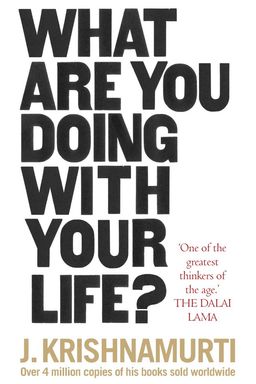
Have you ever wondered why, despite all the progress—our technology, our education, our comforts—life still feels conflicted, fearful, and lonely? In What Are You Doing With Your Life?, philosopher Jiddu Krishnamurti poses this question not as a moral challenge but as an existential one. He argues that humanity’s deep confusion, violence, and suffering stem from our failure to understand the workings of our own minds. To live intelligently and lovingly, you must first understand yourself—not through books, gurus, or psychological theories, but through direct observation of your thoughts, emotions, and relationships.
Krishnamurti’s radical claim is that society is not separate from the individual; the world mirrors the inner life of each person. “What you are,” he says, “the world is.” Therefore, transforming the outer world begins only when you transform yourself. Instead of reforming systems, nations, or ideologies, he urges people to awaken to their own conditioning—the inherited habits of fear, comparison, ambition, and dependence that keep minds trapped in repetition and misery.
The Problem of Self and Conditioning
For Krishnamurti, the self is more than a personality—it’s a process: a collection of memories, ambitions, fears, and desires that constantly seeks security and continuity. This self, though seemingly solid, is the cause of division and conflict. When you identify as a nationality, religion, or ideology, you fragment yourself inwardly and outwardly. Society’s chaos, he explains, is nothing but the projection of innumerable selves seeking security through competition and possession. Understanding this process directly—not through analysis, but through awareness—is the essence of spiritual inquiry. The book insists that analysis can never dissolve the self because thought, the instrument of analysis, is itself part of the self.
As he writes in the opening chapter “What Are You?”—to understand your mind is the first act of real education. Everything else—religion, politics, relationships—is secondary until this understanding occurs. Through observation, not judgment, you begin to see how your thoughts arise from memory and tradition, how your fears and ambitions are inherited patterns of society acting through you. This is not an intellectual exercise but a living awareness, in which every reaction becomes a mirror showing what you are.
Freedom, Love, and the End of Fear
The central movement of Krishnamurti’s philosophy is toward freedom—freedom not from circumstances but from inward psychological conditioning. He distinguishes between freedom and escape. To escape from fear, pain, or loneliness through religion, drugs, or entertainment only deepens slavery. True freedom comes when you see fear fully, without attempting to run away or modify it. In observing fear without intervention, the mind ceases to divide itself into observer and observed, and in that moment of total attention fear dissolves.
“In understanding oneself there is the beginning of freedom, and in freedom there is love.”
Love, for Krishnamurti, is inseparable from freedom and intelligence. He challenges the common ideas of love as possession or attachment, showing that dependence breeds fear and jealousy, not affection. Love exists only when the self is silent—when there is no motive, no demand, no psychological security sought from another. In these insights, Krishnamurti echoes the great spiritual traditions but strips away all authority: no teacher can teach love or truth. They must be discovered through the direct perception of one’s own life.
Living with Awareness Rather Than Accumulation
Throughout the book, Krishnamurti contrasts learning with knowledge. Knowledge, he says, is accumulation—the past stored in memory—while learning is active observation in the present. You can only meet life intelligently when you are learning freshly each moment, not burdened by what you “know.” This living awareness is meditation in his sense: not a technique or mantra, but an undivided attentiveness to every thought, feeling, and movement of the mind as it occurs. When awareness is complete, thought becomes silent and the mind enters stillness, which he calls “the only creative state.”
A Revolution of Daily Living
Krishnamurti’s revolution is psychological rather than political. He sees ambition, competition, and fear of failure as roots of social violence, whether in corporations, schools, or nations. To create peace in the world, you must live peacefully yourself—ending comparison, envy, and possessiveness in relationship. He redefines education as learning the art of living wholeheartedly, not merely mastering techniques to make a living. Similarly, work and livelihood must express love and intelligence, not fear and greed. He designates teaching as the noblest profession, because education should reveal what it means to love, to think clearly, and to live fully.
Ultimately, What Are You Doing With Your Life? is both a mirror and a challenge. It asks you to look at how you act, think, and relate—to see that every fear, ambition, and sorrow is part of the collective mind of humanity. When even one person changes, that change ripples outward, since “the world is an extension of yourself.” The book offers no method, no promise of reward; instead, it invites a lifelong inquiry into your own mind. To Krishnamurti, that inquiry is life itself.