
Idea 1
Designing with Empathy: Building Products People Truly Love
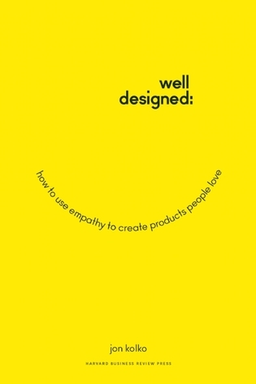
Have you ever wondered why some products—like the iPhone, Airbnb, or Nest—feel almost human, while others seem like cold, confusing tools? In Well-Designed: How to Use Empathy to Create Products People Love, Jon Kolko challenges the traditional logic that building successful products is all about efficiency, technology, and profit margins. Instead, he argues that the secret to meaningful innovation lies in one human quality: empathy.
Kolko contends that truly great products don’t just solve problems—they connect emotionally. They make people smile, trust, and even form attachments. The book is both a philosophical guide and a practical manual for bringing empathy, design thinking, and emotional understanding into the heart of product management. Whether you’re an engineer, marketer, or designer, Kolko wants you to think less like a strategist and more like a storyteller who understands the people behind the market data.
From Design Thinking to Design Doing
The book opens with a simple but powerful argument: most product development processes—filled with feature checklists, endless meetings, and rigid timelines—produce lifeless products. They may function, but they rarely inspire love or loyalty. Kolko describes this as the difference between design thinking—the theoretical understanding of creativity—and design doing—the messy, emotionally grounded process of actually engaging with people and building something for them.
To illustrate, Kolko contrasts bureaucratic corporate approaches with companies like Nest and Airbnb. These organizations behave as if their products have souls. Their products “feel” friendly, delightful, or even caring. The Nest thermostat, for example, took one of the least exciting household devices and transformed it into something people found “sexy” and “beautiful.” These successes, Kolko argues, stem less from cutting-edge technology than from carefully observing, empathizing with, and anticipating human behavior.
Empathy as the Core of Innovation
Kolko’s central premise is that empathy is not an innate talent—it’s a skill that can be developed. Empathy means more than collecting user data or running surveys; it’s about feeling what your users feel. You can only achieve that by getting close to them, observing them in their natural environments, and interpreting not just what they do but why they do it. This process often reveals unspoken desires and emotional needs that traditional market research overlooks.
Design-driven companies, Kolko notes, invest in understanding subtle details of human life that others miss. They discover “latent needs” that users can’t articulate—like the desire to feel safe when sharing their home on Airbnb, or the pleasure of being recognized by a digital assistant that “knows” you.
A Practical Framework for Empathetic Design
Kolko organizes his approach into four steps that merge human understanding with business reality:
- 1. Determine product-market fit by identifying emotional needs shared by communities.
- 2. Identify behavioral insights by engaging deeply with individuals to uncover underlying motivations.
- 3. Sketch a product strategy that articulates emotional value and defines your product’s “personality.”
- 4. Polish the product details through iterative design, storytelling, and relentless attention to emotion-driven decisions.
What ties these steps together is the recognition that people don’t form relationships with spreadsheets—they form them with experiences. When execution remains aligned with empathy, even mundane products can spark joy, trust, or pride.
Why Emotional Products Win
Kolko cites companies like Apple, Starbucks, and JetBlue to show how emotional connection drives profits and loyalty. Their offerings have distinct personalities—the comforting warmth of a barista, the elegance of a Macbook, the optimism of a flight attendant—that make customers fall in love. Emotional differentiation, not technical superiority, sustains these brands.
“People tend to personify products—especially digital ones,” Kolko writes. “They form relationships with products as if they were human.”
This humanization is not accidental. It’s designed deliberately, through empathy and an understanding of emotional value. In contrast, organizations that lack design sensibility chase fads, add unnecessary features, and erode user trust.
Design Thinking for Everyone
Kolko stresses that empathy and creativity aren’t reserved for designers in black turtlenecks. He makes a democratic argument: everyone in an organization—engineers, marketers, product managers—can and should “think like a designer.” This mindset relies on curiosity, playfulness, visual thinking, and optimism about the future. Leaders who embrace these traits can “design” organizations that are more adaptive, collaborative, and inspiring.
Unlike lean or agile methodologies, Kolko’s design process isn’t about speed—it’s about depth. It’s methodical and introspective, favoring meaning over measurement. In that sense, it feels like an antidote to today’s obsession with metrics. “Design,” he insists, “doesn’t claim to be efficient. It claims to be effective.”
Why This Matters Now
In an era of constant digital disruption, empathy might seem like a luxury, but Kolko argues it’s a competitive necessity. As technology floods every corner of life—from thermostats to banking apps—users don’t just judge function anymore; they judge feeling. Products that anticipate emotional needs will dominate those that merely fulfill technical ones.
By the end of Well-Designed, you realize this isn’t just a book about building better products. It’s a manifesto for a more humane business world—one where success is measured not just by metrics, but by moments of joy, trust, and connection that technology can create when guided by empathy.