
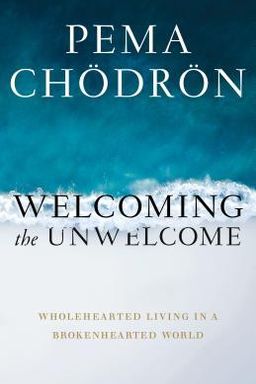
Welcoming the Unwelcome cover

Welcoming the Unwelcome

by Pema Chodron

In ''Welcoming the Unwelcome,'' Pema Chodron introduces Buddhist principles that help readers transform life''s challenges into opportunities for growth. Through practical techniques, she guides us to embrace discomfort, foster compassion, and expand our comfort zones, leading to a more enlightened and fulfilling existence.

Welcoming the Unwelcome: Living Wholeheartedly in a Brokenhearted World

How do you face the heartbreak, uncertainty, and chaos of the world without shutting down? In Welcoming the Unwelcome, Buddhist teacher Pema Chödrön argues that our true strength arises not from escaping discomfort but from embracing it. She contends that the path to awakening—to a open, resilient, fully alive existence—runs straight through the very experiences we habitually reject. If you truly want inner peace, she says, you must stop rejecting the mud of life and learn to find the lotus growing within it.

Chödrön builds on the Mahayana Buddhist tradition, focusing on the cultivation of bodhichitta—the awakened heart—intent on awakening not just for personal happiness, but for the benefit of all beings. This book is a manual for bringing that heart to life in our everyday world, where pain, anger, and polarization seem to dominate the landscape. Through teachings both ancient and personal, she shows how we can become, as the title suggests, people who welcome the unwelcome.

The Courage to Begin with a Broken Heart

Chödrön opens by inviting readers to start their spiritual journey not from calm detachment but from heartbreak. Whether it’s the suffering of a friend, global tragedies, or our own pain, feeling broken is what dissolves our protective shell and awakens compassion. This ‘brokenheartedness,’ she writes, is nothing to fear—it’s a doorway into connection. Her teacher Trungpa Rinpoche told students to “begin with a broken heart” because vulnerability creates the conditions for genuine awakening.

By looking directly at suffering instead of resisting it, bodhichitta naturally arises. It is the intuitive wish to help; the instinct to ease pain wherever it appears. But this instinct is normally buried under layers of fear and defensiveness. Awakening it requires courage—the courage to stop running from discomfort and instead meet it with curiosity and warmth.

Working with the Mind and Its Habits

Much of Chödrön’s teaching explores how mental habits—our knee-jerk judgments, aversions, and desires—create unnecessary suffering. Through daily meditation and mindful awareness, she encourages readers to pause before reacting. In these pauses, we glimpse what she calls “nowness”: the vivid, unfiltered quality of the present moment when the usual chatter drops away. Each time we return to this space, she says, we weaken the old karmic patterns that keep us trapped in self-centered drama.

Her method is practical: payu, or discernment, means noticing the consequences of our thoughts, words, and deeds. By asking simple questions like “Does it matter?” and “What will this choice strengthen in me?” we learn to steer our actions toward wisdom and compassion rather than self-defeating habit.

Facing Polarization, Pain, and Uncertainty

Few teachers address contemporary issues like Chödrön. She writes candidly about political divisions, fear, and the cruelty that arise from clinging to fixed views. Our era, she says, is an ideal training ground for bodhisattvas—the beings committed to staying open and kind in chaotic times. When we catch ourselves dehumanizing others or drowning in cynicism, that recognition itself is an opportunity for awakening. The goal isn’t perfection, but awareness. It’s noticing, again and again, how polarization works within us, then closing that gap through empathy and practice.

Welcoming the Mess with Humor and Humility

As heavy as these teachings may sound, Chödrön infuses them with humor. In one story, her son turns her anxiety over a lost water bottle into a joke about attachment, instantly cutting through her self-seriousness. Humor, she insists, is part of the path. It reminds us that we’re all works in progress. “When we laugh at ourselves,” she writes, “our flaws become less solid and serious.” Laughter lightens the spiritual journey, making space for patience, creativity, and joy.

Like Thich Nhat Hanh’s mindfulness teachings or Tara Brach’s “Radical Acceptance,” Chödrön’s work invites a radical reframe of how we meet life’s pain. Whether through tonglen (the Tibetan meditation of sending and taking), open awareness practice, or simply sitting still with your discomfort, her message is clear: stop running. Stop rejecting. Sit in the middle of your experience—whatever it is—and let it teach you. That’s where compassion begins.

From Personal Healing to Planetary Compassion

Ultimately, Welcoming the Unwelcome is about more than finding inner peace. It’s about contributing to a more humane world. “Whether distraction and aggression proliferate globally or peacefulness and harmony grow stronger,” Chödrön writes, “depends on how we as citizens of the world feel about ourselves.” Healing begins with individuals who trust their basic goodness and do the inner work required to embody it. From that foundation, compassion ripples outward—into relationships, communities, and the planet itself.

If life feels broken, uncertain, or painful, Chödrön’s message is both grounding and inspiring: the very mess you’re trying to avoid is your path to awakening. The lotus blooms because of the mud, not despite it. To “welcome the unwelcome” is to stop dividing your life into good and bad, me and them, happy and sad—and to start meeting everything, absolutely everything, with an open heart.


Begin with a Broken Heart

In her opening teaching, Chödrön encourages readers to start their practice where they are most raw. To awaken, she says, means to feel deeply—to begin with a broken heart. It’s through the cracks of heartbreak that compassion enters. Whether you are grieving a loss, facing disappointment, or overwhelmed by the suffering of the world, that pain is not your enemy; it’s your teacher.

Bodhichitta: The Awakened Heart

Chödrön introduces the Buddhist concept of bodhichitta, a Sanskrit word meaning “awakened heart-mind.” It begins with the wish to free ourselves from confusion so we can help others do the same. This longing is both an aspiration and a commitment. We commit to seeing the truth of our conditioning and habitual reactivity so we can become more available to others. As we confront our fear, jealousy, or shame without judgment, we discover empathy—for ourselves and for every being experiencing the same thing.

Chödrön tells the story of witnessing her teacher Trungpa Rinpoche’s lifelong compassion for all living beings, even after seeing a puppy stoned to death as a child in Tibet. Though he felt powerless to intervene, that memory fueled his determination to live for the benefit of all beings. That’s what it means to begin with a broken heart: to let suffering instill in us a fierce desire to wake up.

The Courage to Stay Present

Our instinct is to shield ourselves from pain. We drink, distract, or keep ourselves busy, but each avoidance deepens our sense of isolation. “Protecting ourselves from vulnerability has never worked,” Chödrön notes. The alternative is to stay. To breathe. To allow the broken heart to expand instead of contract. That willingness marks the beginning of true spiritual maturity.

In practical terms, you can begin by paying attention to what breaks your heart—be it social injustice, personal loss, or your own habitual self-criticism—and then let that tenderness connect you with all who feel the same. Like Brene Brown’s vision of wholehearted living, Chödrön’s approach reframes vulnerability as connection. A broken heart is not a wound to close but a door to open.


Overcoming Polarization

One of Chödrön’s most timely chapters explores how polarization—our habit of dividing experience into for or against, right or wrong—fuels suffering. She argues that this mental habit, mirrored globally in politics and culture, originates in each of our own minds. When we separate ourselves from others, even subtly, we create inner conflict that spreads outward.

Seeing the Seeds of Division

Polarization begins small: the spider in your bathtub you’d rather kill than save; the quiet judgments we pass about coworkers or neighbors; the outrage we feed online. Every thought of “us versus them” deepens this separation. Chödrön tells of how saving a small spider becomes a training in compassion—it’s “a small event for you, a major event for the spider,” she quotes another teacher as saying. Tiny gestures of care rewire the mind toward inclusion instead of hostility.

Beyond Guilt: Using Mistakes as Teachers

When we inevitably act aggressively or lash out, many of us retreat into guilt. But guilt, Chödrön says, keeps us trapped in self-preoccupation. Instead, she recommends honest regret linked to self-awareness: see your anger, see its causes, and let it deepen your understanding of the human condition. You realize how violence everywhere stems from the same ignorance you just witnessed in yourself. Each time you bring compassion to your missteps, you renew your vow to help others awaken.

Practicing “Just Like Me”

To bridge division, Chödrön offers a deceptively simple exercise: look at anyone—especially someone hard to love—and repeat, “Just like me, this person wants to be happy. Just like me, they are afraid of pain. Just like me, they make mistakes.” Even acknowledging this common ground loosens the hardened hatred that fuels polarization. Similar to the “loving-kindness” meditations popularized by Sharon Salzberg, this practice develops empathy without excusing harm.

Ultimately, working with polarization means renouncing the comfort of certainty. “If we can hold this falling apart–ness without becoming fundamentalist,” she writes, “we will help the world.” It’s not our opinions that matter most but our willingness to keep our hearts open in the presence of difference.


The Path of Non-Rejecting

Chödrön reframes growth as the art of not rejecting any part of ourselves. Using the Buddhist image of the lotus and the mud, she reminds us that the flower’s beauty depends on the murky water that nourishes it. The mud represents our confusion, fear, and neuroses; the lotus, our innate goodness. The problem, she says, is that we mistakenly try to get rid of the mud rather than embrace it as part of the whole.

Embracing What You Avoid

When painful feelings arise, our conditioned response is to repress, escape, or indulge them. The path of non-rejecting invites a fourth option: to face and embrace them. Drawing on teachings from Tulku Thondup and Anam Thubten, Chödrön introduces two potent practices for this transformation. In one method, you intensify the unwanted feeling—fear, shame, anger—until you sense it tangibly in your body, then release it like a balloon into spacious awareness, allowing it to dissolve naturally. This physical metaphor helps the emotion lose its solidity.

Tonglen: Breathing with the World

Her second method is tonglen, Tibetan for “sending and taking.” On each in-breath, you take in the world’s pain—including your own—and on each out-breath, you send relief, joy, or ease. Instead of running from suffering, tonglen trains the heart to lean toward it. It reverses our instinct to hold on to pleasure and reject pain. “Even our bad karma is our big chance,” Chödrön says, because the worse we feel, the more we understand and connect to others’ suffering.

Practicing non-rejection changes your relationship to life’s messiness. Nothing is excluded. Even guilt, jealousy, or rage become fuel for awakening. As you learn to meet all of yourself with warmth, you automatically extend that same kindness to others. That is the essence of compassion in action.


Beyond the Comfort Zone

We all have ways of hiding from discomfort—streaming shows, overeating, checking our phones. Chödrön calls these habits our “thumbs,” like babies sucking for safety. In this chapter, she invites us to notice what we take refuge in when life feels hard, then to shift our refuge toward awareness and connection. Growth, she says, only happens beyond comfort.

The Three Zones of Growth

Borrowing from psychologist Lev Vygotsky’s model, she describes three zones: the comfort zone (where we feel safe but stagnant), the learning zone (where we stretch), and the excessive risk zone (where we’re overwhelmed). Staying too long in comfort causes contraction; stepping occasionally into challenge expands resilience. Whether giving away a cherished pen or practicing meditation when you’d rather distract yourself, every small stretch widens your capacity to be present amid life’s unpredictability.

Tonglen as Courage Training

Tonglen appears again here as a method for expanding tolerance for discomfort. Breathing in disappointment or fear and breathing out understanding builds what Chödrön calls “appetite for groundlessness.” Matthieu Ricard—who was once tested in a neuroscience lab while practicing compassion—found he could only take in so much suffering before needing to balance it with sending love outward. That balance, she writes, is the essence of sustainable courage.

“The more willing you are to step out of your comfort zone,” Chödrön concludes, “the more comfortable you feel in life.” Over time, the unknown stops being terrifying. It becomes home.


How You Label It Is How It Appears

Have you ever noticed how two people can look at the same situation and see entirely different worlds? Chödrön, referencing the Tibetan master Longchenpa, reminds us that “how we label things is how they appear.” Our mind creates our world through its constant naming—good, bad, clean, dirty—and then believes those labels are facts. To reclaim reality’s fluidity, we need to challenge this habit of fixation.

Experimenting with Projection

Chödrön illustrates this with her obsessive need for cleanliness as director of Gampo Abbey. Despite constant nagging, the kitchen stayed messy—until she realized the torment came not from dirt but from her labeling of dirt. She experimented by dropping the judgment “dirty,” and miraculously, the kitchen started seeming cleaner. Whether it was or not didn’t matter; her relaxed mind changed her perception and the community’s energy. Inner transformation subtly transforms the outer world.

Enemies as Teachers

Drawing on Thogme Zangpo’s Thirty-Seven Practices, Chödrön encourages seeing every antagonist as a teacher. The child who mocks your flaws or the colleague who criticizes you reveals where your ego is most tender. As eleventh-century teacher Machik Labdrön advised, “Reveal your hidden faults.” When we label others “bad,” we miss the lesson hidden in the discomfort—an invitation to face our own resistance to reality.

Seeing Through Language

Even language itself, she notes, is “random labeling.” Two teachers laughing at a “tree”—a complex organism reduced to a single word—exemplify liberation through humor. When we realize that names are conventions, reality regains its vastness. Our goal isn’t to stop labeling but to use labels lightly, remembering their emptiness. As she puts it, “Never underestimate the power of mind. How you work with things really can transform what seems to be.”

The practice isn’t to deny form but to see that form is fluid. Once we stop being fooled by labels, the ordinary world becomes, as she writes, “light, magical, and free.”


Experiencing Nowness

In one memorable exercise, Chödrön has six hundred people raise their arms, then drop them with a loud slap. The thunderous sound jolts everyone into pure presence—the gap before the mind labels anything. That fleeting gap, she says, is the taste of nowness: the direct, label-free awareness at the heart of spiritual practice.

The Art of Pausing

To cultivate nowness, she recommends the “pause practice.” In moments of irritation or boredom, simply stop. Breathe. Feel the world as it is before the stories rush in. Waiting in line turns from frustration to fascination as you notice light, sounds, faces, and sensations. Pausing interrupts the mental chatter long enough to experience the freshness of emptiness.

Snapshots of Reality

She also offers “snapshot practice”: briefly closing your eyes, then opening them to catch the instant before labeling returns. That first split second reveals how everything appears raw, luminous, and transient. The idea, borrowed from her teacher Trungpa Rinpoche (who was also a photographer), is to train the mind to rest in that living moment—“artistic perception,” as he called it, before concept solidifies.

Practicing nowness, Chödrön says, expands our capacity to live in uncertainty. When we can rest in the “gap” without reaching for conclusions, we discover freedom from fear itself. Life becomes vivid, unpredictable, and fully alive.


Welcoming the Unwelcome with Laughter

Chödrön insists that humor is not just pleasant—it’s essential. Laughter, she writes, is a direct path to compassion because it releases the rigidity that turns spiritual practice into another ego trip. Her teaching stories illuminate how self-seriousness is the enemy of awakening.

The Water Bottle Lesson

When Chödrön once panicked over losing her water bottle, her son quipped to his own child, “See, Grandma’s suffering because she’s attached to that water bottle.” The family’s laughter cut through her neurosis more effectively than any meditation could. Humor, she learned, dismantles fixation. It restores proportion and kindness toward ourselves.

Embracing Our Imperfection

Most of us secretly believe we’re the only “bad Buddhist”—the only one with unkind thoughts, jealousy, or vanity. Chödrön’s humor releases that illusion. She loves cartoons like the monk throttling another under the caption “Having an Unbuddha-like Moment?” and uses them to illustrate that everyone, even teachers, has flaws. Laughing at our humanity connects us rather than shames us.

Humor as Openness

Her teacher Trungpa Rinpoche often used humor to open students’ minds. Once he stretched a simple joke for ninety minutes until the room exploded in collective laughter—then abruptly stopped, resting in open awareness. The laughter had dissolved everyone’s tension, making that stillness immediately accessible. “When the mind is big,” he used to say, “thoughts are like mosquitoes with nowhere to land.”

For Chödrön, joy and laughter are not distractions from spiritual depth; they are its signs. When we can laugh at ourselves, we finally relax enough to love ourselves—and everyone else—just as we are.


Mission Impossible: The Endless Work of Compassion

Chödrön closes her book with a paradox: the bodhisattva’s vow to free all beings from suffering is impossible to fulfill—yet we must commit to it wholeheartedly. This “mission impossible,” she says, keeps our compassion alive forever. It’s what turns personal enlightenment into lifelong service.

The Practice of Bodhichitta

Reciting, “May bodhichitta arise where it has not yet come to be,” Chödrön urges us to nurture the fragile seed of compassion wherever we find it. Like guarding a sapling from frost, we protect the small glimmers of goodness from cynicism, apathy, and self-doubt. With each act of awareness—each moment we pause instead of lash out—we strengthen this awakened heart.

No Exceptions, No End

True compassion, she reminds us, allows no exclusions—not even for those who commit atrocities. “If Hitler had awakened,” she writes, “he would not have caused such harm.” Compassion doesn’t excuse wrongdoing; it recognizes that cruelty arises from ignorance and pain. The bodhisattva’s love extends even here—because separation itself is the disease we’re trying to heal.

For Chödrön, this path is endless, but that’s its beauty. Facing the “impossible” vow each day, we become creative, humble, and alive. The journey never ends—but every step matters. “Whether distraction and aggression proliferate globally or peacefulness grows stronger,” she writes, “depends on how we feel about ourselves.” The world changes when we do.

Dig Deeper

Get personalized prompts to apply these lessons to your life and deepen your understanding.

Go Deeper

Get the Full Experience

Download Insight Books for AI-powered reflections, quizzes, and more.