
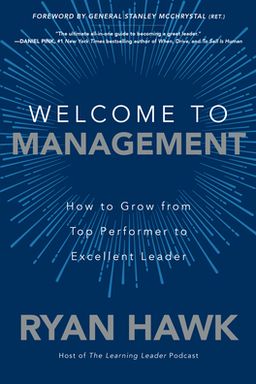
Welcome to Management cover

Welcome to Management

by Ryan Hawk

Welcome to Management is a comprehensive guide for transitioning from top performer to effective leader. Through case studies and expert insights, Ryan Hawk provides a practical framework for personal development and team leadership, ensuring sustainable success.

From Top Performer to Effective Leader

Have you ever wondered why some top performers stumble when they first step into a leadership role? In Welcome to Management: How to Grow from Top Performer to Excellent Leader, Ryan Hawk argues that being an exceptional individual contributor doesn’t automatically make you a great manager. His core message: leadership is learned, not given. To become a truly impactful leader, you must master three domains—leading yourself, building your team, and leading your team—each of which demands self-awareness, discipline, empathy, and a mindset of perpetual learning.

Hawk contends that most people enter management unprepared, assuming their past performance guarantees future success. Yet leadership requires an entirely new skill set. Through personal anecdotes, lessons from his own athletic and corporate experiences, and insights collected from hundreds of world-class leaders interviewed for his podcast The Learning Leader Show, Hawk lays out a structured roadmap. He guides readers from self-mastery to culture building to effective communication and results-oriented execution.

The Learning Mindset of a Leader

At the heart of Hawk’s philosophy is lifelong learning. He quotes Michelangelo’s phrase Ancora imparo—“Yet, I am learning”—as the guiding ethos of great leadership. Hawk began his leadership journey as a professional athlete and later as a corporate sales professional. But when he was promoted to manager—a role that required him to lead former peers—he realized how underprepared he was. That moment of self-doubt taught him his first essential leadership lesson: you cannot lead others until you first lead yourself.

Hawk emphasizes the need to develop a cycle of learning: learn, test, reflect, and teach. This continual process transforms knowledge into wisdom through deliberate reflection and action. He cites thinkers like Charlie Munger, who called himself a “learning machine,” and Tasha Eurich, who demonstrated through research that while 95% of people think they’re self-aware, only about 10–15% actually are. Great leaders start by knowing who they are, how others perceive them, and what they need to do to grow.

From Self to Team: The Core Transition

The book’s core argument builds progressively: before you can build or lead others, you must cultivate internal discipline and self-awareness. Once you can lead yourself effectively, you can move into the next phase—building your team. Hawk compares this to a quarterback guiding teammates on the field: leadership means awareness of both your personal “pocket” and the larger field. From there, you evolve into a coach—a servant leader who develops trust, ownership, and vulnerability among team members.

In Hawk’s framework, management is not about control. It’s about creating an environment where people can thrive. He draws inspiration from figures like Bill Walsh, the legendary coach of the San Francisco 49ers, who said, “The culture precedes positive results.” Culture, in Hawk’s view, is the invisible fabric that binds teams—it’s built from trust, vulnerability, and shared ownership.

Communicating, Coaching, and Delivering Results

After mastering self-leadership and team-building, the next step is learning to communicate and coach effectively. Hawk devotes significant attention to the art of communication—not just the mechanics of emails or meetings, but how to inspire through storytelling, persuasion, and clarity. He argues that every leader must become a “chief clarity officer,” capable of translating strategy into simple, actionable language. Influenced by great communicators such as Simon Sinek and Brené Brown, Hawk emphasizes psychological safety and authentic vulnerability as prerequisites for great leadership communication.

Finally, Hawk’s roadmap leads to performance. In “Make the Grade,” he reframes results not as raw numbers but as reflections of a well-led culture. Getting results means doing three jobs at once: leading (providing vision and inspiration), managing (organizing and controlling resources), and coaching (developing people). The best leaders, he argues, balance all three, driven by humility and service.

Why Hawk’s Framework Matters

In a world where many organizations do little to prepare people for leadership, Welcome to Management provides both a philosophy and a toolkit. Hawk’s integrated model bridges the gap between theory and execution, showing that leadership is not an innate trait—it is a discipline built through practice, reflection, and human connection. Whether you’re a new manager struggling with your first promotion or an experienced leader aiming for greater impact, Hawk’s message resonates: leadership begins and ends with learning. You don’t have to be perfect—you just have to keep becoming.


Lead Yourself First: The Foundations of Self-Mastery

Before you can lead a team, you must know yourself. Hawk insists that self-awareness is the starting point of leadership. Borrowing the metaphor of a quarterback’s “pocket awareness,” he explains how leaders must understand both their internal state and how others perceive them. This dual awareness—internal and external—forms the cornerstone of emotional intelligence, echoing research by Daniel Goleman and Tasha Eurich.

Cultivating Self-Awareness

Hawk introduces tools for reflection such as journaling, assessments like StrengthsFinder or Hogan, and, most importantly, seeking honest feedback from mentors and peers. He warns that most people overestimate their self-awareness—a dangerous blind spot for any leader. To combat this, Hawk advocates intentional reflection: asking yourself daily what went well, what didn’t, and why. This practice separates great learners from stagnant ones.

The Power of Curiosity

Curiosity, Hawk writes, is the lifeblood of leadership. Drawing from psychological research by Todd Kashdan, he defines curiosity as the drive to explore the unknown despite uncertainty. The most effective leaders are “learning machines”—constantly asking, listening, and adapting. Inspired by Charlie Munger and Warren Buffett, Hawk encourages managers to spend time reading, reflecting, and asking questions instead of pretending to have all the answers.

Building a “Learning Machine”

To operationalize lifelong learning, Hawk proposes a four-step framework: Learn, Test, Reflect, and Teach. Learning is driven by mentors and exposure to new ideas; testing applies those lessons in real life; reflection internalizes success and failure; and teaching multiplies the learning by sharing it with others. This creates a cycle of continuous improvement, mirroring Anders Ericsson’s concept of deliberate practice.

Ultimately, Hawk’s message is pragmatic: leadership is not about knowing everything—it’s about becoming someone who can learn and adapt faster than the challenges ahead. As Ryan Holiday says in The Obstacle Is the Way, mastery comes not from perfection but from persistence. Hawk’s version of this truth: keep learning, keep testing, keep becoming.


Self-Discipline, Habits, and Mastery in Action

Once you develop self-awareness, the next challenge is self-discipline. Hawk writes, “People follow leaders who do hard things.” Discipline builds credibility. Drawing inspiration from authors like James Clear (Atomic Habits) and David Goggins (Can’t Hurt Me), Hawk argues that disciplined leaders push through discomfort and establish habits that anchor their performance even amid chaos.

Daily Habits and Routine

Hawk offers vivid examples of structure in action. He follows a “win the morning” philosophy, built around Hal Elrod’s SAVERS method—Silence, Affirmation, Visualization, Exercise, Reading, and Scribing. His mornings begin with hydration, stretching, journaling, and a workout—all before breakfast with his family. The message is clear: how you start your morning sets the tone for how you lead your team.

Presence and Preparation

Leadership isn’t about sitting in an office—it’s about showing up. Hawk recounts lessons from Abraham Lincoln and Teddy Roosevelt, who invested time meeting ordinary citizens to stay connected. Modern leaders, he argues, must do the same: step out from behind the emails and engage directly with their people. “Your presence,” he writes, “is required.” In practical terms, that means making time for face-to-face coaching and understanding ground realities, not just strategy decks.

For Hawk, every great leader shares a common trait—obsessive attention to detail. Whether it’s John Wooden teaching players to tie their shoes or Hawk perfecting a quarterback’s footwork, mastery begins with small details. These daily disciplines—being punctual, prepared, and precise—are what separate amateurs from professionals. In leadership, just as in sports, little things done consistently become big wins over time.


Building a Culture of Trust and Ownership

Culture, Hawk insists, isn’t ping-pong tables or free snacks—it’s the “collective energy of people.” Leaders shape this energy through trust, vulnerability, and ownership. Drawing on anthropological insights from Clifford Geertz and leadership research from Daniel Coyle (The Culture Code), Hawk describes how intentional cultures outlast strategy. The leader’s job is to cultivate, not control—a distinction echoed by Bill Walsh, who said, “The culture precedes positive results.”

Earning Respect and Trust

Respect, Hawk argues, isn’t granted by title; it’s earned through consistent action. He references seven behaviors—competence, conviction, standards, listening, hard work, courage, and consistency—using Dwight Eisenhower’s life to illustrate each one. Trust, meanwhile, requires reciprocity: leaders must trust their people first. Citing General Stanley McChrystal’s insight that “leaders can let you fail, and yet not let you be a failure,” Hawk urges new managers to embrace risk and assume positive intent.

Vulnerability and Safety

Psychological safety—pioneered by Amy Edmondson’s research at Harvard—anchors Hawk’s concept of vulnerability. He illustrates through Kat Cole’s story at Cinnabon how openness builds connection. By sharing personal stories and failures, leaders humanize themselves and create “speed-of-trust” relationships. As Brené Brown aptly puts it, “Vulnerability is courage, not weakness.”

Ownership and Empowerment

Ownership transforms teams from followers to leaders. Inspired by Navy Captain David Marquet (Turn the Ship Around!), Hawk promotes “knowing and asking” instead of “knowing and telling.” Delegation, not micromanagement, empowers people to grow. This means giving high-performers opportunities to train and mentor others. As Mike Krzyzewski does at Duke, Hawk teaches managers to “coach your coaches,” creating leaders who can operate without constant supervision.

Culture isn’t built overnight—it’s reinforced through rituals of trust, encouragement, and celebration. Whether it’s Hawk’s team trophy “The Cup” or a simple “thank you” message from an executive, these acts make excellence visible. The lesson? Culture is not decoration—it’s a daily decision.


Hiring, Firing, and the 'Who' Factor

Perhaps the most critical decision every leader makes is who joins—or stays on—the team. Jim Collins once said, “It’s always about who first.” Hawk agrees wholeheartedly: “The who is everything.” He recalls his father’s advice—hiring, training, and developing the right people will make you successful; hiring the wrong ones will make you broke. Hiring well, for Hawk, isn’t about résumés; it’s about values and integrity.

Finding the Right People

When taking over a team, you inherit a mix of high, average, and low performers. The key is clarity and courage—reward the right behaviors, coach the middle, and make tough calls on the bottom. Drawing from The First 90 Days by Michael Watkins, Hawk notes that new managers must balance stability and change. Those who fail to act decisively risk losing credibility right away.

Hiring for Character, Not Just Skills

Character rules. Citing Warren Buffett’s trifecta—intelligence, energy, integrity—Hawk prioritizes humility, curiosity, and resilience over plain competence. He prefers follow-up interview questions that reveal emotional intelligence, such as, “What did you learn from failure?” or “When did you last ask for help?” The goal is to uncover patterns, not rehearsed answers.

The Hard Truth About Firing

Firing someone, Hawk admits, is painful but necessary for health. He advises transparency, documentation, and compassion. No termination should surprise the employee—it should be the conclusion of a fair, well-communicated process. “Make the hard choice once,” his mentors told him, “instead of avoiding it a hundred times.” Removing poor fits protects both morale and credibility.

Hawk closes with the “Great Performer Paradox.” The best leaders, he says, celebrate when their top performers get promoted—even if it means losing them. Like Bill Walsh’s coaching tree, great managers produce future leaders. In short: your legacy is measured not by what you achieve, but by who you develop.


Communicating with Clarity and Purpose

Every leadership failure, Hawk argues, is ultimately a communication failure. To lead well, you must learn to spread the message with clarity, empathy, and rhythm. Through lessons from Rob DeMartini (former CEO of New Balance), A.G. Lafley, and Herb Kelleher, Hawk explains that clear communication aligns teams, inspires confidence, and saves wasted time.

The Power of Story

Stories, Hawk says, are “data with a soul.” Inspired by Shane Snow and Brené Brown, he teaches leaders to use narrative to make strategy memorable. A great leadership story has seven traits: relatability, conflict, emotion, simplicity, surprise, and resolution. These stories connect people to purpose—transforming numbers into meaning.

Listening and Persuasion

Beyond speaking, great communication starts with listening. Hawk cites Jack Zenger and Joseph Folkman’s insight that “good listeners are like trampolines”—they don’t absorb information, they amplify it. Drawing from Robert Cialdini’s Influence, Hawk distills three persuasion levers every leader can use: reciprocity, social proof, and consistency. Influence, he insists, grows from trust, not authority.

Running Better Meetings

Meetings, he jokes, are “where leadership goes to die” if poorly done. His fix: adopt Cameron Herold’s rule—“No agenda, no attenda.” Start and end on time, assign ownership, and summarize clearly. For remote teams, tools like Slack and Zoom can preserve connection, but nothing replaces in-person presence. As Elon Musk advises, “Leave meetings that aren’t useful.”

When leaders communicate transparently—especially during crises or unpopular decisions—they earn lasting credibility. Hawk’s golden rule captures it best: “Bad news doesn’t get better with age.”


Lead, Manage, and Coach for Results

The ultimate test of leadership is results. Hawk’s final section, “Make the Grade,” defines success as sustained performance built on character, strategy, and discipline. To explain how great leaders get results, he introduces three interlocking roles every manager must balance: Leader, Manager, and Coach.

The Three Hats of Leadership

As a leader, you define vision and inspire belief. As a manager, you steward resources within constraints. As a coach, you develop people. Hawk learned this hard truth when his father told him, “You have to do all three.” Excelling at only one leads to imbalance—either chaos (too much vision), bureaucracy (too much management), or stagnation (too much coaching).

Managing Change and Constraints

Every team faces limits—tight budgets, shifting strategies, and constant change. Quoting Dr. John Kotter’s eight-step change model, Hawk argues that great managers lead through uncertainty by offering continuity. They remind teams of what’s not changing—the mission and shared values. As Marcus Buckingham notes, “Followers choose leaders who make their world less scary.”

Coaching Through Feedback

To sustain excellence, Hawk emphasizes constant feedback loops. He borrows Bill Belichick’s practice of post-win reviews—“Ask why you succeeded.” Leaders must celebrate wins, document lessons, and coach both performance (skills) and development (long-term growth). Journaling, interviews, and retrospectives ensure learning compounds.

Humility and Service

Results are meaningless without humility. Hawk closes the book with an appeal to servant leadership. Quoting Dustyn Kim and Brent Beshore, he highlights the paradox of power: the more you focus on others’ success, the more successful you become. Leadership, in his words, is “using power to clear obstacles for others.”

As Carly Fiorina told him, leadership is solving problems, not seeking promotions. By “running toward the fire” with optimism, realism, and courage, you earn the only promotion that matters: the trust of your people.

Dig Deeper

Get personalized prompts to apply these lessons to your life and deepen your understanding.

Go Deeper

Get the Full Experience

Download Insight Books for AI-powered reflections, quizzes, and more.