
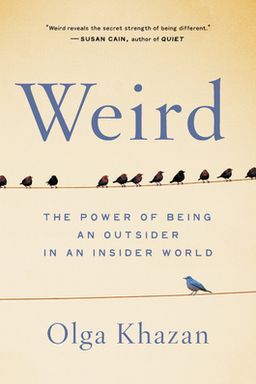
Weird cover

Weird

by Olga Khazan

Weird explores the power of embracing your outsider status in a world that often fears the different. Through interviews and scientific research, Olga Khazan reveals how to transform your uniqueness into a superpower, unlocking creativity and resilience.

The Power of Being Different

What happens when you never quite fit in? In Weird: The Power of Being an Outsider in an Insider World, journalist Olga Khazan explores why society prizes conformity, how it punishes difference, and how people can turn their strangeness into strength. Drawing on her own childhood as a Russian-Jewish immigrant in conservative West Texas, Khazan dissects what it means to live as the odd one out—and how social science explains that persistent unease. She argues that weirdness, far from being a flaw, can become one of your most adaptive tools—if you learn how to wield it.

Growing up outside the norm

Khazan opens by grounding abstract theory in lived reality: her parents celebrating New Year’s Eve with Soviet-era traditions while neighbors prayed for their conversion; classmates mocking her accent; small cultural misunderstandings that made her feel constantly observed. For those who have ever been the only one of their kind—racially, religiously, politically, or temperamentally—this sense of exposure is familiar. Being different, she shows, is not about one moment but about accumulation: every raised eyebrow, joke, or question compounds into identity.

The invisible architecture of norms

Khazan blends memoir with psychology to reveal what governs these encounters: social norms. From Solomon Asch’s conformity studies to Michele Gelfand’s tight-versus-loose cultures, she shows how powerful invisible rules shape behavior. A “tight” society like Singapore enforces strict compliance, while a “loose” one like the Netherlands tolerates deviation. But even in loose ones, pressures to fit can be relentless. You internalize these norms because belonging signals safety, and exclusion feels like danger. In that way, the pull to conform is as biological as it is social.

Exclusion, pain, and resilience

The book then moves through history and physiology. Tribal instincts that once ensured survival now produce bias and scapegoating; Henri Tajfel’s minimal-group experiments proved that people discriminate even when group membership is meaningless. Modern neuroscience further reveals that social rejection lights up the same brain circuits as physical pain. When you are ostracized—ignored, dismissed, or unseen—stress hormones surge, and inflammation rises. Chronic loneliness corrodes the body and mind. Yet, as Khazan notes through stories like Vivienne Ming’s and Emma Gingerich’s, the same hardship can catalyze empathy, reinvention, and a critical awareness that conformists often lack.

The possibilities of principled nonconformity

Khazan contrasts destructive weirdness—alienation that curdles into extremism—with principled deviance, the moral courage to defy bad norms. Stanley Milgram’s obedience studies and stories like Leslie Wagner-Wilson’s escape from Jonestown illuminate how lone dissenters can redirect entire groups. “Weirdness,” in this moral sense, becomes conscience under pressure: a willingness to act differently even when it hurts. Sometimes deviation saves lives.

Learning to live with difference

Khazan’s later chapters shift from analysis to strategy. She offers coping frameworks—earning “idiosyncrasy credits” through initial conformity, reframing discomfort as information rather than injury, analyzing slights in third-person language (Solomon’s paradox), and deliberately practicing extroversion or social risk through “acting as if.” Support networks, from family to institutions, act as stabilizers that transform difference from threat into sustainable identity. Examples like racecar driver Julia Landauer and single mothers Aileen Budow and Sarah Lenti show that even courageous individuality needs backup.

Choosing your relationship to weirdness

In the end, Khazan rejects a single moral of the story. Some find peace by staying different—as surgeon Michael Ain does within Little People of America, refusing to “fix” his body. Others seek relief by finding their kind—like Paul Chabot’s “Conservative Move” migration to culturally aligned regions. Both strategies—changing the world or finding comfort inside it—can be valid. What matters, she suggests, is consciousness: seeing the forces that shape your weirdness, and deciding whether to resist or repurpose them.

Core insight

Weirdness is not a flaw to erase but a form of navigation through social systems designed for sameness. When you understand the origins of conformity, exclusion, and courage, being an outsider becomes more than survival—it becomes a strategy for seeing and shaping the world differently.


The Social Logic of Norms

Khazan emphasizes that our sense of 'normal' is neither natural nor fixed—it’s a social construct. From early experiments in psychology to cross-cultural research, she maps how norms make societies predictable but also oppressive.

Why norms exist

Asch’s 1950s line-length experiments revealed how people will deny clear evidence to align with a unanimous group. Conformity supplies belonging, preserves safety, and reduces uncertainty. Sociologist Émile Durkheim saw this as essential for social order—but, as Khazan notes, it’s also a trap. Norms reward the familiar and repress innovation. In Gelfand’s research, societies under threat—war, disease, scarcity—grow 'tighter', policing behavior more strictly. Loose cultures flourish when survival feels certain. The same rule applies to subcultures: workplaces under stress stiffen their hierarchies, families under strain demand unity. You feel it in your shoulders and your tone: follow the script or risk exile.

How norms evolve

Khazan includes Betsy Levy Paluck’s Rwanda study, where shifting radio dramas—not sermons—moved population attitudes toward tolerance despite unchanged private beliefs. It’s a crucial distinction: perceived norms drive behavior more than conviction. Public cues rewrite what people see as acceptable, even before their hearts catch up. (Note: this insight aligns with Cass Sunstein’s “nudge theory,” showing how minor environmental cues steer collective behavior.)

Genes and personality

Fascinatingly, Khazan reports biological variation in conformity. Shinobu Kitayama’s research links a dopamine receptor gene with sensitivity to social norms: the same variant makes Japanese participants more collectivist and Americans more individualist, amplifying whichever culture surrounds them. Personality traits also play a role—some people, like those high in openness or low in agreeableness, resist group pressure more easily. Your biology, in other words, tunes how loudly you hear the drumbeat of conformity.

Takeaway

Norms protect stability but throttle imagination. Understanding them lets you choose when to obey and when to deviate consciously—an essential skill for anyone who wants to remain authentic in a collective world.


The Roots and Costs of Exclusion

Why do humans so easily exclude? Khazan traces exclusion to evolutionary psychology, history, and daily life. It turns out we don’t need malice to discriminate—just groups.

Group instincts and fear

Henri Tajfel’s “minimal group” experiments found that arbitrary labels (overestimators vs. underestimators) instantly trigger favoritism. This knee-jerk bias once kept tribes cohesive but now fuels nationalism and prejudice. Anthropologists debate whether our ancestors were fiercely xenophobic or flexible traders, but either way, scarcity and fear still harden boundaries. Khazan’s modern examples—immigration clashes in Wisconsin’s Trempealeau County, Jewish-American misunderstandings with Soviet émigrés—show how even small cultural mismatches can snowball into distrust.

The bodily toll of exclusion

Social rejection doesn't just bruise feelings—it scars physiology. Kipling Williams’ “scarlet O” studies proved that exclusion activates the same neural pain pathways as burns. Lonely people exhibit suppressed immunity and chronic inflammation (work by Steve Cole and John Capitanio). Khazan intertwines these findings with human narratives: Emma Gingerich’s banishment from Amish life, Joi’s pregnancy complications under racial stress, and Vivienne Ming’s gender dysphoria that nearly ended her life. These show that alienation can literally harm the body and warp identity.

Extremism and the search for meaning

Exclusion also reshapes behavior. Arie Kruglanski’s “significance quest” model explains why alienated people gravitate to radical groups: they promise what ostracism erodes—status and purpose. The line between loneliness and fanaticism can be heartbreakingly thin. That’s why, Khazan argues, inclusion isn’t charity—it’s prevention.

Practical lesson

To counter exclusion, reduce perceived threat and amplify contact. Seeing outsiders as specific individuals rather than symbols—names, stories, handshakes—reverses the spiral of dehumanization.


Moral Courage and Principled Deviance

At the midpoint of the book, Khazan pivots from pain to power: what happens when your nonconformity resists cruelty? Here she celebrates principled deviants—people who stand against oppressive norms even when obedience would be safer.

The ripple effect of refusal

Milgram’s famous shock experiments exposed how obedience seduces ordinary people into cruelty. Yet a small minority—14 of 40 participants—refused harmful orders. When even one confederate joined their dissent, others followed suit. This is contagion in reverse: virtue spreading through example. Khazan calls it the “permission effect”: one courage grants others theirs.

Stories of escape and survival

Leslie Wagner-Wilson’s escape from the 1978 Jonestown massacre illuminates this courage. Despite manipulation and fear, she protected her child and fled, one of only a few dozen survivors. Another deviant, Christine Miller, publicly challenged Jim Jones minutes before the deaths—proof that conscience can persist even at the brink. These people rejected the tribe’s delusion by anchoring themselves in principle rather than belonging.

How to apply moral nonconformity

You don’t need a cult to test courage. Speaking early and clearly, naming what’s wrong, and building small alliances replicate the psychology of principled defiance. When two people oppose injustice together, group conformity collapses faster. Moral courage is contagious, and you can be patient zero.

Moral takeaway

Refusing corrupt norms isn’t only self-preservation—it’s instruction. You show others that dissent is possible, converting silence into dialogue.


Support and Belonging in Difference

Khazan shows that strangeness alone rarely becomes strength without scaffolding. You thrive as an outsider when you have allies, mentors, or institutions that cushion risk. Support converts vulnerability into freedom.

The protective power of community

Racecar driver Julia Landauer’s career almost collapsed from mechanical failures and financial strain. But constant encouragement from parents and teammates allowed her to persevere amid resource gaps. Studies show young adults with engaged—but not overbearing—parents adapt better to challenge. Support doesn’t coddle; it steadies.

Chosen family vs. social disapproval

Aileen Budow’s decision to pursue single motherhood succeeded partly because friends threw her “donor party” and celebrated her choice. Sarah Lenti faced prayers instead of help, leaving her isolated. The contrast illustrates how encouragement makes nonconformity sustainable. When society refuses validation, you need micro-communities that supply it.

Networks and norms

Institutional frameworks amplify personal support. Cristina Bicchieri’s threshold model of norm change shows how people act once a few peers do; collective backing lowers psychological cost. Grants, small sponsors, and mentors function as credibility bridges—the same 'idiosyncrasy credits' that allow future deviation.

Essential idea

Different doesn’t mean alone. Build your tribe before your rebellion, and the risks of authenticity shrink to survivable size.


Mastering Discomfort and Reframing

Being weird guarantees awkward moments. Khazan offers psychological tools to make them bearable—and even transformative.

Earning idiosyncrasy credits

Edwin Hollander’s idea of 'idiosyncrasy credits' describes how temporary conformity earns you leeway to deviate later. Professor Beverly Stiles begins courses on masculinity before introducing feminism, ensuring trust first. The lesson: blend familiarity with innovation. Show the tribe you understand its code before you rewrite it.

Reclaiming ownership of discomfort

Asma, a Muslim woman navigating southern hospitality and microaggressions, copes by reminding herself, “Their discomfort is theirs, not mine.” This tiny cognitive reframe neutralizes shame. Similarly, Daniel, a preschool educator accused unfairly, gained calm by analyzing his crisis through organizational-behavior theory—what Khazan links to 'Solomon’s paradox.' When you view yourself from a third-person angle, you gain wisdom unavailable inside emotion.

Mantra

“They stared; I felt uneasy; their curiosity is not my problem.” A script simple enough to recall mid-insult, yet powerful enough to restore control.


Transforming Yourself on Purpose

Khazan dispels the myth that personality is fixed. You can train new social habits and even shift core traits through deliberate action—a theme supported by psychologists Brent Roberts and Richard Wiseman.

Behavior before belief

Curt, whose shortened arm once drew mockery, reinvented himself in college through “acting as if.” He practiced speeches to 400 people, joined groups, studied abroad, and forced small talk until discomfort eased. Over time, the behavior altered self-narrative. Todd, once socially isolated, used calendar reminders to check in with friends until relationships became natural. The result? Learned extroversion—one behavior at a time.

Scientific validation

Therapy studies reveal measurable trait change in weeks: reduced neuroticism, increased conscientiousness. The engine is repetition—each act rehearses identity. 'Act as if' is both psychological trick and moral exercise: practice the self you intend to become until it stops feeling fake.

Practical micro-rule

Pick one behavior matching the trait you want—invite a colleague, volunteer a comment, take an unfamiliar class—and do it daily for two weeks. Self-concept updates by experience, not epiphany.


Balancing Identity and Belonging

In the final section, Khazan confronts an existential choice: should you keep standing out, or find a safe enclave of the like-minded?

Owning visible difference

Surgeon Michael Ain, born with dwarfism, declined limb-lengthening surgery and instead built solidarity through Little People of America. Collective pride replaced shame. Staying visibly different, in this sense, demands the world evolve around you rather than the other way around.

Choosing comfort zones

Paul Chabot’s 'Conservative Move' illustrates the opposite impulse: voluntary relocation to ideological compatibility. For some, sameness is sanity. Khazan treats neither path as superior; both are survival strategies under cultural strain.

Complex in‑between identities

Ariel Henley, who underwent facial surgeries, feels both gratitude and loss. Vivienne Ming’s gender transition granted freedom yet heightened visibility. Mary Duffy’s plus-size modeling became activism but didn’t silence body envy. Their ambivalence reminds you that belonging and individuality seldom balance neatly—they oscillate.

Decision guide

Ask three questions: Which option protects my dignity? Which enables my purpose? Which will I regret least? Whether you adapt or resist, choose intentionally, not reactively.

Dig Deeper

Get personalized prompts to apply these lessons to your life and deepen your understanding.

Go Deeper

Get the Full Experience

Download Insight Books for AI-powered reflections, quizzes, and more.