
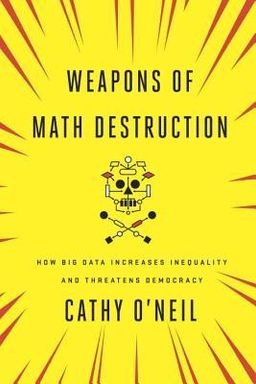
Weapons of Math Destruction cover

Weapons of Math Destruction

by Cathy O'Neil

Weapons of Math Destruction exposes the hidden dangers of algorithms that shape our lives. Discover how these tools, meant to be objective, often perpetuate inequality and threaten democracy. Gain essential insights to protect yourself in a data-driven world.

How Big Data Becomes a Weapon Against People

What happens when the numbers that promise fairness actually make life more unfair? In Weapons of Math Destruction, Cathy O’Neil poses this uncomfortable question and delivers a powerful argument: that the algorithms and predictive models governing modern life are not neutral. They are human creations, infused with bias, and when scaled across millions, they amplify injustice rather than eliminate it.

O’Neil contends that Big Data systems—those invisible algorithms deciding who gets hired, who receives a loan, or how long someone serves in prison—behave like Weapons of Math Destruction (WMDs). They’re opaque, operate at massive scale, and cause real harm. While they promise efficiency and objectivity, their inner workings conceal discriminatory assumptions, bad data, and feedback loops that punish the poor, reinforce privilege, and undermine democracy.

The Rise of Algorithms as Invisible Authorities

You might assume that mathematics makes decisions fairer. After all, numbers seem precise and emotionless. But as O’Neil explains, models reflect the goals and biases of their creators. Imagine a school system evaluating teachers by test scores or a corporation choosing employees through automated personality tests. What seems objective is often laden with assumptions—the idea that test results alone measure learning or that certain personality traits correlate with productivity. When such flawed models scale up, their errors multiply, turning into societal crises.

These systems, O’Neil writes, now touch nearly every part of daily life: education, employment, criminal justice, finance, health care, and even civic participation. They simplify complex realities into quantifiable inputs—ZIP codes, social networks, credit ratings—and then judge people by those proxies. The opacity means those targeted rarely know why they were denied a mortgage or lost a job. There’s no appeal. As O’Neil remarks, WMDs replace human discretion with automated punishment.

From Promise to Peril: When Efficiency Outranks Fairness

Why did we let math become an instrument of inequality? O’Neil’s journey helps explain. Once a Harvard-trained mathematician and hedge fund analyst, she believed data could make the world smarter and fairer. But after seeing how risk models fueled the 2008 financial collapse—misleading investors while enriching insiders—she realized that efficiency and profit had eclipsed accountability. The same logic drove education reforms like Washington D.C.’s value-added model, which fired good teachers like Sarah Wysocki based on flawed student test data. The formula looked scientific, but its blind spots—poverty, cheating, and context—destroyed careers and worsened school inequality.

This story sets the pattern for the book’s central argument: that everywhere we deploy Big Data with narrow definitions of success, we build WMDs. They might help a hedge fund optimize profits, an insurance company price risk, or a school district increase graduation rates—but they sacrifice fairness, truth, and humanity in the process.

Three Traits of Destructive Models

O’Neil identifies three shared traits that define a Weapon of Math Destruction:

  • Opacity—People cannot see how they’re being judged or what data is used. Algorithms operate as black boxes protected by corporate secrecy.
  • Scale—They operate across millions, magnifying errors that would harm only a few in smaller systems.
  • Damage—They produce tangible harm—lost jobs, denied loans, longer prison sentences—without accountability or correction.

When these three combine, society suffers. As O’Neil demonstrates, WMDs in recidivism scoring, credit assessment, and hiring create vicious feedback loops: algorithms label the poor as risky, denying them opportunities, which makes them even riskier according to future models. The systems feed on their own data, deepening inequality.

Why It Matters—And What’s at Stake

If unchecked, these mathematical systems don’t just harm individuals; they fragment society. The privileged benefit from customized prediction engines that open doors—elite colleges, lucrative jobs, curated ads—while the marginalized encounter opaque walls that block progress. “The rich are served by people,” O’Neil writes, “while the poor are processed by machines.” This inversion of fairness transforms democracy itself: when algorithms dictate civic decisions like voting outreach or policing priorities, they sculpt politics around profit and prejudice.

Throughout the book, O’Neil explores how these WMDs spread—from education to employment, advertising to criminal justice—and argues for transparency, accountability, and ethical design. Weapons of Math Destruction is not a rejection of data but a call to responsibility. By the end, you see that math alone won’t save us; only conscious moral choices about how we use it can. O’Neil’s message is simple but urgent: the math that shapes our future must serve humanity, not oppress it.


The Anatomy of a Model

Before we can spot harmful algorithms, we need to understand what makes a model tick. O’Neil describes models as simplified versions of reality—a way to mimic complex processes using data and logic. Every model, she explains, requires inputs, outputs, and a definition of success. It might predict a baseball player’s batting average, a teacher’s effectiveness, or a citizen’s risk of recidivism. But as she warns, models always contain judgments. When those judgments intersect with human lives, they become moral instruments, not mere mathematical ones.

Three Examples of Models in Action

To reveal the spectrum between healthy and harmful models, O’Neil contrasts three real-world examples. First, she holds up baseball analytics—popularized by Moneyball—as a “healthy” model. In sports, everyone can see the data: hits, strikes, fielding percentages. The model’s goal (winning) is transparent, and errors are corrected by constant feedback. Baseball models learn and adapt, generating trust.

Her second example is a personal one, a family meal model. When she plans dinner, O’Neil informally models her family’s appetites—gathering inputs like preferences, health goals, and available ingredients. If her output (the meal) fails to please everyone, she adjusts next time. It’s dynamic and self-correcting. Real-world complexity remains manageable because feedback is immediate.

Finally, she introduces a deeply troubling case: the recidivism risk assessment used in courts across 24 states. This model predicts the likelihood that a convict will reoffend, guiding judges in sentencing. At first glance, it looks scientific, based on questionnaires like the LSI-R (Level of Service Inventory–Revised). But behind the math lie biased proxies—questions about family criminal history, neighborhood crime rates, police contact history—all of which correlate with poverty and race. The model calculates risk using these social biases and presents them as objective facts.

From Prediction to Prejudice

These risk systems represent, as O’Neil puts it, “opinions embedded in mathematics.” They replace explicit discrimination (a biased judge) with implicit algorithmic discrimination. A poor Black defendant from a heavily policed neighborhood accumulates risk points—not because he personally committed more crimes, but because the system encodes centuries of racial inequality. Judges then use that “risk score” to justify longer sentences. This creates feedback loops: longer sentences fuel incarceration, distorted data confirms bias, and poor communities become further criminalized.

The Traits of Healthy vs. Toxic Models

  • Healthy Models—Transparent, dynamic, and self-correcting. They use relevant data tied directly to outcomes (like a baseball score) and openly refine themselves.
  • Toxic Models—Opaque, static, and self-confirming. They rely on proxies (ZIP code for creditworthiness, test score for teaching skill) and lack feedback loops that reveal mistakes.

If you apply these traits more broadly, you can see O’Neil’s larger insight: transparency and feedback transform a model into a trustworthy tool. When those elements vanish, models become dogmas that distort reality. And when scaled, they evolve into Weapons of Math Destruction.


Financial Disillusionment: The Crisis and Its Lessons

O’Neil’s personal disillusionment began on Wall Street. As a quant at the hedge fund D.E. Shaw, she helped design mathematical models to anticipate market movements. It was exhilarating work—until she realized that the formulas driving trades represented not abstract profits but real human lives: mortgages, savings, and retirements. The 2008 crash exposed how bad math had become an ideological weapon, cloaked in complexity but used to exploit and mislead.

The Mortgage-Backed Security: A Weapon in Disguise

In the housing bubble, banks bundled thousands of mortgages into bonds called mortgage-backed securities and sold them as safe investments. Rating agencies blessed this toxic mix with AAA scores, built on models assuming that defaults were random and rare. But those assumptions ignored systemic fraud and social reality. Subprime loans targeted vulnerable people—like Alberto Ramirez, a strawberry picker earning $14,000 who was sold a $720,000 home backed by deceitful brokers. The math, O’Neil writes, served as “smoke screen.” It wasn’t enlightenment; it was camouflage for greed.

How False Data Became Gospel

Data scientists, hypnotized by elegant formulas, treated fraud-ridden inputs as facts. Risk assessments were siloed, opaque, and designed to please clients. When reality diverged, feedback loops broke—models weren’t corrected but scaled further. This corruption of mathematics, O’Neil argues, revealed how the pursuit of efficiency and profit distorts truth. When profits rise, models are deemed “successful” regardless of moral consequence.

Lessons from the Crash: Math Without Insight

Once the financial system exploded, even the most sophisticated models couldn’t decipher the debris. O’Neil contrasts this blindness with models that learn—like baseball analytics—versus the risk models that multiplied “horseshit but couldn’t decipher it.” Quantitative tools scale error faster than human judgment ever could. The crisis exposed the peril of treating algorithms as infallible gods.

After the crash, O’Neil resolved to fight financial WMDs. Her experience taught her a crucial principle: without transparency and moral oversight, even brilliant math becomes destructive. Wall Street’s models weren’t neutral—they were moral failures quantified.


Educational Algorithms and the Race to Rank

Education, O’Neil shows, is one of the most vivid battlegrounds for data misuse. The U.S. News college rankings system, launched in 1983, began as a benign way to inform students but evolved into a national obsession that warped higher education. This ranking model, O’Neil argues, is a textbook WMD: it’s scaled, opaque, and damaging. Colleges now shape admissions, spending, and even ethics around rising in its hierarchy.

How College Rankings Became a National Diet

O’Neil compares the rankings to imposing a single diet across 330 million people. The uniform criteria—SAT scores, acceptance rates, alumni giving—force every college to chase the same goals, suffocating diversity. Schools like Texas Christian University pumped millions into new student centers and football facilities simply to attract applicants and improve selectivity scores. Others, like Bucknell and Iona, faked data. U.S. News rewarded compliance, not creativity.

The Feedback Loop of Prestige and Debt

The rankings drove a nationwide arms race. Colleges escalated tuition, funding luxury amenities, and recruiting elite students to climb the list, ignoring affordability. Students chased prestige instead of fit, often ending up with crippling loans. By omitting cost from the formula, U.S. News effectively commanded institutions to spend more while students paid the price. Between 1985 and 2013, tuition skyrocketed 500 percent.

A parallel industry of consultants and predictors arose—firms like Noel-Levitz and RightStudent mined student demographics to optimize enrollment portfolios: wealthier applicants were prioritized, while needy ones were sidelined. Inequality deepened as affluent families gamed the system with expensive tutors and $16,000 college “boot camps.” Everyone was chasing a model’s rewards rather than meaningful education.

Turning Metrics Into Meaning

O’Neil ultimately calls for transparency and redefined objectives: what if success meant access, affordability, and real learning? President Obama’s attempt at a new federal ranking focused on outcomes like graduation rate and affordability—but even that, she notes, could create new feedback loops and gaming. The solution isn’t another model; it’s giving citizens data to craft their own values. As O’Neil writes, “They don’t need to know statistics—the software can build models for each person.” Democracy in data means choice, not control.


When Algorithms Exploit the Vulnerable

What happens when mathematical precision meets human desperation? O’Neil exposes how data-driven advertising and for-profit universities weaponize personal information to prey upon the poor. Instead of helping people, these companies use behavioral analytics to find and exploit “pain points”—weaknesses like insecurity, debt, or trauma—and convert them into revenue.

Predatory Advertising as Data Engineering

The University of Phoenix, Corinthian Colleges, and Vatterott College spent tens of millions targeting low-income students with online ads. Their algorithms scanned Google searches and social media data, baiting struggling individuals with false promises of affordable degrees and upward mobility. Recruiters were trained to look for “Welfare Mom w/Kids” or “Recent Divorce”—people in emotional distress were seen as profitable leads. These WMDs scaled psychological manipulation, turning misery into business.

Debt as Destiny

Once enrolled, students financed tuition through government-backed loans—often two or three times what public colleges charged. The result was predictable: massive default and lifelong debt. Corinthian Colleges collapsed under fraud investigations, leaving $3.5 billion in unpaid loans. Yet data systems celebrated the profitability of these recruits. They didn’t compute moral damage; only conversion efficiency.

O’Neil connects these exploitative loops to payday loans and data brokers who sell personal records for pennies. One FTC case revealed brokers selling bank data from low-income clients for fifty cents per name—information later used to empty accounts. Algorithms find need, not to alleviate it, but to monetize it. As O’Neil writes bitterly, “Vulnerability is worth gold.”

The Ethical Flip: Using Data to Help, Not Hunt

By contrasting malicious optimization with constructive alternatives, O’Neil shows that prediction itself isn’t evil—it’s intent that matters. Using the same data, we could identify students at risk and offer scholarships, or locate isolated communities and deliver aid. The same machine learning that drives exploitation could drive compassion if success were defined not as profit but as uplift. Changing the objective function—what the model optimizes—can disarm mathematical weapons.

Dig Deeper

Get personalized prompts to apply these lessons to your life and deepen your understanding.

Go Deeper

Get the Full Experience

Download Insight Books for AI-powered reflections, quizzes, and more.