
Idea 1
Thinking Straight in a Misleading World
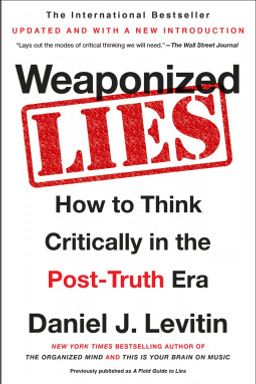
Have you ever felt overwhelmed by all the information thrown at you—news headlines, social media posts, graphs, polls, and studies that all seem to contradict each other? Daniel Levitin’s Weaponized Lies dives deep into this confusion, arguing that our modern world has made deception easier and truth harder to find. He contends that the only real protection you have against manipulation is to strengthen your critical thinking—your ability to evaluate numbers, words, and claims with logic and humility.
Levitin’s core claim is that misinformation isn't just accidental anymore—it’s been weaponized. In our post-truth era, lies are crafted deliberately to trigger emotion, mislead reason, and distort public judgment. Through examples ranging from fake news conspiracies like “Pizzagate” to misleading graphs on Fox News, he shows how falsehoods spread faster than their debunkings. The average citizen, Levitin warns, has stopped learning how to think about claims critically. He likens our current situation to practicing democracy while blindfolded—citizens can vote, argue, and buy, but without the skills to recognize deceit.
Truth in the Age of Data Overload
Levitin begins with an unsettling realization: we now live in a "data-drenched age" where quantity overwhelms quality. Every day, we’re bombarded by statistics about health, economics, and politics that sound scientific but often conceal bias or faulty reasoning. He connects this problem to education itself—pointing out that students read fewer books each year after second grade, and many adults can’t make even simple inferences from printed text. The result is a population easily swayed by emotional headlines or visually deceptive charts.
He challenges euphemisms like “fake news” or “alternative truth,” arguing that they dilute the moral weight of lying. A falsehood should not be softened into a “theory”; it’s a lie. The infamous Pizzagate shooting becomes his startling illustration—one man acted violently because he never learned what evidence really looks like. Instead of analyzing sources and checking facts, he trusted emotion and rumor, mistaking investigation for scrolling social media. The takeaway is sharp: misinformation spreads not because liars are smarter, but because audiences are unprepared.
Three Kinds of Defense
Levitin organizes his defense against misinformation in three broad strategies: evaluating numbers, evaluating words, and evaluating the world. These correspond to the book’s three parts. First, he teaches you to dismantle deceptive statistics, showing how averages, percentages, and graphs hide distortion. Next, he moves into the realm of words and authority—how pseudoscientific jargon and expert titles can mask ignorance or deliberate bias. Finally, he explores reasoning itself: the scientific method, logical fallacies, and the meaning of probability as tools for understanding uncertainty. By mastering these areas, he argues, anyone can resist being manipulated.
The Moral Dimension of Critical Thinking
For Levitin, critical thinking isn’t a dry academic skill—it’s a moral responsibility. At heart, his book is about restoring intellectual humility. As he puts it, “If we realize we don’t know everything, we can learn. If we think we know everything, learning is impossible.” This humility separates knowledge from arrogance and makes learning possible even in disagreement. He calls out the cultural tendency to treat opinion as fact, arguing that democracy cannot function if facts lose their authority.
The book thus operates as a survival guide for the digital era—part primer on logic, part public-service manifesto. Levitin joins the tradition of works like Darrell Huff’s How to Lie with Statistics and Nate Silver’s The Signal and the Noise, urging readers to look beneath numbers and narratives. It’s not enough to share information; we must interrogate it. Misinformation can destroy reputations, shape elections, and even incite violence. The antidote, as Levitin insists, is disciplined curiosity: asking how we know, who benefits, and what counts as evidence. His tone is both professor and citizen—a neuroscientist alarmed that cognitive lazy habits can turn entire societies irrational.
By the end of his introduction, Levitin leaves you with a challenge: truth matters, but it needs defenders. In a world where lies have become weapons, your best armor is not outrage—it’s understanding. The rest of Weaponized Lies teaches you exactly how to build it, piece by piece.