
Idea 1
Race, Power, and the Struggle for Honest History
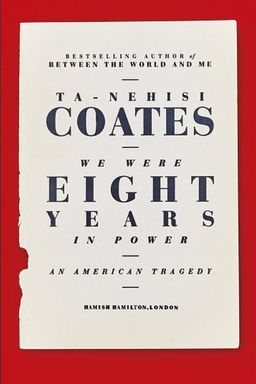
Why does America resist acknowledging what it owes Black people? Through political history, reportage, and memoir, Ta-Nehisi Coates argues that the enduring national project is not equality but the preservation of white innocence. Across his essays—from Reconstruction to Obama to Trump—Coates shows how Black achievement often provokes reassertions of dominance, how progress generates backlash, and how forgetting functions as a national defense mechanism.
At the heart of this work is a clear proposition: racism is not merely personal prejudice; it is a *system of plunder* that converts Black labor, property, and respectability into economic and psychological wages for white Americans. You are asked to see history not as a series of unfortunate mistakes but as the architecture of deliberate theft—financial, political, and emotional.
The Roots of Plunder
Coates begins with the paradox Du Bois identified a century ago: “good Negro government” threatens the racial order more than bad government ever could. When Black politicians built schools and infrastructure in Reconstruction-era South Carolina, white legislators responded not by matching competence but by rewriting constitutions to suppress the Black vote. This logic—fear of effective Black agency—reappears across generations, from Reconstruction to the Obama presidency.
You can see the pattern in Coates’s reading of Barack Obama: the calm, scandal-free presidency became the twenty-first-century proof that Black competence still unsettles white mythology. Birtherism, Tea Party fury, and eventually Donald Trump's ascent operate as the latest chapter in America’s history of backlash against evidence of Black excellence.
Culture, Morality, and Structural Theft
From Bill Cosby’s moral lectures to debates over the Moynihan Report, Coates traces how the American conversation about Black advancement keeps returning to individual virtue instead of structural reality. In Cosby’s “Pound Cake” era, the critique of Black cultural failure gained traction even as evidence mounted that discriminatory policy—redlining, biased courts, and the carceral state—crippled progress. Coates admires moral discipline but insists that character cannot compensate for laws designed to extract wealth and dignity. He asks you to read moral exhortation as part of a larger story about how respectability becomes both armor and trap.
The Writer’s Witness
The narrative is also personal. Coates recounts learning to write through hip-hop’s precision and Baldwin’s moral fire, discovering that every sentence carries ethical obligations—accuracy, acknowledgement, and beauty. His evolution from a Baltimore youth to national voice parallels the racial history he documents: persistence amid systemic doubt. Writing, he explains, is not therapy; it’s testimony. It is how you prove that feeling robbed is not paranoia but empirical reality.
Reparations as Moral Reckoning
Ultimately, the essays converge on reparations. Clyde Ross’s struggle in Chicago—cheated through contract housing, punished for striving—shows that plunder is not metaphorical. The wealth gap is engineered. True national maturity, Coates argues, demands open reckoning through efforts like HR 40, not because a check can restore lost generations but because democracy cannot survive on denial. Like Germany after the Holocaust, America must learn sobriety—the ability to live honestly with its own history.
By the time Coates concludes with Trump as “the first white president,” he has built an indictment that joins history, policy, and spirit: each advance in Black freedom reveals what whiteness is built to protect. The task he sets you is not comfort but clarity—to study, to name, and to act with the sobriety that comes from truth-telling.